The Horse and His Rider
by Aesop
Adapted Version
The Soldier had a big, strong Horse. The Soldier loved his Horse very much. They were in a war. The Soldier needed the Horse. The Soldier gave the Horse good food. He gave it hay and corn. The Horse was happy. The Horse was strong. It helped the Soldier in war.
Then the war ended. The Soldier did not need his war Horse. He stopped giving it good food. He gave the Horse bad, dry food. The Horse did not like this food. It was not strong food. The Soldier did not care for the Horse. The Horse felt hungry.
The Soldier made the Horse work very hard. The Horse carried very big logs. The logs were heavy. The Horse walked slowly. It was very tired. The Horse was sad. Its back hurt. The Soldier made it carry many loads. The Horse felt weak. It missed the good old days.
One day, a new war started. A loud trumpet blew. The Soldier heard the sound. He must go to war again. He needed his Horse. He remembered his strong Horse. The Soldier felt ready.
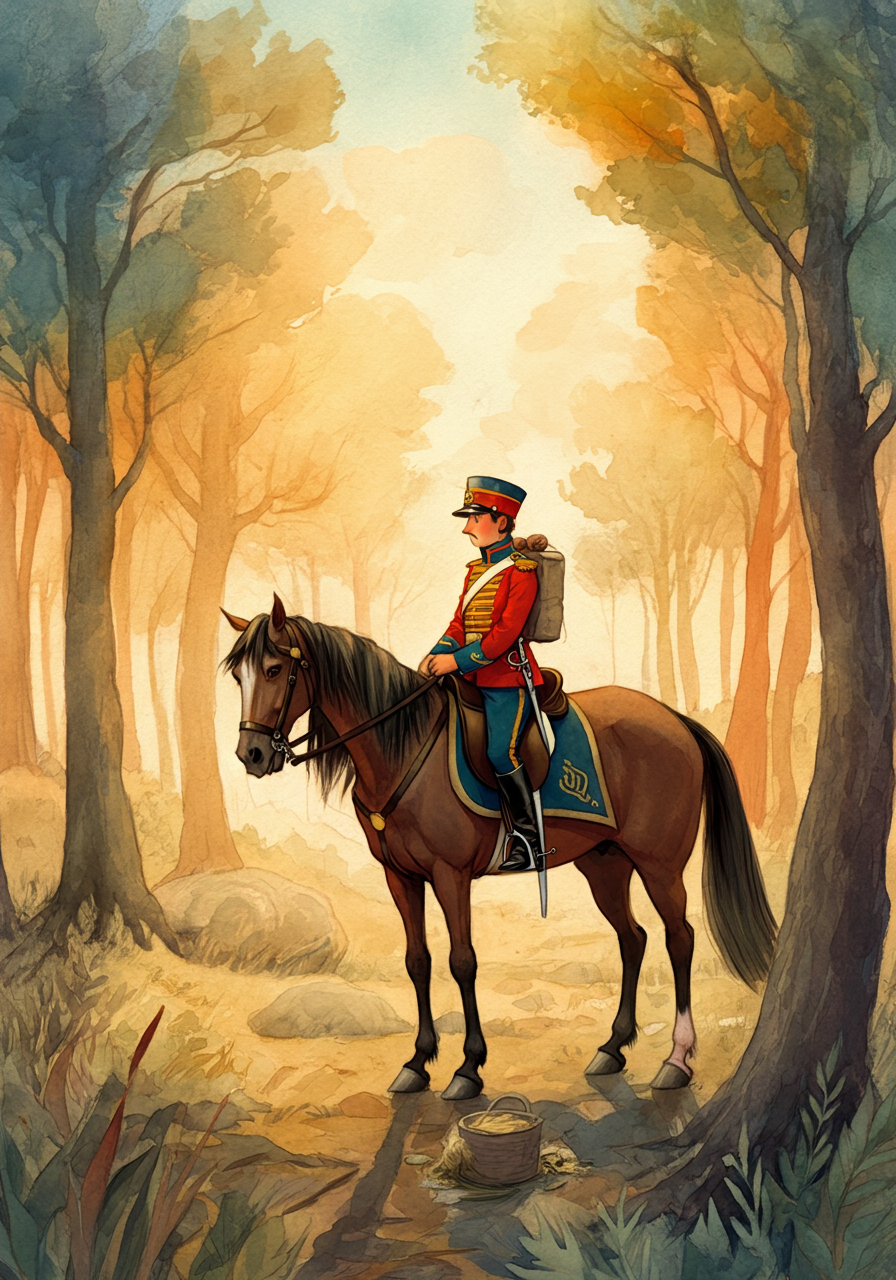
The Soldier got ready for war. He put shiny war clothes on the Horse. He put a saddle on its back. Then the Soldier put on his heavy armor. The armor was very heavy. He got on the Horse. He was ready to fight. The Horse stood still.
The Horse was very weak. It was not strong anymore. The Soldier and his armor were too heavy. The Horse tried to walk. But it could not. It was too much. It fell down fast. It lay on the ground. The Horse could not get up.
The Horse looked at the Soldier. It spoke in a soft voice. "I am not strong now," it said. "You made me weak like a donkey. I carried heavy logs for you. I ate bad food. I cannot be a warhorse fast. You must walk to war now." The Soldier had to walk.
It is good to be kind. Always take care of things. Take care of people who help you.
Original Story
The Horse and His Rider
A HORSE SOLDIER took the utmost pains with his charger. As long as the war lasted, he looked upon him as his fellow-helper in all emergencies and fed him carefully with hay and corn. But when the war was over, he only allowed him chaff to eat and made him carry heavy loads of wood, subjecting him to much slavish drudgery and ill-treatment. War was again proclaimed, however, and when the trumpet summoned him to his standard, the Soldier put on his charger its military trappings, and mounted, being clad in his heavy coat of mail. The Horse fell down straightway under the weight, no longer equal to the burden, and said to his master, “You must now go to the war on foot, for you have transformed me from a Horse into an Ass; and how can you expect that I can again turn in a moment from an Ass to a Horse?”
Moral of the Story
Do not neglect or mistreat those who have served you well, for you may need their help again.
Characters

The Horse Soldier ★ protagonist
A man of average height and sturdy build, accustomed to the rigors of military life. His face is weathered from sun and wind, with a serious expression. He possesses strong hands, calloused from handling weapons and reins.
Attire: During wartime, he wears a heavy, polished chainmail coat over a simple tunic, sturdy leather breeches, and tall leather boots. In peacetime, he wears plain, coarse linen tunic and trousers, with a rough leather belt and worn leather boots, suitable for manual labor.
Wants: To succeed in war and to live comfortably in peace, prioritizing his own immediate needs and convenience.
Flaw: Lack of foresight, ingratitude, and a tendency to exploit resources without considering long-term consequences.
He experiences no personal arc, failing to learn from his mistakes and facing the direct consequences of his poor treatment of his horse.
Pragmatic, opportunistic, ungrateful, short-sighted, demanding.

The Charger ◆ supporting
A once magnificent warhorse, initially strong and well-muscled, with a powerful build suitable for carrying a soldier in armor. Over time, its ribs become more prominent, and its musculature diminishes due to poor feeding and heavy labor.
Attire: During wartime, it wears military trappings: a sturdy leather saddle, bridle with metal bits, and possibly decorative barding or a saddle blanket. In peacetime, it wears a simple, worn harness for pulling loads, without any adornment.
Wants: To serve its master and survive, initially driven by good treatment and later by necessity.
Flaw: Its physical dependence on its master for care and sustenance.
Transforms from a proud warhorse into a beast of burden, then attempts to revert, only to find its physical capabilities irrevocably diminished. It learns the harsh reality of its master's ingratitude.
Loyal (initially), resilient, patient, long-suffering, wise (by experience).
Locations

Military Barracks / Stables
A functional stable area where the warhorse is kept and cared for during wartime, likely with stalls and feeding troughs. Later, it becomes a place of neglect.
Mood: Initially diligent and purposeful, later becoming neglectful and harsh.
The horse is fed carefully with hay and corn during wartime, then neglected with chaff and heavy labor during peacetime.

Peacetime Farm / Wood-gathering Area
A rural, possibly forested area where the horse is forced to carry heavy loads of wood, indicating a shift from military service to common labor.
Mood: Toilsome, burdensome, reflecting the horse's ill-treatment.
The horse is made to carry heavy loads of wood, experiencing slavish drudgery.

Military Muster Point / Assembly Ground
An open area where soldiers and their mounts gather when war is proclaimed, characterized by the sound of trumpets and the sight of military preparations.
Mood: Urgent, tense, a sudden call to action.
War is proclaimed, the trumpet sounds, and the soldier attempts to mount his now-weakened horse.
Story DNA
Moral
Do not neglect or mistreat those who have served you well, for you may need their help again.
Plot Summary
During wartime, a soldier meticulously cares for his charger, but once peace is declared, he neglects and mistreats the horse, feeding it poorly and burdening it with heavy loads. When war breaks out again, the soldier attempts to mount his horse in full armor, but the weakened animal collapses. The horse then tells the soldier that he has transformed it into an ass, and it can no longer serve as a warhorse, forcing the soldier to go to battle on foot.
Themes
Emotional Arc
neglect to regret
Writing Style
Narrative Elements
Cultural Context
Aesop's fables often reflect common human behaviors and social structures of ancient Greece, using animals to illustrate moral lessons.
Plot Beats (7)
- A soldier takes great care of his charger during wartime, feeding it well.
- When the war ends, the soldier neglects his horse, feeding it only chaff.
- The soldier forces the horse to carry heavy loads of wood, treating it poorly.
- Another war is declared, and the trumpet calls the soldier to battle.
- The soldier puts military trappings on the horse and mounts it, clad in heavy armor.
- The horse, weakened and out of condition, immediately falls down under the weight.
- The horse tells its master that he has turned it into an ass, and it cannot instantly become a warhorse again, forcing the soldier to go on foot.