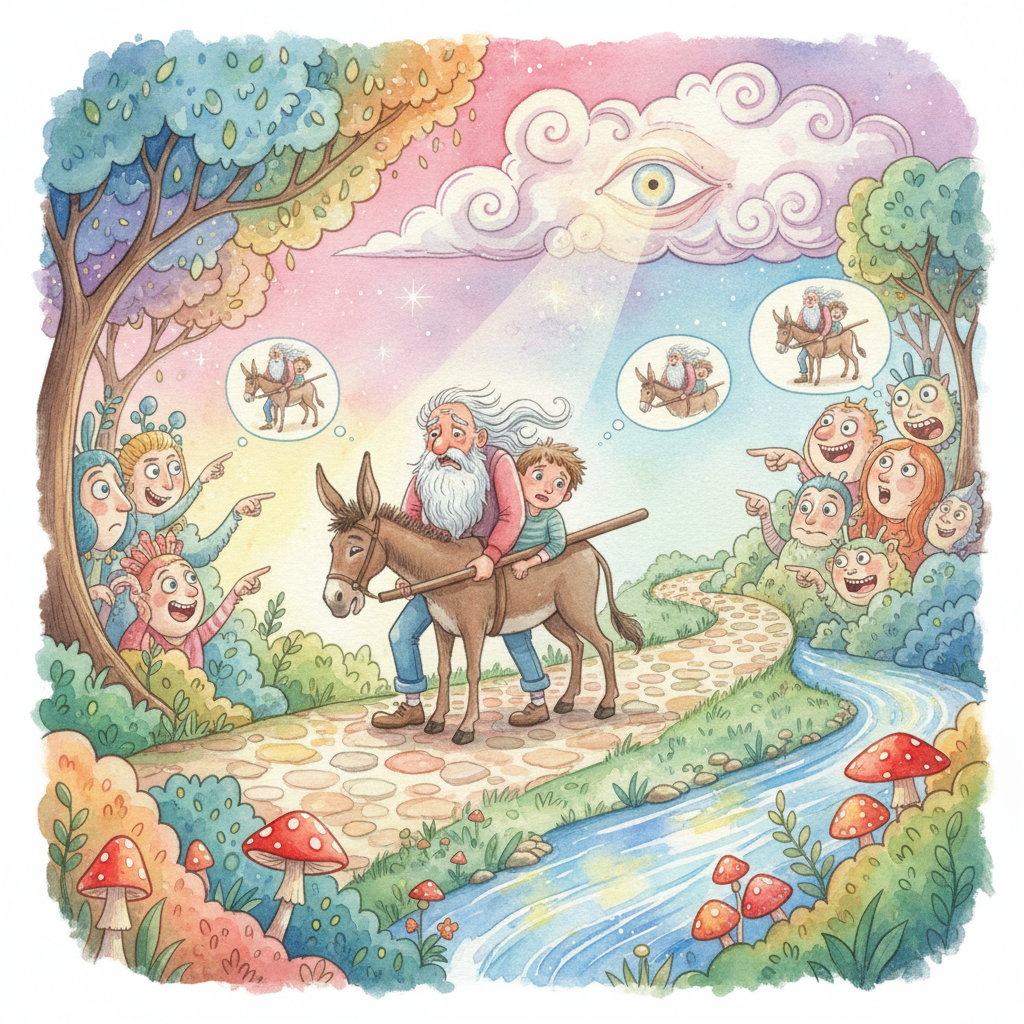
The Salt Merchant and His Ass
by Aesop

Adapted Version
A merchant had a donkey. They went to the sea. They went to buy salt. The donkey carried big bags. This was their work every day.
One day, they went home. They crossed a small stream. The Donkey made a wrong step. Splash! The Donkey fell in the water. The salt was in the bags. The water touched the salt. The salt went away. The bags felt light. The Donkey was happy.
The Merchant went back to the sea. He bought more salt. He put much more salt in the bags. The bags were very heavy again. The Donkey carried the heavy bags. They walked home.
Soon, they came to the stream again. The Donkey remembered the light bags. It thought, "I will fall down now." It wanted the salt to go away. The Donkey fell down on purpose. Splash! It fell into the water.
The salt went away again. The bags felt light. The Donkey stood up. It made a happy sound. It was very happy. It thought it was very clever. It tricked the Merchant.
The Merchant watched the Donkey. He saw what happened. He knew the Donkey's trick. The Donkey fell on purpose. The Merchant was not happy.
The Merchant had a new idea. He took the Donkey back to the sea. He did not buy salt. He bought many sponges instead. He put the sponges in the bags.
They came to the stream again. The Donkey remembered its trick. It thought, "I will fall again!" It wanted the sponges to go away. The Donkey fell down on purpose. Splash! It fell into the water.
The sponges drank the water. They got very big. They got very, very heavy. The bags were not light now. The bags were much, much heavier. The Donkey had a big load.
The Donkey stood up slowly. Its back hurt. Its trick did not work. The Donkey learned a lesson. Being lazy made its work much harder.
Original Story
The Salt Merchant and His Ass
A PEDDLER drove his Ass to the seashore to buy salt. His road home lay across a stream into which his Ass, making a false step, fell by accident and rose up again with his load considerably lighter, as the water melted the sack. The Peddler retraced his steps and refilled his panniers with a larger quantity of salt than before. When he came again to the stream, the Ass fell down on purpose in the same spot, and, regaining his feet with the weight of his load much diminished, brayed triumphantly as if he had obtained what he desired. The Peddler saw through his trick and drove him for the third time to the coast, where he bought a cargo of sponges instead of salt. The Ass, again playing the fool, fell down on purpose when he reached the stream, but the sponges became swollen with water, greatly increasing his load. And thus his trick recoiled on him, for he now carried on his back a double burden.
Moral of the Story
Laziness and deceit often lead to greater burdens than honest effort.
Characters

The Salt Merchant ★ protagonist
A man of average height and sturdy build, accustomed to manual labor and walking long distances. His skin is tanned from exposure to the sun, with calloused hands.
Attire: Simple, practical clothing suitable for a merchant in ancient Greece or a similar Mediterranean setting. He wears a short, knee-length chiton made of coarse linen, possibly cinched at the waist with a leather belt. Sturdy leather sandals are on his feet.
Wants: To conduct his business successfully and efficiently, to make a living, and to teach his ass a lesson.
Flaw: Initially trusting, but quick to learn from experience.
He learns from his ass's trickery and adapts his strategy, ultimately outsmarting the animal. He becomes more cunning and less susceptible to manipulation.
Observant, clever, patient, resourceful, pragmatic.

The Ass ⚔ antagonist
A sturdy, grey-brown donkey of average size, with strong legs and a short, bristly mane. Its fur is a dusty grey-brown, indicative of working outdoors.
Attire: A simple, well-worn leather harness with a wooden pack saddle, from which two large panniers (baskets or sacks) hang on either side. The panniers are made of coarse woven material.
Wants: To lighten its load and avoid hard work.
Flaw: Its own laziness and overconfidence, which ultimately lead to a worse outcome.
Starts by accidentally discovering a trick, then deliberately employs it, and finally falls victim to its own cunning, ending up with a heavier burden. It learns that shortcuts can backfire.
Clever, lazy, cunning, mischievous, self-serving.
Locations

Seashore Salt Market
A bustling Mediterranean seashore, likely with a small, sandy beach or rocky cove where merchants unload goods from small boats. The air is salty and filled with the cries of vendors. Piles of coarse sea salt are visible, perhaps in woven baskets or on tarpaulins, glistening under the sun. Simple, open-air stalls or temporary shelters might be present for transactions.
Mood: busy, commercial, functional
The Peddler buys salt and later sponges, marking the beginning and turning point of the Ass's trick.

The Stream Crossing
A shallow, rocky stream cutting across a dirt path, likely in a rural, sun-drenched Mediterranean landscape. The water is clear, revealing smooth river stones on the bed. The banks are gently sloped, possibly with some sparse, dry grasses or low-lying scrub typical of the region. The path itself is well-trodden earth, leading away into a landscape of olive groves or dry hills.
Mood: ordinary, functional, later mischievous
The Ass repeatedly falls here, first by accident, then on purpose, to lighten its load, leading to its eventual comeuppance.
Story DNA
Moral
Laziness and deceit often lead to greater burdens than honest effort.
Plot Summary
A peddler's ass accidentally falls into a stream, dissolving its salt load and making it lighter. The ass then deliberately repeats this trick to lighten its burden. Recognizing the deception, the peddler loads the ass with sponges instead of salt. When the ass intentionally falls into the stream again, the sponges absorb water, making the load much heavier, thus teaching the lazy ass a harsh lesson about its trickery.
Themes
Emotional Arc
cleverness to comeuppance
Writing Style
Narrative Elements
Cultural Context
Aesop's Fables are a collection of fables credited to Aesop, a slave and storyteller believed to have lived in ancient Greece between 620 and 564 BCE. They are characterized by anthropomorphic animal characters and a moral lesson.
Plot Beats (10)
- A peddler takes his ass to the seashore to buy salt.
- On the way home, the ass accidentally falls into a stream, and the salt dissolves, lightening its load.
- The peddler returns to buy more salt, loading the ass with a larger quantity.
- When they reach the stream again, the ass deliberately falls, believing it will lighten its load once more.
- The ass brays triumphantly, having successfully lightened its burden through trickery.
- The peddler understands the ass's trick.
- The peddler takes the ass back to the coast and buys sponges instead of salt.
- The ass, expecting to lighten its load, intentionally falls into the stream for the third time.
- The sponges absorb water, becoming much heavier, doubling the ass's burden.
- The ass's attempt to avoid work results in a much greater hardship.