THE GOLDEN DUCK
by Anthony R. Montalba
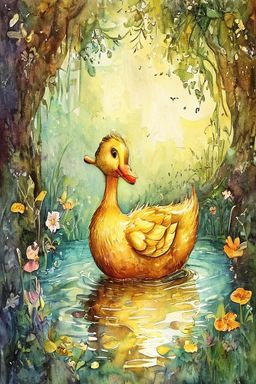
Adapted Version
Emma is a kind girl. She lives with her kin. Emma lives with her aunt Jutta. Her sister Ann lives there. Her brother Henry lives there. They all live in a small house. Jutta is a poor woman.
One night, a big storm came. Rain fell very hard. A knock came at the door. Jutta opened the door. An old woman stood there. She needed help. Jutta let her in. The old woman was a fairy.
The fairy saw Emma's kind heart. She gave Emma a gift. When Emma cried, pearls fell from her eyes. Her hair turned to gold. This was a magic gift. The fairy gave a warning. Emma must hide her face. The sun must not touch her face. She must wear a veil. This was key. A big problem would come.
Jutta used Emma's magic gifts. She got many gold and pearls. They bought nice things. People saw their new things. The neighbors talked about them. They were not kind. Jutta did not like this. Jutta wanted to move. They went to a new city. The city was Prague.
Henry went to Prague first. He met a man. The man was a Count. The Count was kind to Henry. Henry told the Count a secret. He told about Emma's gifts. He told about her looks. He told it by mistake.
The Count liked Emma very much. He loved her. He wanted to marry her. He sent a special carriage. The carriage was all covered. This kept Emma safe. The sun could not touch her. He wanted her to be well.
Ann was not happy. She was mean to Emma. She tricked Emma in the carriage. Ann told Emma to look. Emma lifted her veil. The sun touched Emma's face. Emma changed very fast. She turned into a golden duck. The duck flew away.
The Count was very sad. He was very angry. He thought Henry tricked him. Henry had to stay in a room. He could not leave. Ann was sent away. She left the castle.
One day, a golden duck flew in. It flew into Henry's room. The duck spoke to Henry. It was Emma! She told Henry it all. Ann played a trick. The sun touched her face.
A helper heard the duck talk. He told the Count. The Count did not believe him. The Count listened in secret. He heard Emma's voice. He learned the truth. He was very sad.
The Count tried to catch Emma. He wanted her to stay. But Emma flew away fast. She did not want to be caught. The Count asked Henry for help. He asked Henry to tell Emma. He wanted Emma to stay.
Ann was gone. Jutta was gone too. Henry and the Count talked. They became friends again. They were not angry now. They both hoped for Emma. They wanted her to come back.
Emma visited Henry at times. She came as a golden duck. But she did not stay long. The Count still tried to catch her. Emma flew away each time. She did not like this.
The Count was still sad. He wanted Emma back. He made a new plan. He tried to trap Emma. He shut the window fast. Emma was in Henry's room. But Emma was too fast. She flew out the small hole.
Henry was very sad. He left the castle. He walked far away. Then the fairy came. She stood before him. The fairy told him what to do. He must go back. The Count must be sorry. He must be truly sorry. Then Emma could change back. She could be a girl again.
Henry went back to the castle. The Count was not well. He was very sad. The Count was truly sorry. He told Henry this. He said he would be good. He would be a good man now.
The Count made his promise. The window opened wide. Emma flew in. She changed back to a girl! She was very pretty. Emma and the Count married. They were very happy. They lived a good life.
Emma and the Count are happy. They live a good life. It is good to be kind and honest.
Original Story
THE GOLDEN DUCK.
\[Bohemian.\]
eep in the bosom of a wood once stood a little cottage, inhabited by a poor widow. Her name was Jutta, and she had formerly lived in easy circumstances, but through various misfortunes, without any fault of her own, she had fallen into poverty.
By the labour of her hands she with difficulty contrived to support herself, her daughter Adelheid, and the two children of her departed brother, Henry and Emma. The children, who were good and pious, especially Henry and Emma, did their utmost to assist her by their diligence: the girls spun, and the boy helped the old woman to cultivate the garden, and tended the sheep, whose milk formed the principal part of their daily sustenance.
One evening they were all sitting together in the little cottage, whilst a tremendous storm raged without. The rain poured down in torrents, and flash after flash of lightning followed the thunder, which broke over the mountains, and seemed as if it would never cease.
The old woman had just sung to the children the song of the water-sprite who danced with a young maiden till he drew her down into the abyss, when suddenly they heard a tap at the door. The startled children huddled close together, but the mother took courage and opened it, when a soft female voice begged her to give shelter to a traveller who had been overtaken in the forest by the storm.
The stranger was an elderly woman of a noble and dignified appearance, but so kind and friendly in her manner that all were anxious to show her some attention. Whilst the widow was regretting that her poverty did not allow her to receive such a guest in a more worthy manner, Henry lighted the fire, and Emma was anxious to kill her favourite pigeons for her supper, but the lady would not permit this, and took only a little milk.
The following morning, when Jutta and the children awoke, they were not a little astonished at beholding, instead of the aged woman who had entered the hut the night before, a youthful one of superhuman beauty, arrayed in a magnificent dress which sparkled with diamonds.
"Know," said the stranger to the widow, "that you yesterday received into your dwelling no mortal, but a fairy; I always try those mortals whom I desire to benefit, and you have stood the trial. To little Emma I am especially beholden, because she would yesterday have killed for my supper what she most values, her pigeons. For this she shall be gifted. Whenever she weeps, either for joy or sorrow, pearls instead of tears shall drop from her eyes, and the hairs she combs from her head shall turn into threads of pure gold. But beware that no ray of sun ever shine upon her uncovered countenance, for then a great misfortune will befall her; from henceforth never let her go into the open air without being covered with a veil."
The beneficent fairy having thus spoken, vanished; but Jutta, who was desirous to prove the truth of her words, hastily spread a large cloth on the ground, placed the little maiden on it, and commenced combing her long fair locks. Immediately the hairs that fell on the cloth became threads of gold, and when the old woman told the child how rich and grand she might now become, and what pretty toys she might buy, she wept for joy, and the most beautiful pearls rolled from her eyes upon the linen cloth.
The next day the old woman betook herself to the nearest town, sold the pearls and the threads of gold, and bought a fine veil, without which Emma was never suffered to leave the house. She often combed the child's hair several times in the day, telling her all the time the prettiest tales, which drew from her eyes abundance of tears, either of pleasure or compassion, so that in a short time Jutta possessed a considerable treasure in gold and pearls.
At first she sold her treasures to Jews, and received but little for them, as they believed the goods were stolen. By and by, however, when she had become possessed of a small landed estate in the district, she traded with jewellers and goldsmiths, who paid her according to the value of her goods, and so at length she collected a very considerable treasure.
Meanwhile Adelheid and Emma grew into young women. But the increasing wealth of the old woman, whom her neighbours had formerly known to be in such straitened circumstances, and who knew not how she had acquired her riches, gave occasion for envious tongues to utter many an evil speech against her. Still further were their curiosity and ill-nature excited by the singular circumstance that Emma always went about veiled, and under these circumstances, what could be more natural than that the greater part of them were ready to swear without hesitation that old Jutta was a vile witch, and ought to be burned?
Now although these evil speeches were unable to do the widow any real injury, still she was not a little vexed and annoyed when they reached her ears, or when she perceived that she was looked upon with suspicious and wondering looks; and finding it impossible by obliging and friendly conduct, or even by conferring benefits, to win the hearts of her neighbours, or to stop their calumnies, she preferred to abandon altogether the place where she had been known in indifferent circumstances, and to go far away, where her riches would not excite suspicions against her. She therefore resolved to sell her estate, and to take up her residence in the city of Prague. In order, however, not to be too precipitate, she first sent thither her nephew, Henry, that she might become a little acquainted with their future residence, before removing from the former one.
So Henry went to the Bohemian capital, and, as he was a personable youth, had good manners, and was richly provided with money by his aunt, so that he could live in as good style as any of the nobles of the land, he soon became on friendly terms with numerous counts and other illustrious persons. Judging by his personal appearance and expenditure they took him for one of their own station; nay, one of them, a young count, became his confidential friend, and, as wine often unlocks the secrets of the heart, it happened one day that Henry let out the whole secret concerning his sister, quite forgetting at the moment his aunt's strict prohibition ever to reveal it.
When the count heard so much of the extraordinary understanding, good heart, sweetness, and beauty of the young maiden who was possessed of such wonderful gifts, his heart at once glowed with love for her, and he said with great warmth:—
"I myself possess a domain of such great value, that I am in no need of the riches of another; but I have ever desired to have a wife distinguished above all others for her beauty, virtue, and other rare gifts; therefore I offer my hand to your sister, and I swear to you that I will do all in my power that I may call so wonderful a maiden my own."
Henry perceived his indiscretion now that it was too late, and he could not withstand the earnest entreaties of his friend to obtain for him the hand of his sister. In order, indeed, to lose no time, the count immediately caused to be constructed an entirely closed and well-covered carriage in which to transport Emma to him, without her being exposed to a breath of air.
Surprising as was his proposal, it was so honourable a one, that, after a few minutes' reflection, Emma could not think of refusing such an illustrious and amiable young man as Henry described the count to be. The brother, therefore, hastened back with the news of her consent, and the count immediately went to his residence, in order to make preparations for the reception of his bride, and for a magnificent bridal entertainment.
During the interval, Emma, accompanied by her mother and Adelheid, began her journey, and when they had proceeded about half-way, they came to a great forest. The heat was oppressive, and Emma happened to draw aside her veil, just as Jutta, in order to look after the attendants whom the count had sent to escort his bride on the journey, thoughtlessly opened the door of the carriage. No sooner did a sunbeam shine on the maiden, than she was suddenly transformed into a golden duck, flew out of the carriage, and vanished from the sight of her terrified aunt.
As soon as the old woman had recovered from her first alarm, she was greatly troubled how to escape the wrath of the count. They had still to traverse a considerable portion of the forest. So she sent the servants who had not perceived the occurrence, under some pretext, to a village at some distance, and during their absence she covered her own daughter with Emma's veil. On their return they found the old woman in the greatest distress; she wrung her hands, and related with well simulated despair, that having gone with her daughter only a few steps from the carriage, armed men had surprised them, and carried off her Adelheid.
The count's servants, deceived by the despairing words and gestures of the old woman, searched the forest, in hopes of tracing the robbers, but as was to be expected, without success. Meanwhile Jutta instructed her daughter in the part she was to play, in order that she in Emma's place might become the count's wife. And as she feared she might not be able to conceal the cheat from Henry, she desired the servants not to go through Prague, but to take the direct road to the count's castle.
When they arrived, Jutta descended alone from the carriage, carefully closed it again, and besought the count, that until her niece had entirely recovered from the fatigue of the journey, he would permit them both to occupy a chamber from which all daylight could be excluded, and she forbade at first any visit from the bridegroom. Impatient as the latter was to see his bride, he yet submitted to this delay which the old woman so earnestly requested of him. The most splendid apartments were now thrown open to the mother and daughter, and the most inner chamber of the suite was so hung with curtains that no daylight could penetrate. In this room dwelt Jutta with her daughter, and even Henry, who came to visit his supposed sister, was, under pretext of her being indisposed, not allowed to enter. As his aunt, however, provided him with plenty of money, and the merry life in Prague pleased him better than the retirement of the country, he soon returned thither.
The count, whom Jutta put off from day to day under various pretexts from visiting his bride, at length lost patience, and would not be longer withheld by the gold and pearls which Jutta continually brought him; he forced his way into the chamber, and clasped Adelheid in his arms.
Although the count could not but remark that Adelheid in no degree corresponded to the description her brother had given of her, he was still prepared to fulfil his word, and was therefore married, though with the greatest privacy, to the false bride. Very shortly, he became aware that neither her heart nor mind possessed the excellence that had been represented to him; and in consequence of this discovery, when he next met his brother-in-law, he overwhelmed him with reproaches. The contemptuous expressions which the count used respecting his bride, whom Henry had only known as the loveliest and most amiable maiden in all Bohemia, so incensed Henry, that he forgot all the consideration due to the rich and powerful man, and the count, who, besides this, believed himself to have been deceived by Henry, caused him to be seized, brought to his castle, and thrown into a deep dungeon.
The wife of the count, who was also most severely punished for the crime in which she had taken part, overwhelmed her mother with the bitterest reproaches. More than once she was on the point of confessing the fraud to her husband, but he drove her from him, and would not listen to her.
Whilst these women were thus suffering for their crime, Henry sat in his dungeon, hopeless of ever recovering his freedom, or of being able to take vengeance on him who had so unjustly treated him; when one day, as he lay in despair, a sweet voice reached him, which sang a song he had often listened to when his sister Emma used to sing it in former days.
The youth, who distinctly recognised his sister's voice, uttered her name, and on looking upwards, he saw, by the light of the moon, a duck fluttering before him, whose feathers were of gold, and whose neck was adorned by a costly row of pearls.
Then said the golden duck to the astonished youth, "I am thy sister Emma, who, transformed into a golden duck, fly about without a home."
She then related to her brother what had occurred during the journey, and the deception her aunt had been guilty of. As she thus recounted her unhappy fate, which constrained her to fly about unprotected, her life exposed to the snares of the hunters, whilst her beloved brother was languishing in prison, she wept abundantly; and the tears rolled about the tower as costly pearls, and golden feathers fell from her, and glittered on the dark ground.
The brother and sister pitied and tried to console each other. Henry especially lamented his talkativeness, which had brought all this misfortune upon them. At day-break the duck flew away, after promising to visit her brother every night.
After this intercourse had lasted some time, one night she did not make her appearance, which threw poor Henry into the greatest anxiety, for he feared she might, for the sake of her precious feathers, have been caught, or perhaps even killed. Then, for the first time, the door of his prison was opened; the count's superintendent entered, announced that he was free, and conducted him to the very same apartments which he had occupied in happier days.
Before Henry could recover from his surprise, the count himself entered, tenderly embraced him, and besought his forgiveness for all the suffering that had been inflicted on him.
The warder of the tower, it appeared, had remarked the golden duck, and heard with astonishment how she spoke with a human voice, and conversed with the prisoner; all of which he had disclosed to the count. The count thus discovered, by listening in secret to their conversation, the fraud which had imposed the false bride upon him instead of the true and beautiful one. Vain, however, were his efforts the following night to get the golden duck into his power; she escaped from all the attendants who endeavoured to catch her; and snares and nets and all the artifices they practised, and all the pains they took, were of no avail.
Then the count entreated the intercession of the brother. Since his hard fate had robbed him of such an amiable wife, he besought her at least in her present form to inhabit his castle. It was possible that his grief, his love, might move the offended fairy to restore her to her former shape.
Henry freely forgave the count, and promised to make his request known to his sister the next time she should visit him. Before, however, the duck's next visit, Adelheid expired, for the reproaches of her husband, and her own grief and remorse, had brought her to the grave. As soon as she was dead, the count banished Jutta to a remote place and forbade her ever to appear in his presence again. With Henry he lived on his former friendly terms.
Both lived in hopes of the reappearance of the golden duck. Long did they wait in vain, and they began to fear that the endeavours of the count to catch her had scared her from the place for ever, when one afternoon, as Henry was sitting alone in the dining-hall, she flew in at the window, and began gathering up the scattered crumbs on the table. How great was the brother's joy! He addressed her by the tenderest names, stroked her golden feathers, and inquired why she had remained so long absent.
Then Emma complained of the efforts to catch her, which the count's servants had made, and threatened never to return should such he repeated. The entreaty which Henry made in the count's name that she would dwell in the castle she decidedly rejected; and as she heard a noise in the adjoining chamber, she hastily flew away.
For a long time the youth hesitated whether he should tell the count of his sister's visit; as, however, he knew the strong affection of his friend, and feared he might not refrain from fresh attempts against the liberty of the golden duck, he resolved to say nothing about it. But the count had seen the duck fly past, and when Henry said nothing about it, he conceived mistrust of him, and laid a new plan to get possession of her.
The following morning, when Emma flew into her brother's chamber, the window was suddenly closed, the count having fastened a cord to it from above, and in a few moments he entered the room thinking he had now made sure of the much-desired prize. But the duck fluttered about, and made her exit through the keyhole.
Henry was much distressed, for he feared that he should now see his beloved sister no more, and heaped reproaches on the astonished count, who returned them to him so liberally, that they separated in mutual disgust, and Henry resolved to quit the city and wander through the wide world.
One day after he had long travelled he found himself in a thick fir wood, when suddenly a female form of great dignity stood before him, in whom Henry at once recognised the fairy who had so richly gifted his sister.
"Wherefore," said she, with a reproachful look, "didst thou leave the castle at the time when thy sister's ill fortune, of which thou wert the cause, was beginning to turn to good? Hasten back immediately, confirm the count in the remorse for his profligate life which is now awakening in him, and the golden duck will then be released from her enchantment. And not only shall she retain the wonderful gifts she has hitherto possessed, but thenceforth she shall no longer have to fear air and sun-light."
The fairy disappeared, and Henry returned full of hope to the castle. On his way thither he met several of the count's servants, who told him their lord had sent them out with commands not to return until they found him. For they added, since Henry's departure had left the count so lonely and forsaken, he had fallen sick through sorrow and longing after his friend.
When Henry entered the count's chamber, he found him lying on his bed really ill and unhappy. He comforted him with the fairy's promise, and the count solemnly vowed that he would never more return to his wild and sinful mode of life.
Scarcely had he uttered this solemn vow, when the window flew open of itself, the golden duck flew into the chamber, and, perching on the bed-post, said, "The period of my trials is completed. I may now return to my former figure and remain with you for ever."
Then the golden feathers dropped from her body; the long beak rounded into mouth and chin, above which gazed a pair of lovely eyes; before they could look round, a wondrously beautiful maiden stood before them, magnificently habited, and her joy at being re-united to her brother and her bridegroom drew the purest pearls from her eyes.
At the sight of her the count felt himself at once cured of his illness, and, a few days after, the nuptial feast was celebrated with all the pomp and magnificence befitting the high station and great wealth of the count.
---
Moral of the Story
Revealing secrets for personal gain can lead to misfortune, but true love and repentance can break enchantments and restore happiness.
Characters

Jutta ◆ supporting
A woman of advanced age, likely with the weathered hands and stooped shoulders of someone who has endured hardship and manual labor. Her build is probably slender due to poverty.
Attire: Simple, worn peasant clothing made of coarse linen or wool, likely in muted, earthy tones, reflecting her poverty. Perhaps a plain, long-sleeved dress and an apron.
Wants: To secure a better life for herself and her family, especially her grandchildren, and to escape the judgment of her neighbors.
Flaw: Susceptible to gossip and social pressure, leading her to abandon her home. Her initial greed for wealth also makes her exploit Emma's gift.
Starts as a struggling, pious widow, becomes wealthy through Emma's gift, but then becomes socially isolated due to her sudden riches and her neighbors' suspicions. She moves to Prague to escape this, but her actions lead to Emma's misfortune. Her ultimate fate is banishment by the Count.
Resourceful, loving, pious, somewhat opportunistic, and easily vexed by gossip. She is driven by a desire to provide for her family.

Adelheid ◆ supporting
A young woman, likely of average height and build, with the appearance of a peasant girl who works with her hands.
Attire: Simple, functional peasant clothing, such as a linen smock or dress, possibly with an apron, in muted colors like brown, grey, or undyed linen.
Wants: Initially, to assist her mother. Later, to gain wealth and status by impersonating Emma.
Flaw: Greed and a willingness to deceive, leading to her downfall and early death.
Starts as a supporting family member, becomes the 'false bride' through deception, experiences a brief period of luxury, but then dies from remorse and her husband's reproaches.
Not explicitly detailed, but implied to be less pious and diligent than Henry and Emma, and later, deceitful and remorseful.

Henry ★ protagonist
A personable youth, implying a pleasant appearance and good build. He is described as 'personable youth' and later as 'brother' to Emma, suggesting a youthful, appealing physique.
Attire: Initially simple peasant clothes. Later, when in Prague, he wears 'good style' clothing, implying fine, tailored garments of the era, possibly velvet or brocade tunics, breeches, and hose, in rich colors like deep blue or forest green, suitable for mingling with nobles.
Wants: To help his family, to find happiness for his sister, and to maintain his friendship with the Count.
Flaw: His naivety and trust in others, which initially leads to Emma's misfortune. His hesitation to tell the Count about Emma's visit also causes further problems.
Starts as a poor, diligent boy, becomes a wealthy and respected youth in Prague, suffers imprisonment due to deception, helps to resolve the enchantment, and ultimately facilitates his sister's happiness and the Count's redemption.
Pious, diligent, loyal, affectionate, honorable, and somewhat naive. He is deeply devoted to his sister and friend.

Emma ★ protagonist
Initially a small child, later a 'wondrously beautiful maiden'. As a golden duck, she is a duck with feathers of pure gold.
Attire: Initially simple peasant clothes. As a maiden, 'magnificently habited', implying a rich, elegant gown, possibly of silk or brocade, in vibrant colors, adorned with jewels, befitting a noble bride. As a duck, she wears her own golden feathers.
Wants: Initially, to help her family. Later, to escape her enchantment and be reunited with her brother and true love.
Flaw: Her vulnerability to the sun's rays, which causes her enchantment. Her initial innocence makes her susceptible to others' exploitation.
Starts as a poor, kind child, receives magical gifts, is exploited by her aunt, falls victim to a curse due to her cousin's deception, is enchanted into a golden duck, endures trials, and is finally freed to marry the Count and live happily.
Pious, kind, compassionate, innocent, and later, resilient and determined. She is deeply affectionate towards her brother.

The Fairy ◆ supporting
Initially appears as an 'elderly woman of a noble and dignified appearance'. The next morning, she is a 'youthful one of superhuman beauty'.
Attire: As an elderly woman, simple but dignified clothing, perhaps a dark, flowing cloak. As a youthful fairy, a 'magnificent dress which sparkled with diamonds', suggesting an ethereal gown made of fine, shimmering fabric, perhaps white or silver, adorned with countless jewels.
Wants: To test mortals, reward virtue, and ensure justice and happiness for those who deserve it.
Flaw: None explicitly stated; she seems all-powerful within her domain.
Appears to set the plot in motion with her gifts and warning, then reappears to guide Henry towards resolving Emma's enchantment.
Benevolent, wise, just, observant, and testing. She rewards kindness and punishes deceit, but also offers guidance for redemption.

The Count ◆ supporting
A nobleman, likely of a commanding presence and good build, befitting his status. He is described as having a 'profligate life' initially, suggesting a certain worldly appearance, but later becomes ill and remorseful.
Attire: Rich, noble attire of the Bohemian court: velvet doublets, silk hose, fine breeches, possibly a cloak, in deep, luxurious colors like crimson, gold, or dark green, adorned with embroidery and jewels.
Wants: Initially, to marry a beautiful woman and enjoy life. Later, to regain his true bride and his friend, and to atone for his past.
Flaw: His impulsiveness, susceptibility to deception, and initial profligate lifestyle. His attempts to capture the golden duck also show a lack of understanding and respect.
Starts as a profligate noble, is deceived into marrying the wrong woman, suffers the loss of his true bride, imprisons his friend, experiences deep remorse and illness, and is ultimately redeemed by his vow and reunited with Emma.
Initially profligate, easily deceived, impulsive, and somewhat cruel (imprisoning Henry). Later, remorseful, loving, and repentant.
Locations

Jutta's Bohemian Cottage
A small, humble cottage, likely a half-timbered Fachwerk house with a thatched roof, nestled deep within a wood. The interior is simple, with a hearth for firelight. It's a place of poverty but also warmth and family.
Mood: Cozy, secure, but also tense due to the raging storm outside; later, filled with wonder and revelation.
The fairy, disguised as an elderly woman, seeks shelter here and later reveals her true form and bestows gifts upon Emma.

Count's Castle in Prague
A grand, opulent castle befitting a Bohemian count, likely featuring Gothic or early Renaissance architecture common in Prague, with high ceilings, large windows, and richly decorated chambers. It contains a dining hall, private chambers, and a prison tower.
Mood: Initially grand and luxurious, later becoming a place of imprisonment, sorrow, and longing, eventually transforming into a setting for reconciliation and joy.
Henry is imprisoned here, Emma (as the golden duck) visits him, and later, Emma is transformed back into her human form, leading to the count's recovery and their wedding.

Thick Fir Wood
A dense forest dominated by fir trees, creating a dark and secluded environment. The ground is likely covered with pine needles and undergrowth, with limited light penetrating the canopy.
Mood: Mysterious, solitary, and a place of significant revelation and guidance.
Henry encounters the fairy here, who instructs him on how to break Emma's enchantment.
Story DNA
Moral
Revealing secrets for personal gain can lead to misfortune, but true love and repentance can break enchantments and restore happiness.
Plot Summary
A poor widow's niece, Emma, is gifted by a fairy with tears of pearls and golden hair, but must always keep her face veiled from the sun. Her aunt exploits these gifts for wealth, leading them to move to Prague. Emma's brother, Henry, inadvertently reveals her secret to a Count who falls in love with her. However, Emma's jealous sister, Adelheid, tricks her into exposing her face to the sun, transforming her into a golden duck. The Count, feeling deceived, imprisons Henry. The golden duck visits Henry, revealing the truth, which the Count eventually overhears. After much suffering and the Count's repentance, a fairy intervenes, guiding Henry to help break the enchantment, leading to Emma's transformation back and her marriage to the now-reformed Count.
Themes
Emotional Arc
suffering to triumph
Writing Style
Narrative Elements
Cultural Context
The story reflects common fairy tale tropes of magical gifts, curses, and the triumph of virtue, set against a backdrop of social hierarchy and superstition prevalent in pre-industrial European societies.
Plot Beats (17)
- Jutta, a poor widow, lives with her daughter Adelheid and her brother's children, Henry and Emma, in a cottage.
- During a storm, they shelter an old woman who is secretly a fairy.
- The fairy, impressed by Emma's kindness, gifts her with tears of pearls and golden hair, with a strict warning to always keep her face veiled from the sun.
- Jutta exploits Emma's gifts to gain immense wealth, but this attracts suspicion and calumny from neighbors, prompting a move to Prague.
- Henry goes to Prague, befriends a Count, and drunkenly reveals Emma's magical gifts and beauty.
- The Count falls in love with Emma and proposes marriage, arranging a special covered carriage for her journey.
- During the journey, Adelheid, out of jealousy, tricks Emma into lifting her veil, exposing her to sunlight and transforming her into a golden duck.
- The Count, believing he was deceived, imprisons Henry and punishes Adelheid.
- Emma, as the golden duck, visits Henry in prison, explaining the deception and her transformation.
- The Count's warder overhears the golden duck speaking and informs the Count, who then secretly listens and discovers the truth.
- The Count tries to capture the duck, but she escapes; he then entreats Henry to ask Emma to stay at the castle.
- Adelheid dies from grief and remorse; Jutta is banished; Henry and the Count reconcile and hope for Emma's return.
- Emma occasionally visits Henry as a duck but refuses to stay due to the Count's attempts to capture her.
- The Count, growing suspicious of Henry's silence, tries to trap the duck in Henry's room, but she escapes through the keyhole.
- Henry, distraught, leaves the castle, but is met by the fairy who instructs him to return and confirm the Count's remorse to break Emma's enchantment.
- Henry returns to a sick and remorseful Count, who vows to change his life.
- Upon the Count's vow, Emma transforms back into a maiden, and she and the Count marry, living happily ever after.