The Squire's Bride
by Gudrun Thorne-Thomsen
Adapted Version
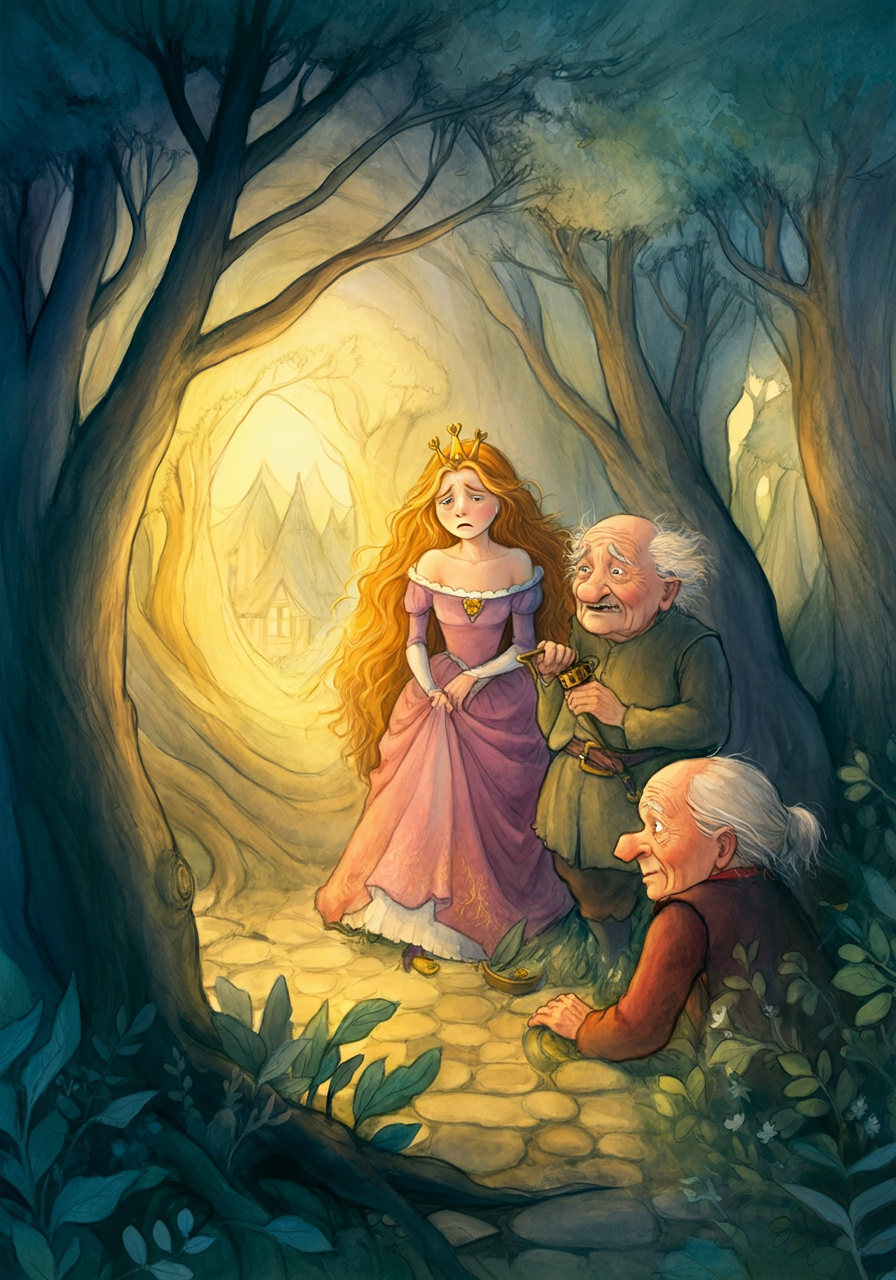
Once upon a time, there was a rich man named Mr. Grumbles. He lived in a big house. He wanted a wife! Lily worked in his field. Mr. Grumbles saw Lily. "I want to marry," he said. "Be my wife, Lily!"
Lily said, "No, thank you." Mr. Grumbles was surprised. He was not happy. He always got what he wanted. He wanted Lily more now.
Mr. Grumbles talked to Lily's Dad. "Help me," he said. "Lily must marry me." He offered money. He offered land. Lily's Dad said, "Yes, I will help."
Lily's Dad talked to Lily. "You must marry him," he said. But Lily said, "No." She was very firm.
Mr. Grumbles was impatient. "Make the wedding fast!" he told Lily's Dad. He thought Lily would say yes. She would be surprised.
The wedding day came. Mr. Grumbles sent Tom. Tom was a farm boy. "Go get what was promised!" he said.
Tom went to Lily. Lily was clever. She knew the trick. "My dad promised the Brown Horse," she said. "Go get her. She is in the field."
Tom found the Brown Horse. He brought the big horse to Mr. Grumbles' house.
Mr. Grumbles saw the horse. He thought it was Lily. "Take her upstairs!" he said to Tom. "Get help if you need it."
Tom and other boys pushed the big horse. Up, up, up the stairs! It was very hard work. The horse made loud noises. Neigh!
Mr. Grumbles told the women. "Dress her in a white dress!" he said. "Put flowers and a crown on her."
The women laughed. They dressed the Brown Horse. A white dress. Pretty flowers. A shiny crown. The horse looked funny!
Mr. Grumbles waited for Lily. But the Brown Horse came! She wore a white dress. Everyone laughed very loud. Mr. Grumbles' face turned red.
Mr. Grumbles felt very, very silly. He never asked anyone to marry him again. He learned a lesson. You cannot make people do things.
Original Story
The Squire's Bride
There was once a very rich squire who owned a large farm, had plenty of silver at the bottom of his chest, and money in the bank besides; but there was something he had not, and that was a wife.
One day a neighbor's daughter was working for him in the hayfield. The squire liked her very much and, as she was a poor man's daughter, he thought that if he only mentioned marriage she would be more than glad to take him at once. So he said to her, "I've been thinking I want to marry."
"Well, one may think of many things," said the lassie, as she stood there and smiled slyly. She really thought the old fellow ought to be thinking of something that behooved him better than getting married at his time of life.
"Now, you see," he said, "I was thinking that you should be my wife!"
"No, thank you," said she, "and much obliged for the honor."
The squire was not used to being gainsaid, and the more she refused him the more he wanted her. But the lassie would not listen to him at all. So the old man sent for her father and told him that, if he could talk his daughter over and arrange the whole matter for him, he would forgive him the money he had lent him, and would give him the piece of land which lay close to his meadow into the bargain.
"Yes, yes, be sure I'll bring the lass to her senses," said the father. "She is only a child and does not know what is best for her."
But all his coaxing, all his threats and all his talking, went for naught. She would not have the old miser, if he sat buried in gold up to his ears, she said.
The squire waited and waited, but at last he got angry and told the father that he had to settle the matter at once if he expected him to stand by his bargain, for now he would wait no longer.
The man knew no other way out of it, but to let the squire get everything ready for the wedding; then, when the parson and the wedding guests had arrived, the squire would send for the lassie as if she were wanted for some work on the farm. When she got there they would marry her right away, in such a hurry that she would have no time to think it over.
When the guests had arrived the squire called one of his farm lads, told him to run down to his neighbor and ask him to send up immediately what he had promised.
"But if you are not back with her in a twinkling," he said, shaking his fist at him, "I'll——"
He did not finish, for the lad ran off as if he had been shot at.
"My master has sent me to ask for that which you promised him," said the lad, when he got to the neighbor, "but, pray, lose no time, for master is terribly busy to-day."
"Yes, yes! Run down in the meadow and take her with you—there she goes," answered the neighbor.
The lad ran off and when he came to the meadow he found the daughter there raking the hay.
"I am to fetch what your father has promised my master," said the lad.
"Ah, ha!" thought she, "is that what they are up to?" And with a wicked twinkle of the eye, she said, "Oh, yes, it's that little bay mare of ours, I suppose. You had better go and take her. She stands tethered on the other side of the pea field."
The boy jumped on the back of the bay mare and rode home at full gallop.
"Have you got her with you?" asked the squire.
"She is down at the door," said the lad.
"Take her up to the room my mother had," said the squire.
"But, master, how can I?" said the lad.
"Do as I tell you," said the squire. "And if you can't manage her alone, get the men to help you," for he thought the lassie might be stubborn.
When the lad saw his master's face he knew it would be no use to argue. So he went and got all the farm hands together to help him. Some pulled at the head and the forelegs of the mare and others pushed from behind, and at last they got her upstairs and into the room. There lay all the wedding finery ready.
"Well, that's done, master!" said the lad, while he wiped his wet brow, "but it was the worst job I have ever had here on the farm."
"Never mind, never mind, you shall not have done it for nothing," said his master, and he pulled a bright silver coin out of his pocket and gave it to the lad. "Now send the women up to dress her."
"But, I say—master!—"
"None of your talk!" cried the squire. "Tell them to hold her while they dress her, and mind not to forget either wreath or crown."
The lad ran into the kitchen:
"Listen, here, lasses," he called out, "you are to go upstairs and dress up the bay mare as a bride—I suppose master wants to play a joke on his guests."
The women laughed and laughed, but ran upstairs and dressed the bay mare in everything that was there. And then the lad went and told his master that now she was all ready, with wreath and crown and all.
"Very well, bring her down. I will receive her at the door myself," said the squire.
There was a clatter and a thumping on the stairs, for that bride, you know, had no silken slippers on.
When the door was opened and the squire's bride entered the room, you can imagine there was laughing and tittering and grinning enough.
And as for the squire, they say he never went courting again.
Moral of the Story
One cannot force love or marriage, and those who try may find themselves outsmarted and shamed.
Characters

The Squire ★ protagonist
A man of mature age, likely stout or well-fed due to his wealth, with a commanding presence. His build suggests a life of comfort rather than hard labor. He carries himself with an air of self-importance.
Attire: Wealthy Norwegian farmer's attire of the 19th century: a dark, well-tailored wool suit, perhaps a waistcoat of fine fabric, a crisp white linen shirt, and polished leather boots. His clothing would be practical but of high quality, indicative of his status as a landowner.
Wants: To acquire a wife to complete his image of a successful, wealthy landowner, and to satisfy his desire for what he cannot easily obtain.
Flaw: His arrogance and inability to accept refusal. He is easily outwitted by those he underestimates.
He begins as an arrogant man who believes he can buy a wife. He ends up humiliated and, it is implied, learns a lesson about forcing others, as he 'never went courting again.'
Arrogant, stubborn, accustomed to getting his own way, short-tempered, and somewhat oblivious to others' feelings or intentions. He is also somewhat naive about human nature, especially women.

The Lassie ★ protagonist
A young, agile woman, likely slender and strong from farm work. Her movements are quick and purposeful, reflecting her sharp wit.
Attire: Typical 19th-century Norwegian peasant working clothes: a simple, sturdy linen or homespun wool dress, possibly a patterned apron over it, and practical, worn leather shoes or wooden clogs. Her clothes would be clean but show signs of labor.
Wants: To avoid marrying the old miser and to maintain her independence and dignity.
Flaw: Her poverty and her father's debt make her vulnerable to coercion, but she overcomes this with her wit.
She begins as a young woman working in the fields, targeted by the Squire. She successfully outwits him, preserving her freedom and dignity, demonstrating her cleverness and strength of character.
Clever, quick-witted, independent, defiant, and resourceful. She possesses a strong sense of self and refuses to be coerced.

The Lassie's Father ◆ supporting
A man of humble means, likely thin and weathered from a life of hard work. His posture might be slightly stooped from labor or worry.
Attire: Simple, worn 19th-century Norwegian peasant clothing: a homespun linen shirt, sturdy wool trousers, and a patched jacket. His clothes would be functional but clearly not new or luxurious.
Wants: To clear his debt with the Squire and gain a piece of land, securing his family's financial future, even at his daughter's expense.
Flaw: His financial vulnerability and fear of the Squire's power make him compromise his daughter's happiness.
He begins as a father willing to sacrifice his daughter's happiness for financial gain. He is ultimately outwitted by his daughter's cleverness, though his personal arc isn't explicitly detailed beyond his initial actions.
Pliable, easily swayed by financial incentives, somewhat weak-willed, and concerned with practical matters (like debt). He genuinely believes he knows what's best for his daughter, even if it's against her will.

The Farm Lad ◆ supporting
A young, energetic farmhand, likely lean and strong from physical labor. He moves quickly and efficiently, especially when under pressure.
Attire: Typical 19th-century Norwegian farmhand attire: a simple linen shirt, sturdy wool trousers, and a practical, perhaps worn, vest. His clothes would be functional and show signs of use.
Wants: To obey his master's commands to avoid punishment and to earn his wages.
Flaw: His fear of the Squire makes him follow even the most absurd orders without question.
He serves as a catalyst for the Lassie's plan and a witness to the Squire's humiliation. He doesn't undergo a significant personal arc but highlights the absurdity of the situation.
Obedient, diligent, easily intimidated by the Squire, but also observant and capable of humor (as seen when he tells the women to dress the mare).

The Bay Mare ○ minor
A medium-sized horse with a reddish-brown coat (bay color), a dark mane, and a dark tail. She is strong and sturdy, typical of a farm horse.
Attire: Initially, just a tether. Later, she is dressed in full wedding finery: a white bridal gown, a wreath of flowers, and a crown, all ill-fitting and comically draped over her.
Wants: To be a horse, to graze, and to resist being moved or dressed in an uncomfortable manner.
Flaw: She is an animal and cannot communicate her resistance verbally, making her an unwitting participant in the prank.
She is an object of the Lassie's clever trick. She is transformed from a farm animal into a 'bride', leading to the Squire's public humiliation.
Animalistic, stubborn when forced into unnatural situations, but otherwise docile.
Locations

Squire's Farmhouse
A large, prosperous Norwegian farmhouse, likely a 'gård' with multiple buildings, featuring a main dwelling with a 'loftstue' (upper room) where the bride's finery is laid out. The interior would have sturdy timber construction, possibly painted or whitewashed walls, and simple, functional furnishings. The stairs are robust enough to withstand a horse being dragged up them.
Mood: Initially expectant and bustling with wedding preparations, later descends into chaos and uproarious laughter.
The wedding preparations take place here, the mare is dressed as the bride, and the squire receives his 'bride' at the door, leading to the story's climax.

Hayfield
A wide, open meadow covered in cut hay, with the scent of drying grass in the air. The ground is uneven, typical of a working farm field, possibly with some wildflowers or weeds among the hay. The sun is high, indicating midday or early afternoon.
Mood: Initially peaceful and industrious, later becomes a place of trickery and quick thinking.
The lassie is working here when the squire's lad comes to fetch 'what was promised', and she cleverly directs him to the bay mare.
Story DNA
Moral
One cannot force love or marriage, and those who try may find themselves outsmarted and shamed.
Plot Summary
A wealthy and arrogant squire decides he wants to marry a poor neighbor's daughter, but she repeatedly refuses him. Undeterred, the squire bribes her father to force the marriage and plans a surprise wedding. On the wedding day, the clever lassie tricks the farm lad sent to fetch her, sending a bay mare in her place. The squire, thinking the mare is his stubborn bride, orders it dressed in wedding finery and brought to the ceremony, leading to his public humiliation when the horse is revealed to the guests, and he never courts again.
Themes
Emotional Arc
arrogance to humiliation
Writing Style
Narrative Elements
Cultural Context
Reflects a time when social standing and wealth could be used to coerce marriage, and the limited agency of women, especially those from poorer families.
Plot Beats (14)
- A rich squire decides he wants a wife and proposes to a neighbor's daughter working in his field.
- The lassie refuses the squire, who is unaccustomed to being denied and becomes more determined.
- The squire offers the lassie's father a bribe (debt forgiveness and land) to force his daughter to marry him.
- The father tries to persuade his daughter, but she steadfastly refuses the old miser.
- Impatient, the squire tells the father to arrange the wedding immediately, planning to surprise the lassie into marriage.
- On the wedding day, the squire sends a farm lad to fetch "what you promised him" from the neighbor.
- The lassie, understanding the trick, tells the lad that her father promised the squire their bay mare and directs him to it.
- The lad brings the bay mare back to the squire's farm.
- The squire, thinking it's the stubborn lassie, orders the lad to take "her" upstairs to the bridal room, even if he needs help.
- The lad and other farmhands struggle to get the mare upstairs and into the room.
- The squire then orders the women to dress "her" in wedding finery, including a wreath and crown.
- The women, thinking it's a joke, dress the bay mare as a bride.
- The squire, expecting his bride, receives the mare at the door, leading to widespread laughter and his utter humiliation.
- The squire is so shamed that he never attempts to court anyone again.