The Ass and the Little Dog
by Jean de La Fontaine
Adapted Version
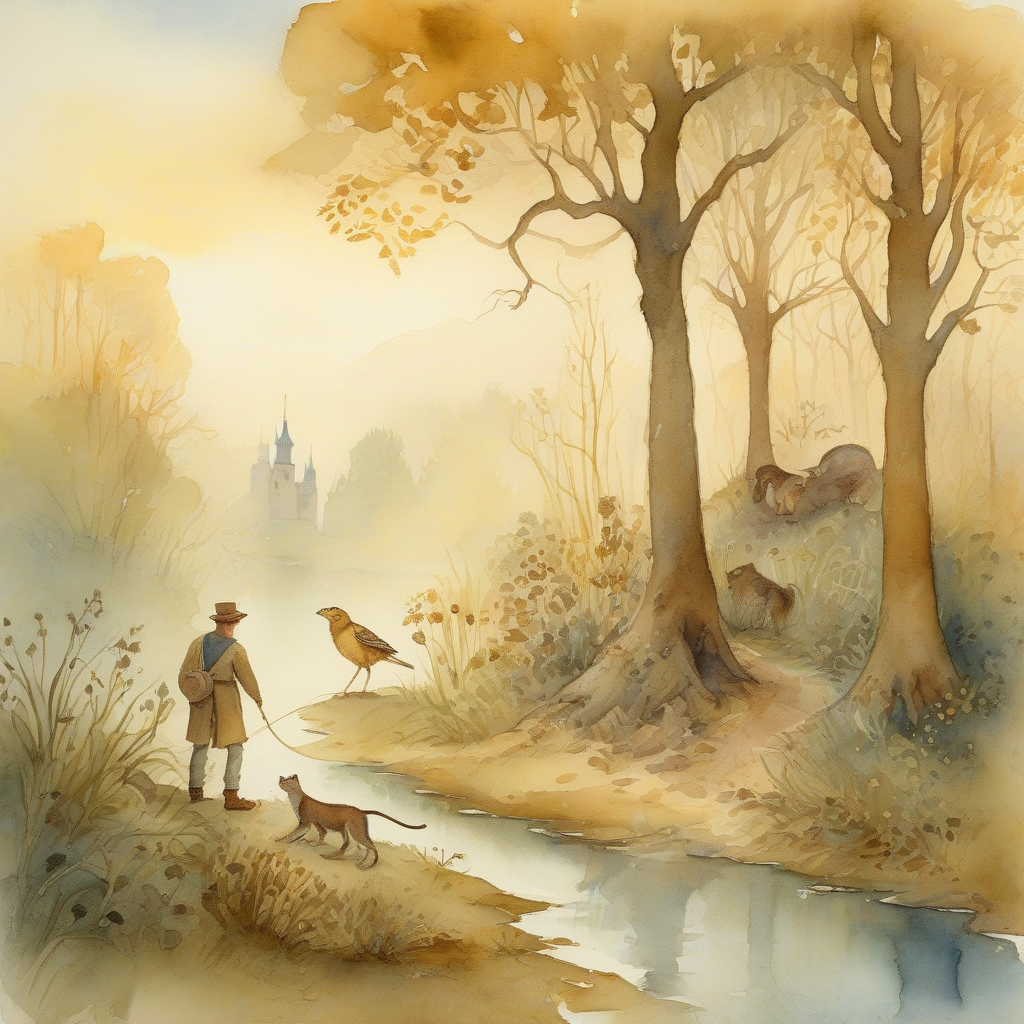
Once there was a big, strong Donkey. He worked hard each day. He carried many things. He saw a new thing. He wished he was other.
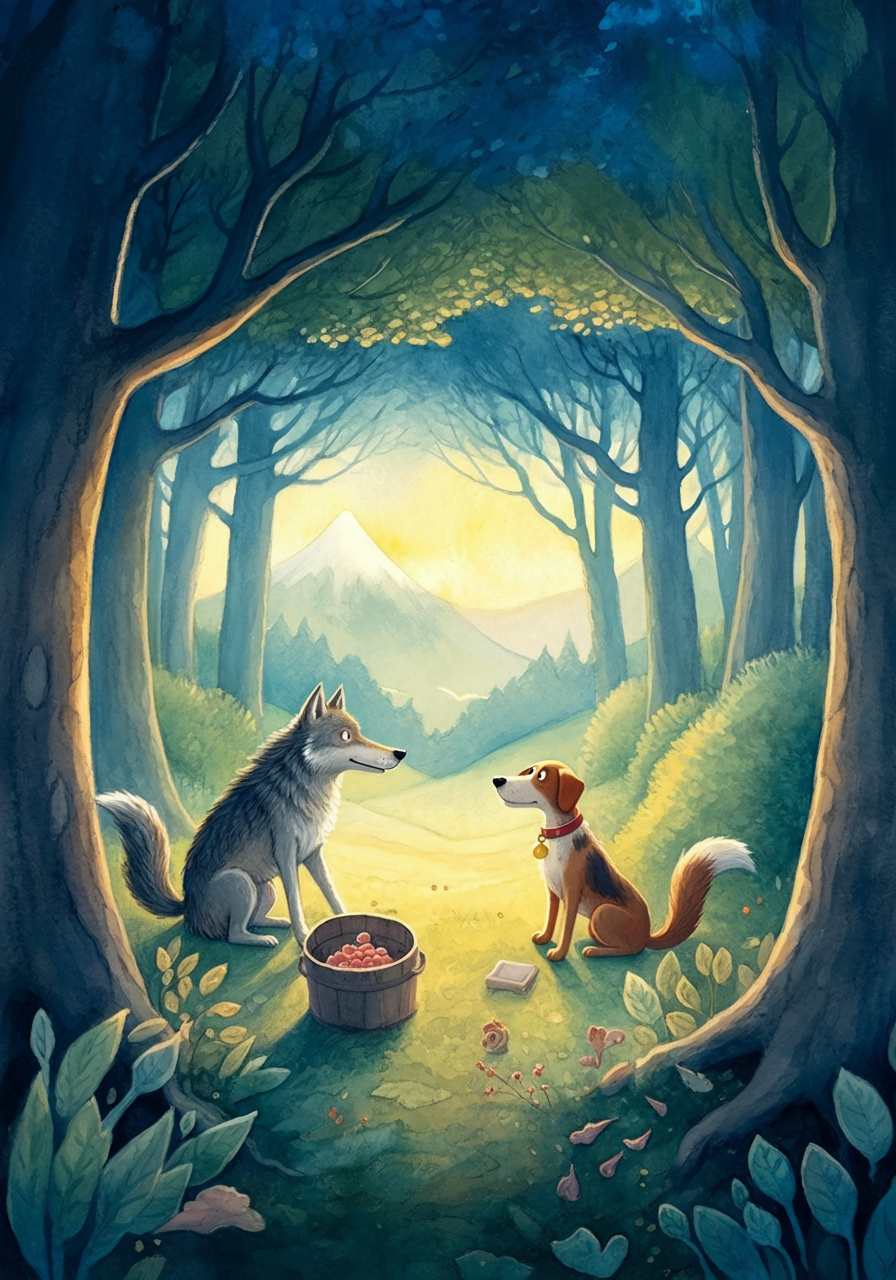
The Donkey saw the Little Dog. The Little Dog was small. He had soft fur. The Little Dog played with the Master. The Master gave many pets. The Master gave much love. The Little Dog was very happy. He wagged his tail. The Donkey watched them. He saw the Master smile.
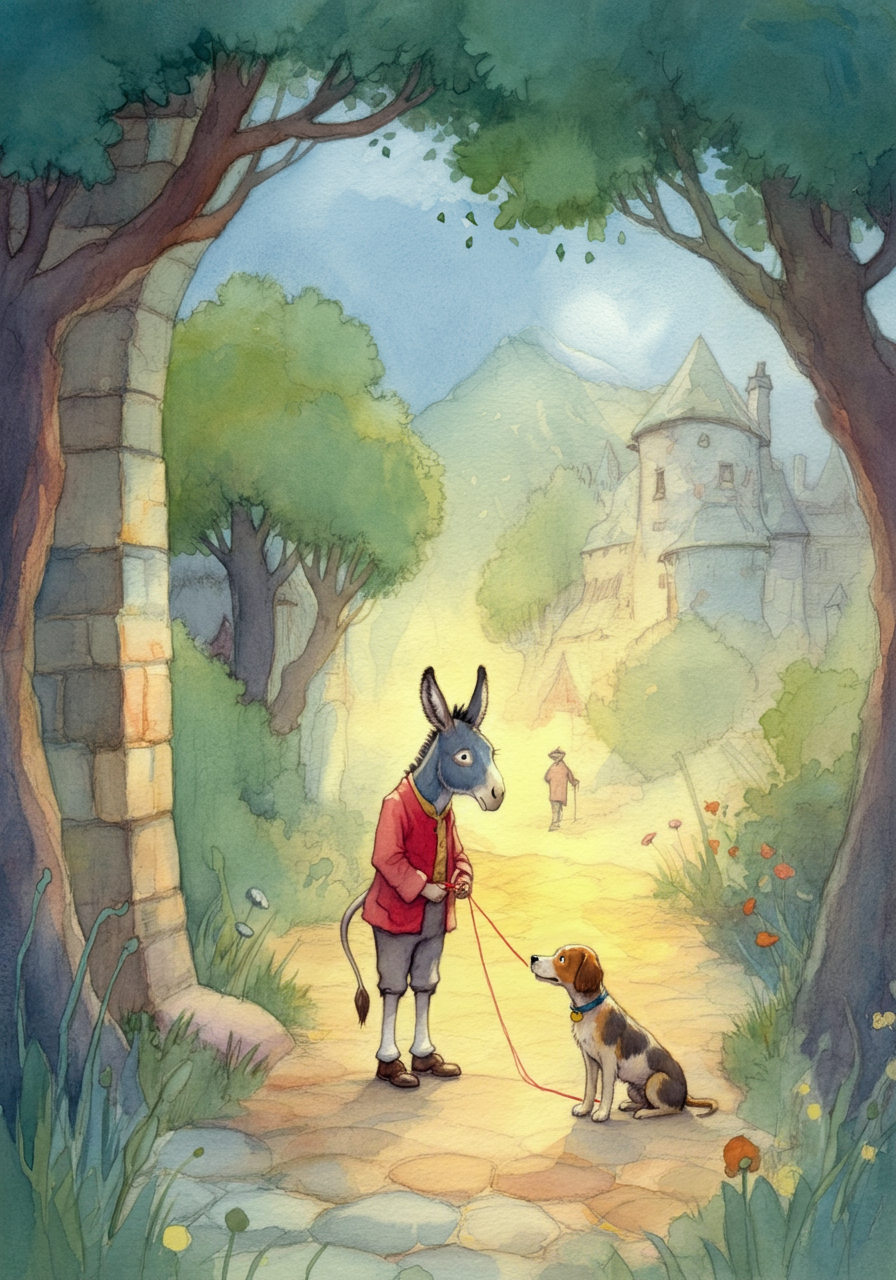
The Little Dog played very gently. He got many hugs from Master. Master held him close. The Donkey thought, "How does he do this? I want hugs too. I want to be loved by Master."
The Donkey thought, "I can do that too. I am strong. I can be gentle. I want hugs from Master. I will try it now. I will make him happy. I will make Master smile."
The Master sat outside. He was resting in the sun. The Donkey walked slowly to him. He wanted to surprise him. He wanted to give Master a big hug.
The Donkey lifted his big foot. His foot was very big. It was a heavy foot. He moved his foot up. He tried to touch Master's face. He wanted to be gentle. But it was not gentle. It was very clumsy. His foot was so heavy.
The Donkey made a loud sound. "Hee-haw!" he said loudly. He thought it was a happy sound. He thought Master would like it. He wanted to show love.
The Master was very surprised. He jumped a little. He was a little scared. He said, "Oh no, Donkey! Go away now! This is not good. Please go away!"
The Donkey felt very sad. He made a big mistake. He could not be a Little Dog. He was a Donkey. He went back to his work. He felt a little wiser now. He knew a new thing.
The Donkey learned a lesson that day. It was a big lesson. It is good to be yourself. All are special. All have their own good way. Be happy as you are.
Original Story
The Ass and the Little Dog.
One's native talent from its course Cannot be turned aside by force; But poorly apes the country clown The polish'd manners of the town. Their Maker chooses but a few With power of pleasing to imbue; Where wisely leave it we, the mass, Unlike a certain fabled ass, That thought to gain his master's blessing By jumping on him and caressing. "What!" said the donkey in his heart; "Ought it to be that puppy's part To lead his useless life In full companionship With master and his wife, While I must bear the whip? What doth the cur a kiss to draw? Forsooth, he only gives his paw! If that is all there needs to please, I'll do the thing myself, with ease." Possess'd with this bright notion,— His master sitting on his chair, At leisure in the open air,— He ambled up, with awkward motion, And put his talents to the proof; Upraised his bruised and batter'd hoof, And, with an amiable mien, His master patted on the chin, The action gracing with a word— The fondest bray that e'er was heard! O, such caressing was there ever? Or melody with such a quaver? "Ho! Martin! here! a club, a club bring!" Out cried the master, sore offended. So Martin gave the ass a drubbing,— And so the comedy was ended.
---
Moral of the Story
It is unwise to imitate others' actions without understanding the context or possessing the appropriate nature and grace.
Characters

The Ass ★ protagonist
A sturdy, medium-sized donkey with a stocky build, strong legs, and a somewhat coarse, grey-brown coat. His hooves are described as 'bruised and batter'd', suggesting a life of labor.
Attire: None, as he is an animal. Perhaps a simple, worn leather halter or bridle, though not explicitly mentioned.
Wants: To gain his master's affection and companionship, similar to the Little Dog, and to be relieved of his laborious life.
Flaw: Lack of self-awareness and inability to understand appropriate social cues or his own limitations. He believes he can simply imitate others without understanding the underlying nature of their appeal.
He attempts to change his role from a beast of burden to a beloved companion but fails spectacularly, reinforcing his original status through his clumsy actions.
Envious, imitative, well-meaning but misguided, clumsy, and ultimately foolish in his attempts to gain affection through inappropriate actions.

The Little Dog ◆ supporting
A small, lively dog, likely a lapdog breed, with a light, agile build. His size and ability to 'give his paw' and 'kiss' suggest a breed known for companionship.
Attire: None, as he is an animal. Perhaps a small, simple collar.
Wants: To enjoy the companionship and affection of his master and his wife.
Flaw: Not explicitly stated, but perhaps a certain fragility or dependence on human affection, as he is a pet.
Remains a static character, serving as a foil to the Ass, highlighting the difference between natural charm and forced imitation.
Affectionate, playful, charming, and intuitive, understanding how to appropriately interact with his master to receive love.

The Master ◆ supporting
A man of average build, likely a landowner or farmer, given the presence of a donkey and the mention of a 'country clown'. His hands might show signs of work, but he is described as 'sitting on his chair, at leisure in the open air'.
Attire: Simple, practical clothing suitable for a rural landowner in 17th-century France (La Fontaine's era). Perhaps a linen shirt, a waistcoat, breeches, and sturdy shoes. Not overly ornate, but comfortable for leisure.
Wants: To enjoy his leisure and the companionship of his pet, and to maintain order and appropriate behavior from his animals.
Flaw: His quick temper and immediate resort to punishment when his comfort or expectations are disrupted.
Remains a static character, serving as the arbiter of appropriate behavior and the dispenser of consequences.
Appreciative of appropriate affection, easily offended by clumsy or inappropriate gestures, practical, and quick to discipline.

Martin ○ minor
A sturdy, capable servant, likely a farmhand, with a practical build. His appearance would reflect his working-class status.
Attire: Simple, durable peasant clothing typical of 17th-century French farmhands: a coarse linen tunic or shirt, practical trousers, and sturdy boots. Nothing decorative.
Wants: To serve his master and follow instructions.
Flaw: Not explicitly shown, as he is a minor character, but perhaps a lack of independent thought or compassion when following orders.
A static character, serving only to execute the Master's command.
Obedient, dutiful, and unhesitating in carrying out orders.
Locations

Master's Country Estate Courtyard
An open-air area within a country estate, likely paved or hard-packed earth, where the master relaxes in a chair. It's a place for leisure and observation.
Mood: Initially peaceful and leisurely, quickly turning chaotic and punitive.
The ass attempts to mimic the dog's affection, leading to his punishment.
Story DNA
Moral
It is unwise to imitate others' actions without understanding the context or possessing the appropriate nature and grace.
Plot Summary
An ass, envious of a little dog's easy life and the affection it receives from their master, decides to imitate the dog's charming behavior. Believing he can easily replicate the dog's simple gesture of giving a paw, the ass awkwardly approaches his master. He raises his hoof, pats the master's chin, and brays loudly as a sign of affection. However, the master is offended by the ass's clumsy and forceful display and orders a servant to beat the ass, thus ending his ill-conceived attempt at imitation.
Themes
Emotional Arc
envy to humiliation
Writing Style
Narrative Elements
Cultural Context
La Fontaine's fables often drew on classical sources (like Aesop) and were popular in 17th-century France, reflecting social observations and moral instruction.
Plot Beats (10)
- The narrator introduces the theme that one's nature cannot be forced and that imitation can be poor.
- The narrator states that few are chosen to have the power of pleasing, unlike a fabled ass.
- The ass observes a little dog enjoying a life of companionship with the master and his wife, while the ass bears the whip.
- The ass wonders what the dog does to receive kisses, noting the dog only gives its paw.
- The ass decides that if a simple paw is all it takes, he can easily do the same.
- The ass approaches his master, who is sitting at leisure in the open air.
- With awkward motion, the ass raises his hoof and pats his master on the chin.
- The ass accompanies this gesture with a loud bray, intended as a fond word.
- The master is offended and cries out for his servant Martin to bring a club.
- Martin gives the ass a beating, bringing the 'comedy' to an end.