THE EMERALD ROC
by Unknown
Adapted Version
A king has a garden. Three apples grow there. Each year, a magic creature comes. It takes the apples. The king is sad. He has three sons.
The first brother says, "I watch the apples." He is big. At night, he is scared. He runs away. The magic creature comes. It takes the apples.
The second brother says, "I watch the apples." He is also scared. He runs away. The magic creature comes. It takes the apples.
The brave prince says, "I help." The king is worried. "You are small," he says. The brave prince is brave. He goes to the garden.
At night, the magic creature comes. It makes a soft "whoosh" sound. The brave prince is not scared. He has a magic arrow. He throws the arrow. The magic creature goes away. The apples are safe.
The brave prince is happy. He gives the apples to the king. The king is proud. "You are brave," he says.
The next day, the brave prince sees a glitter path. It goes to a well. The brave prince wants to see. His brothers come too.
The well has a big stone. The first brother tries. He cannot move it. The second brother tries. He cannot move it. The brave prince touches the stone. It moves easy.
The brave prince wants to go down. The first brother says, "I am big. I go first." He goes down. He is scared. "Pull me up!" he says. They pull him up.
The second brother goes down. He is scared. "Pull me up!" he says. They pull him up.
The brave prince says, "I go down." He goes down. It is dark. He is not scared.
He finds a room. A girl is there. She is knitting. He finds a new room. A new girl is there. She is more pretty. He finds a third room. A very pretty girl is there. She is the kind princess.
The kind princess says, "Hello. A big dragon sleeps here. Be quiet." The brave prince says, "I help you."
He finds the big dragon. It is sleeping. It is very big. The brave prince is brave. He wakes it up. The big dragon says, "Hello." It is friendly. The brave prince helps the girls leave.
They go to the well. The kind princess goes up. The second girl goes up. The brave prince ties a rope. He sends the kind princess up. The rope breaks by chance. The brave prince is left behind.
The kind princess gives him magic hairs. "Use these," she says. The brave prince uses the hairs. A friendly helper comes. The helper lifts him out. The brave prince is safe.
He goes to a new city. He wears a hat. He works for a jewelry maker. The jewelry maker is sad. The king wants pretty jewels for his daughters.
The brave prince uses magic. He makes pretty jewels. The jewelry maker gives them to the king. The girls are happy. They think of the brave prince.
The brave prince works for a clothes maker. The clothes maker is sad. The king wants nice dresses for his daughters.
The brave prince uses magic. He makes nice dresses. The clothes maker gives them to the king. The girls are very happy.
There is a fun party. There is a game day. The first brother plays a game. The brave prince goes in secret. He wears black clothes. He wins the game. The first brother is surprised.
The second brother plays a game. The brave prince goes in secret. He wears gold clothes. He wins the game. The second brother is surprised.
A bad man plays a game. He is mean to the king. The brave prince goes in secret. He wears silver clothes. He stops the bad man.
The brave prince shows who he is. He tells the king all. "My brothers left me," he says. "The bad man was mean."
The king is happy. He hugs the brave prince. "My son!" he says. The brothers go away. The brave prince marries the kind princess.
The brave prince is happy. Being kind and brave is good. The prince and princess smile. They live happily ever after.
Original Story
THE EMERALD ROC
PART I
THE DRAGON OF THE APPLES
Once upon a time, in the pleasure garden of a king, there grew a tree which produced three apples every year. But the king had never tasted one of them. In the middle of the night, before they were quite ripe, a seven-headed genie always came and carried them away.
Now, the king had three sons. One day the eldest son came into his father’s presence, kissed the ground, then arose and stood before him.
“What dost thou wish, my son?” asked the king.
“My father,” was the answer, “thou knowest that the precious apples should be ripe upon the morrow. To-night I would keep watch in the garden and kill the genie.”
“Thou speakest well, my son,” said the king.
Thereupon the prince took a bow in his hand and hid himself in the garden. At midnight there was a terrific earthquake, followed by a black cloud, out of which the genie emerged and walked toward the tree upon which hung the precious fruit. At sight of him the affrighted prince forgot his determination and ran to the palace for safety. The genie plucked the apples and carried them away.
In the morning the king sent for the prince and inquired if he had accomplished his purpose.
“Sire,” was the reply, “I barely escaped with my life!”
When a year had passed the second son asked that he be allowed to kill the monster. His ill fortune was like unto that of his brother. At the end of another year the youngest prince came into his father’s presence.
“If your majesty only consent,” he pleaded, “I will go and kill this evil creature who trespasses upon your private grounds.”
But the king was loath to let his favorite son rush into danger, and demurred, saying: “If thy brothers could not accomplish this hazardous undertaking how canst thou hope to do it? Alas! thou wilt surely perish.”
Nevertheless, upon the pleading of the boy, permission was granted him. The grateful young prince placed the Koran in his bosom, took a poisoned arrow in his hand, and sought a secluded spot in the garden.
Exactly at midnight there was an earthquake, after which appeared a dense cloud, out of which emerged the seven-headed genie and approached the tree which bore the precious fruit.
“By the power of Allah!” cried the young prince as he threw the poisoned arrow. It passed through all the seven heads of the monster, who, uttering a cry that made the earth to tremble, sank upon the ground.
The prince gathered the apples, ran with them to his father, and told what he had done.
“Brave art thou, my son!” cried the king. “I perceive that thou hast great courage.”
But the prince was not content. Kissing the ground before his father, he asked permission to remove the body of the genie from off the face of the earth. And, although the king had grave fears for his son’s safety, he was persuaded to yield consent.
PART II
THE DRAGON OF THE WELL
Very early upon the following morning the prince, taking his two elder brothers with him, entered the royal garden. A strange sight met their eyes. The body of the genie had turned to blood and was flowing away in a stream.
The young prince, fearing that this boded mischief to the kingdom of his father, determined to follow the course of the stream. After walking for several days the princes found that it came to an end at the mouth of a well.
Now, the well was covered with an immense stone, which the two elder brothers tried in vain to remove. As soon, however, as the youngest had touched it with his finger, they lifted it without difficulty.
This youngest, then, desired to descend at once and kill the dragon. But the eldest detained him, saying, “It is not for thee to do this while I, the eldest, am here.”
So they tied a rope around the waist of the eldest and began to let him down into the well. But he was scarcely inside when he cried: “Alas! I am burning. Pull me out, quickly!”
The others drew him out and tied the rope around the second prince’s waist. But he had no more than entered the mouth of the well when he, also, called out. “Alas! I freeze!” were his words. “Pull me up!”
The youngest prince then said to his brothers: “It surely is permitted me to try. But should I cry, ‘I burn!’ or ‘I freeze!’ you shall pay no heed; but hasten the more to let me down.”
The others agreed to this. And when the youth called out that he was burning or freezing, they gave out more rope. After some time the bottom was reached by the brave young prince, who freed himself from the rope and began to walk through a long hall which stretched before him.
Presently he came to a room, in which a beautiful maiden sat knitting. He did not tarry, however, but passed on into another room, where was another maiden, also knitting, who was more beautiful than the first. Still the prince tarried not. He entered a third room, where—what should he see? A maiden whose beauty exceeded all imagery, who dazzled the eyes of a beholder as if a sun had dropped into the room. The prince could not look into her face. He fell deeply in love with her from that moment and cried:
“Maiden, art thou human?”
“I am human,” the maiden answered. “But, O, my knight, how didst thou reach this place? Knowest thou not that there dwelleth a dragon within this well? If he hear thee he will surely kill thee.”
“I am come to kill this monster,” replied the youth. “So do thou quickly show me where he may be found.”
The maiden, although she loved him, gave the desired direction, because she saw that Allah must have led him thither.
When the prince entered the door pointed out to him—what should he see! A genie who was like a minaret for height, and so huge that a common knight must lose his senses at the mere sight of him.
When this being perceived his visitor he lifted his thousand-pound stick and, uttering a sound that shook the earth, rushed upon him. The prince almost gave himself up for lost. But, seizing his sword, he shouted, “Through the power of Allah!” and struck upward with such force that the giant’s head was completely severed from his body. He sank to the ground, delivering up his soul to Hades.
At once the prince returned to the maiden; after which he gathered all the jewels he could find and, together with the three princesses, returned to the bottom of the well. After calling to his brothers to let down the rope, he tied it about the first maiden. “Here, my elder brother, is thy portion!” he shouted. When this one had been rescued he fastened the rope about the second, and cried, “Here, my second brother, is thy portion!” But when it came the turn of the maiden who was the young prince’s own choice, she said to him:
“My prince, do thou go first and I surely will follow. Verily, I fear that thy brothers, seeing me, will be envious and leave thee in the well.”
But the prince would not listen. He scorned to leave his beloved one in the gloomy prison. So the maiden, sad at heart, gave him three hairs from her head, saying: “If it chance that they cut the rope which holds thee, instantly rub these hairs. Two sheep will appear at the foot of the well. If thou fallest upon the white one, thou wilt come, instantly, out upon the face of the earth. But, alas! shouldst thou strike upon the black one, he will carry thee seven leagues farther under the earth.”
The prince placed the hairs in his bosom, parted tenderly with his beloved, then calling out that she was his own portion, sent the maiden to the top.
And the unfortunate prediction came to pass. When the brothers perceived that the third princess was as the full moon for beauty, they were very angry, and said: “What is this that he hath done! Will he keep the most beautiful one for himself?” And when they had drawn him to the very top they cut the rope. The brave young prince fell, over and over, into the depths of the well. But, just before he reached the bottom, he succeeded in rubbing together the three hairs which had been given him. Instantly, two sheep appeared; and he, falling upon the back of the black one, was borne seven leagues under the surface of the earth.
We will now return to the wicked brothers, who conveyed the three maidens directly to their father’s palace. Upon entering the king’s presence they wept and cried: “Alas, father! The Genie of the Well has destroyed our little brother! But we have rescued these three maidens.”
When the king heard these words he wept bitter tears and commanded that there be very great mourning for his youngest son.
PART III
THE DRAGON OF THE FOUNTAIN
Let us now return to the youngest prince.
Destiny, having carried him seven leagues under the earth, surprised him still further, by showing him there, another world. He walked until evening, when he reached a city and knocked at the first door. It was opened by an aged woman, who asked what he desired.
“Mother, wilt thou take me in for the night?”
“Ah, my son,” was her reply, “I have no place to sleep myself. How, then, can I harbor thee?”
Her sense of hospitality was so quickened by the gift of three gold pieces that she conducted the prince to an upper chamber. He then asked for a draught of water; at which the old woman went to the cupboard and brought a jar of water, in the bottom of which lay a finger’s depth of slime. When the prince saw that no beast would taste of such water as had been offered to him he asked:
“How is this, mother, that you offer me such as this with which to quench my thirst?”
Thereupon the old woman made answer: “O, my son! The water of this country is cut off by a huge dragon, who demands every year that a maiden be given to him. During the time that he is tearing her into pieces and eating her, water flows from the spring which supplies this city. At other times we have none. So thou canst see how we suffer. Just now we are hard pressed, because it is the end of the year. To-morrow they will give the king’s daughter to the dragon. Haply, that sacrifice may suffice for all time. And if they do not give her, Allah have mercy! We must all perish!”
When the brave young prince heard this he became lost in thought. Very early the next morning he found his way to the fountain, where were great multitudes of people, each with jugs in their hands. Presently slaves appeared leading the king’s daughter, who was dressed in red garments richly adorned. When they had led her to the brink of the fountain they left her there. It was near the time appointed for the appearance of the monster, and the poor young princess was weeping bitterly.
At this pitiable sight the spirit of the young prince became heavy with sorrow. He made a great decision that he would endeavor to rescue the sufferer. Approaching her, he said:
“Fair princess, get thou behind me. Hold fast to me, and have no fear!”
The maiden obeyed gladly. The prince then bent his bow and stood in readiness. Very shortly there appeared in the west a seven-headed dragon. Fire flashed from his mouth and nostrils. The earth trembled as he approached. “Aha!” he cried. “Hitherto hath my portion been one. Now has it become two.” And from half an hour’s distance he tried to draw the prince and the young maiden to him.
But the prince, bracing his feet, stood firmly; and, although the dragon used such force that, had they been a mountain, it must have come to his mouth, he could not move them. He came nearer and tried again.
Then the prince took a firmer stand and cried, “Bismillah! Through the power of Allah!” and let fly an arrow which entered the open mouth of the fiend and came through his neck. He leaped three times, then fell with such force as to raise a great cloud of earth about him. So much blood ran from his mouth and nose that the water was hidden quite. But after a few minutes it was washed away, and the water became clearer than it had been before.
The maiden secretly dipped her finger in the blood of the dragon and made a mark upon the back of her deliverer. Then, the cloud being so dense that neither her departure nor that of the prince was visible, she hastened to the palace.
When the king saw that his daughter was still living he was afraid, and began to upbraid her. She acquitted herself by telling the circumstances of her deliverance and assuring her father that her promise had not been broken. The king could not believe the great good fortune. He went, himself, to see the dead dragon, which was so awful in its proportions as to make the spectator lose his senses. Then the king, being exceedingly desirous of rewarding their rescuer, asked his daughter whether she could surely recognize him. The princess insisted that she would be able to do this, whereupon the king sent out criers, commanding that all the inhabitants of the country, between the ages of one and seventy, should pass before the palace.
Let us return to the prince. After having freed the land from the cruel curse of the dragon, he returned to the house of the old woman and sat down in his chamber. But the woman rebuked him for disregarding the decree of the king, and bade him go to the palace.
The prince believed in obeying the commands of a sovereign. He became one in the long line which marched past the palace of the king. The princess saw his approach, from the window behind which she was hidden, and made a sign to the guards, who laid hold upon him and conducted him into the presence of the king. The mark of blood upon the back of the prince convinced everyone that he indeed was the one who had saved them.
The king then bade the prince ask anything that his heart wanted. The modest youth wished for his majesty’s health, and that whenever it should near the end it might be renewed. At this the king answered: “My son, thou profitest nothing through my good health. Ask something for thyself.”
Then the prince desired to be granted three days in which to render a decision; after which he returned to the house of the old woman.
PART IV
THE FRIENDLY ROC
The prince was very sad. He longed for his home; for his father, the king; for his princess, who was like the full moon for beauty. He was vexed with the cruelty of his two brothers, against whom he had done no harm. Upon the next day he took his bow and went to the mountains. As the day was warm, he sat down under a tree and fell asleep.
Now, it chanced that in this very tree was the brood of an emerald roc, to which the mother-bird brought food once each year. This day chanced to be the very one upon which she was to come. While the prince was sleeping, an immense snake began to climb the tree. The screams of the young birds wakening the prince, he sprang up, discovered the snake, and straightway nailed it to the tree with an arrow. Again he lay down and slept.
Presently the mother-bird appeared in the sky, saw the prince, and, fearing that he had killed her young ones, was about to fall upon him, when the little ones cried out, “Mother, mother! this sleeping prince has rescued us from our mortal enemy, the Great Black Snake.” And, verily, there was the snake, still hanging from the tree.
The great bird descended softly, sat down beside the prince, and spread one wing to shield him from the rays of the sun. After a little the prince awoke, and thought that a tent had been spread above him. When the grateful bird knew that he had wakened she bade him ask from her any favor that he desired. The prince requested to be taken to the surface of the earth.
The roc replied that this would be exceedingly difficult. However, even at the cost of her own life, she would endeavor to satisfy him, since he had saved the lives of her children. In order that she might be able to undertake this task, she required that he supply her with forty sheep and forty casks of wine; that whenever, upon the journey, she said “Hah!” he could give her meat, and when she said “Huh!” he would be able to give her drink.
Upon this the prince went to the king and requested that he be given, graciously, forty sheep and forty casks of wine. These were carried to the bird, who placed the sheep on one wing, the wine upon the other; the prince mounted her back, and immediately the journey was undertaken.
The prince supplied the great bird with food and drink, according to her direction, until there came a day when she said “Hah!” and there was no meat to give her. The command was repeated. The prince hastily cut off the calf of his leg and gave it to her. The bird, perceiving that it was human flesh, put it in a corner of her mouth and would not eat it. Shortly after this they arrived at the mouth of the well; whereupon the bird said, “My prince, we have reached the face of the earth. Go, now. And may Allah be with thee!”
But the prince could not walk, because of his leg. And as he did not wish to reveal this to the roc he answered, “Do thou depart first, I pray thee; then will I go.”
The bird knew the reason for this answer, and, taking the piece of flesh from her mouth, she replaced it in such marvelous manner that the leg was better than before.
The prince then bade the bird good-bye. And with that he found himself in his own country. Before he should be recognized, he secured a tight cap of skin, which gave him the appearance of baldness. It was more than this. There were upon the cap certain marks which gave an impression that the wearer was suffering from a disease of the scalp. This was so designed that no one would approach too near the person of the prince and thus discover him. He then changed garments with a shepherd, and in this garb went directly to the pleasure garden of his father, where he asked the gardener to take him as an assistant.
The gardener refused; but the pleadings of the youth finally forced him to consent. After a few days the gardener gathered a great bunch of roses and went away, leaving the pleasure garden in charge of his seemingly faithful assistant.
PART V
THE MAGIC HAIRS
No sooner was the gardener gone than the prince took the hairs given him by the princess and rubbed them together. Immediately a slave appeared and asked, “What are thy commands, O prince?”
“Bring me a fine horse, a fine suit of clothes, and a set of weapons,” was the answer.
In another moment the slave brought all that had been commanded, and assisted the young man to dress and mount his horse. After this the prince rode all about the garden, trampling upon and destroying the plants. As he rode he glanced toward the palace and rejoiced to see that the three princesses were there and that he was recognized by them. He then gave the horse, clothes, and weapons to the slave and retired to a corner of the garden.
When the gardener returned—what should he see! The beautiful garden nearly in ruins, and the bald-headed assistant weeping in a corner. He began beating him, but the maidens called from a window: “Do not beat the lad! Verily, a rider from without came and destroyed the plants. Thy assistant is not to blame.”
After a few days the gardener again went away, and left the boy in charge of the place. The second time he called for a horse, destroyed many things which had escaped before, then sat down and awaited the return of the gardener. The maidens had fully recognized him this time. They rejoiced that the good prince had returned to the face of the earth, but, not knowing his plans, they bided his time and said nothing.
The gardener returned shortly, and was so greatly incensed at what he saw that he was about to chastise his assistant severely, when the maidens called commanding him to cease. A third time was the young prince left alone, and a third time did he despoil the garden—this time so grievously that not a branch was left. When the gardener returned he found nothing growing. Taking hold of the youth, he threw him without the gate.
Now, the prince was desirous of learning about the affairs of the kingdom. He had found that his brothers had not the courage to challenge one who appeared and behaved disrespectfully unto their father, the king. He went therefore to a jeweler and requested to be taken as an apprentice. The jeweler had no need of an assistant, but as the lad asked that he be permitted even to carry his coals, he was accepted.
Now, when the maidens had been brought unto the palace the king commanded that the first two prepare for their wedding. They, however, begged to be allowed forty days in which to prepare. When they had recognized the good prince they hoped for release, and, to assure themselves that he was upon the earth continually, they asked many things which none but he would have power to grant. One wanted a golden shuttle and a golden needle which would make lace without hands. The second asked for a golden tray, upon which must be a golden hen with forty golden chickens and all eating golden grains of barley. The third demanded a golden tray around which a golden rabbit and a golden hare were chasing each other.
Now, the wicked princes, believing that they had destroyed their brother, desired that the people might become dissatisfied with their father’s rule; so they pressed him to fulfill the requests of the princesses. The king did according to their desire; for he was very sad at heart and had no wish to live longer. Therefore he summoned all the jewelers of his kingdom and commanded that they execute the three orders. The jewelers, after consulting together, begged that they be granted forty days of grace. This request was granted by the king, who threatened certain death to all of them if, upon the fortieth day, his demands were not fulfilled. Thereupon, very much cast down in spirit, the jewelers were permitted to return to their homes.
The apprentice prince, seeing his master in this state, asked the cause of his anxiety. The master answered him roughly; but, as the youth persisted, he replied that the king’s sons had rescued three princesses, each of whom demanded a special article made of gold, before the two who were designed for them in marriage would consent to the nuptials. When asked to describe the articles, and after he had done so, the apprentice cried: “My master, I thought it had been some impossible thing that was required of thee. Trouble thyself no longer. Furnish me with a bag of nuts for food, another of raisins, and with forty candles. Thou shalt have these curious articles upon the morning of the fortieth day. Fear not!”
“Since the boy craves nuts and raisins,” said the master to himself, “I will permit him to have them. For myself, I shall need nothing long.”
The prince shut himself into a room, ate the nuts and raisins, burned his candles, and enjoyed himself. He was learning much about the kingdom and his brothers. Upon the fortieth night he rubbed the magic hairs which the maiden had given him, and commanded the slave, who appeared, to bring the articles demanded by the three princesses. They were brought and placed within a carved casket which stood in the room.
At early morning the jeweler appeared. He was pale with fear as he demanded how the boy had spent his time. “Why dost thou ask? My answer lies hidden within the casket.”
With trembling hands the master opened the casket, and was so overpowered at what he saw that he fell upon the apprentice’s neck in a swoon. When he had revived, he hastened to the palace and spread the precious creations before the king. Then were the three maidens very happy, for they knew that the good prince was not only upon the face of the earth, but that he possessed great power.
When the jeweler returned to the shop he was grieved because the apprentice requested his freedom, and would not be persuaded to remain. “Have I not saved thy life and the lives of thy fellow craftsmen? And wilt thou refuse me freedom?” asked the young man. So the jeweler permitted him to depart.
Then the prince went directly to the shop of a tailor, and again asked that he might serve an apprenticeship; and, although the tailor had no need of help, he refused to be turned away. This he did because he had heard of another request made by the maidens. They desired to gain more time and had asked for three robes, which had not been cut with scissors, nor sewn by needles; and each of which should be brought them in a filbert shell.
The king felt that he was in the power of some strange evil. At the urgent request of his sons he summoned the tailors of the kingdom and gave them the command. Now, the tailors had trembled greatly when they learned what had been required of the jewelers. They felt assured that not one of them could fulfill the imperial order; nevertheless, since they wished to live as long as possible, they asked for forty days in which to prepare the three robes. “Very well,” replied their sovereign, “but if my command is not obeyed, upon the forty-first day you all shall lose your heads.”
When the master of the prince returned, in great dejection, to his shop, the new apprentice asked the cause of his anxiety. “Do not vex me!” was the impatient answer. But, as the day wore on, the prince learned the cause of his master’s hopelessness. “Is that anything to trouble thee?” asked the youth. “Give to me forty bags of nuts, forty bags of raisins, and forty candles. Upon the forty-first day thou shalt have what thou desirest.” The tailor, because he did not like to grieve a lad who showed so much interest, gave to him all that he had asked. The prince shut himself up as beforehand, and upon the fortieth night bade the slave, whom he had summoned with the magic hairs, to bring the three robes and place them within a brazen casket upon the table. When morning came the tailor, without experiencing any degree of hope, came to the door and asked what had been accomplished. The apprentice desired him to open the casket and behold the fulfillment of his promise. The tailor was overjoyed, and hastened to the palace; whereupon the king at once gave order that the wedding festivities should begin.
A tournament of javelin throwing was arranged to take place upon the running grounds, in which, upon the first day, the eldest prince was to show his skill. The whole city turned out to witness the spectacle; and the grateful tailor said to his apprentice, “Come, let us go together and see the eldest prince play Zerid.” But the youth objected on account of his baldness; saying that he feared something might hit him accidentally and hinder the healing of the sores.
So the tailor left him alone in the shop. The prince then summoned the slave of the magic hairs and commanded that a tall black horse, a set of javelins, and a black suit of clothes be brought him. This was done immediately. The prince cast off his hateful headdress, arrayed himself in the handsome clothing, mounted his horse, and rode to the place of tournament, where the eldest son of the king was playing. It was easy to recognize his brother. Riding directly to him, the newcomer challenged to single combat, and, with a wonderful throw, so wounded him in the arm that he fell off his horse. In the confusion which followed, the victor returned to the shop of the tailor, gave back the horse, the javelins, and the clothing, sent the slave to his place under the earth, and sat down to await the coming of his master.
When the tailor appeared he cried: “O, my son! It is well that thou didst not go with me to-day.” Then he sat down and related all that had passed. But, during the relation, the prince learned that there was a great uprising planned against the king, and that the son of the grand vizier was to murder the two princes and take the throne. This had all come about through the restlessness of the people, which had been caused by the long unkindness of the king’s sons.
The next day, when the second son of the king was to rule the tournament, the tailor again took his departure. His apprentice instantly summoned the slave of the magic hairs, and ordered a yellow horse, a suit made from cloth of gold, and a set of gold-mounted javelins. When these were furnished him he rode to the place of tournament, and dismounted his second brother by wounding him in the leg; after which he returned quickly to the shop, resumed his former appearance, and sat down to await the coming of his master. When the tailor returned, and related the events of the day, the apprentice praised Allah that he had not accompanied him.
Now, upon the third day was the son of the grand vizier to rule the exhibition of skill. So the prince was exceedingly anxious to see his master depart. When the tailor was once out of sight, a white horse and a silver-embroidered suit with silver-mounted javelins were ordered from the slave of the magic hairs. When these arrived the prince made haste to array himself and to depart, as before, to the running ground. The grand vizier’s son was challenged, and with rare skill he was run through the heart and killed.
This time the victor did not disappear, as he had done upon each of the previous days, but continued to ride about openly, until he was arrested and dragged before the king. Before his entrance there the king had given orders that the murderer should have his head stricken off. As the prince approached the throne he said: “O, most noble and gracious sovereign! My brothers abandoned me in the well; the son of the grand vizier plotted against thy most precious life; and wilt thou now kill me, thy faithful son?”
When the king knew indeed that it was the son whom he had so deeply mourned, he was overjoyed. Falling upon the neck of the young prince, he wept and asked: “My son, what dost thou desire? Shall I command the death of thy two brothers?” But the young man was as noble when victory crowned him as when the bitterness of defeat had taxed his powers. He answered: “My father, since I am so happy as to find thee still unharmed, let us say, Allah be praised! Allah’s will be done! But do thou, I pray thee, give a palace, far away from thine own, unto each of my brothers; command that the elder be married to the first princess, the second to the second princess; then do thou graciously permit me to marry the youngest, whom I deeply love and through whom it has been possible for me thus to rescue thee and preserve unto thee thy kingdom.”
So it all came about as the brave young prince had requested. The two brothers were given palaces at a distance from that of the king; there was feasting and rejoicing upon the part of all the people during forty days; after which the youngest son of the king was married to the most beautiful princess and lived happily ever afterward.
Here endeth this story, with Salaam! which meaneth peace.
Moral of the Story
True courage and nobility of spirit will ultimately triumph over wickedness and deceit.
Characters

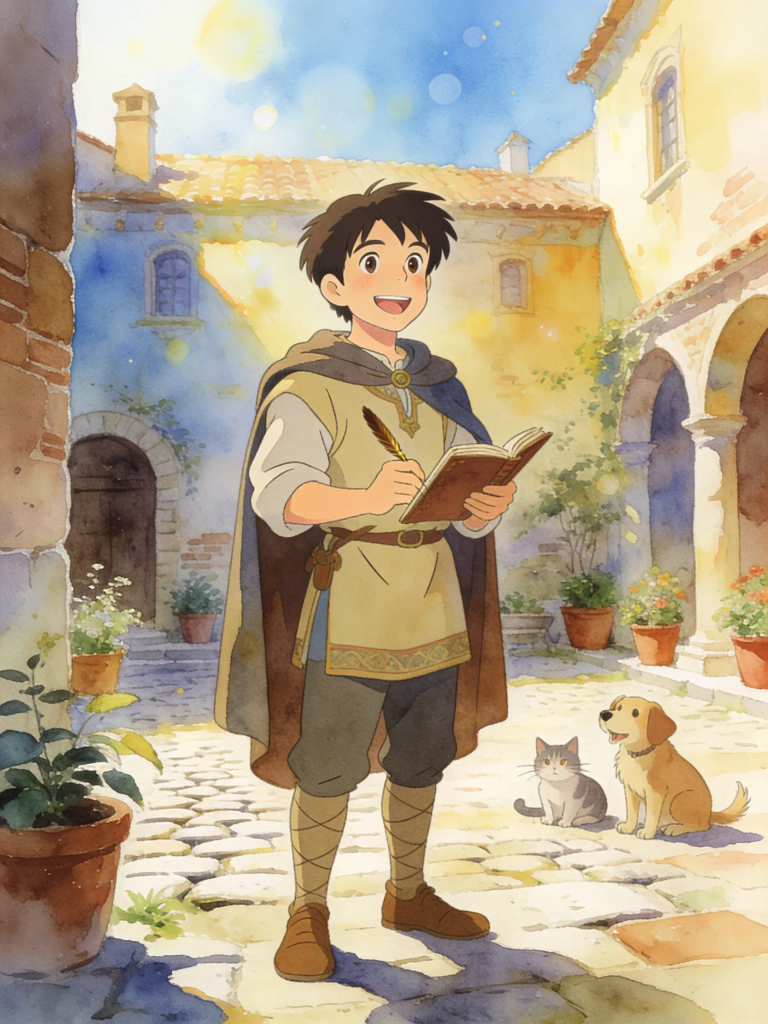
The Youngest Prince ★ protagonist
Lean and agile build, of average height for a young man, with a determined yet kind countenance. His features are likely those of a Middle Eastern or North African prince, with a warm, olive complexion.
Attire: Initially, simple, practical clothing suitable for a prince on a quest, perhaps a tunic and trousers in muted colors. When disguised as the tailor's apprentice, he wears plain, patched garments and a 'hateful headdress' to conceal his identity and a bald head. For the tournaments, he wears three distinct, magnificent outfits: a black suit, a suit made from cloth of gold, and a silver-embroidered suit, each accompanied by matching horses and javelins, indicating fine silks and rich embroidery.
Wants: To protect his father's kingdom, prove his worth, defeat evil, and ultimately marry the maiden he loves.
Flaw: His compassion, while a strength, could be seen as a weakness by some, as he spares his brothers despite their treachery.
Transforms from an underestimated youngest son into a proven hero, a wise leader, and a loving husband, ultimately saving his father's kingdom and securing his own happiness.
Brave, determined, resourceful, compassionate, and wise. He is not easily deterred by danger or hardship and shows great loyalty and love for his father and the kingdom.

The King ◆ supporting
A man of advanced years, likely with a regal but somewhat weary bearing. His build might be slightly stooped with age, but he retains an air of authority. His skin is likely tanned from years in a warm climate, perhaps with a few wrinkles.
Attire: Rich, flowing robes made of fine silk or brocade, possibly in deep jewel tones like emerald or sapphire, adorned with gold embroidery and perhaps a jeweled turban or crown, indicative of a Middle Eastern monarch.
Wants: To protect his kingdom and his sons, to enjoy the fruits of his garden, and to ensure a stable succession.
Flaw: His initial reluctance to trust his youngest son, and his tendency to be swayed by fear for his children's safety.
Learns to trust and appreciate his youngest son, moving from a state of worry and disappointment to joy and pride.
Initially cautious and somewhat pessimistic due to past disappointments, but ultimately loving, just, and grateful. He values courage and wisdom.

The Eldest Prince ◆ supporting
A young man of average build, perhaps slightly less robust than his youngest brother. His features are likely similar to his family's Middle Eastern heritage, but perhaps with a more anxious or less confident expression.
Attire: Initially, fine princely attire, perhaps a tunic and trousers in rich fabrics. Later, when attempting to descend the well, he would wear more practical, but still noble, clothing. For the tournament, he wears a black suit of clothes, likely of fine material.
Wants: To gain his father's approval and maintain his status as the eldest, but without genuine effort or risk.
Flaw: Cowardice and envy, which lead him to abandon his brother in the well and later to be easily defeated.
Remains largely unchanged, demonstrating his inherent flaws and ultimately being exiled from the main palace.
Boastful, cowardly, and envious. He lacks true courage and is quick to abandon his duties when faced with fear.

The Second Prince ◆ supporting
Similar to his eldest brother, a young man of average build, likely with Middle Eastern features. He shares the family's physical traits but lacks the courage of the youngest.
Attire: Princely attire, similar to his brothers, but distinct. For the tournament, he wears a suit made from cloth of gold, indicating rich, shimmering fabric.
Wants: To prove himself to his father, but without genuine bravery or commitment.
Flaw: Cowardice and a lack of resilience, as shown by his quick retreat from the well.
Like his eldest brother, he remains unchanged, ultimately being exiled.
Similar to his eldest brother: boastful, cowardly, and envious. He also fails in his attempts to face danger.

The Seven-Headed Genie (Dragon of the Apples) ⚔ antagonist
A monstrous, colossal being with seven distinct heads. Its body is immense and powerful, capable of causing an earthquake with its mere appearance. Its skin is likely scaly or leathery, dark and formidable.
Attire: None, as it is a monstrous creature. Its body is its covering.
Wants: To steal the precious apples, possibly for its own sustenance or as a display of power.
Flaw: Vulnerable to a poisoned arrow, especially one thrown with divine power.
Defeated and killed by the Youngest Prince, its body transforming into a stream of blood.
Malicious, destructive, and greedy. It takes pleasure in stealing the king's apples and causing fear.

The Dragon of the Well (Second Genie) ⚔ antagonist
A genie of immense height, described as being 'like a minaret' and so huge that a common knight would lose his senses. Its build is powerful and intimidating.
Attire: None, as it is a monstrous creature. Its body is its covering.
Wants: To protect its lair and kill any intruders.
Flaw: Vulnerable to a powerful, divinely-aided sword strike.
Defeated and killed by the Youngest Prince.
Violent, territorial, and destructive. It guards its domain fiercely.

The Most Beautiful Maiden (Youngest Princess) ◆ supporting
Her beauty is described as exceeding all imagery, dazzling the eyes like a sun. She possesses an ethereal and captivating presence. Her complexion is likely fair and radiant, contrasting with her dark hair and eyes, typical of a beautiful maiden in Middle Eastern tales.
Attire: Simple but elegant garments, perhaps a flowing silk dress in a soft, light color (like cream or pale blue) that highlights her beauty, possibly with subtle embroidery, indicating her captivity but inherent nobility. She is found knitting, suggesting a modest, domestic appearance.
Wants: To escape her captivity, to find love, and to be reunited with the world above.
Flaw: Her captivity makes her vulnerable, but she is not weak in spirit.
Rescued from captivity and becomes the beloved wife of the Youngest Prince, achieving happiness and freedom.
Kind, loving, wise, and faithful. She recognizes the prince's divine guidance and bravely assists him.

The Tailor ◆ supporting
A man of average build, likely somewhat thin from his trade, with the typical features of a Middle Eastern craftsman. His hands might be calloused or nimble from years of sewing.
Attire: Practical, simple working clothes, likely a tunic and trousers made of sturdy linen or cotton in earthy tones, perhaps with a leather apron. His clothes would show signs of his trade, possibly with threads or pins.
Wants: To fulfill the king's command and save his own life, and to provide for his household.
Flaw: His anxiety and lack of hope when faced with impossible tasks.
Moves from despair to immense relief and joy, realizing the true nature of his apprentice.
Kind, anxious, easily overwhelmed by pressure, but ultimately grateful and loyal. He is a good master to his apprentice.
Locations

King's Pleasure Garden
A royal garden where a special tree grows, producing three apples annually. It is a secluded spot, likely walled, and becomes a battleground at midnight.
Mood: Initially serene and fruitful, becoming tense and dangerous at night due to the genie's visits.
The site of the annual apple theft by the seven-headed genie, and where the youngest prince finally defeats the monster.

The Well leading to the Dragon's Lair
A deep well, covered by an immense stone, marking the end of the blood-stream. It serves as a dangerous entrance to an underground realm.
Mood: Mysterious and foreboding, a gateway to unknown dangers.
The entry point for the princes to pursue the source of the genie's blood, leading to the underground dragon.

Underground Dragon's Lair
A series of interconnected rooms and a long hall beneath the well. The rooms are progressively more opulent, culminating in a chamber where a maiden of unparalleled beauty resides, and another where a colossal genie-dragon dwells.
Mood: Initially mysterious and dangerous, becoming enchanting and then terrifying. The maiden's chamber is dazzling, while the dragon's is immense and threatening.
The prince's journey through this lair leads him to the beautiful princess and the final confrontation with the powerful genie-dragon.

Royal Palace of the King
The king's residence, where he holds court and where the princes report their deeds. It is a place of authority and celebration.
Mood: Formal and regal, a place of both concern and great joy.
The king receives news of the genie's defeat, and later, the prince reveals his identity and saves the kingdom, leading to wedding festivities.

Running Grounds / Tournament Field
An open field designated for javelin throwing tournaments, where large crowds gather to witness the spectacle.
Mood: Excited and festive, but also tense due to the underlying plots and challenges.
The prince, disguised, challenges and defeats his brothers and the grand vizier's son, revealing their treachery and saving the kingdom.
Story DNA
Moral
True courage and nobility of spirit will ultimately triumph over wickedness and deceit.
Plot Summary
A king's youngest son, unlike his cowardly brothers, bravely slays a seven-headed genie stealing the king's apples. He then follows the genie's blood trail to a well, where he defeats a larger dragon and rescues three princesses. His jealous brothers betray him, leaving him for dead in the well, but he escapes using magic hairs. Disguised as an apprentice, he uses his magic to fulfill impossible tasks for the princesses, revealing his survival and power. Finally, he exposes his brothers' treachery and a vizier's plot during a tournament, leading to his triumphant reunion with the king, the exile of his brothers, and his marriage to the most beautiful princess.
Themes
Emotional Arc
abandonment to triumph
Writing Style
Narrative Elements
Cultural Context
Reflects common themes and narrative structures found in Middle Eastern folklore, often emphasizing divine intervention and moral justice.
Plot Beats (13)
- A seven-headed genie steals the king's apples annually; the two elder princes fail to stop it.
- The youngest prince successfully kills the seven-headed genie with a poisoned arrow.
- The prince follows the genie's blood trail to a well, where his brothers fail to descend.
- The youngest prince descends into the well, finds three princesses, and kills a giant genie/dragon.
- He sends the princesses up, but his jealous brothers cut the rope, leaving him trapped.
- Using magic hairs from his beloved princess, he summons a slave and escapes the well, landing in a distant land.
- Disguised as a bald apprentice, he works for a jeweler and uses his magic to produce impossible jewels for the princesses.
- The jeweler presents the jewels to the king, making the princesses happy and revealing the prince's survival.
- The prince then works for a tailor, using his magic to create impossible robes for the princesses.
- The tailor presents the robes to the king, leading to wedding festivities and a javelin tournament.
- The prince secretly participates in the tournament on three consecutive days, defeating his elder brothers and killing the grand vizier's son, who was plotting against the king.
- On the third day, he reveals himself to the king, explaining his brothers' betrayal and the vizier's plot.
- The king, overjoyed, exiles the treacherous brothers and allows the youngest prince to marry his beloved princess, and they live happily ever after.