HOW LITTLE TOM WAS FOUND BY HIS GODMOTHER
by Václav Tille
Adapted Version
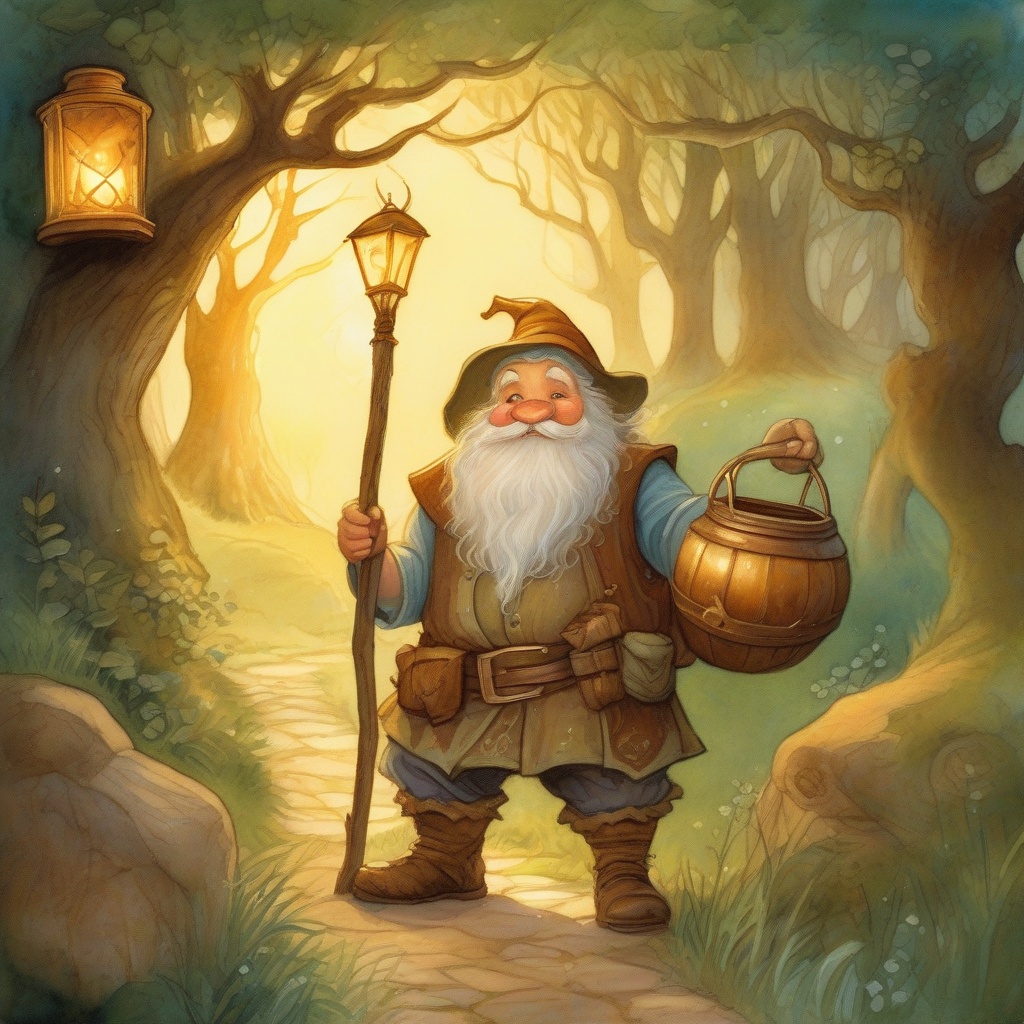
Once, a kind old woman lived in a hut. Winter was cold. Snow covered all. She felt alone. She missed her tiny friends. She planned to go to town.
She walked to town. She heard a big flood was coming. Lots of rain made the water rise. She hurried home. The water was very big. She could not cross. She stayed with kind people in the village.
The next day, the water went down. The Godmother went to her hut. Her garden was muddy. But her pets were safe. Rover barked with joy. Speckle mooed a welcome. The hens came out.
Inside, the floor was wet. By the fire, she saw a thing. A tiny boy rowed a little boat. It was a nut shell. He was very small. He looked very tired.
The Godmother lifted him with care. "Thank you, kind Godmother," he said. "I am Little Tom." She gave him milk. He ate a crumb of bread. He fell asleep.
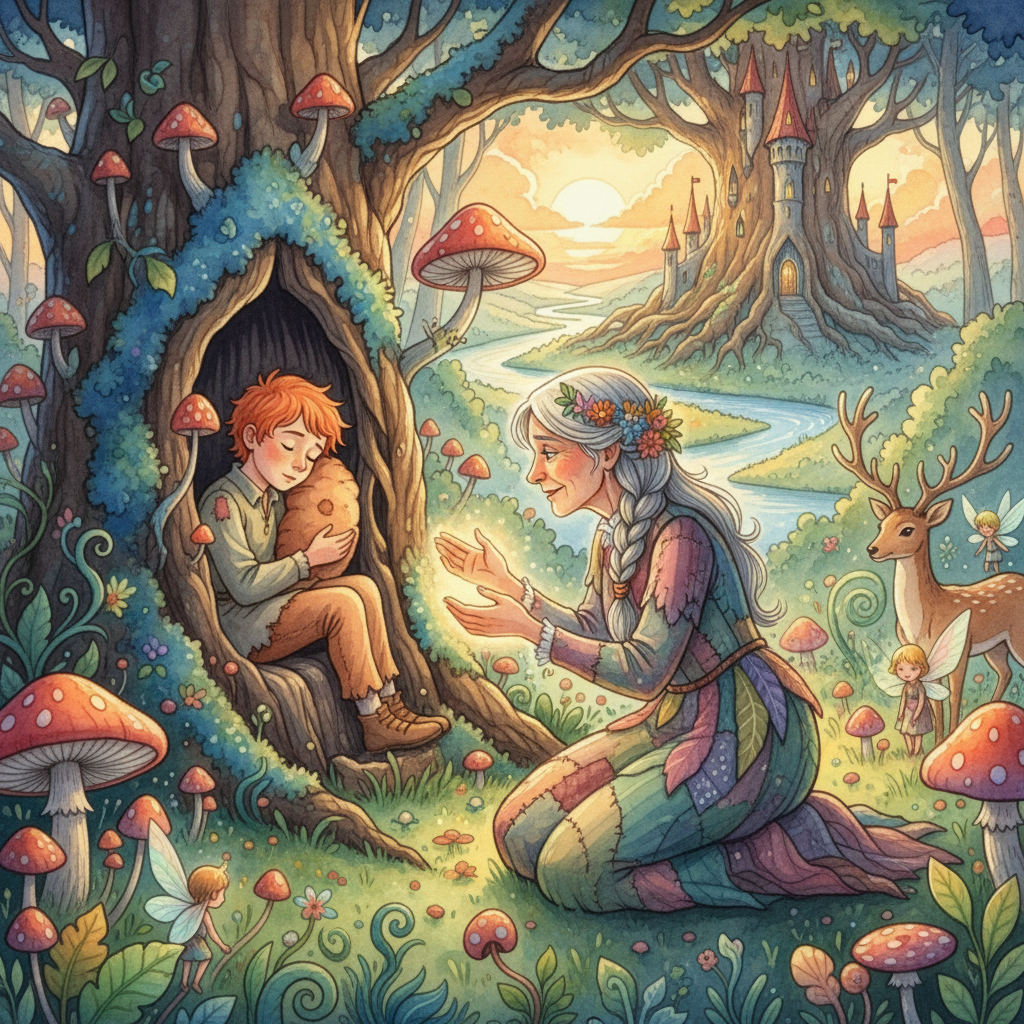
When he woke up, he was sad. "My home is gone," he cried. The Godmother soothed him. "You can stay with me," she said. She gave him a pretty egg. It was hollow inside. "This is your new home," she said.
She put the egg under a special tree. Little Tom was happy. He started to build. He made a little wall. He planned a tiny garden. He worked very hard.
The Godmother found a magic stone. It was hollow inside. It had many tiny things. Little Tom was so happy. "This is from my old home!" he said.
He took out tiny chairs. He took out tiny clothes. He took out tiny cups. He built his castle in the egg. He worked all day. The Godmother helped him with big things.
They ate as one each night. The Godmother had soup. Little Tom had a tiny seed. He told her stories. He told her about his old home. He told her about his kin. He felt a little sad sometimes.
The Godmother listened kindly. She wanted him to be happy. She thought about his future. "Even when we lose something, we can build anew. We can be kind and work hard."
Little Tom played in his egg home. He was safe. The Godmother smiled. He was loved.
Original Story
HOW LITTLE TOM WAS FOUND BY HIS GODMOTHER.
THE SPRING. THE FLOOD. HOW THE GODMOTHER FOUND LITTLE TOM IN A NUTSHELL. HOW LITTLE TOM TOOK UP HIS ABODE ON CASTLE EASTER EGG. HOW THE GODMOTHER BROUGHT LITTLE TOM HIS OUTFIT. WHAT LITTLE TOM TOLD HIS GODMOTHER ABOUT THE REALM OF GOBLINS.
---
The winter was cruelly cold. Snow covered the paths and drifted high against the little hut. With difficulty the herb woman made paths to the stable and to the brook.
In the night, when she could not sleep, she listened to every slight sound, in the hope that her little friends would appear again. But nothing ever happened; it was only the hoot of an owl outside, or the squeak of a mouse. The gnomes never came forth again from their underground realm.
So, in the day time she read and sewed, pondering how she could go to the nearest town to change her money and buy many little things for her comfort and for the improvement of the little hut. Her gold pieces she had hidden well behind a green tile on the hearth.
Finally, the snow began to melt, the sun became warmer, the fields lost their coat of white, the meadows became green, and spring had come. When Easter arrived, she had already planted her garden and stripped the roses of their winter coverings. The snow drops and gillyflowers were blossoming by the brook; the cowslips were poking their yellow caps out of their beds, and over the fields the larks sang joyously.
The herb woman placed her treasure in a covered basket, shut the hens in their coops, put fresh grass in Speckle's manger, let the dog, Rover, into the yard, locked the door of the little hut and went on her way to town. She walked lightly, as if she had grown younger during the winter and did not at all mind the long journey.
In town she was surprised at what she received for her gold; if she should live a hundred years, she could not use all her money. So it was placed in a bank for safe keeping and the people treated her with great respect. They knew that she had come from a good family, but as she had lived so modestly, no one knew how wealthy she was.
When she had made her purchases and finished her business, she wished to rest awhile in town, but word had come that the heavy rain in the mountains had caused the snow to melt and the water to rush down in torrents. She knew very well how bad the brook became when it was swollen and she worried lest the hut might be carried away and something happen to Speckle. So she hurried home and, on the way, she saw the swollen brook stretched out over the meadows like a lake.
When she reached the village, it was dark, and already the people were beginning to light up their houses. Many of the little foot bridges had been swept away, the water reached nearly to the village square and she found it impossible to cross the stream. The torrent raged and stormed, bearing along branches, small trees and cakes of ice.
In vain the old lady peered across the bank to the farther shore in the attempt to see if her little hut was still standing; but the darkness was so thick that you could cut it with a knife. There was nothing left for her to do but to ask the good villagers for shelter over night.
The next day, when the sun shone out, the torrent had subsided and the brook was running between its banks in a steady stream. The hut was still standing, but the bank was undermined and the little bridge carried away. So the widow had herself taken across in a boat and, in great anxiety, hurried to the hut to see what changes had been wrought. The garden was covered with mud and on the meadow were little pools of glistening water. Out of the yard bounded Rover barking heartily and, from her stall, Speckle mooed a welcome. The hens came hurrying out of their coop, flapping their wings and cackling, and straightway began to scratch in the ground in search of little worms. Inside the hut, the hall was wet through and in the best room stood little pools of water.
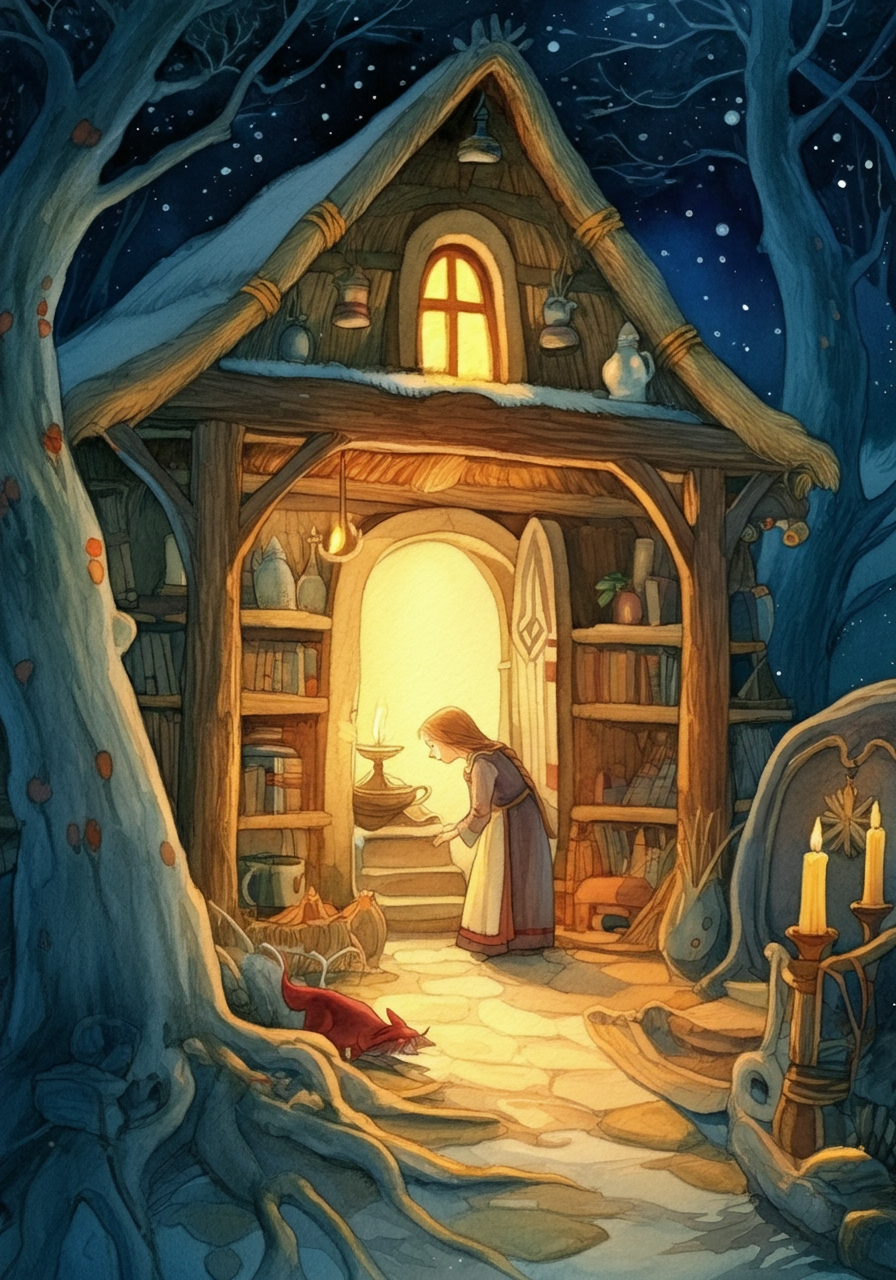
The herb woman took her broom and swept out some of the water and with a cloth mopped up the little pools. Near the hearth the water was quite deep and swirling around and running away through the hole behind. On the water swam a tiny barge formed from a hazel nut, and in this boat was a very small lad indeed, rowing with his oars of straw and working with all his might, so that the whirlpool should not carry him back into the hole.
The widow lifted up the shell very carefully and placed it on the palm of her hand. The tiny lad, letting go his oars, clasped his hands and said, »Dear Godmother, I thank you very much for saving me. I am Little Tom, but am so very tired that I can hardly sit up.« But his weariness came only from his efforts to keep himself from being swept back into the hole.
His Godmother placed the little fellow gingerly on the table and next to him she put a drop of milk and beside it a crumb of bread. Little Tom gulped the milk eagerly and ate nearly the whole crumb. When she placed near him a tiny bit of cloth for a pillow, Tom lay down and fell asleep.
She watched the little fellow tenderly as he lay there so quietly and all worn out with his hard work. He was now a fullgrown lad, finely built and with black hair. His little hands he had clasped across his breast. She felt very badly to think of his sufferings through the night in that terrible flood and she wondered what might have happened to the underground realm of the gnomes.
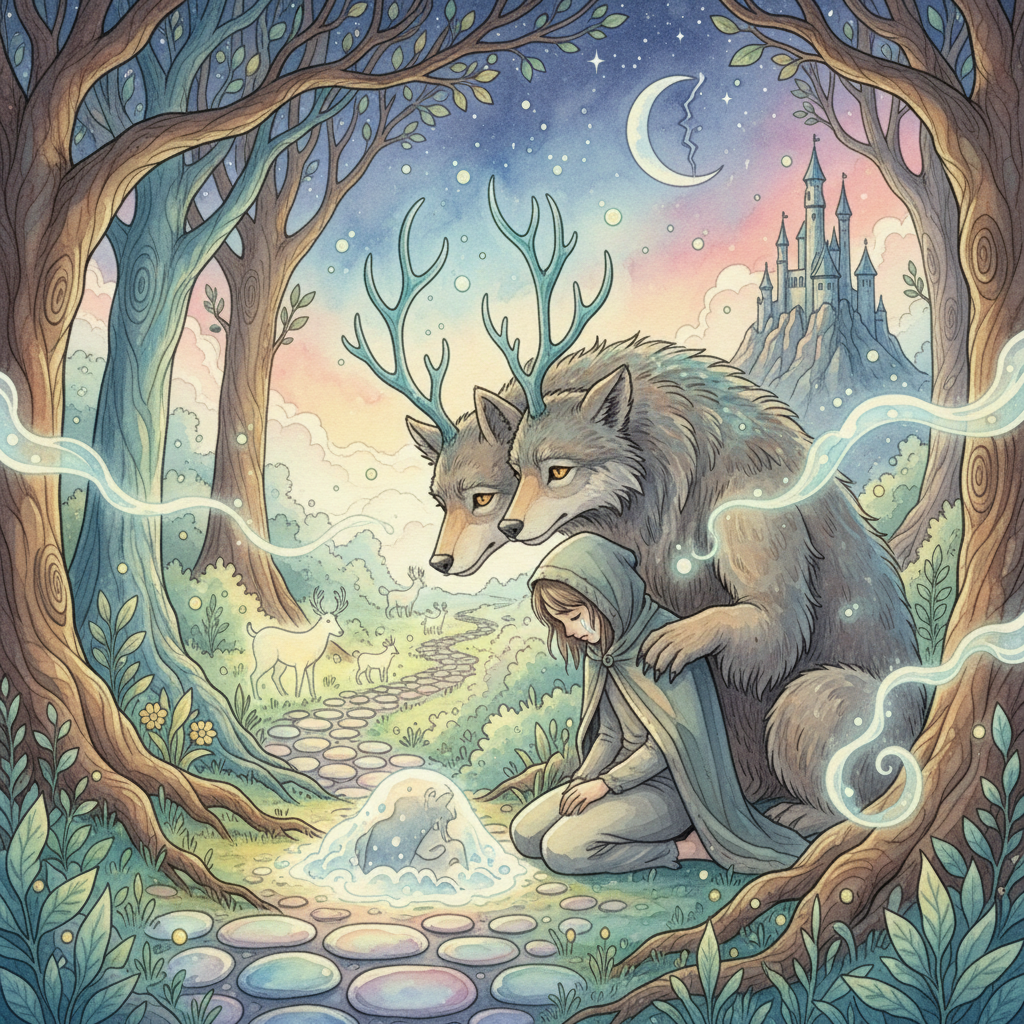
While he was sleeping, she started to work. She scrubbed the floor very clean, then sifted dry sand all over it; cleaned up the garden, and then put some soup to cook over the fire in the kitchen. When she returned to the big room, Little Tom was sitting up, rubbing his blue eyes with his little fists and calling for his mother. As he looked around, he recognized his Godmother and began to cry bitterly. The old lady tried to soothe him, begging him not to cry and to tell her all that had happened. But, for a long time, he could not be quieted. When he had cried himself out, he told her what misfortunes had come upon the underground realm.
All the gnomes were quietly sleeping, utterly unconscious of any danger, when, all of a sudden, great waters came from under the well, flooded the entire town, tore down the walls and rose to the upper floors. His mother woke Little Tom and ran with him to the upper corridor, through which was already running the stream which was their main river.
On this stream stood the great navy of the gnomes, made from walnut shells. The entire court entered the ships and started rowing to the east from the underground country; but the stream continued to rise and the over-crowded ships began to rock, until they sank one after the other and all the gnomes were lost. Little Tom knew how to swim very well but he would surely have been drowned, if he had not caught hold of a hazel-nut boat. This was taken up by a little current and swept through the hole by the hearth into the Godmother's large room.
Instantly, Little Tom knew where he was, for his parents had often told him of his christening and how kind the Godmother was to them all; so he continued to row with all his might, hoping that his Godmother would return in time to save him.
She was surprised to find him grown up, for at Christmas time, he was only a tiny baby, wrapped up in his cushions. Little Tom explained, that with the gnomes each week is counted as a year, so that he was now fifteen years old. Before that age, no prince may ever leave the underground realm, but must be studying and learning and, after that, he may only go into the outside world for experience. They were just preparing to celebrate his coming of age at his Godmother's and to send him on his journey into the world, when the great flood came and destroyed the whole kingdom. Little Tom was the only one of them to be saved, and that seemed to be through a miracle.
The Godmother did not wish to remind him of his misfortunes, so she told him that she would take good care of him and that he would find it very pleasant in her hut; but she was worried how she should find a suitable place for him to sleep, and how she should clothe him and provide the things necessary for his comfort.
She placed him on the top of the linen press and opened the altar for him; and when he saw the faces of the little figures, Tom became very cheerful, saying that the lady with the Child on her lap was very much like his mother. While Little Tom was looking at the kings, the shepherds and the manger, his Godmother found a nice, large Easter egg that was all hollow and gaily painted in red and yellow. With a pin she pricked out a door on one side, and on the other, two windows; then she set the egg firmly in the earth, under the tree and told him this would be his home and that he should carry some earth inside, and stamp it into a hard, level floor. She wanted to give him something to keep him busy, so that he would not think of the misfortunes that had befallen him.
Little Tom crawled inside and admired the great hall, beautifully arched from the finest alabaster, standing under the wonderful tree with its golden fruit. He asked his Godmother to set him in the branches, so that he might look at the golden nuts and taste of the figs and dates. He was happy to think that this magic tree from the outside world would shelter him for many, many years.
Then he climbed down the trunk, lowering himself by the little spines as if they were the rounds of a ladder. He decided to build a wall all around Castle Easter Egg and to lay out a garden under the tree.
The herb woman left him busily working and, taking her hoe, went to the well by the chapel to learn how the kingdom of the gnomes had fared. She took out the stone engraved with the horseshoe and dug behind in until she saw a little corridor, in which was a confusion of stones, mud and water. Everything was torn down and ruined and of the gnomes, she heard not a sound. She felt very sad to think they all had perished and she started to cover the hole and replace the stone. But when she took it up, she was surprised to find how light it seemed. Examining it more carefully, she noticed at the back a tiny, polished metal door. Upon pressing this with her finger, it opened and she saw that the inside of the stone was entirely hollowed out and filled with many little particles.
It occurred to her that, perhaps after all, some possessions of the gnomes remained that might prove useful to Tom; so she put the stone on her shoulder and taking care that nothing should fall out, carried it home.
When she came into the big room, she found that Tom had already made the floor inside his castle and was now engaged in building a wall around it out of shining, little pebbles. The Godmother laid a cloth on the top of the press and placed the stone on the cloth.
»Little Tom,« she said, »I have brought you something for remembrance. Your kingdom is all gone; but do not be sorry, for you will stay with me and we will live happily together. Now, perhaps you will find something in this stone that will be useful to you.«
Tom crawled sadly into the stone, but, at once, shouted with pleasure. »Dear Godmother,« he called, »this is our royal treasury and it contains furniture, clothes, linen, arms and dishes; all sorts of things. Now, I have everything I need and you will see how nicely I will arrange my new home.«
At once, he began to carry out of the stone the rich stores he found there. His Godmother placed a tiny piece of cloth by the stone and when Tom had piled it high with cupboards, tables and chairs, she raised it very carefully and placed it under the tree. In spite of all her care, it happened that she broke the leg of a chair and knocked off a corner of cupboard. She was very sorry, but Tom soothed her by saying that he would repair everything. When he began to bring out the dishes, painted porcelain left by his grandmother, cups, saucers and pitchers, old silver pieces and other treasures, he was very fearful that she might break these, too. To her, they seemed like tiny bits of glistening sand; but she made him a little wooden staircase that she set against the tree box, and up and down this he climbed, carrying his treasures to his castle. He worked so hard all day that by night he was completely tired out.
---
In the meantime, the Godmother had gone about her own work; but when, in the evening, she came back into the room she found that the stone had been cleaned out. In the door of Castle Easter Egg hung a flowered carpet for a curtain and at the windows were little shades. Inside, the furniture had all been set in order, but, outside, there still remained piles of the precious stores. She was sorry she could not see inside very well to look at Tom's housekeeping, and was afraid to touch the egg lest his castle should go to pieces.
In the morning, he was early awake and went carefully over his garden, measuring out the paths and deciding where he would have lawns, and where he would start a forest of moss. Then he made a store room for his surplus supplies, dug a well and completed the wall around the castle.
His Godmother helped him as best she could, cutting tiny pieces of wood and cloth for his use. The well they made from an old thimble. She left him busy at work, noting how diligent and orderly he was and how well he had been educated; for he seemed to understand everything that needed to be done. She was pleased that he had so much to keep him busy, that he would have no time for bitter reflections.
During the day, each went about his or her own work; but in the evening they sat together, the Godmother at the table eating her thick soup and potatoes. Upon the table Tom had his own little table and chair opposite her. For his supper, he had a baked grain of wheat, a hash of sunflower seed, or two or three grains of millet fried in butter. He always ate with delicacy. His food tasted good to him and after it was eaten, he drank some milk.
When they had cleared away the things they talked together. The Godmother wished to know how the gnomes lived in their underground kingdom and Tom told her all that he could. What they did outside in the fields, he did not know, for he had been obliged to remain at home and study in the schools; but he described very well all that happened in the underground town which had bustled with people. He had seen long lines of them bringing home food, riding on grasshoppers, making traps for flies and butterflies, bringing in the captured tree insects and the spotted bugs which were kept in roomy stalls.
For himself, he had a fine grasshopper, which carried him along the corridors lighted by torches from dried wood which gave out soft blue flames. He told how his father and mother used to play with him and about his little friend Chrysomela, a sweet little girl who had been educated with him. Together, they used to run and play and watch the gnomes digging in the mountains or go for a row on the underground river. Then he spoke of the frequent visits of foreign guests, gold beetles, and spotted wood bugs who came in stately processions and brought fine messages of greeting and beautiful presents. He told especially of a visit, just before the flood, made by many black ants whom the gnomes feasted and welcomed with great honor. His father, the king, presented them to him, telling him how diligent and orderly they were and what good friends they were to him. He promised Tom that when he should grow up he would send him to them for their teaching, so that he might learn how to rule over the kingdom.
Tom would often speak of these things he remembered, but, at the end, he would always become sad, when he thought how all his kingdom had been destroyed and everything had disappeared, and that he would never again see his loved ones.
The Godmother listened to his stories with great pleasure, but she realized that Tom must have some occupation that would keep him busy and not only prevent him from thinking too much of the past, but also prepare him for the life he was to lead in the future.
---
CHAPTER THREE.
Moral of the Story
Even after great loss, one can find a new purpose and build a fulfilling life with kindness and diligence.
Characters

The Herb Woman ★ protagonist
A woman of advanced age, but with a surprising lightness in her step, suggesting good health despite her years. Her build is likely slender from a life of modest living and physical work.
Attire: Simple, practical peasant attire suitable for a woman living in a small hut in a Central European village. Likely a long, dark linen or wool skirt, a plain blouse, and a sturdy apron. Her clothes are clean and well-maintained, but not luxurious.
Wants: To live a comfortable, peaceful life, and to care for those around her. After finding Tom, her motivation shifts to providing him with a safe home and a fulfilling life.
Flaw: Her deep empathy can lead to worry and sadness, especially when she thinks of Tom's past suffering or the loss of his kingdom.
Initially focused on her own comfort and the upkeep of her home, she transforms into a loving godmother and guardian, finding new purpose in raising Little Tom.
Kind, resourceful, diligent, thoughtful, nurturing. She is practical, planning for her future comfort, and deeply caring, as shown by her concern for her animals and later, for Little Tom.

Little Tom ★ protagonist
A very small lad, finely built, no taller than a hazelnut shell. He is described as 'fullgrown' in the context of his tiny species, but appears as a child to humans. His hands are tiny.
Attire: Initially found without specific clothes, but later receives an outfit from his Godmother, and then retrieves his own royal treasury of clothes. These would be miniature, finely made garments suitable for a gnome prince, likely in rich, natural colors and fabrics like silk or velvet, scaled down.
Wants: To rebuild a semblance of his lost home and kingdom, to find purpose, and to be cared for. He desires to learn and grow into a wise ruler.
Flaw: His deep sorrow and longing for his lost family and kingdom can overwhelm him, leading to bitter reflections.
From a lost, weary, and grieving refugee, he transforms into a diligent builder and a hopeful, albeit still melancholic, young gnome prince, finding a new home and purpose with his Godmother.
Diligent, orderly, intelligent, sensitive, resilient, and initially quite sad. He is a natural leader and builder, but also prone to melancholy when remembering his lost home.

Speckle ○ minor
A cow, likely of a common European breed, with a distinctive speckled coat.
Attire: None, as a farm animal.
Wants: To graze and be cared for.
Flaw: Vulnerable to natural disasters like floods.
Remains a constant, comforting presence.
Loyal, calm, and welcoming, as she 'mooed a welcome' to the Herb Woman.

Rover ○ minor
A dog, likely a common working or farm dog breed, with a sturdy build.
Attire: None, as a farm animal.
Wants: To protect his home and greet his owner.
Flaw: None explicitly stated.
Remains a constant, protective presence.
Loyal, protective, and enthusiastic, as he 'bounded out barking heartily'.
Locations

Herb Woman's Hut (Exterior)
A small, modest hut, likely a traditional Czech cottage, with a garden and a yard. Initially covered in deep snow during winter, then surrounded by blossoming snowdrops, gillyflowers, and cowslips in spring. After the flood, the garden is covered in mud, and the surrounding meadow has glistening pools of water. A brook runs nearby, which becomes a raging torrent during the flood.
Mood: Initially isolated and quiet, then bustling with spring life, later anxious and desolate during the flood, finally recovering and peaceful.
The herb woman lives here, prepares for her journey, and later returns to find her home affected by the flood. It's the primary setting for her daily life.

Herb Woman's Hut (Interior)
The inside of the herb woman's small, cozy hut, likely a traditional Czech cottage interior. It contains a hearth with a green tile, a hall, and a 'best room'. After the flood, the hall is wet through, and the best room has little pools of water. Near the hearth, the water is deep and swirling, with a hole where water runs away.
Mood: Initially cozy and lived-in, then chaotic and damaged by the flood, later restored to a clean, orderly, and nurturing space.
Little Tom is found here in his hazelnut boat. It becomes his new home, where he builds his miniature 'Castle Easter Egg' and shares meals and stories with his Godmother.

Castle Easter Egg (Tom's Miniature Home)
A miniature castle built by Little Tom inside a hollowed-out stone, which is placed on a cloth on top of a press (cupboard). It has a tiny, polished metal door, a floor made of shining pebbles, walls, a flowered carpet for a curtain, and little window shades. It contains miniature furniture, clothes, linen, arms, dishes, and other treasures from the gnomes' royal treasury.
Mood: Magical, industrious, a miniature world of comfort and order, reflecting Tom's diligence and longing for his lost home.
This is Tom's new home, where he meticulously recreates his lost kingdom, stores his treasures, and lives his daily life under the care of his Godmother.

Underground Realm of the Gnomes
A bustling underground town, filled with gnomes. It features corridors lit by torches with soft blue flames, an underground river, schools, and roomy stalls for captured insects. It was a vibrant kingdom with a royal treasury, now destroyed by the flood.
Mood: Magical, industrious, lively, and now tragically lost and remembered with sadness.
This is Little Tom's original home, described through his memories. It represents his lost past and the source of his identity and treasures.
Story DNA
Moral
Even after great loss, one can find a new purpose and build a fulfilling life with kindness and diligence.
Plot Summary
After a harsh winter, an old herb woman returns from town to find her hut flooded. She discovers a tiny, fully grown gnome prince named Little Tom, who recounts the tragic destruction of his underground kingdom by a great flood. The kind Godmother provides Tom with a hollow Easter egg as a new home, and later uncovers a magical stone containing the gnomes' royal treasury. Little Tom diligently uses these treasures to furnish his miniature castle, adapting to his new life with his Godmother, who encourages his industry and listens to his stories of the past, helping him find purpose despite his profound loss.
Themes
Emotional Arc
suffering to triumph
Writing Style
Narrative Elements
Cultural Context
Václav Tille was a Czech folklorist, and his stories often draw on traditional Central European folk motifs and a sense of connection to nature and the unseen world.
Plot Beats (13)
- The herb woman endures a cold winter, missing her gnome friends, and plans a trip to town.
- She travels to town, handles her finances, and hears news of a severe flood caused by melting snow.
- Rushing home, she finds the brook swollen and is forced to seek shelter overnight in the village.
- The next morning, she returns to her hut, finding it damaged by the flood, but her animals are safe.
- Inside, she discovers a tiny lad, Little Tom, rowing a hazelnut shell in a whirlpool by her hearth.
- Tom, a gnome prince, explains he was swept from his destroyed underground kingdom and is now fifteen years old due to gnome aging.
- The Godmother provides him with a hollow Easter egg as a home and places it under a magic tree in her garden.
- Tom begins to build a wall and garden around his new 'Castle Easter Egg'.
- The Godmother investigates the gnome kingdom's well and finds a hollow stone containing the gnomes' royal treasury.
- Tom joyfully retrieves furniture, clothes, and other treasures from the stone to furnish his castle.
- He diligently arranges his new home and garden, with his Godmother's help for larger tasks.
- They establish a routine, sharing meals and conversation, with Tom recounting tales of his lost gnome kingdom.
- The Godmother realizes Tom needs occupation to cope with his loss and prepare for his future.