LES ANIMAUX MALADES DE LA PESTE
by Jean de La Fontaine
Adapted Version
A big sickness came to the animal land. All the animals felt very weak and sad. They could not play. They could not eat. They were very quiet. No one smiled. It was a bad time.
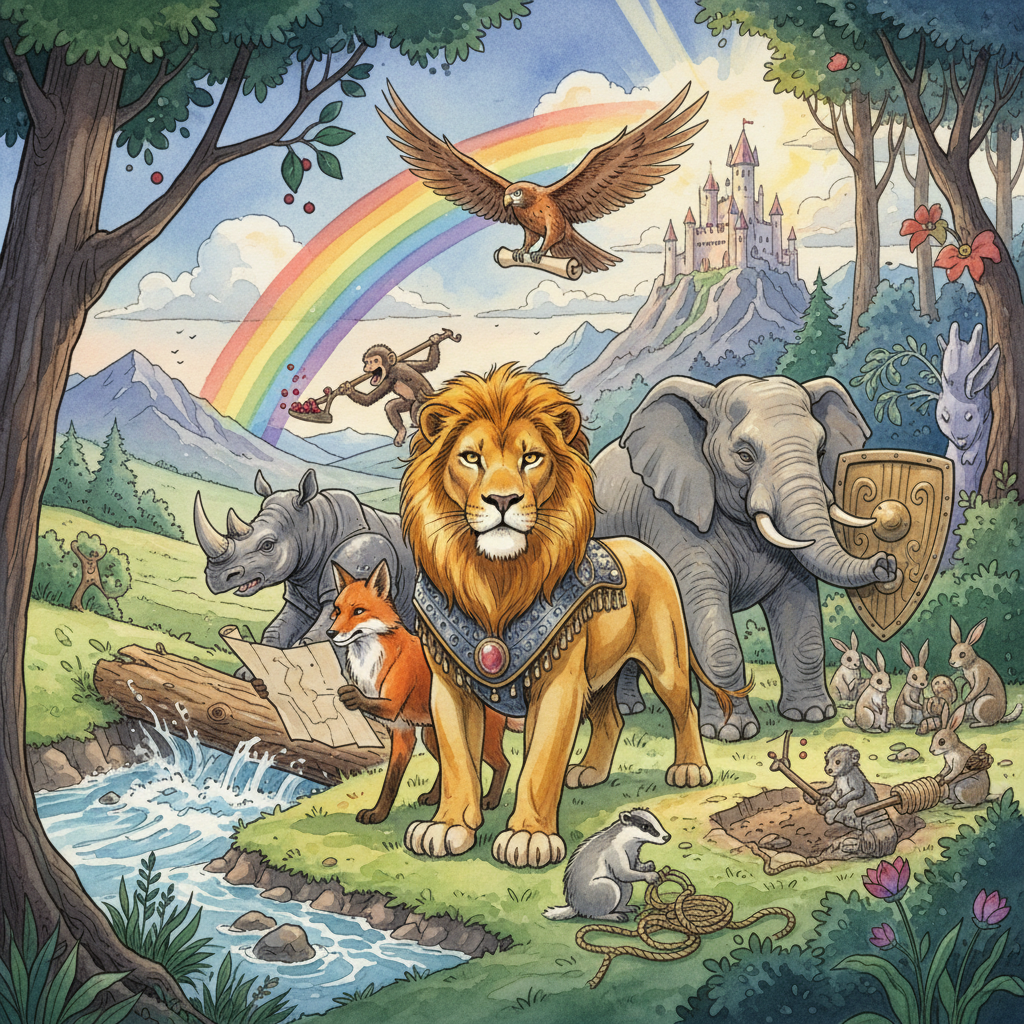
The Lion was the king. He called all the animals. He said, "We are all sick." "One must leave." "This will make the sickness go away." "We must find the worst one."
The Lion spoke first. He said, "I ate many sheep." "I ate a shepherd." "These were very bad things." "Maybe I should leave now." "I want the sickness to stop." He looked very sad.
The Fox spoke very quickly. He said, "Oh, King Lion!" "You are good!" "You are so strong!" "Eating sheep is not bad." "You did nothing wrong!" "You are a great, great king!"
Other big animals spoke. The Tiger told his story. The Bear told his story. They did bad things too. But no one blamed them. The Fox said, "You are good!" All animals agreed. They said, "You are good!"
Then the Donkey came forward. He spoke very softly. He said, "I was very hungry." "I ate green grass." "It was not my grass." "This was a bad thing."
A Wolf stood up very fast. He shouted, "Stop! Stop!" "This is very, very bad!" "This is a big, big crime!" "Eating grass not yours!" "This is why we are all sick!" "The Donkey is the real problem!"
All the animals listened. They all agreed with the Wolf. "Yes, the Donkey is bad!" "His crime is very big!" "He must leave us now!" So, the Donkey had to leave. He went away from them.
This story tells us something. Life is not always fair. Big animals do bad things. No one blames them. Small animals do small things. They get all the blame. This is not fair at all.
Original Story
LES ANIMAUX MALADES DE LA PESTE.
Un mal qui répand la terreur, Mal que le Ciel en sa fureur Inventa pour punir les crimes de la terre, La peste (puisqu’il faut l’appeler par son nom), Capable d’enrichir en un jour l’Achéron, Faisoit aux animaux la guerre. Ils ne mouroient pas tous, mais tous étoient frappés; On n’en voyoit point d’occupés A chercher le soutien d’une mourante vie; Nul mets n’excitoit leur envie; Ni loups ni renards n’épioient La douce et l’innocente proie; Les tourterelles se fuyoient: Plus d’amour, partant plus de joie. Le lion tint conseil, et dit: Mes chers amis, Je crois que le Ciel a permis Pour nos péchés cette infortune. Que le plus coupable de nous Se sacrifie aux traits du céleste courroux; Peut-être il obtiendra la guérison commune. L’histoire nous apprend qu’en de tels accidents On fait de pareils dévouements. Ne nous flattons donc point; voyons sans indulgence L’état de notre conscience. Pour moi, satisfaisant mes appétits gloutons, J’ai dévoré force moutons. Que m’avoient-ils faits? Nulle offense; Même il m’est arrivé quelquefois de manger Le berger. Je me dévouerai donc, s’il le faut; mais je pense Qu’il est bon que chacun s’accuse ainsi que moi; Car on doit souhaiter, selon toute justice, Que le plus coupable périsse. Sire, dit le renard, vous êtes trop bon roi; Vos scrupules font voir trop de délicatesse. Eh bien! manger moutons, canaille, sotte espèce, Est-ce un péché? Non, non. Vous leur fîtes, seigneur, En les croquant, beaucoup d’honneur; Et quant au berger, l’on peut dire Qu’il étoit digne de tous maux, Étant de ces gens-là qui sur les animaux Se font un chimérique empire. Ainsi dit le renard, et flatteurs d’applaudir. On n’osa trop approfondir Du tigre, ni de l’ours, ni des autres puissances, Les moins pardonnables offenses: Tous les gens querelleurs, jusqu’aux simples mâtins, Au dire de chacun, étoient de petits saints. L’âne vint à son tour, et dit: J’ai souvenance Qu’en un pré de moines passant, La faim, l’occasion, l’herbe tendre, et, je pense, Quelque diable aussi me poussant, Je tondis de ce pré la largeur de ma langue; Je n’en avois nul droit, puisqu’il faut parler net. A ces mots, on cria haro sur le baudet. Un loup, quelque peu clerc, prouva par sa harangue Qu’il falloit dévouer ce maudit animal, Ce pelé, ce galeux, d’où venoit tout leur mal. Sa peccadille fut jugée un cas pendable. Manger l’herbe d’autrui! quel crime abominable! Rien que la mort n’étoit capable D’expier son forfait. On le lui fit bien voir.
Selon que vous serez puissant ou misérable, Les jugements de cour vous rendront blanc ou noir.
II
Moral of the Story
Justice is often applied differently depending on one's social status and power, with the weak suffering for the sins of the strong.
Characters

The Lion ★ protagonist
A large, powerful African lion, with a muscular build and a commanding presence. His fur is a rich golden-brown, well-groomed despite the plague. He carries himself with the natural authority of a king.
Attire: None, as he is an animal. His natural fur and mane serve as his 'attire'.
Wants: To appease the heavens and end the plague affecting his animal kingdom, and to maintain his image as a just and benevolent ruler.
Flaw: Susceptible to flattery and biased in favor of the powerful, leading him to overlook the greater sins of his peers.
Starts by proposing a seemingly fair solution and admitting his own significant sins, but ultimately succumbs to the flattery of the Fox and allows the powerful to escape judgment, revealing the hypocrisy of the court.
Pious, self-aware, seemingly just, but ultimately influenced by flattery. He is willing to admit his own faults, at least initially, and proposes a solution for the common good.

The Fox ◆ supporting
A sleek, agile red fox, of medium build, with a bushy tail. His movements are quick and cunning.
Attire: None, as he is an animal. His natural fur serves as his 'attire'.
Wants: To protect himself and other powerful animals from judgment, and to maintain his favored position by flattering the Lion.
Flaw: His reliance on deceit and manipulation, which, while effective in this context, is morally bankrupt.
Remains consistent in his cunning and manipulative nature, successfully diverting the court's attention from the powerful to the weak.
Cunning, manipulative, sycophantic, and self-serving. He is a master of flattery and rhetoric.

The Ass ○ minor
A sturdy, somewhat scruffy grey donkey, with a humble and unassuming appearance. His fur is a dull grey, and he appears somewhat worn.
Attire: None, as he is an animal. His natural fur serves as his 'attire'.
Wants: To honestly confess his sins as requested by the Lion, believing in the fairness of the process.
Flaw: His naivety and lack of self-preservation, leading him to confess a minor sin that is then exaggerated.
Starts as an honest confessor and ends as the unjustly condemned victim, highlighting the hypocrisy of the court.
Humble, honest, naive, and ultimately a scapegoat. He genuinely admits his minor transgression.

The Wolf ⚔ antagonist
A lean, gaunt grey wolf, with a predatory build. His fur is coarse and matted, suggesting a life of hardship and cunning.
Attire: None, as he is an animal. His natural fur serves as his 'attire'.
Wants: To deflect blame from himself and other powerful predators, and to find a scapegoat for the plague.
Flaw: His inherent cruelty and lack of empathy, which makes him a tool of injustice.
Remains consistent in his role as the unjust prosecutor, successfully condemning the innocent Ass.
Cruel, opportunistic, hypocritical, and self-righteous. He is quick to condemn others while excusing his own greater sins.
Locations

The Forest Clearing Council
A somber, open clearing within a dense, ancient European forest, likely in France, where the animals gather. The ground is probably covered with fallen leaves and sparse, sickly undergrowth, reflecting the plague's impact. The air is heavy and still.
Mood: Somber, tense, fearful, hypocritical, judgmental.
The animals hold a council to determine who among them is most guilty and should be sacrificed to appease the heavens and end the plague.

Monks' Meadow
A lush, green meadow belonging to monks, implying a well-tended, fertile patch of land. It stands in stark contrast to the general desolation caused by the plague, making the donkey's 'crime' seem even more trivial.
Mood: Peaceful, fertile, but also a place of temptation for the hungry donkey.
The donkey recalls eating a small amount of grass from this meadow, an act that is later condemned as a grave sin.
Story DNA
Moral
Justice is often applied differently depending on one's social status and power, with the weak suffering for the sins of the strong.
Plot Summary
A devastating plague strikes the animal kingdom, prompting the Lion to call a council where he suggests the most sinful among them should sacrifice themselves to appease Heaven. The Lion confesses his own significant transgressions, but the cunning Fox quickly defends him, excusing his actions. Other powerful animals are similarly absolved of their greater misdeeds. However, when the humble Donkey confesses to merely nibbling grass from a monk's field, he is immediately condemned by the Wolf and the assembly as the cause of the plague and sacrificed, illustrating how justice is unfairly meted out based on power and status.
Themes
Emotional Arc
desperation to cynical realization
Writing Style
Narrative Elements
Cultural Context
La Fontaine's fables often satirized the social and political injustices of his time (17th century France), using animals to comment on human society and power structures without direct criticism.
Plot Beats (9)
- A plague descends upon the animal kingdom, causing widespread suffering and disrupting their natural behaviors.
- The Lion convenes a council, suggesting that one animal must sacrifice itself to atone for their collective sins and end the plague.
- The Lion confesses his own sins of eating sheep and a shepherd, offering himself as a sacrifice.
- The Fox quickly defends the Lion, arguing that his actions were not sins but rather honors to his prey, and that the shepherd deserved it.
- The other powerful animals are similarly excused, their grave misdeeds overlooked or downplayed by the assembly.
- The Donkey, in his turn, confesses to a minor transgression: eating a small amount of grass from a monk's field out of hunger.
- A Wolf immediately seizes upon the Donkey's confession, declaring it a heinous crime and the true cause of the plague.
- The assembly unanimously condemns the Donkey, who is then sacrificed.
- The fable concludes with the explicit moral that justice is applied differently based on one's power and status.