Aladdin and the wonderful lamp
by Andrew Lang

Aladdin and the Magic Lamp
Aladdin was a poor boy. He did not like to work. He only played all day. This made his mother sad. His father had gone. One day, a man came. He said he was Aladdin's uncle. Aladdin smiled. The man was not his real uncle. He was a wizard. The wizard was nice to Aladdin. He gave him new clothes. He showed him the city. Aladdin's mother was glad.
The next day, they went for a walk. They walked to the mountains. Aladdin was very tired. The wizard told fun stories. They came to a special place. The wizard made a fire. He put magic powder on it. The ground opened. There were steps going down. "Go down," said the wizard. "Get an old lamp for me." Aladdin was scared. The wizard gave him a ring. "Take this ring," he said. "It will help you." Aladdin went down the steps. He found a garden. The fruit was shiny. He picked some. He found the lamp. He went back to the door. The wizard was there. "Give me the lamp!" said the wizard. Aladdin said, "No. Let me out first." The wizard was angry. He closed the ground. Aladdin was stuck.
Aladdin was in the dark. He was very sad. He rubbed his hands. He rubbed the ring. A genie came out of the ring! The genie was big but kind. "I am the Ring's Slave," said the genie. "I can help you." "Please take me home!" said Aladdin. The genie did. Aladdin was home. He told his mother all. He showed her the lamp. It was dirty. His mother cleaned the lamp. One more genie came out! This genie was the Lamp Genie. He was friendly. "Ask for food," said Aladdin. The genie brought a nice meal. They were very happy. The genies could give them any wish.
Aladdin used the genies to get rich. He got a big house. He wore fine clothes. The Sultan saw him. The Sultan liked Aladdin. Aladdin met the Princess. They became good friends. They got married. Aladdin and the Princess were very happy.
But the wizard came back. He wanted the lamp. He tricked the Princess. He pretended to sell new lamps. "Trade your lamp for a new one," he said. The Princess did not know it was magic. She gave him the lamp. The wizard used the lamp. He took the palace and the Princess far away. Aladdin was very sad. He did not know where his wife was.
Aladdin used the ring genie. "Take me to the Princess!" he said. The genie took him on a magic journey. He found the Princess. She was happy to see him. They made a plan. The Princess gave the wizard a sleepy drink. He fell asleep. Aladdin took back the lamp. He used the genie. The genie brought the palace and the Princess home. The Sultan was so happy. He hugged his daughter. Aladdin told the Sultan everything. They all had fun.
But there was one more wizard. He was the first wizard's brother. He wanted to trick Aladdin. He dressed as False Fatima. He went to the palace. The Princess liked False Fatima. False Fatima had a plan. She wanted the lamp. She said, "Your hall is beautiful. It needs a special egg." The Princess told Aladdin. Aladdin asked the Lamp Genie for the egg. The genie was upset. "That is my master's egg!" he said. "False Fatima is a bad wizard. Be careful!" Aladdin was brave. He found False Fatima. He caught False Fatima. He made him go away forever. The palace was safe again.
Aladdin and the Princess lived happily. They were kind and wise. Later, Aladdin became the leader. He was a good Sultan. He remembered to be careful. Even with magic, you must think. And they lived happily ever after.
Original Story
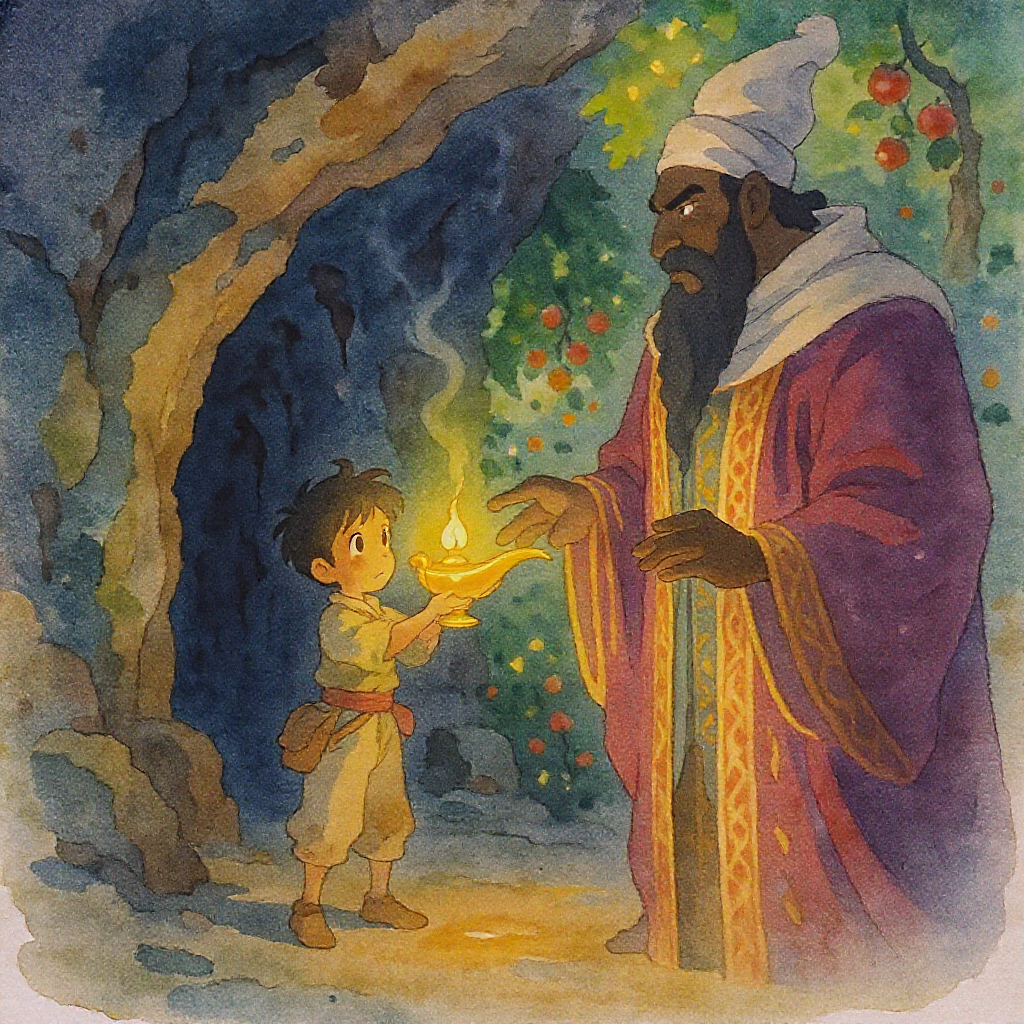
ALADDIN AND THE WONDERFUL LAMP There once lived a poor tailor, who had a son called Aladdin, a careless, idle boy who would do nothing but play ball all day long in the streets with little idle boys like himself. This so grieved the father that he died; yet, in spite of his mother’s tears and prayers, Aladdin did not mend his ways. One day, when he was playing in the streets as usual, a stranger asked him his age, and if he was not the son of Mustapha the tailor. “I am, sir,” replied Aladdin; “but he died a long while ago.” On this the stranger, who was a famous African magician, fell on his neck and kissed him, saying, “I am your uncle, and knew you from your likeness to my brother. Go to your mother and tell her I am coming.” Aladdin ran home and told his mother of his newly found uncle. “Indeed, child,” she said, “your father had a brother, but I always thought he was dead.” However, she prepared supper, and bade Aladdin seek his uncle, who came laden with wine and fruit. He presently fell down and kissed the place where Mustapha used to sit, bidding Aladdin’s mother not to be surprised at not having seen him before, as he had been forty years out of the country. He then turned to Aladdin, and asked him his trade, at which the boy hung his head, while his mother burst into tears. On learning that Aladdin was idle and would learn no trade, he offered to take a shop for him and stock it with merchandise. Next day he bought Aladdin a fine suit of clothes and took him all over the city, showing him the sights, and brought him home at nightfall to his mother, who was overjoyed to see her son so fine. The next day the magician led Aladdin into some beautiful gardens a long way outside the city gates. They sat down by a fountain and the magician pulled a cake from his girdle, which he divided between them. They then journeyed onward till they almost reached the mountains. Aladdin was so tired that he begged to go back, but the magician beguiled him with pleasant stories, and led him on in spite of himself. At last they came to two mountains divided by a narrow valley. “We will go no farther,” said the false uncle. “I will show you something wonderful; only do you gather up sticks while I kindle a fire.” When it was lit the magician threw on it a powder he had about him, at the same time saying some magical words. The earth trembled a little and opened in front of them, disclosing a square flat stone with a brass ring in the middle to raise it by. Aladdin tried to run away, but the magician caught him and gave him a blow that knocked him down. “What have I done, uncle?” he said piteously; whereupon the magician said more kindly: “Fear nothing, but obey me. Beneath this stone lies a treasure which is to be yours, and no one else may touch it, so you must do exactly as I tell you.” At the word treasure Aladdin forgot his fears, and grasped the ring as he was told, saying the names of his father and grandfather. The stone came up quite easily, and some steps appeared. “Go down,” said the magician; “at the foot of those steps you will find an open door leading into three large halls. Tuck up your gown and go through them without touching anything, or you will die instantly. These halls lead into a garden of fine fruit trees. Walk on until you come to a niche in a terrace where stands a lighted lamp. Pour out the oil it contains, and bring it to me.” He drew a ring from his finger and gave it to Aladdin, bidding him prosper. Aladdin found everything as the magician had said, gathered some fruit off the trees, and, having got the lamp, arrived at the mouth of the cave. The magician cried out in a great hurry: “Make haste and give me the lamp.” This Aladdin refused to do until he was out of the cave. The magician flew into a terrible passion, and throwing some more powder on to the fire, he said something, and the stone rolled back into its place. The magician left Persia for ever, which plainly showed that he was no uncle of Aladdin’s, but a cunning magician, who had read in his magic books of a wonderful lamp, which would make him the most powerful man in the world. Though he alone knew where to find it, he could only receive it from the hand of another. He had picked out the foolish Aladdin for this purpose, intending to get the lamp and kill him afterward. For two days Aladdin remained in the dark, crying and lamenting. At last he clasped his hands in prayer, and in so doing rubbed the ring, which the magician had forgotten to take from him. Immediately an enormous and frightful genie rose out of the earth, saying: “What wouldst thou with me? I am the Slave of the Ring, and will obey thee in all things.” Aladdin fearlessly replied: “Deliver me from this place!” whereupon the earth opened, and he found himself outside. As soon as his eyes could bear the light he went home, but fainted on the threshold. When he came to himself he told his mother what had passed, and showed her the lamp and the fruits he had gathered in the garden, which were, in reality, precious stones. He then asked for some food. “Alas! child,” she said, “I have nothing in the house, but I have spun a little cotton and will go and sell it.” Aladdin bade her keep her cotton, for he would sell the lamp instead. As it was very dirty she began to rub it, that it might fetch a higher price. Instantly a hideous genie appeared, and asked what she would have. She fainted away, but Aladdin, snatching the lamp, said boldly: “Fetch me something to eat!” The genie returned with a silver bowl, twelve silver plates containing rich meats, two silver cups, and two bottles of wine. Aladdin’s mother, when she came to herself, said: “Whence comes this splendid feast?” “Ask not, but eat,” replied Aladdin. So they sat at breakfast till it was dinner-time, and Aladdin told his mother about the lamp. She begged him to sell it, and have nothing to do with devils. “No,” said Aladdin, “since chance hath made us aware of its virtues, we will use it, and the ring likewise, which I shall always wear on my finger.” When they had eaten all the genie had brought, Aladdin sold one of the silver plates, and so on until none were left. He then had recourse to the genie, who gave him another set of plates, and thus they lived for many years. One day Aladdin heard an order from the Sultan proclaimed that everyone was to stay at home and close his shutters while the Princess, his daughter, went to and from the bath. Aladdin was seized by a desire to see her face, which was very difficult, as she always went veiled. He hid himself behind the door of the bath, and peeped through a chink. The Princess lifted her veil as she went in, and looked so beautiful that Aladdin fell in love with her at first sight. He went home so changed that his mother was frightened. He told her he loved the Princess so deeply that he could not live without her, and meant to ask her in marriage of her father. His mother, on hearing this, burst out laughing, but Aladdin at last prevailed upon her to go before the Sultan and carry his request. She fetched a napkin and laid in it the magic fruits from the enchanted garden, which sparkled and shone like the most beautiful jewels. She took these with her to please the Sultan, and set out, trusting in the lamp. The Grand Vizier and the lords of council had just gone in as she entered the hall and placed herself in front of the Sultan. He, however, took no notice of her. She went every day for a week, and stood in the same place. When the council broke up on the sixth day the Sultan said to his Vizier: “I see a certain woman in the audience-chamber every day carrying something in a napkin. Call her next time, that I may find out what she wants.” Next day, at a sign from the Vizier, she went up to the foot of the throne and remained kneeling till the Sultan said to her: “Rise, good woman, and tell me what you want.” She hesitated, so the Sultan sent away all but the Vizier, and bade her speak frankly, promising to forgive her beforehand for anything she might say. She then told him of her son’s violent love for the Princess. “I prayed him to forget her,” she said, “but in vain; he threatened to do some desperate deed if I refused to go and ask your Majesty for the hand of the Princess. Now I pray you to forgive not me alone, but my son Aladdin.” The Sultan asked her kindly what she had in the napkin, whereupon she unfolded the jewels and presented them. He was thunderstruck, and turning to the Vizier said: “What sayest thou? Ought I not to bestow the Princess on one who values her at such a price?” The Vizier, who wanted her for his own son, begged the Sultan to withhold her for three months, in the course of which he hoped his son would contrive to make him a richer present. The Sultan granted this, and told Aladdin’s mother that, though he consented to the marriage, she must not appear before him again for three months. Aladdin waited patiently for nearly three months, but after two had elapsed his mother, going into the city to buy oil, found every one rejoicing, and asked what was going on. “Do you not know,” was the answer, “that the son of the Grand Vizier is to marry the Sultan’s daughter to-night?” Breathless, she ran and told Aladdin, who was overwhelmed at first, but presently bethought him of the lamp. He rubbed it, and the genie appeared, saying, “What is thy will?” Aladdin replied: “The Sultan, as thou knowest, has broken his promise to me, and the Vizier’s son is to have the Princess. My command is that to-night you bring hither the bride and bridegroom.” “Master, I obey,” said the genie. Aladdin then went to his chamber, where, sure enough, at midnight the genie transported the bed containing the Vizier’s son and the Princess. “Take this new-married man,” he said, “and put him outside in the cold, and return at daybreak.” Whereupon the genie took the Vizier’s son out of bed, leaving Aladdin with the Princess. “Fear nothing,” Aladdin said to her; “you are my wife, promised to me by your unjust father, and no harm shall come to you.” The Princess was too frightened to speak, and passed the most miserable night of her life, while Aladdin lay down beside her and slept soundly. At the appointed hour the genie fetched in the shivering bridegroom, laid him in his place, and transported the bed back to the palace. Presently the Sultan came to wish his daughter good-morning. The unhappy Vizier’s son jumped up and hid himself, while the Princess would not say a word, and was very sorrowful. The Sultan sent her mother to her, who said: “How comes it, child, that you will not speak to your father? What has happened?” The Princess sighed deeply, and at last told her mother how, during the night, the bed had been carried into some strange house, and what had passed there. Her mother did not believe her in the least, but bade her rise and consider it an idle dream. The following night exactly the same thing happened, and next morning, on the Princess’s refusal to speak, the Sultan threatened to cut off her head. She then confessed all, bidding him to ask the Vizier’s son if it were not so. The Sultan told the Vizier to ask his son, who owned the truth, adding that, dearly as he loved the Princess, he had rather die than go through another such fearful night, and wished to be separated from her. His wish was granted, and there was an end to feasting and rejoicing. When the three months were over, Aladdin sent his mother to remind the Sultan of his promise. She stood in the same place as before, and the Sultan, who had forgotten Aladdin, at once remembered him, and sent for her. On seeing her poverty the Sultan felt less inclined than ever to keep his word, and asked his Vizier’s advice, who counselled him to set so high a value on the Princess that no man living could come up to it. The Sultan then turned to Aladdin’s mother, saying: “Good woman, a Sultan must remember his promises, and I will remember mine, but your son must first send me forty basins of gold brimful of jewels, carried by forty black slaves, led by as many white ones, splendidly dressed. Tell him that I await his answer.” The mother of Aladdin bowed low and went home, thinking all was lost. She gave Aladdin the message, adding: “He may wait long enough for your answer!” “Not so long, mother, as you think,” her son replied. “I would do a great deal more than that for the Princess.” He summoned the genie, and in a few moments the eighty slaves arrived, and filled up the small house and garden. Aladdin made them set out to the palace, two and two, followed by his mother. They were so richly dressed, with such splendid jewels in their girdles, that everyone crowded to see them and the basins of gold they carried on their heads. They entered the palace, and, after kneeling before the Sultan, stood in a half-circle round the throne with their arms crossed, while Aladdin’s mother presented them to the Sultan. He hesitated no longer, but said: “Good woman, return and tell your son that I wait for him with open arms.” She lost no time in telling Aladdin, bidding him make haste. But Aladdin first called the genie. “I want a scented bath,” he said, “a richly embroidered habit, a horse surpassing the Sultan’s, and twenty slaves to attend me. Besides this, six slaves, beautifully dressed, to wait on my mother; and lastly, ten thousand pieces of gold in ten purses.” No sooner said than done. Aladdin mounted his horse and passed through the streets, the slaves strewing gold as they went. Those who had played with him in his childhood knew him not, he had grown so handsome. When the Sultan saw him he came down from his throne, embraced him, and led him into a hall where a feast was spread, intending to marry him to the Princess that very day. But Aladdin refused, saying, “I must build a palace fit for her,” and took his leave. Once home, he said to the genie: “Build me a palace of the finest marble, set with jasper, agate, and other precious stones. In the middle you shall build me a large hall with a dome, its four walls of massy gold and silver, each having six windows, whose lattices, all except one which is to be left unfinished, must be set with diamonds and rubies. There must be stables and horses and grooms and slaves; go and see about it!” The palace was finished by the next day, and the genie carried him there and showed him all his orders faithfully carried out, even to the laying of a velvet carpet from Aladdin’s palace to the Sultan’s. Aladdin’s mother then dressed herself carefully, and walked to the palace with her slaves, while he followed her on horseback. The Sultan sent musicians with trumpets and cymbals to meet them, so that the air resounded with music and cheers. She was taken to the Princess, who saluted her and treated her with great honor. At night the Princess said good-by to her father, and set out on the carpet for Aladdin’s palace, with his mother at her side, and followed by the hundred slaves. She was charmed at the sight of Aladdin, who ran to receive her. “Princess,” he said, “blame your beauty for my boldness if I have displeased you.” She told him that, having seen him, she willingly obeyed her father in this matter. After the wedding had taken place Aladdin led her into the hall, where a feast was spread, and she supped with him, after which they danced till midnight. Next day Aladdin invited the Sultan to see the palace. On entering the hall with the four-and-twenty windows, with their rubies, diamonds, and emeralds, he cried: “It is a world’s wonder! There is only one thing that surprises me. Was it by accident that one window was left unfinished?” “No, sir, by design,” returned Aladdin. “I wished your Majesty to have the glory of finishing this palace.” The Sultan was pleased, and sent for the best jewelers in the city. He showed them the unfinished window, and bade them fit it up like the others. “Sir,” replied their spokesman, “we cannot find jewels enough.” The Sultan had his own fetched, which they soon used, but to no purpose, for in a month’s time the work was not half done. Aladdin, knowing that their task was vain, bade them undo their work and carry the jewels back, and the genie finished the window at his command. The Sultan was surprised to receive his jewels again, and visited Aladdin, who showed him the window finished. The Sultan embraced him, the envious Vizier meanwhile hinting that it was the work of enchantment. Aladdin had won the hearts of the people by his gentle bearing. He was made captain of the Sultan’s armies, and won several battles for him, but remained modest and courteous as before, and lived thus in peace and content for several years. But far away in Africa the magician remembered Aladdin, and by his magic arts discovered that Aladdin, instead of perishing miserably in the cave, had escaped, and had married a princess, with whom he was living in great honor and wealth. He knew that the poor tailor’s son could only have accomplished this by means of the lamp, and traveled night and day until he reached the capital of China, bent on Aladdin’s ruin. As he passed through the town he heard people talking everywhere about a marvellous palace. “Forgive my ignorance,” he asked, “what is this palace you speak Of?” “Have you not heard of Prince Aladdin’s palace,” was the reply, “the greatest wonder of the world? I will direct you if you have a mind to see it.” The magician thanked him who spoke, and having seen the palace, knew that it had been raised by the Genie of the Lamp, and became half mad with rage. He determined to get hold of the lamp, and again plunge Aladdin into the deepest poverty. Unluckily, Aladdin had gone a-hunting for eight days, which gave the magician plenty of time. He bought a dozen copper lamps, put them into a basket, and went to the palace, crying: “New lamps for old!” followed by a jeering crowd. The Princess, sitting in the hall of four-and-twenty windows, sent a slave to find out what the noise was about, who came back laughing, so that the Princess scolded her. “Madam,” replied the slave, “who can help laughing to see an old fool offering to exchange fine new lamps for old ones?” Another slave, hearing this, said: “There is an old one on the cornice there which he can have.” Now this was the magic lamp, which Aladdin had left there, as he could not take it out hunting with him. The Princess, not knowing its value, laughingly bade the slave take it and make the exchange. She went and said to the magician: “Give me a new lamp for this.” He snatched it and bade the slave take her choice, amid the jeers of the crowd. Little he cared, but left off crying his lamps, and went out of the city gates to a lonely place, where he remained till nightfall, when he pulled out the lamp and rubbed it. The genie appeared, and at the magician’s command carried him, together with the palace and the Princess in it, to a lonely place in Africa. Next morning the Sultan looked out of the window toward Aladdin’s palace and rubbed his eyes, for it was gone. He sent for the Vizier and asked what had become of the palace. The Vizier looked out too, and was lost in astonishment. He again put it down to enchantment, and this time the Sultan believed him, and sent thirty men on horseback to fetch Aladdin in chains. They met him riding home, bound him, and forced him to go with them on foot. The people, however, who loved him, followed, armed, to see that he came to no harm. He was carried before the Sultan, who ordered the executioner to cut off his head. The executioner made Aladdin kneel down, bandaged his eyes, and raised his scimitar to strike. At that instant the Vizier, who saw that the crowd had forced their way into the courtyard and were scaling the walls to rescue Aladdin, called to the executioner to stay his hand. The people, indeed, looked so threatening that the Sultan gave way and ordered Aladdin to be unbound, and pardoned him in the sight of the crowd. Aladdin now begged to know what he had done. “False wretch!” said the Sultan, “come thither,” and showed him from the window the place where his palace had stood. Aladdin was so amazed that he could not say a word. “Where is my palace and my daughter?” demanded the Sultan. “For the first I am not so deeply concerned, but my daughter I must have, and you must find her or lose your head.” Aladdin begged for forty days in which to find her, promising, if he failed, to return and suffer death at the Sultan’s pleasure. His prayer was granted, and he went forth sadly from the Sultan’s presence. For three days he wandered about like a madman, asking everyone what had become of his palace, but they only laughed and pitied him. He came to the banks of a river, and knelt down to say his prayers before throwing himself in. In so doing he rubbed the magic ring he still wore. The genie he had seen in the cave appeared, and asked his will. “Save my life, genie,” said Aladdin, “bring my palace back.” “That is not in my power,” said the genie; “I am only the Slave of the Ring; you must ask him of the lamp.” “Even so,” said Aladdin, “but thou canst take me to the palace, and set me down under my dear wife’s window.” He at once found himself in Africa, under the window of the Princess, and fell asleep out of sheer weariness. He was awakened by the singing of the birds, and his heart was lighter. He saw plainly that all his misfortunes were owing to the loss of the lamp, and vainly wondered who had robbed him of it. That morning the Princess rose earlier than she had done since she had been carried into Africa by the magician, whose company she was forced to endure once a day. She, however, treated him so harshly that he dared not live there altogether. As she was dressing, one of her women looked out and saw Aladdin. The Princess ran and opened the window, and at the noise she made Aladdin looked up. She called to him to come to her, and great was the joy of these lovers at seeing each other again. After he had kissed her Aladdin said: “I beg of you, Princess, in God’s name, before we speak of anything else, for your own sake and mine, tell me that has become of an old lamp I left on the cornice in the hall of four-and-twenty windows, when I went a-hunting.” “Alas!” she said, “I am the innocent cause of our sorrows,” and told him of the exchange of the lamp. “Now I know,” cried Aladdin, “that we have to thank the African magician for this! Where is the lamp?” “He carries it about with him,” said the Princess. “I know, for he pulled it out of his breast to show me. He wishes me to break my faith with you and marry him, saying that you were beheaded by my father’s command. He is for ever speaking ill of you but I only reply by my tears. If I persist, I doubt not but he will use violence.” Aladdin comforted her, and left her for a while. He changed clothes with the first person he met in the town, and having bought a certain powder, returned to the Princess, who let him in by a little side door. “Put on your most beautiful dress,” he said to her “and receive the magician with smiles, leading him to believe that you have forgotten me. Invite him to sup with you, and say you wish to taste the wine of his country. He will go for some and while he is gone I will tell you what to do.” She listened carefully to Aladdin and when he left she arrayed herself gaily for the first time since she left China. She put on a girdle and head-dress of diamonds, and, seeing in a glass that she was more beautiful than ever, received the magician, saying, to his great amazement: “I have made up my mind that Aladdin is dead, and that all my tears will not bring him back to me, so I am resolved to mourn no more, and have therefore invited you to sup with me; but I am tired of the wines of China, and would fain taste those of Africa.” The magician flew to his cellar, and the Princess put the powder Aladdin had given her in her cup. When he returned she asked him to drink her health in the wine of Africa, handing him her cup in exchange for his, as a sign she was reconciled to him. Before drinking the magician made her a speech in praise of her beauty, but the Princess cut him short, saying: “Let us drink first, and you shall say what you will afterward.” She set her cup to her lips and kept it there, while the magician drained his to the dregs and fell back lifeless. The Princess then opened the door to Aladdin, and flung her arms round his neck; but Aladdin put her away, bidding her leave him, as he had more to do. He then went to the dead magician, took the lamp out of his vest, and bade the genie carry the palace and all in it back to China. This was done, and the Princess in her chamber only felt two little shocks, and little thought she was at home again. The Sultan, who was sitting in his closet, mourning for his lost daughter, happened to look up, and rubbed his eyes, for there stood the palace as before! He hastened thither, and Aladdin received him in the hall of the four-and-twenty windows, with the Princess at his side. Aladdin told him what had happened, and showed him the dead body of the magician, that he might believe. A ten days’ feast was proclaimed, and it seemed as if Aladdin might now live the rest of his life in peace; but it was not to be. The African magician had a younger brother, who was, if possible, more wicked and more cunning than himself. He traveled to China to avenge his brother’s death, and went to visit a pious woman called Fatima, thinking she might be of use to him. He entered her cell and clapped a dagger to her breast, telling her to rise and do his bidding on pain of death. He changed clothes with her, colored his face like hers, put on her veil, and murdered her, that she might tell no tales. Then he went toward the palace of Aladdin, and all the people, thinking he was the holy woman, gathered round him, kissing his hands and begging his blessing. When he got to the palace there was such a noise going on round him that the Princess bade her slave look out of the window and ask what was the matter. The slave said it was the holy woman, curing people by her touch of their ailments, whereupon the Princess, who had long desired to see Fatima, sent for her. On coming to the Princess the magician offered up a prayer for her health and prosperity. When he had done the Princess made him sit by her, and begged him to stay with her always. The false Fatima, who wished for nothing better, consented, but kept his veil down for fear of discovery. The Princess showed him the hall, and asked him what he thought of it. “It is truly beautiful,” said the false Fatima. “In my mind it wants but one thing.” “And what is that?” said the Princess. “If only a roc’s egg,” replied he, “were hung up from the middle of this dome, it would be the wonder of the world.” After this the Princess could think of nothing but the roc’s egg, and when Aladdin returned from hunting he found her in a very ill humor. He begged to know what was amiss, and she told him that all her pleasure in the hall was spoiled for the want of a roc’s egg hanging from the dome. “If that is all,” replied Aladdin, “you shall soon be happy.” He left her and rubbed the lamp, and when the genie appeared commanded him to bring a roc’s egg. The genie gave such a loud and terrible shriek that the hall shook. “Wretch!” he cried, “is it not enough that I have done everything for you, but you must command me to bring my master and hang him up in the midst of this dome? You and your wife and your palace deserve to be burnt to ashes, but that this request does not come from you, but from the brother of the African magician, whom you destroyed. He is now in your palace disguised as the holy woman--whom he murdered. He it was who put that wish into your wife’s head. Take care of yourself, for he means to kill you.” So saying, the genie disappeared. Aladdin went back to the Princess, saying his head ached, and requesting that the holy Fatima should be fetched to lay her hands on it. But when the magician came near, Aladdin, seizing his dagger, pierced him to the heart. “What have you done?” cried the Princess. “You have killed the holy woman!” “Not so,” replied Aladdin, “but a wicked magician,” and told her of how she had been deceived. After this Aladdin and his wife lived in peace. He succeeded the Sultan when he died, and reigned for many years, leaving behind him a long line of kings.(1) (1) Arabian Nights.
Moral of the Story
Even with immense power, wisdom and caution are necessary to overcome cunning adversaries and maintain happiness.
Characters

Aladdin ★ protagonist
Poorly dressed at the beginning, later wears fine clothes.
Attire: Initially ragged clothes, later a fine suit of clothes, then changes clothes with a random person.
Initially idle and easily led, later brave, resourceful, and obedient (to the genies).

Aladdin's Mother ◆ supporting
Poor, hardworking.
Attire: Simple, worn clothing appropriate for a poor widow.
Loving, worried, initially skeptical but supportive.

African Magician ⚔ antagonist
Presents himself as Aladdin's uncle.
Attire: Fine clothes suitable for someone pretending to be a wealthy relative.
Deceitful, power-hungry, cruel.

Slave of the Ring ◆ supporting
Enormous and frightful.
Obedient, powerful, bound to the ring's owner.

Genie of the Lamp ◆ supporting
Hideous.
Obedient, powerful, bound to the lamp's owner.

Princess ◆ supporting
Beautiful.
Attire: Rich gowns, girdle and head-dress of diamonds.
Initially passive, then becomes clever and resourceful.

Sultan ○ minor
Not described.
Attire: Royal robes.
Initially quick to anger, later grateful and forgiving.

False Fatima ⚔ antagonist
The second magician disguised as an old, pious woman.
Attire: The clothes of a pious woman, including a veil.
Wicked, cunning, vengeful.
Locations

Aladdin's humble home
A poor tailor's house, implying simple furnishings and a sense of poverty.
Mood: Initially sorrowful due to the father's death, later hopeful and then wondrous as Aladdin discovers the lamp's power.
Aladdin and his mother discover the power of the lamp and the genie for the first time.

The valley of the hidden entrance
A narrow valley between two mountains, with a fire burning near a square stone with a brass ring.
Mood: Eerie and suspenseful, filled with the magician's dark magic.
The magician reveals the hidden entrance to the underground treasure and attempts to trick Aladdin.

Underground halls and garden
Three large halls leading to a garden of fine fruit trees, with a niche in a terrace containing a lighted lamp.
Mood: Mysterious and magical, with a sense of hidden danger and untold riches.
Aladdin retrieves the lamp, unaware of its true power, and becomes trapped.

The palace in China
A magnificent palace with a hall of four-and-twenty windows, richly decorated and filled with treasures.
Mood: Luxurious and regal, but also threatened by the magician's schemes.
The Princess is almost tricked by the magician, but Aladdin saves her and the palace is transported back to China.
Story DNA
Moral
Even with immense power, wisdom and caution are necessary to overcome cunning adversaries and maintain happiness.
Plot Summary
Aladdin, a lazy youth, is tricked by a sorcerer into retrieving a magic lamp from a cave, but is then abandoned. He discovers the lamp and a magic ring each house a genie, granting him immense wealth and allowing him to marry the Sultan's daughter. The sorcerer returns, steals the lamp, and transports the palace and Princess to Africa. Aladdin, using the ring's genie, travels to Africa, reunites with the Princess, and together they defeat the sorcerer. Later, the sorcerer's brother attempts revenge by disguising himself, but Aladdin is warned by the lamp's genie and kills him, securing his happy future as a prince and eventual Sultan.
Themes
Emotional Arc
suffering to triumph
Writing Style
Narrative Elements
Cultural Context
Though often associated with 'One Thousand and One Nights,' Aladdin was added to the collection by Antoine Galland in the 18th century, possibly based on a Syrian storyteller's tale, and its setting is ambiguously 'China' but with clear Middle Eastern cultural elements.
Plot Beats (14)
- Aladdin, a lazy boy, is approached by a magician posing as his uncle.
- The magician takes Aladdin to a magical cave and tricks him into retrieving an old lamp, then abandons him.
- Trapped, Aladdin discovers a magic ring and then the lamp, summoning two genies who grant wishes.
- Aladdin uses the lamp's power to gain wealth, impress the Sultan, and marry the Princess.
- The African magician returns, tricks the Princess into trading the lamp, and transports the palace and Princess to Africa.
- Aladdin, using the ring's genie, is transported to Africa to reunite with the Princess.
- Aladdin and the Princess devise a plan to drug the magician; the Princess executes it, and Aladdin kills the magician.
- Aladdin reclaims the lamp, and the palace and Princess are returned to their original location.
- The Sultan is overjoyed, and Aladdin explains the events.
- The African magician's more wicked brother seeks revenge, disguising himself as a holy woman.
- The disguised magician infiltrates the palace and suggests the Princess ask Aladdin for a roc's egg to complete the hall.
- Aladdin asks the lamp's genie for the roc's egg, but the genie reveals the magician's brother's plot and identity.
- Aladdin confronts and kills the disguised magician, saving himself and his family.
- Aladdin and the Princess live happily, and Aladdin eventually succeeds the Sultan.


