Hansel and Grettel
by Andrew Lang

Hansel and Grettel
Once, there were two children, Hansel and Grettel. They lived with father near a big forest. They had no food. The father was very sad. "We have nothing to eat," he said. The stepmother said, "Leave them in the forest. They can find help." The father said no. But the stepmother said it again. The father was very sad. He said yes.
Hansel heard them. He could not sleep. He went outside. The moon was bright. He saw white stones. He put many stones in his pocket. "Do not worry," he told Grettel. "I have a plan."
In the morning, the stepmother woke them. "Come," she said. "To the forest," she said, giving bread. They walked into the forest. Hansel dropped white stones on the path. He looked back at the house. "What do you see?" asked the father. "I see my white cat," said Hansel. "That is the sun," said the stepmother.
They made a fire. "Sit here," said the stepmother. They said, "We will get food," and left. Hansel and Grettel sat by the fire. They ate their bread. They fell asleep. It was dark when they woke up. Grettel was scared. "How do we go home?" she cried. "Wait for the moon," said Hansel.
The moon came up. The white stones shone. Hansel took Grettel's hand. They followed the stones. They walked all night. In the morning, they were home. The father was so happy. He hugged them. The stepmother was not happy. "You were gone a long time," she said.
Soon, there was no food again. The stepmother said to leave the children deeper. The father was sad. But he said yes again. Hansel wanted to get stones. But the door was locked. In the morning, he got bread. He dropped pieces of bread on the path.
They walked deep into the forest. The father made a fire. "Rest here," he said. Then the father and stepmother went away. Hansel and Grettel slept. When they woke up, it was dark. They could not find the bread. Birds had eaten it. They were lost. They walked for a long time. They were very hungry.
They saw a little house. The house was made of bread. It had a cake roof. The windows were sugar. "We can eat!" said Grettel. They ate a piece of the house. An old woman asked, "Who eats my house?" "Come in," she said. "You can have food and a bed."
The woman was not kind. She wanted to keep them. She gave Hansel lots of food. "Eat and get strong," she said. She locked Hansel in a room. "You must work for me," she told Grettel. Grettel had to clean and cook.
The woman checked on Hansel. "Are you strong yet?" she asked. Hansel held out a thin bone. "I am not strong," he said. The woman could not see well. She thought the bone was his finger.
The woman got angry. "I will use the big oven," she said. She told Grettel, "Make the oven hot. We will bake bread." Grettel was scared. "How to get in the oven?" she asked. She put her head in. Grettel pushed her. The woman fell in. Grettel closed the oven door. The woman was trapped. She cried, but she could not get out.
Grettel ran to Hansel. She opened the door. "We are free!" she said. They looked in the house. They found many shiny gold coins. They filled their pockets. They filled Grettel's apron. They ran away from the house.
They walked a long time. They came to a big lake. A white duck swam there. "We need help," said Grettel. The duck came to them. Hansel sat on the duck's back. The duck swam across. Then the duck swam back. Grettel sat on the duck's back. The duck swam across. "Thank you," they said.
They knew the forest now. They saw their house. They ran to the door. They ran inside. The father was there. He was so happy to see them. "I am sorry," he said. The stepmother was not there. She had gone away.
Grettel opened her apron. Gold coins fell out. Hansel took coins from his pockets. "Look what we have!" he said. The father smiled. "You were very brave and clever," he said. "Now we are happy." They had food. They had a warm house. They were together. And they lived happily ever after.
Original Story
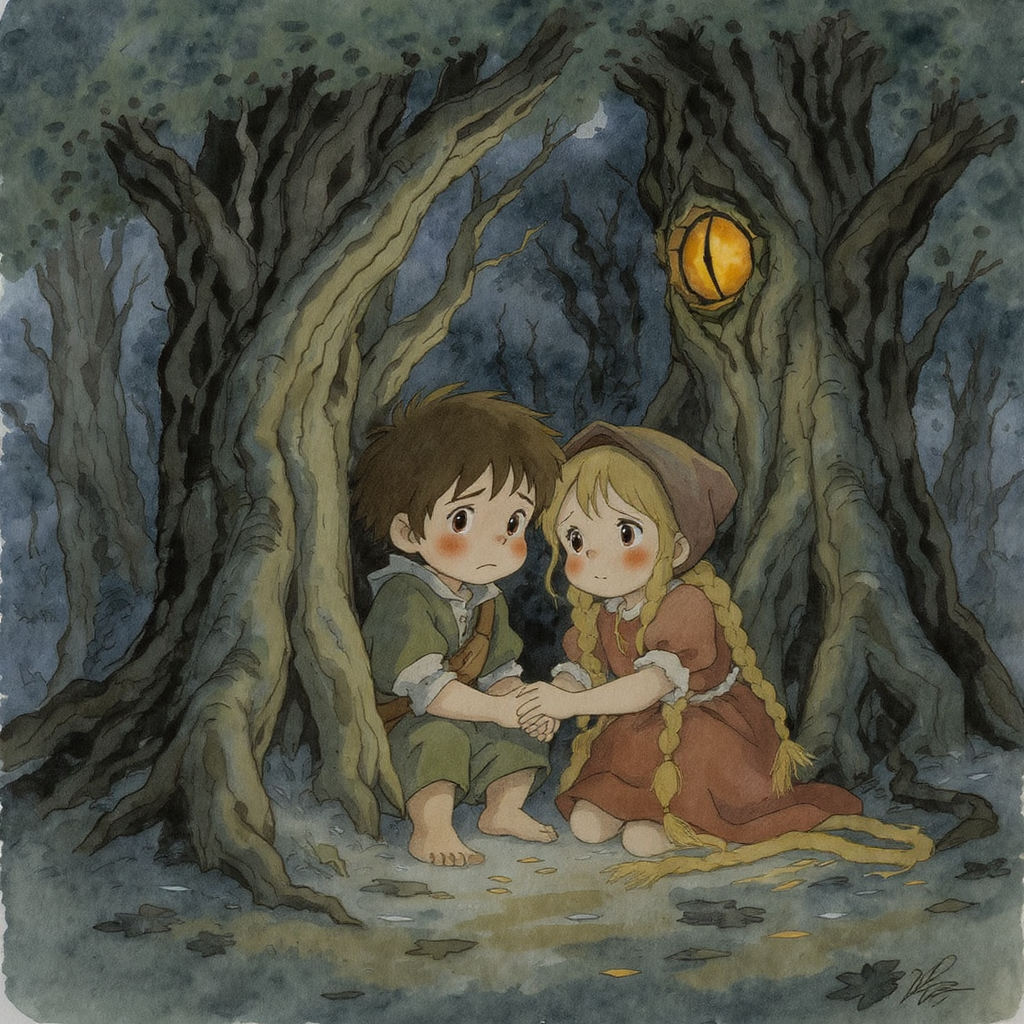
HANSEL AND GRETTEL Once upon a time there dwelt on the outskirts of a large forest a poor woodcutter with his wife and two children; the boy was called Hansel and the girl Grettel. He had always little enough to live on, and once, when there was a great famine in the land, he couldn’t even provide them with daily bread. One night, as he was tossing about in bed, full of cares and worry, he sighed and said to his wife: “What’s to become of us? how are we to support our poor children, now that we have nothing more for ourselves?” “I’ll tell you what, husband,” answered the woman; “early to-morrow morning we’ll take the children out into the thickest part of the wood; there we shall light a fire for them and give them each a piece of bread; then we’ll go on to our work and leave them alone. They won’t be able to find their way home, and we shall thus be rid of them.” “No, wife,” said her husband, “that I won’t do; how could I find it in my heart to leave my children alone in the wood? The wild beasts would soon come and tear them to pieces.” “Oh! you fool,” said she, “then we must all four die of hunger, and you may just as well go and plane the boards for our coffins”; and she left him no peace till he consented. “But I can’t help feeling sorry for the poor children,” added the husband. The children, too, had not been able to sleep for hunger, and had heard what their step-mother had said to their father. Grettel wept bitterly and spoke to Hansel: “Now it’s all up with us.” “No, no, Grettel,” said Hansel, “don’t fret yourself; I’ll be able to find a way to escape, no fear.” And when the old people had fallen asleep he got up, slipped on his little coat, opened the back door and stole out. The moon was shining clearly, and the white pebbles which lay in front of the house glittered like bits of silver. Hansel bent down and filled his pocket with as many of them as he could cram in. Then he went back and said to Grettel: “Be comforted, my dear little sister, and go to sleep: God will not desert us”; and he lay down in bed again. At daybreak, even before the sun was up, the woman came and woke the two children: “Get up, you lie-abeds, we’re all going to the forest to fetch wood.” She gave them each a bit of bread and said: “There’s something for your luncheon, but don’t you eat it up before, for it’s all you’ll get.” Grettel took the bread under her apron, as Hansel had the stones in his pocket. Then they all set out together on the way to the forest. After they had walked for a little, Hansel stood still and looked back at the house, and this maneuver he repeated again and again. His father observed him, and said: “Hansel, what are you gazing at there, and why do you always remain behind? Take care, and don’t lose your footing.” “Oh! father,” said Hansel, “I am looking back at my white kitten, which is sitting on the roof, waving me a farewell.” The woman exclaimed: “What a donkey you are! that isn’t your kitten, that’s the morning sun shining on the chimney.” But Hansel had not looked back at his kitten, but had always dropped one of the white pebbles out of his pocket on to the path. When they had reached the middle of the forest the father said: “Now, children, go and fetch a lot of wood, and I’ll light a fire that you may not feel cold.” Hansel and Grettel heaped up brushwood till they had made a pile nearly the size of a small hill. The brushwood was set fire to, and when the flames leaped high the woman said: “Now lie down at the fire, children, and rest yourselves: we are going into the forest to cut down wood; when we’ve finished we’ll come back and fetch you.” Hansel and Grettel sat down beside the fire, and at midday ate their little bits of bread. They heard the strokes of the axe, so they thought their father was quite near. But it was no axe they heard, but a bough he had tied on a dead tree, and that was blown about by the wind. And when they had sat for a long time their eyes closed with fatigue, and they fell fast asleep. When they awoke at last it was pitch dark. Grettel began to cry, and said: “How are we ever to get out of the wood?” But Hansel comforted her. “Wait a bit,” he said, “till the moon is up, and then we’ll find our way sure enough.” And when the full moon had risen he took his sister by the hand and followed the pebbles, which shone like new threepenny bits, and showed them the path. They walked on through the night, and at daybreak reached their father’s house again. They knocked at the door, and when the woman opened it she exclaimed: “You naughty children, what a time you’ve slept in the wood! we thought you were never going to come back.” But the father rejoiced, for his conscience had reproached him for leaving his children behind by themselves. Not long afterward there was again great dearth in the land, and the children heard their mother address their father thus in bed one night: “Everything is eaten up once more; we have only half a loaf in the house, and when that’s done it’s all up with us. The children must be got rid of; we’ll lead them deeper into the wood this time, so that they won’t be able to find their way out again. There is no other way of saving ourselves.” The man’s heart smote him heavily, and he thought: “Surely it would be better to share the last bite with one’s children!” But his wife wouldn’t listen to his arguments, and did nothing but scold and reproach him. If a man yields once he’s done for, and so, because he had given in the first time, he was forced to do so the second. But the children were awake, and had heard the conversation. When the old people were asleep Hansel got up, and wanted to go out and pick up pebbles again, as he had done the first time; but the woman had barred the door, and Hansel couldn’t get out. But he consoled his little sister, and said: “Don’t cry, Grettel, and sleep peacefully, for God is sure to help us.” At early dawn the woman came and made the children get up. They received their bit of bread, but it was even smaller than the time before. On the way to the wood Hansel crumbled it in his pocket, and every few minutes he stood still and dropped a crumb on the ground. “Hansel, what are you stopping and looking about you for?” said the father. “I’m looking back at my little pigeon, which is sitting on the roof waving me a farewell,” answered Hansel. “Fool!” said the wife; “that isn’t your pigeon, it’s the morning sun glittering on the chimney.” But Hansel gradually threw all his crumbs on the path. The woman led the children still deeper into the forest farther than they had ever been in their lives before. Then a big fire was lit again, and the mother said: “Just sit down there, children, and if you’re tired you can sleep a bit; we’re going into the forest to cut down wood, and in the evening when we’re finished we’ll come back to fetch you.” At midday Grettel divided her bread with Hansel, for he had strewn his all along their path. Then they fell asleep, and evening passed away, but nobody came to the poor children. They didn’t awake till it was pitch dark, and Hansel comforted his sister, saying: “Only wait, Grettel, till the moon rises, then we shall see the bread-crumbs I scattered along the path; they will show us the way back to the house.” When the moon appeared they got up, but they found no crumbs, for the thousands of birds that fly about the woods and fields had picked them all up. “Never mind,” said Hansel to Grettel; “you’ll see we’ll find a way out”; but all the same they did not. They wandered about the whole night, and the next day, from morning till evening, but they could not find a path out of the wood. They were very hungry, too, for they had nothing to eat but a few berries they found growing on the ground. And at last they were so tired that their legs refused to carry them any longer, so they lay down under a tree and fell fast asleep. On the third morning after they had left their father’s house they set about their wandering again, but only got deeper and deeper into the wood, and now they felt that if help did not come to them soon they must perish. At midday they saw a beautiful little snow-white bird sitting on a branch, which sang so sweetly that they stopped still and listened to it. And when its song was finished it flapped its wings and flew on in front of them. They followed it and came to a little house, on the roof of which it perched; and when they came quite near they saw that the cottage was made of bread and roofed with cakes, while the window was made of transparent sugar. “Now we’ll set to,” said Hansel, “and have a regular blow-out.(1) I’ll eat a bit of the roof, and you, Grettel, can eat some of the window, which you’ll find a sweet morsel.” Hansel stretched up his hand and broke off a little bit of the roof to see what it was like, and Grettel went to the casement and began to nibble at it. Thereupon a shrill voice called out from the room inside: “Nibble, nibble, little mouse, Who’s nibbling my house?” The children answered: “Tis Heaven’s own child, The tempest wild,” and went on eating, without putting themselves about. Hansel, who thoroughly appreciated the roof, tore down a big bit of it, while Grettel pushed out a whole round window-pane, and sat down the better to enjoy it. Suddenly the door opened, and an ancient dame leaning on a staff hobbled out. Hansel and Grettel were so terrified that they let what they had in their hands fall. But the old woman shook her head and said: “Oh, ho! you dear children, who led you here? Just come in and stay with me, no ill shall befall you.” She took them both by the hand and let them into the house, and laid a most sumptuous dinner before them--milk and sugared pancakes, with apples and nuts. After they had finished, two beautiful little white beds were prepared for them, and when Hansel and Grettel lay down in them they felt as if they had got into heaven. (1) He was a vulgar boy! The old woman had appeared to be most friendly, but she was really an old witch who had waylaid the children, and had only built the little bread house in order to lure them in. When anyone came into her power she killed, cooked, and ate him, and held a regular feast-day for the occasion. Now witches have red eyes, and cannot see far, but, like beasts, they have a keen sense of smell, and know when human beings pass by. When Hansel and Grettel fell into her hands she laughed maliciously, and said jeeringly: “I’ve got them now; they sha’n’t escape me.” Early in the morning, before the children were awake, she rose up, and when she saw them both sleeping so peacefully, with their round rosy cheeks, she muttered to herself: “That’ll be a dainty bite.” Then she seized Hansel with her bony hand and carried him into a little stable, and barred the door on him; he might scream as much as he liked, it did him no good. Then she went to Grettel, shook her till she awoke, and cried: “Get up, you lazy-bones, fetch water and cook something for your brother. When he’s fat I’ll eat him up.” Grettel began to cry bitterly, but it was of no use; she had to do what the wicked witch bade her. So the best food was cooked for poor Hansel, but Grettel got nothing but crab-shells. Every morning the old woman hobbled out to the stable and cried: “Hansel, put out your finger, that I may feel if you are getting fat.” But Hansel always stretched out a bone, and the old dame, whose eyes were dim, couldn’t see it, and thinking always it was Hansel’s finger, wondered why he fattened so slowly. When four weeks had passed and Hansel still remained thin, she lost patience and determined to wait no longer. “Hi, Grettel,” she called to the girl, “be quick and get some water. Hansel may be fat or thin, I’m going to kill him to-morrow and cook him.” Oh! how the poor little sister sobbed as she carried the water, and how the tears rolled down her cheeks! “Kind heaven help us now!” she cried; “if only the wild beasts in the wood had eaten us, then at least we should have died together.” “Just hold your peace,” said the old hag; “it won’t help you.” Early in the morning Grettel had to go out and hang up the kettle full of water, and light the fire. “First we’ll bake,” said the old dame; “I’ve heated the oven already and kneaded the dough.” She pushed Grettel out to the oven, from which fiery flames were already issuing. “Creep in,” said the witch, “and see if it’s properly heated, so that we can shove in the bread.” For when she had got Grettel in she meant to close the oven and let the girl bake, that she might eat her up too. But Grettel perceived her intention, and said: “I don’t know how I’m to do it; how do I get in?” “You silly goose!” said the hag, “the opening is big enough; see, I could get in myself,” and she crawled toward it, and poked her head into the oven. Then Grettel gave her a shove that sent her right in, shut the iron door, and drew the bolt. Gracious! how she yelled, it was quite horrible; but Grettel fled, and the wretched old woman was left to perish miserably. Grettel flew straight to Hansel, opened the little stable-door, and cried: “Hansel, we are free; the old witch is dead.” Then Hansel sprang like a bird out of a cage when the door is opened. How they rejoiced, and fell on each other’s necks, and jumped for joy, and kissed one another! And as they had no longer any cause for fear, they went in the old hag’s house, and here they found, in every corner of the room, boxes with pearls and precious stones. “These are even better than pebbles,” said Hansel, and crammed his pockets full of them; and Grettel said: “I too will bring something home,” and she filled her apron full. “But now,” said Hansel, “let’s go and get well away from the witch’s wood.” When they had wandered about for some hours they came to a big lake. “We can’t get over,” said Hansel; “I see no bridge of any sort or kind.” “Yes, and there’s no ferry-boat either,” answered Grettel; “but look, there swims a white duck; if I ask her she’ll help us over,” and she called out: “Here are two children, mournful very, Seeing neither bridge nor ferry; Take us upon your white back, And row us over, quack, quack!” The duck swam toward them, and Hansel got on her back and bade his little sister sit beside him. “No,” answered Grettel, “we should be too heavy a load for the duck: she shall carry us across separately.” The good bird did this, and when they were landed safely on the other side, and had gone for a while, the wood became more and more familiar to them, and at length they saw their father’s house in the distance. Then they set off to run, and bounding into the room fell on their father’s neck. The man had not passed a happy hour since he left them in the wood, but the woman had died. Grettel shook out her apron so that the pearls and precious stones rolled about the room, and Hansel threw down one handful after the other out of his pocket. Thus all their troubles were ended, and they lived happily ever afterward. My story is done. See! there runs a little mouse; anyone who catches it may make himself a large fur cap out of it.(1) (1) Grimm. SNOW-WHITE AND ROSE-RED A poor widow once lived in a little cottage with a garden in front of it, in which grew two rose trees, one bearing white roses and the other red. She had two children, who were just like the two rose trees; one was called Snow-white and the other Rose-red, and they were the sweetest and best children in the world, always diligent and always cheerful; but Snow-white was quieter and more gentle than Rose-red. Rose-red loved to run about the fields and meadows, and to pick flowers and catch butterflies; but Snow-white sat at home with her mother and helped her in the household, or read aloud to her when there was no work to do. The two children loved each other so dearly that they always walked about hand in hand whenever they went out together, and when Snow-white said, “We will never desert each other,” Rose-red answered: “No, not as long as we live”; and the mother added: “Whatever one gets she shall share with the other.” They often roamed about in the woods gathering berries and no beast offered to hurt them; on the contrary, they came up to them in the most confiding manner; the little hare would eat a cabbage leaf from their hands, the deer grazed beside them, the stag would bound past them merrily, and the birds remained on the branches and sang to them with all their might. No evil ever befell them; if they tarried late in the wood and night overtook them, they lay down together on the moss and slept till morning, and their mother knew they were quite safe, and never felt anxious about them. Once, when they had slept all night in the wood and had been wakened by the morning sun, they perceived a beautiful child in a shining white robe sitting close to their resting-place. The figure got up, looked at them kindly, but said nothing, and vanished into the wood. And when they looked round about them they became aware that they had slept quite close to a precipice, over which they would certainly have fallen had they gone on a few steps further in the darkness. And when they told their mother of their adventure, she said what they had seen must have been the angel that guards good children. Snow-white and Rose-red kept their mother’s cottage so beautifully clean and neat that it was a pleasure to go into it. In summer Rose-red looked after the house, and every morning before her mother awoke she placed a bunch of flowers before the bed, from each tree a rose. In winter Snow-white lit the fire and put on the kettle, which was made of brass, but so beautifully polished that it shone like gold. In the evening when the snowflakes fell their mother said: “Snow-white, go and close the shutters,” and they drew round the fire, while the mother put on her spectacles and read aloud from a big book and the two girls listened and sat and span. Beside them on the ground lay a little lamb, and behind them perched a little white dove with its head tucked under its wings. One evening as they sat thus cosily together someone knocked at the door as though he desired admittance. The mother said: “Rose-red, open the door quickly; it must be some traveler seeking shelter.” Rose-red hastened to unbar the door, and thought she saw a poor man standing in the darkness outside; but it was no such thing, only a bear, who poked his thick black head through the door. Rose-red screamed aloud and sprang back in terror, the lamb began to bleat, the dove flapped its wings, and Snow-white ran and hid behind her mother’s bed. But the bear began to speak, and said: “Don’t be afraid: I won’t hurt you. I am half frozen, and only wish to warm myself a little.” “My poor bear,” said the mother, “lie down by the fire, only take care you don’t burn your fur.” Then she called out: “Snow-white and Rose-red, come out; the bear will do you no harm; he is a good, honest creature.” So they both came out of their hiding-places, and gradually the lamb and dove drew near too, and they all forgot their fear. The bear asked the children to beat the snow a little out of his fur, and they fetched a brush and scrubbed him till he was dry. Then the beast stretched himself in front of the fire, and growled quite happily and comfortably. The children soon grew quite at their ease with him, and led their helpless guest a fearful life. They tugged his fur with their hands, put their small feet on his back, and rolled him about here and there, or took a hazel wand and beat him with it; and if he growled they only laughed. The bear submitted to everything with the best possible good-nature, only when they went too far he cried: “Oh! children, spare my life!
Moral of the Story
Resourcefulness and courage can overcome even the most dire circumstances and evil intentions.
Characters

Hansel ★ protagonist
Small, thin from hunger
Attire: Simple peasant boy's clothing: small coat, breeches, perhaps a cap
Resourceful, brave, protective

Grettel ★ protagonist
Small, thin from hunger
Attire: Simple peasant girl's clothing: simple dress, apron
Timid, loyal, clever

Woodcutter ◆ supporting
Gaunt, worn from poverty and hard labor
Attire: Simple woodcutter's clothing: tunic, breeches, boots
Weak-willed, loving (initially), regretful

Stepmother ⚔ antagonist
Thin, hardened by poverty
Attire: Simple peasant woman's clothing: plain dress, apron
Cruel, manipulative, pragmatic

White Duck ◆ supporting
White feathers
Helpful, kind
Locations

Woodcutter's Cottage
A poor dwelling on the outskirts of a large forest, with a back door and a yard in front covered with white pebbles.
Mood: impoverished, anxious, fearful
The children overhear the plan to abandon them; Hansel gathers pebbles.

Deep Forest Clearing
The thickest part of the woods, where a large fire is lit. Later, it becomes pitch dark and disorienting.
Mood: desolate, frightening, hopeless
The children are abandoned; they fall asleep and become lost.

Pebble Path
A path through the dark woods, illuminated by the moon and the glittering white pebbles.
Mood: hopeful, guided, relieved
Hansel and Grettel find their way back home the first time.

Duck Pond
A body of water with no bridge or ferry, but a white duck swims there.
Mood: hopeful, helpful
The duck carries them across the water.
Story DNA
Moral
Resourcefulness and courage can overcome even the most dire circumstances and evil intentions.
Plot Summary
Facing famine, a woodcutter's wife convinces him to abandon their children, Hansel and Grettel, in the forest. Hansel's clever use of pebbles allows them to return home once, but a second attempt with breadcrumbs fails. Lost and starving, they discover a house made of sweets, inhabited by a wicked witch who intends to eat them. Through Grettel's quick thinking, they outsmart and kill the witch, escape with her treasure, and eventually find their way back to their repentant father, now free from the wicked stepmother.
Themes
Emotional Arc
innocence to suffering to triumph
Writing Style
Narrative Elements
Cultural Context
Famines were a real threat in pre-industrial Europe, sometimes leading to desperate measures. The 'wicked stepmother' trope often reflects societal anxieties or the reality of remarriage in times of high mortality.
Plot Beats (15)
- A poor woodcutter's family faces famine; the stepmother convinces the reluctant father to abandon Hansel and Grettel in the forest.
- Hansel overhears the plan and secretly collects white pebbles to mark their path.
- The parents lead the children deep into the forest, leave them by a fire, and depart.
- Hansel and Grettel follow the moonlight-glowing pebbles and successfully return home, much to the father's relief and the stepmother's anger.
- During a second famine, the stepmother again forces the father to abandon the children; Hansel tries to use breadcrumbs, but birds eat them.
- Lost and starving, Hansel and Grettel wander for days until they find a house made of gingerbread and sweets.
- An old woman, a wicked witch, invites them in, offering food and beds, but her true intention is to fatten them up and eat them.
- The witch imprisons Hansel to fatten him, forcing Grettel to do chores and prepare meals, while constantly checking Hansel's finger to see if he's plump enough.
- The witch grows impatient and decides to eat Hansel regardless, ordering Grettel to prepare the oven for baking bread (and Grettel).
- Grettel, feigning ignorance, tricks the witch into demonstrating how to enter the oven, then shoves her in and locks it, killing the witch.
- Grettel frees Hansel, and they discover rooms filled with the witch's treasure: pearls and precious stones.
- They fill their pockets and aprons with the jewels and escape the witch's house.
- After wandering, they encounter a large lake and are helped across by a white duck, one at a time.
- They recognize familiar landmarks, run home, and find their father, who has been grieving their loss; the wicked stepmother has died.
- Hansel and Grettel pour out their treasures, ending their family's poverty, and they live happily ever after.


