Little Thumb
by Andrew Lang

Little Thumb
Once upon a time, there was a poor home with seven boys. The youngest was Little Thumb. He was small but very smart. The home had no food. They were often hungry. Father and Mother felt sad. They did not know what to do. Little Thumb liked to help. He used his smart ideas. His brothers loved him. They played with each other each day.
The home had no food. They were very hungry. Father and Mother were very sad. They talked in a low voice at night. They said, "We must go to the deep forest." They hoped to find food. Little Thumb listened with care. He heard their plan. He wanted to help his kin.
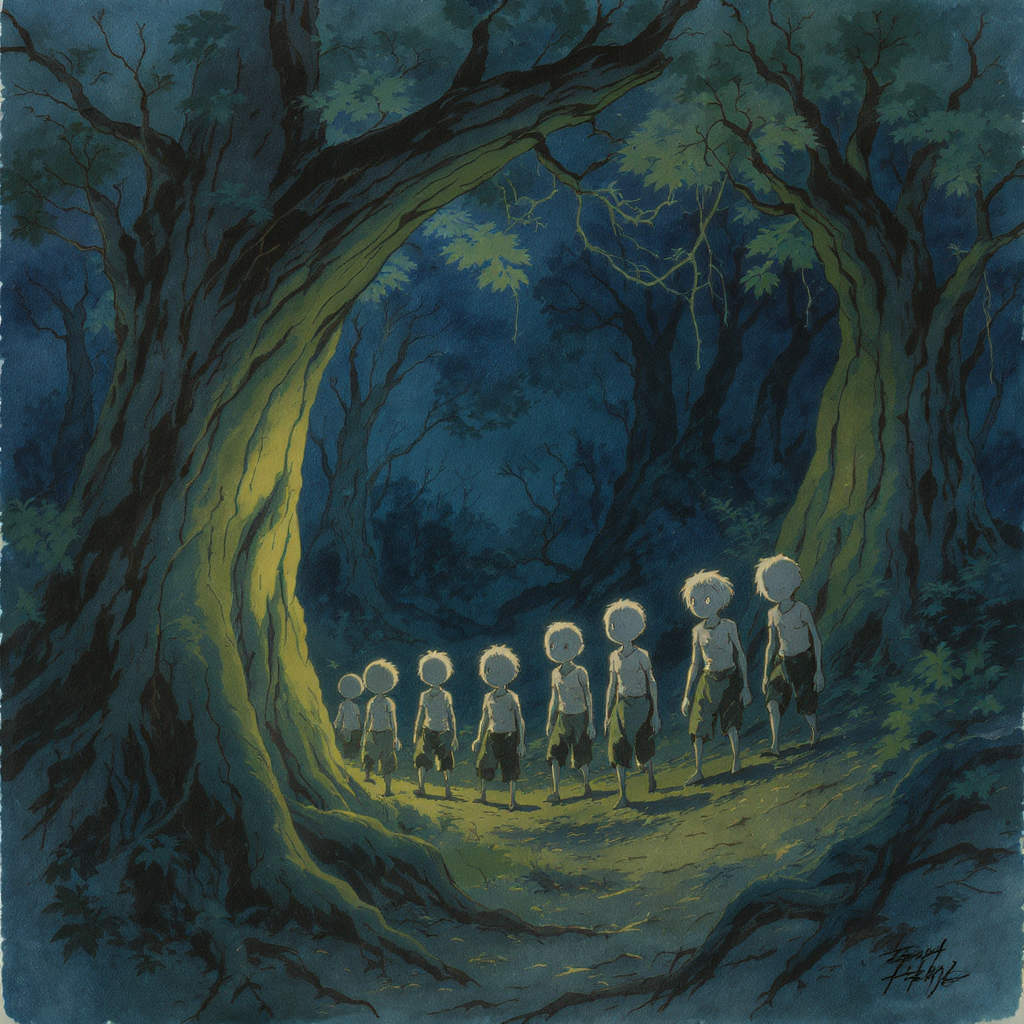
Very early, Little Thumb went to the river. He filled his pockets with small white stones. The stones were smooth and shiny. He put them in his pockets. Then he went back home. He was ready for the walk.
The whole home walked into the big forest. Father cut wood. The boys gathered sticks. They worked with each other. Then Father and Mother walked away. They got lost. The brothers were scared. They cried loud. Little Thumb was not scared. He followed the white stones he dropped. The stones shone on the path. He led his brothers home. They were safe again.
Later, the home was hungry again. They went to the forest one more time. Little Thumb dropped breadcrumbs this time. He thought the birds would not eat them. But birds ate the crumbs. The crumbs were gone. The boys were lost in the dark. They felt alone.
They saw a light. It was a big house. An Ogre lived there with his wife. The house looked strange. The boys wanted to know more. They walked near.
The Ogre's wife was kind. She hid the boys. She gave them food. But the Ogre found them. He was big and loud. He said, "I will catch you in the morning." The boys were scared.
Little Thumb had a smart idea. He swapped his brothers' hats with golden crowns. The crowns were shiny. The Ogre got very mixed up. He thought his girls were the boys. He chased his own girls away. The girls ran fast. The Ogre was angry.
Little Thumb and his brothers ran away. They ran very fast. They ran through the dark. The Ogre ran after them. He had magic boots. The boots could take seven big steps. The boots made loud sounds.
The boys hid under a big rock. The rock was dark and safe. The Ogre was very tired. He sat on the rock. He fell asleep. He snored loud.
Little Thumb was very smart. He took the Ogre's magic boots. The boots fit him just right. He put them on his feet. He felt strong.
Little Thumb used the boots. He went to the Ogre's house. He told the Ogre's wife a story. The story was about a lost treasure. She believed him. She gave him all the Ogre's gold. The gold was heavy and shiny.
Little Thumb went home with the gold. His kin was so happy. They had enough food now. They had a good home. They ate with each other. They smiled and laughed.
Being smart and quick can help you fix big problems and keep your kin safe.
Original Story
LITTLE THUMB
There was, once upon a time, a man and his wife fagot-makers by trade, who had several children, all boys. The eldest was but ten years old, and the youngest only seven.
They were very poor, and their seven children incommoded them greatly, because not one of them was able to earn his bread. That which gave them yet more uneasiness was that the youngest was of a very puny constitution, and scarce ever spoke a word, which made them take that for stupidity which was a sign of good sense. He was very little, and when born no bigger than one’s thumb, which made him be called Little Thumb.
The poor child bore the blame of whatsoever was done amiss in the house, and, guilty or not, was always in the wrong; he was, notwithstanding, more cunning and had a far greater share of wisdom than all his brothers put together; and, if he spake little, he heard and thought the more.
There happened now to come a very bad year, and the famine was so great that these poor people resolved to rid themselves of their children. One evening, when they were all in bed and the fagot-maker was sitting with his wife at the fire, he said to her, with his heart ready to burst with grief:
“Thou seest plainly that we are not able to keep our children, and I cannot see them starve to death before my face; I am resolved to lose them in the wood to-morrow, which may very easily be done; for, while they are busy in tying up fagots, we may run away, and leave them, without their taking any notice.”
“Ah!” cried his wife; “and canst thou thyself have the heart to take thy children out along with thee on purpose to lose them?”
In vain did her husband represent to her their extreme poverty: she would not consent to it; she was indeed poor, but she was their mother. However, having considered what a grief it would be to her to see them perish with hunger, she at last consented, and went to bed all in tears.
Little Thumb heard every word that had been spoken; for observing, as he lay in his bed, that they were talking very busily, he got up softly, and hid himself under his father’s stool, that he might hear what they said without being seen. He went to bed again, but did not sleep a wink all the rest of the night, thinking on what he had to do. He got up early in the morning, and went to the river-side, where he filled his pockets full of small white pebbles, and then returned home.
They all went abroad, but Little Thumb never told his brothers one syllable of what he knew. They went into a very thick forest, where they could not see one another at ten paces distance. The fagot-maker began to cut wood, and the children to gather up the sticks to make fagots. Their father and mother, seeing them busy at their work, got away from them insensibly, and ran away from them all at once, along a by-way through the winding bushes.
When the children saw they were left alone, they began to cry as loud as they could. Little Thumb let them cry on, knowing very well how to get home again, for, as he came, he took care to drop all along the way the little white pebbles he had in his pockets. Then he said to them:
“Be not afraid, brothers; father and mother have left us here, but I will lead you home again, only follow me.”
They did so, and he brought them home by the very same way they came into the forest. They dared not go in, but sat themselves down at the door, listening to what their father and mother were saying.
The very moment the fagot-maker and his wife reached home the lord of the manor sent them ten crowns, which he had owed them a long while, and which they never expected. This gave them new life, for the poor people were almost famished. The fagot-maker sent his wife immediately to the butcher’s. As it was a long while since they had eaten a bit, she bought thrice as much meat as would sup two people. When they had eaten, the woman said:
“Alas! where are now our poor children? they would make a good feast of what we have left here; but it was you, William, who had a mind to lose them: I told you we should repent of it. What are they now doing in the forest? Alas! dear God, the wolves have perhaps already eaten them up; thou art very inhuman thus to have lost thy children.”
The fagot-maker grew at last quite out of patience, for she repeated it above twenty times, that they should repent of it, and that she was in the right of it for so saying. He threatened to beat her if she did not hold her tongue. It was not that the fagot-maker was not, perhaps, more vexed than his wife, but that she teased him, and that he was of the humor of a great many others, who love wives to speak well, but think those very importunate who are continually doing so. She was half-drowned in tears, crying out:
“Alas! where are now my children, my poor children?”
She spoke this so very loud that the children, who were at the gate, began to cry out all together:
“Here we are! Here we are!”
She ran immediately to open the door, and said, hugging them:
“I am glad to see you, my dear children; you are very hungry and weary; and my poor Peter, thou art horribly bemired; come in and let me clean thee.”
Now, you must know that Peter was her eldest son, whom she loved above all the rest, because he was somewhat carroty, as she herself was. They sat down to supper, and ate with such a good appetite as pleased both father and mother, whom they acquainted how frightened they were in the forest, speaking almost always all together. The good folks were extremely glad to see their children once more at home, and this joy continued while the ten crowns lasted; but, when the money was all gone, they fell again into their former uneasiness, and resolved to lose them again; and, that they might be the surer of doing it, to carry them to a much greater distance than before.
They could not talk of this so secretly but they were overheard by Little Thumb, who made account to get out of this difficulty as well as the former; but, though he got up very early in the morning to go and pick up some little pebbles, he was disappointed, for he found the house-door double-locked, and was at a stand what to do. When their father had given each of them a piece of bread for their breakfast, Little Thumb fancied he might make use of this instead of the pebbles by throwing it in little bits all along the way they should pass; and so he put the bread in his pocket.
Their father and mother brought them into the thickest and most obscure part of the forest, when, stealing away into a by-path, they there left them. Little Thumb was not very uneasy at it, for he thought he could easily find the way again by means of his bread, which he had scattered all along as he came; but he was very much surprised when he could not find so much as one crumb; the birds had come and had eaten it up, every bit. They were now in great affliction, for the farther they went the more they were out of their way, and were more and more bewildered in the forest.
Night now came on, and there arose a terribly high wind, which made them dreadfully afraid. They fancied they heard on every side of them the howling of wolves coming to eat them up. They scarce dared to speak or turn their heads. After this, it rained very hard, which wetted them to the skin; their feet slipped at every step they took, and they fell into the mire, whence they got up in a very dirty pickle; their hands were quite benumbed.
Little Thumb climbed up to the top of a tree, to see if he could discover anything; and having turned his head about on every side, he saw at last a glimmering light, like that of a candle, but a long way from the forest. He came down, and, when upon the ground, he could see it no more, which grieved him sadly. However, having walked for some time with his brothers toward that side on which he had seen the light, he perceived it again as he came out of the wood.
They came at last to the house where this candle was, not without an abundance of fear: for very often they lost sight of it, which happened every time they came into a bottom. They knocked at the door, and a good woman came and opened it; she asked them what they would have.
Little Thumb told her they were poor children who had been lost in the forest, and desired to lodge there for God’s sake.
The woman, seeing them so very pretty, began to weep, and said to them:
“Alas! poor babies; whither are ye come? Do ye know that this house belongs to a cruel ogre who eats up little children?”
“Ah! dear madam,” answered Little Thumb (who trembled every joint of him, as well as his brothers), “what shall we do? To be sure the wolves of the forest will devour us to-night if you refuse us to lie here; and so we would rather the gentleman should eat us; and perhaps he may take pity upon us, especially if you please to beg it of him.”
The Ogre’s wife, who believed she could conceal them from her husband till morning, let them come in, and brought them to warm themselves at a very good fire; for there was a whole sheep upon the spit, roasting for the Ogre’s supper.
As they began to be a little warm they heard three or four great raps at the door; this was the Ogre, who had come home. Upon this she hid them under the bed and went to open the door. The Ogre presently asked if supper was ready and the wine drawn, and then sat himself down to table. The sheep was as yet all raw and bloody; but he liked it the better for that. He sniffed about to the right and left, saying:
“I smell fresh meat.”
“What you smell so,” said his wife, “must be the calf which I have just now killed and flayed.”
“I smell fresh meat, I tell thee once more,” replied the Ogre, looking crossly at his wife; “and there is something here which I do not understand.”
As he spoke these words he got up from the table and went directly to the bed.
“Ah, ah!” said he; “I see then how thou wouldst cheat me, thou cursed woman; I know not why I do not eat thee up too, but it is well for thee that thou art a tough old carrion. Here is good game, which comes very quickly to entertain three ogres of my acquaintance who are to pay me a visit in a day or two.”
With that he dragged them out from under the bed one by one. The poor children fell upon their knees, and begged his pardon; but they had to do with one of the most cruel ogres in the world, who, far from having any pity on them, had already devoured them with his eyes, and told his wife they would be delicate eating when tossed up with good savory sauce. He then took a great knife, and, coming up to these poor children, whetted it upon a great whet-stone which he held in his left hand. He had already taken hold of one of them when his wife said to him:
“Why need you do it now? Is it not time enough to-morrow?”
“Hold your prating,” said the Ogre; “they will eat the tenderer.
“But you have so much meat already,” replied his wife, “you have no occasion; here are a calf, two sheep, and half a hog.”
“That is true,” said the Ogre; “give them their belly full that they may not fall away, and put them to bed.”
The good woman was overjoyed at this, and gave them a good supper; but they were so much afraid they could not eat a bit. As for the Ogre, he sat down again to drink, being highly pleased that he had got wherewithal to treat his friends. He drank a dozen glasses more than ordinary, which got up into his head and obliged him to go to bed.
The Ogre had seven daughters, all little children, and these young ogresses had all of them very fine complexions, because they used to eat fresh meat like their father; but they had little gray eyes, quite round, hooked noses, and very long sharp teeth, standing at a good distance from each other. They were not as yet over and above mischievous, but they promised very fair for it, for they had already bitten little children, that they might suck their blood.
They had been put to bed early, with every one a crown of gold upon her head. There was in the same chamber a bed of the like bigness, and it was into this bed the Ogre’s wife put the seven little boys, after which she went to bed to her husband.
Little Thumb, who had observed that the Ogre’s daughters had crowns of gold upon their heads, and was afraid lest the Ogre should repent his not killing them, got up about midnight, and, taking his brothers’ bonnets and his own, went very softly and put them upon the heads of the seven little ogresses, after having taken off their crowns of gold, which he put upon his own head and his brothers’, that the Ogre might take them for his daughters, and his daughters for the little boys whom he wanted to kill.
All this succeeded according to his desire; for, the Ogre waking about midnight, and sorry that he deferred to do that till morning which he might have done over-night, threw himself hastily out of bed, and, taking his great knife,
“Let us see,” said he, “how our little rogues do, and not make two jobs of the matter.”
He then went up, groping all the way, into his daughters’ chamber, and, coming to the bed where the little boys lay, and who were every soul of them fast asleep, except Little Thumb, who was terribly afraid when he found the Ogre fumbling about his head, as he had done about his brothers’, the Ogre, feeling the golden crowns, said:
“I should have made a fine piece of work of it, truly; I find I drank too much last night.”
Then he went to the bed where the girls lay; and, having found the boys’ little bonnets,
“Ah!” said he, “my merry lads, are you there? Let us work as we ought.”
And saying these words, without more ado, he cut the throats of all his seven daughters.
Well pleased with what he had done, he went to bed again to his wife. So soon as Little Thumb heard the Ogre snore, he waked his brothers, and bade them all put on their clothes presently and follow him. They stole down softly into the garden, and got over the wall. They kept running about all night, and trembled all the while, without knowing which way they went.
The Ogre, when he awoke, said to his wife: “Go upstairs and dress those young rascals who came here last night.”
The wife was very much surprised at this goodness of her husband, not dreaming after what manner she should dress them; but, thinking that he had ordered her to go and put on their clothes, she went up, and was strangely astonished when she perceived her seven daughters killed, and weltering in their blood.
She fainted away, for this is the first expedient almost all women find in such cases. The Ogre, fearing his wife would be too long in doing what he had ordered, went up himself to help her. He was no less amazed than his wife at this frightful spectacle.
“Ah! what have I done?” cried he. “The wretches shall pay for it, and that instantly.”
He threw a pitcher of water upon his wife’s face, and, having brought her to herself, said:
“Give me quickly my boots of seven leagues, that I may go and catch them.”
He went out, and, having run over a vast deal of ground, both on this side and that, he came at last into the very road where the poor children were, and not above a hundred paces from their father’s house. They espied the Ogre, who went at one step from mountain to mountain, and over rivers as easily as the narrowest kennels. Little Thumb, seeing a hollow rock near the place where they were, made his brothers hide themselves in it, and crowded into it himself, minding always what would become of the Ogre.
The Ogre, who found himself much tired with his long and fruitless journey (for these boots of seven leagues greatly fatigued the wearer), had a great mind to rest himself, and, by chance, went to sit down upon the rock where the little boys had hid themselves. As it was impossible he could be more weary than he was, he fell asleep, and, after reposing himself some time, began to snore so frightfully that the poor children were no less afraid of him than when he held up his great knife and was going to cut their throats. Little Thumb was not so much frightened as his brothers, and told them that they should run away immediately toward home while the Ogre was asleep so soundly, and that they should not be in any pain about him. They took his advice, and got home presently. Little Thumb came up to the Ogre, pulled off his boots gently and put them on his own legs. The boots were very long and large, but, as they were fairies, they had the gift of becoming big and little, according to the legs of those who wore them; so that they fitted his feet and legs as well as if they had been made on purpose for him. He went immediately to the Ogre’s house, where he saw his wife crying bitterly for the loss of the Ogre’s murdered daughters.
“Your husband,” said Little Thumb, “is in very great danger, being taken by a gang of thieves, who have sworn to kill him if he does not give them all his gold and silver. The very moment they held their daggers at his throat he perceived me, and desired me to come and tell you the condition he is in, and that you should give me whatsoever he has of value, without retaining any one thing; for otherwise they will kill him without mercy; and, as his case is very pressing, he desired me to make use (you see I have them on) of his boots, that I might make the more haste and to show you that I do not impose upon you.”
The good woman, being sadly frightened, gave him all she had: for this Ogre was a very good husband, though he used to eat up little children. Little Thumb, having thus got all the Ogre’s money, came home to his father’s house, where he was received with abundance of joy.
There are many people who do not agree in this circumstance, and pretend that Little Thumb never robbed the Ogre at all, and that he only thought he might very justly, and with a safe conscience, take off his boots of seven leagues, because he made no other use of them but to run after little children. These folks affirm that they are very well assured of this, and the more as having drunk and eaten often at the fagot-maker’s house. They aver that when Little Thumb had taken off the Ogre’s boots he went to Court, where he was informed that they were very much in pain about a certain army, which was two hundred leagues off, and the success of a battle. He went, say they, to the King, and told him that, if he desired it, he would bring him news from the army before night.
The King promised him a great sum of money upon that condition. Little Thumb was as good as his word, and returned that very same night with the news; and, this first expedition causing him to be known, he got whatever he pleased, for the King paid him very well for carrying his orders to the army. After having for some time carried on the business of a messenger, and gained thereby great wealth, he went home to his father, where it was impossible to express the joy they were all in at his return. He made the whole family very easy, bought places for his father and brothers, and, by that means, settled them very handsomely in the world, and, in the meantime, made his court to perfection.(1)
(1) Charles Perrault.
Moral of the Story
Cunning and quick-wittedness can overcome even the most formidable dangers and lead to prosperity.
Characters

Little Thumb ★ protagonist
Very small, no bigger than a thumb at birth, puny constitution
Attire: Simple peasant boy's clothing: tunic, breeches, perhaps a cap
Cunning, wise, observant, resourceful

Fagot-maker ◆ supporting
Poorly nourished, careworn
Attire: Worn and patched peasant clothing suitable for woodcutting
Desperate, conflicted, easily swayed

Fagot-maker's Wife ◆ supporting
Thin from hunger, initially resistant to abandoning her children
Attire: Simple, worn peasant woman's dress
Maternal, emotional, prone to nagging

Ogre ⚔ antagonist
Large, imposing, owns boots of seven leagues
Attire: Imposing attire, perhaps with crude jewelry or trophies
Violent, easily fooled, gluttonous

Ogre's Wife ◆ supporting
Large, imposing
Attire: Rich clothing
Easily frightened, obedient

Peter ○ minor
Eldest son, gets dirty
Attire: Simple peasant boy's clothing: tunic, breeches, perhaps a cap
Beloved by his mother
Locations

Fagot-maker's Cottage
A small, poor cottage with a fireplace where the parents discuss abandoning their children. A single room where all seven children sleep.
Mood: desperate, grief-stricken, anxious
The parents decide to abandon their children; the children return after being abandoned the first time.

Thick Forest
A dense forest so thick that people cannot see each other from ten paces away. Winding bushes line a by-way.
Mood: eerie, disorienting, frightening
The children are abandoned twice; Little Thumb drops pebbles to find their way back.

Ogre's House
A large house, presumably well-furnished, with a bed where the Ogre and his wife sleep, and another bed where their seven daughters sleep. Has an upstairs.
Mood: terrifying, dangerous
The Ogre mistakenly slits the throats of his own daughters; Little Thumb steals the Ogre's boots.

Hollow Rock
A large rock with a hollow space underneath, located near a road between mountains and rivers.
Mood: tense, precarious, fearful
The children hide from the Ogre; the Ogre falls asleep on top of the rock.
Story DNA
Moral
Cunning and quick-wittedness can overcome even the most formidable dangers and lead to prosperity.
Plot Summary
In a time of famine, a poor woodcutter and his wife decide to abandon their seven sons in the forest. The youngest, Little Thumb, though small and often underestimated, overhears their plan and uses white pebbles to lead his brothers home. A second abandonment attempt fails when birds eat his breadcrumb trail, leading the boys to the house of a terrifying Ogre. Little Thumb's quick thinking saves them when he tricks the Ogre into killing his own daughters instead of the boys. After escaping, Little Thumb steals the Ogre's magical Seven-League Boots, using them to acquire great wealth and secure his family's future, proving that cleverness can overcome brute strength and dire circumstances.
Themes
Emotional Arc
suffering to triumph
Writing Style
Narrative Elements
Cultural Context
This version is attributed to Charles Perrault, a key figure in the development of the literary fairy tale in 17th-century France. The theme of child abandonment due to famine reflects historical realities of extreme poverty.
Plot Beats (14)
- A poor family with seven sons, the youngest, Little Thumb, is small but clever.
- A famine leads the parents to decide to abandon their children in the forest.
- Little Thumb overhears the plan and gathers white pebbles.
- The parents abandon the children, but Little Thumb uses the pebbles to guide them home.
- The parents are initially relieved but then decide to abandon them again, this time Little Thumb's breadcrumb trail is eaten by birds.
- Lost and afraid, Little Thumb spots a distant light and leads his brothers to an Ogre's house.
- The Ogre's wife hides the boys, but the Ogre discovers them and plans to kill them in the morning.
- Little Thumb swaps his brothers' bonnets with the golden crowns of the Ogre's daughters, causing the Ogre to kill his own children by mistake.
- Little Thumb and his brothers escape the Ogre's house.
- The Ogre pursues them using his Seven-League Boots.
- Little Thumb hides his brothers and himself in a rock, and the Ogre, exhausted, falls asleep on it.
- Little Thumb steals the Ogre's Seven-League Boots.
- Little Thumb uses the boots to trick the Ogre's wife into giving him all the Ogre's treasure, or alternatively, uses them to become a royal messenger.
- Little Thumb returns home wealthy, providing for his family and securing their future.


