Prince Darling
by Andrew Lang

Prince Darling and the Fairy Truth
Once upon a time, there was a kind king and his son, Prince Darling.
The king loved his son very much. One sunny day, the king walked in the forest. He saw a little white rabbit. The rabbit was stuck in some bushes. "Oh no!" said the king. He helped the rabbit get free. The rabbit smiled. It was not a real rabbit! It turned into a fairy. "I am the Fairy Truth," she said softly. "Thank you for your kindness. I will be a friend to your son, Prince Darling. I will help him learn to be good." The king was very happy. He thanked the fairy.
The king had to go on a long journey. "Be good and kind, my son," he told Prince Darling. "Listen to the fairy." Prince Darling felt sad. He would miss his father. The fairy came to see him. She had a gold ring. "This ring is for you," she said. "It will help you be good. The ring pricks if you are not kind." Prince Darling promised to be good. He put on the ring.
For a time, Prince Darling was very good. The ring never pricked him. He played nicely with his dog, Bibi. He shared his toys. He was happy. But then, he became restless. He did not want to listen. He was mean to Bibi. He pulled Bibi's tail. The ring pricked his finger! "Ouch!" he said. He did not care. He took the ring off. He threw it away.
Prince Darling became very selfish and unkind. He yelled at everyone. He did not share. The fairy was sad. She wanted to help him learn. So, she used her magic. She changed him. He became a big, scary beast. He was no longer a prince. He had to live in the woods.
As a big beast, he was caught by a man. The man was an unkind keeper. He put the beast in a cage. One day, a danger came. A big dog tried to attack the keeper. The beast felt kind. He broke the cage. He saved his keeper. Because he was kind, magic happened. He changed again. He became a little white dog.
A queen found the little dog. She took him home. She loved him very much. But the dog was always hungry. The queen did not feed him enough. One day, the dog saw a very hungry girl. She looked sad. The dog had one piece of bread. He gave it to her. It was a kind thing to do. The girl smiled.
The dog saw his friend, Celia. She was taken into a not nice place. It was a dark house. He wanted to help her. But he was small. He felt sorry. He remembered when he was unkind like that. He wished he could help.
He was kind and sorry, so he changed again. He became a pretty white dove. He could fly high! He looked for Celia. He flew over trees and rivers.
He found her in a quiet place. It was a peaceful garden. The fairy was there too, in disguise. She looked like an old woman. Celia saw the pretty dove. "Oh, a dove!" she said. "I will love you," she said softly. The dove cooed.
The fairy smiled. She became herself again. She was shiny and bright. She changed the dove back into Prince Darling. He was so happy to see Celia. "Celia!" he said. "I am sorry for being unkind." Celia smiled. "I forgive you," she said.
The fairy took them home. Prince Darling became king again. He married Celia. They had a big wedding. He wore his gold ring. It never pricked him. He was always kind and good. He helped his people. He shared food and toys.
Being kind and good made him happy and loved. Everyone liked him. And they were happy and always good. They smiled every day.
Original Story
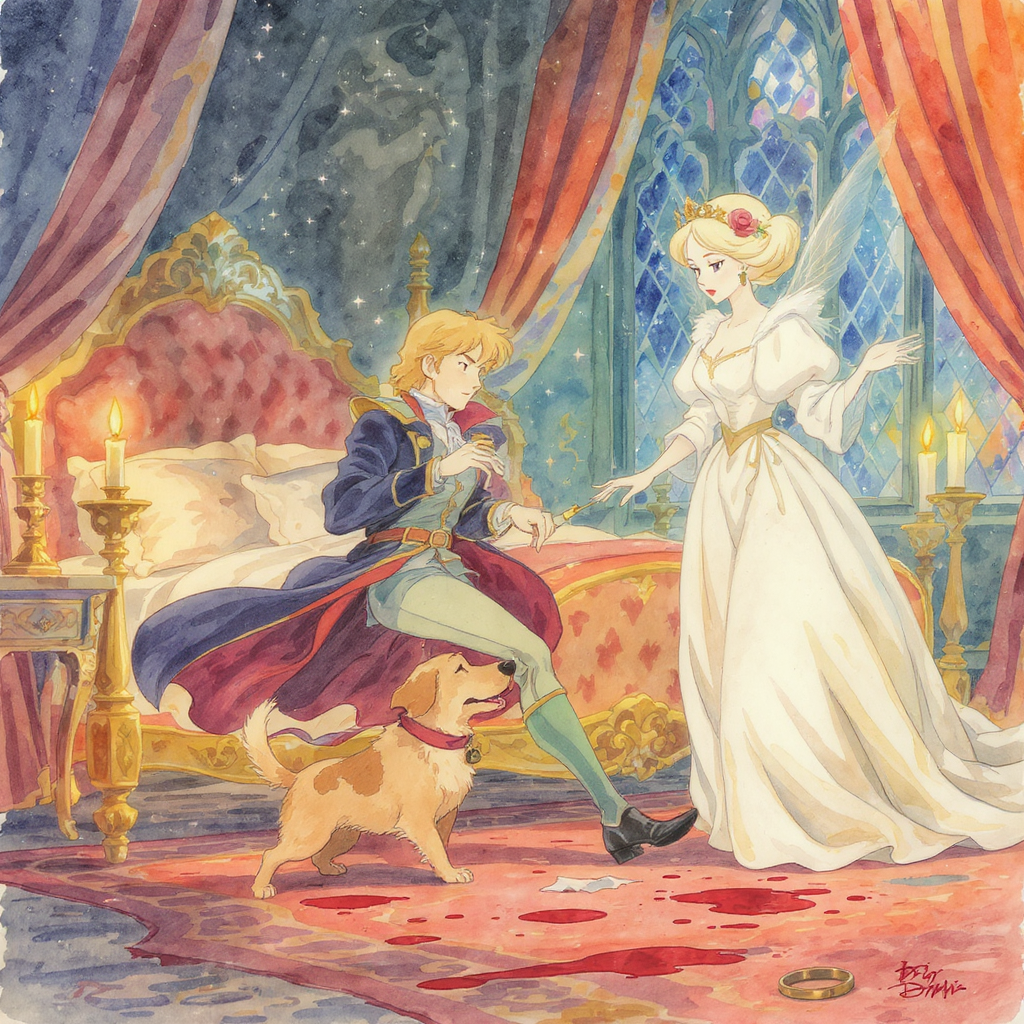
PRINCE DARLING ONCE upon a time there lived a king who was so just and kind that his subjects called him “the Good King.” It happened one day, when he was out hunting, that a little white rabbit, which his dogs were chasing, sprang into his arms for shelter. The King stroked it gently, and said to it: “Well, bunny, as you have come to me for protection I will see that nobody hurts you.” And he took it home to his palace and had it put in a pretty little house, with all sorts of nice things to eat. That night, when he was alone in his room, a beautiful lady suddenly appeared before him; her long dress was as white as snow, and she had a crown of white roses upon her head. The good King was very much surprised to see her, for he knew his door had been tightly shut, and he could not think how she had got in. But she said to him: “I am the Fairy Truth. I was passing through the wood when you were out hunting, and I wished to find out if you were really good, as everybody said you were, so I took the shape of a little rabbit and came to your arms for shelter, for I know that those who are merciful to animals will be still kinder to their fellow-men. If you had refused to help me I should have been certain that you were wicked. I thank you for the kindness you have shown me, which has made me your friend for ever. You have only to ask me for anything you want and I promise that I will give it to you.” “Madam,” said the good King, “since you are a fairy you no doubt know all my wishes. I have but one son whom I love very dearly, that is why he is called Prince Darling. If you are really good enough to wish to do me a favor, I beg that you will become his friend.” “With all my heart,” answered the Fairy. “I can make your son the handsomest prince in the world, or the richest, or the most powerful; choose whichever you like for him.” “I do not ask either of these things for my son,” replied the good King; “but if you will make him the best of princes, I shall indeed be grateful to you. What good would it do him to be rich, or handsome, or to possess all the kingdoms of the world if he were wicked? You know well he would still be unhappy. Only a good man can be really contented.” “You are quite right,” answered the Fairy; “but it is not in my power to make Prince Darling a good man unless he will help me; he must himself try hard to become good, I can only promise to give him good advice, to scold him for his faults, and to punish him if he will not correct and punish himself.” The good King was quite satisfied with this promise; and very soon afterward he died. Prince Darling was very sorry, for he loved his father with all his heart, and he would willingly have given all his kingdoms and all his treasures of gold and silver if they could have kept the good King with him. Two days afterward, when the Prince had gone to bed, the Fairy suddenly appeared to him and said: “I promised your father that I would be your friend, and to keep my word I have come to bring you a present.” At the same time she put a little gold ring upon his finger. “Take great care of this ring,” she said: “it is more precious than diamonds; every time you do a bad deed it will prick your finger, but if, in spite of its pricking, you go on in your own evil way, you will lose my friendship, and I shall become your enemy.” So saying, the Fairy disappeared, leaving Prince Darling very much astonished. For some time he behaved so well that the ring never pricked him, and that made him so contented that his subjects called him Prince Darling the Happy. One day, however, he went out hunting, but could get no sport, which put him in a very bad temper; it seemed to him as he rode along that his ring was pressing into his finger, but as it did not prick him he did not heed it. When he got home and went to his own room, his little dog Bibi ran to meet him, jumping round him with pleasure. “Get away!” said the Prince, quite gruffly. “I don’t want you, you are in the way.” The poor little dog, who didn’t understand this at all, pulled at his coat to make him at least look at her, and this made Prince Darling so cross that he gave her quite a hard kick. Instantly his ring pricked him sharply, as if it had been a pin. He was very much surprised, and sat down in a corner of his room feeling quite ashamed of himself. “I believe the Fairy is laughing at me,” he thought. “Surely I can have done no great wrong in just kicking a tiresome animal! What is the good of my being ruler of a great kingdom if I am not even allowed to beat my own dog?” “I am not making fun of you,” said a voice, answering Prince Darling’s thoughts. “You have committed three faults. First of all, you were out of temper because you could not have what you wanted, and you thought all men and animals were only made to do your pleasure; then you were really angry, which is very naughty indeed; and lastly, you were cruel to a poor little animal who did not in the least deserve to be ill-treated. “I know you are far above a little dog, but if it were right and allowable that great people should ill-treat all who are beneath them, I might at this moment beat you, or kill you, for a fairy is greater than a man. The advantage of possessing a great empire is not to be able to do the evil that one desires, but to do all the good that one possibly can.” The Prince saw how naughty he had been, and promised to try and do better in future, but he did not keep his word. The fact was he had been brought up by a foolish nurse, who had spoiled him when he was little. If he wanted anything he only had to cry and fret and stamp his feet and she would give him whatever he asked for, which had made him self-willed; also she had told him from morning to night that he would one day be a king, and that kings were very happy, because everyone was bound to obey and respect them, and no one could prevent them from doing just as they liked. When the Prince grew old enough to understand, he soon learned that there could be nothing worse than to be proud, obstinate, and conceited, and he had really tried to cure himself of these defects, but by that time all his faults had become habits; and a bad habit is very hard to get rid of. Not that he was naturally of a bad disposition; he was truly sorry when he had been naughty, and said: “I am very unhappy to have to struggle against my anger and pride every day; if I had been punished for them when I was little they would not be such a trouble to me now.” His ring pricked him very often, and sometimes he left off what he was doing at once; but at other times he would not attend to it. Strangely enough, it gave him only a slight prick for a trifling fault, but when he was really naughty it made his finger actually bleed. At last he got tired of being constantly reminded, and wanted to be able to do as he liked, so he threw his ring aside, and thought himself the happiest of men to have got rid of its teasing pricks. He gave himself up to doing every foolish thing that occurred to him, until he became quite wicked and nobody could like him any longer. One day, when the Prince was walking about, he saw a young girl who was so very pretty that he made up his mind at once that he would marry her. Her name was Celia, and she was as good as she was beautiful. Prince Darling fancied that Celia would think herself only too happy if he offered to make her a great queen, but she said fearlessly: “Sire, I am only a shepherdess, and a poor girl, but, nevertheless, I will not marry you.” “Do you dislike me?” asked the Prince, who was very much vexed at this answer. “No, my Prince,” replied Celia; “I cannot help thinking you very handsome; but what good would riches be to me, and all the grand dresses and splendid carriages that you would give me, if the bad deeds which I should see you do every day made me hate and despise you?” The Prince was very angry at this speech, and commanded his officers to make Celia a prisoner and carry her off to his palace. All day long the remembrance of what she had said annoyed him, but as he loved her he could not make up his mind to have her punished. One of the Prince’s favorite companions was his foster-brother, whom he trusted entirely; but he was not at all a good man, and gave Prince Darling very bad advice, and encouraged him in all his evil ways. When he saw the Prince so downcast he asked what was the matter, and when he explained that he could not bear Celia’s bad opinion of him, and was resolved to be a better man in order to please her, this evil adviser said to him: “You are very kind to trouble yourself about this little girl; if I were you I would soon make her obey me. Remember that you are a king, and that it would be laughable to see you trying to please a shepherdess, who ought to be only too glad to be one of your slaves. Keep her in prison, and feed her on bread and water for a little while, and then, if she still says she will not marry you, have her head cut off, to teach other people that you mean to be obeyed. Why, if you cannot make a girl like that do as you wish, your subjects will soon forget that they are only put into this world for our pleasure.” “But,” said Prince Darling, “would it not be a shame if I had an innocent girl put to death? For Celia has done nothing to deserve punishment.” “If people will not do as you tell them they ought to suffer for it,” answered his foster-brother; “but even if it were unjust, you had better be accused of that by your subjects than that they should find out that they may insult and thwart you as often as they please.” In saying this he was touching a weak point in his brother’s character; for the Prince’s fear of losing any of his power made him at once abandon his first idea of trying to be good, and resolve to try and frighten the shepherdess into consenting to marry him. His foster-brother, who wanted him to keep this resolution, invited three young courtiers, as wicked as himself to sup with the Prince, and they persuaded him to drink a great deal of wine, and continued to excite his anger against Celia by telling him that she had laughed at his love for her; until at last, in quite a furious rage, he rushed off to find her, declaring that if she still refused to marry him she should be sold as a slave the very next day. But when he reached the room in which Celia had been locked up, he was greatly surprised to find that she was not in it, though he had the key in his own pocket all the time. His anger was terrible, and he vowed vengeance against whoever had helped her to escape. His bad friends, when they heard him, resolved to turn his wrath upon an old nobleman who had formerly been his tutor; and who still dared sometimes to tell the Prince of his faults, for he loved him as if he had been his own son. At first Prince Darling had thanked him, but after a time he grew impatient and thought it must be just mere love of fault-finding that made his old tutor blame him when everyone else was praising and flattering him. So he ordered him to retire from his Court, though he still, from time to time, spoke of him as a worthy man whom he respected, even if he no longer loved him. His unworthy friends feared that he might some day take it into his head to recall his old tutor, so they thought they now had a good opportunity of getting him banished for ever. They reported to the Prince that Suliman, for that was the tutor’s name, had boasted of having helped Celia to escape, and they bribed three men to say that Suliman himself had told them about it. The Prince, in great anger, sent his foster-brother with a number of soldiers to bring his tutor before him, in chains, like a criminal. After giving this order he went to his own room, but he had scarcely got into it when there was a clap of thunder which made the ground shake, and the Fairy Truth appeared suddenly before him. “I promised your father,” said she sternly, “to give you good advice, and to punish you if you refused to follow it. You have despised my counsel, and have gone your own evil way until you are only outwardly a man; really you are a monster--the horror of everyone who knows you. It is time that I should fulfil my promise, and begin your punishment. I condemn you to resemble the animals whose ways you have imitated. You have made yourself like the lion by your anger, and like the wolf by your greediness. Like a snake, you have ungratefully turned upon one who was a second father to you; your churlishness has made you like a bull. Therefore, in your new form, take the appearance of all these animals.” The Fairy had scarcely finished speaking when Prince Darling saw to his horror that her words were fulfilled. He had a lion’s head, a bull’s horns, a wolf’s feet, and a snake’s body. At the same instant he found himself in a great forest, beside a clear lake, in which he could see plainly the horrible creature he had become, and a voice said to him: “Look carefully at the state to which your wickedness has brought you; believe me, your soul is a thousand times more hideous than your body.” Prince Darling recognized the voice of the Fairy Truth and turned in a fury to catch her and eat her up if he possibly could; but he saw no one, and the same voice went on: “I laugh at your powerlessness and anger, and I intend to punish your pride by letting you fall into the hands of your own subjects.” The Prince began to think that the best thing he could do would be to get as far away from the lake as he could, then at least he would not be continually reminded of his terrible ugliness. So he ran toward the wood, but before he had gone many yards he fell into a deep pit which had been made to trap bears, and the hunters, who were hiding in a tree, leaped down, and secured him with several chains, and led him into the chief city of his own kingdom. On the way, instead of recognizing that his own faults had brought this punishment upon him, he accused the Fairy of being the cause of all his misfortunes, and bit and tore at his chains furiously. As they approached the town he saw that some great rejoicing was being held, and when the hunters asked what had happened they were told that the Prince, whose only pleasure it was to torment his people, had been found in his room, killed by a thunder-bolt (for that was what was supposed to have become of him). Four of his courtiers, those who had encouraged him in his wicked doings, had tried to seize the kingdom and divide it between them, but the people, who knew it was their bad counsels which had so changed the Prince, had cut off their heads, and had offered the crown to Suliman, whom the Prince had left in prison. This noble lord had just been crowned, and the deliverance of the kingdom was the cause of the rejoicing. “For,” they said, “he is a good and just man, and we shall once more enjoy peace and prosperity.” Prince Darling roared with anger when he heard this; but it was still worse for him when he reached the great square before his own palace. He saw Suliman seated upon a magnificent throne, and all the people crowded round, wishing him a long life that he might undo all the mischief done by his predecessor. Presently Suliman made a sign with his hand that the people should be silent, and said: “I have accepted the crown you have offered me, but only that I may keep it for Prince Darling, who is not dead as you suppose; the Fairy has assured me that there is still hope that you may some day see him again, good and virtuous as he was when he first came to the throne. Alas!” he continued, “he was led away by flatterers. I knew his heart, and am certain that if it had not been for the bad influence of those who surrounded him he would have been a good king and a father to his people. We may hate his faults, but let us pity him and hope for his restoration. As for me, I would die gladly if that could bring back our Prince to reign justly and worthily once more.” These words went to Prince Darling’s heart; he realized the true affection and faithfulness of his old tutor, and for the first time reproached himself for all his evil deeds; at the same instant he felt all his anger melting away, and he began quickly to think over his past life, and to admit that his punishment was not more than he had deserved. He left off tearing at the iron bars of the cage in which he was shut up, and became as gentle as a lamb. The hunters who had caught him took him to a great menagerie, where he was chained up among all the other wild beasts, and he determined to show his sorrow for his past bad behavior by being gentle and obedient to the man who had to take care of him. Unfortunately, this man was very rough and unkind, and though the poor monster was quite quiet, he often beat him without rhyme or reason when he happened to be in a bad temper. One day when this keeper was asleep a tiger broke its chain, and flew at him to eat him up. Prince Darling, who saw what was going on, at first felt quite pleased to think that he should be delivered from his persecutor, but soon thought better of it and wished that he were free. “I would return good for evil,” he said to himself, “and save the unhappy man’s life.” He had hardly wished this when his iron cage flew open, and he rushed to the side of the keeper, who was awake and was defending himself against the tiger. When he saw the monster had got out he gave himself up for lost, but his fear was soon changed into joy, for the kind monster threw itself upon the tiger and very soon killed it, and then came and crouched at the feet of the man it had saved. Overcome with gratitude, the keeper stooped to caress the strange creature which had done him such a great service; but suddenly a voice said in his ear: “A good action should never go unrewarded,” and at the same instant the monster disappeared, and he saw at his feet only a pretty little dog! Prince Darling, delighted by the change, frisked about the keeper, showing his joy in every way he could, and the man, taking him up in his arms, carried him to the King, to whom he told the whole story. The Queen said she would like to have this wonderful little dog, and the Prince would have been very happy in his new home if he could have forgotten that he was a man and a king. The Queen petted and took care of him, but she was so afraid that he would get too fat that she consulted the court physician, who said that he was to be fed only upon bread, and was not to have much even of that. So poor Prince Darling was terribly hungry all day long, but he was very patient about it. One day, when they gave him his little loaf for breakfast, he thought he would like to eat it out in the garden; so he took it up in his mouth and trotted away toward a brook that he knew of a long way from the palace. But he was surprised to find that the brook was gone, and where it had been stood a great house that seemed to be built of gold and precious stones. Numbers of people splendidly dressed were going into it, and sounds of music and dancing and feasting could be heard from the windows. But what seemed very strange was that those people who came out of the house were pale and thin, and their clothes were torn, and hanging in rags about them. Some fell down dead as they came out before they had time to get away; others crawled farther with great difficulty; while others again lay on the ground, fainting with hunger, and begged a morsel of bread from those who were going into the house, but they would not so much as look at the poor creatures. Prince Darling went up to a young girl who was trying to eat a few blades of grass, she was so hungry. Touched with compassion, he said to himself: “I am very hungry, but I shall not die of starvation before I get my dinner; if I give my breakfast to this poor creature perhaps I may save her life.” So he laid his piece of bread in the girl’s hand, and saw her eat it up eagerly. She soon seemed to be quite well again, and the Prince, delighted to have been able to help her, was thinking of going home to the palace, when he heard a great outcry, and, turning round, saw Celia, who was being carried against her will into the great house. For the first time the Prince regretted that he was no longer the monster, then he would have been able to rescue Celia; now he could only bark feebly at the people who were carrying her off, and try to follow them, but they chased and kicked him away. He determined not to quit the place till he knew what had become of Celia, and blamed himself for what had befallen her. “Alas!” he said to himself, “I am furious with the people who are carrying Celia off, but isn’t that exactly what I did myself, and if I had not been prevented did I not intend to be still more cruel to her?” Here he was interrupted by a noise above his head--someone was opening a window, and he saw with delight that it was Celia herself, who came forward and threw out a plate of most delicious-looking food, then the window was shut again, and Prince Darling, who had not had anything to eat all day, thought he might as well take the opportunity of getting something. He ran forward to begin, but the young girl to whom he had given his bread gave a cry of terror and took him up in her arms, saying: “Don’t touch it, my poor little dog--that house is the palace of pleasure, and everything that comes out of it is poisoned!” At the same moment a voice said: “You see a good action always brings its reward,” and the Prince found himself changed into a beautiful white dove. He remembered that white was the favorite color of the Fairy Truth, and began to hope that he might at last win back her favor. But just now his first care was for Celia, and rising into the air he flew round and round the house, until he saw an open window; but he searched through every room in vain. No trace of Celia was to be seen, and the Prince, in despair, determined to search through the world till he found her. He flew on and on for several days, till he came to a great desert, where he saw a cavern, and, to his delight, there sat Celia, sharing the simple breakfast of an old hermit. Overjoyed to have found her, Prince Darling perched upon her shoulder, trying to express by his caresses how glad he was to see her again, and Celia, surprised and delighted by the tameness of this pretty white dove, stroked it softly, and said, though she never thought of its understanding her: “I accept the gift that you make me of yourself, and I will love you always.” “Take care what you are saying, Celia,” said the old hermit; “are you prepared to keep that promise?” “Indeed, I hope so, my sweet shepherdess,” cried the Prince, who was at that moment restored to his natural shape. “You promised to love me always; tell me that you really mean what you said, or I shall have to ask the Fairy to give me back the form of the dove which pleased you so much.” “You need not be afraid that she will change her mind,” said the Fairy, throwing off the hermit’s robe in which she had been disguised and appearing before them. “Celia has loved you ever since she first saw you, only she would not tell you while you were so obstinate and naughty. Now you have repented and mean to be good you deserve to be happy, and so she may love you as much as she likes.” Celia and Prince Darling threw themselves at the Fairy’s feet, and the Prince was never tired of thanking her for her kindness. Celia was delighted to hear how sorry he was for all his past follies and misdeeds, and promised to love him as long as she lived. “Rise, my children,” said the Fairy, “and I will transport you to the palace, and Prince Darling shall have back again the crown he forfeited by his bad behavior.” While she was speaking, they found themselves in Suliman’s hall, and his delight was great at seeing his dear master once more. He gave up the throne joyfully to the Prince, and remained always the most faithful of his subjects. Celia and Prince Darling reigned for many years, but he was so determined to govern worthily and to do his duty that his ring, which he took to wearing again, never once pricked him severely.(1) (1) Cabinet des Fees.
Moral of the Story
True happiness and worth come from inner goodness, self-control, and kindness, not from power, wealth, or outward appearance.
Characters

Prince Darling ★ protagonist
Initially handsome, later transformed into a dog and then a dove, finally regaining his human form.
Attire: Royal attire befitting a prince, including a gold ring; as a dog, no clothing; as a dove, pure white plumage.
Initially spoiled, self-willed, and prone to anger; later remorseful, compassionate, and determined to be good.

Fairy Truth ◆ supporting
Beautiful, with a long white dress and a crown of white roses.
Attire: Long white dress as white as snow, crown of white roses.
Wise, just, and benevolent; acts as a moral guide and punisher.

The Good King ◆ supporting
Not explicitly described, but implied to be regal and kind-looking.
Attire: Royal attire, including a crown and fine robes.
Just, kind, and concerned with his son's moral character.

Celia ◆ supporting
Not explicitly described, but implied to be beautiful and virtuous.
Attire: Simple clothing, initially rags, later appropriate attire for a queen.
Kind, compassionate, and loving; serves as a catalyst for the Prince's transformation.

Bibi ○ minor
Small dog
Loyal and affectionate
Locations

King's Hunting Grounds
A wood where the good King is hunting; implied to have rabbits and dogs.
Mood: peaceful, then fateful
The King shows mercy to the rabbit, revealing his good nature to the Fairy Truth.

Royal Palace Room
The King's private room, door tightly shut.
Mood: private, magical
The Fairy Truth reveals herself and offers the King a gift for his son.

Golden Pleasure Palace
A grand house built of gold and precious stones, replacing a brook. Sounds of music, dancing, and feasting emanate from within. People emerge pale, thin, and in rags, some dying of hunger.
Mood: deceptive, alluring, deadly
Celia is taken to the palace, and Prince Darling learns of its true nature.

Hermit's Cavern in the Desert
A simple cavern in a vast desert, where an old hermit shares a meager breakfast.
Mood: desolate, simple, revelatory
Prince Darling finds Celia and declares his love, and the Fairy Truth reveals herself.

Suliman's Hall
The throne room of Prince Darling's palace.
Mood: grand, celebratory
Prince Darling and Celia return to reclaim the throne and begin their reign.
Story DNA
Moral
True happiness and worth come from inner goodness, self-control, and kindness, not from power, wealth, or outward appearance.
Plot Summary
A good king's spoiled son, Prince Darling, is given a magical ring by the Fairy Truth that pricks him for bad deeds. He initially behaves well but eventually removes the ring, succumbing to cruelty and tyranny. His wickedness leads to a series of humbling transformations into various animals, forcing him to experience suffering and learn empathy. Through selfless acts in his animal forms, he gradually redeems himself, culminating in a final act of kindness and regret that restores him to his human form, allowing him to marry the virtuous Celia and rule justly.
Themes
Emotional Arc
pride to humility to wisdom
Writing Style
Narrative Elements
Cultural Context
Part of a collection of European fairy tales, often reflecting 18th-19th century moralizing tones and societal expectations for royalty.
Plot Beats (13)
- The Good King saves a rabbit, which reveals itself to be the Fairy Truth, who promises to befriend his son, Prince Darling, and guide him towards goodness.
- The King dies, and the Fairy Truth gives Prince Darling a magical ring that pricks him whenever he does a bad deed.
- Prince Darling initially behaves well, but eventually grows impatient with the ring's corrections and removes it, leading him to indulge his selfish desires and become tyrannical.
- He attempts to force Celia, a beautiful shepherdess, to marry him, but she refuses due to his wickedness, causing him to imprison her and threaten her with death.
- The Fairy Truth intervenes, transforming Prince Darling into a hideous monster, forcing him to experience the fear and revulsion he inflicted on others.
- As a monster, he is captured and chained, but a selfless act of saving his cruel keeper from a tiger transforms him into a beautiful little dog.
- As a dog, he is adopted by the Queen but kept hungry; he encounters a starving girl and gives her his only piece of bread.
- He witnesses Celia being taken into the 'palace of pleasure' (a place of ruin), realizing his past wrongs and regretting his powerlessness to save her.
- His selfless act of giving his bread and his regret transform him into a white dove, symbolizing purity and hope.
- As a dove, he searches for Celia and finds her in a desert with the Fairy Truth, disguised as a hermit.
- Celia, unaware of his identity, expresses her love for the dove, and the Fairy Truth reveals herself, restoring Prince Darling to his human form.
- Prince Darling and Celia marry and return to his kingdom, where he rules justly, always wearing the ring, which no longer pricks him severely.
- He reigns as a good king, having learned the value of kindness, self-control, and true goodness.


