The gold-spinners
by Andrew Lang

The Clever Little Tailor
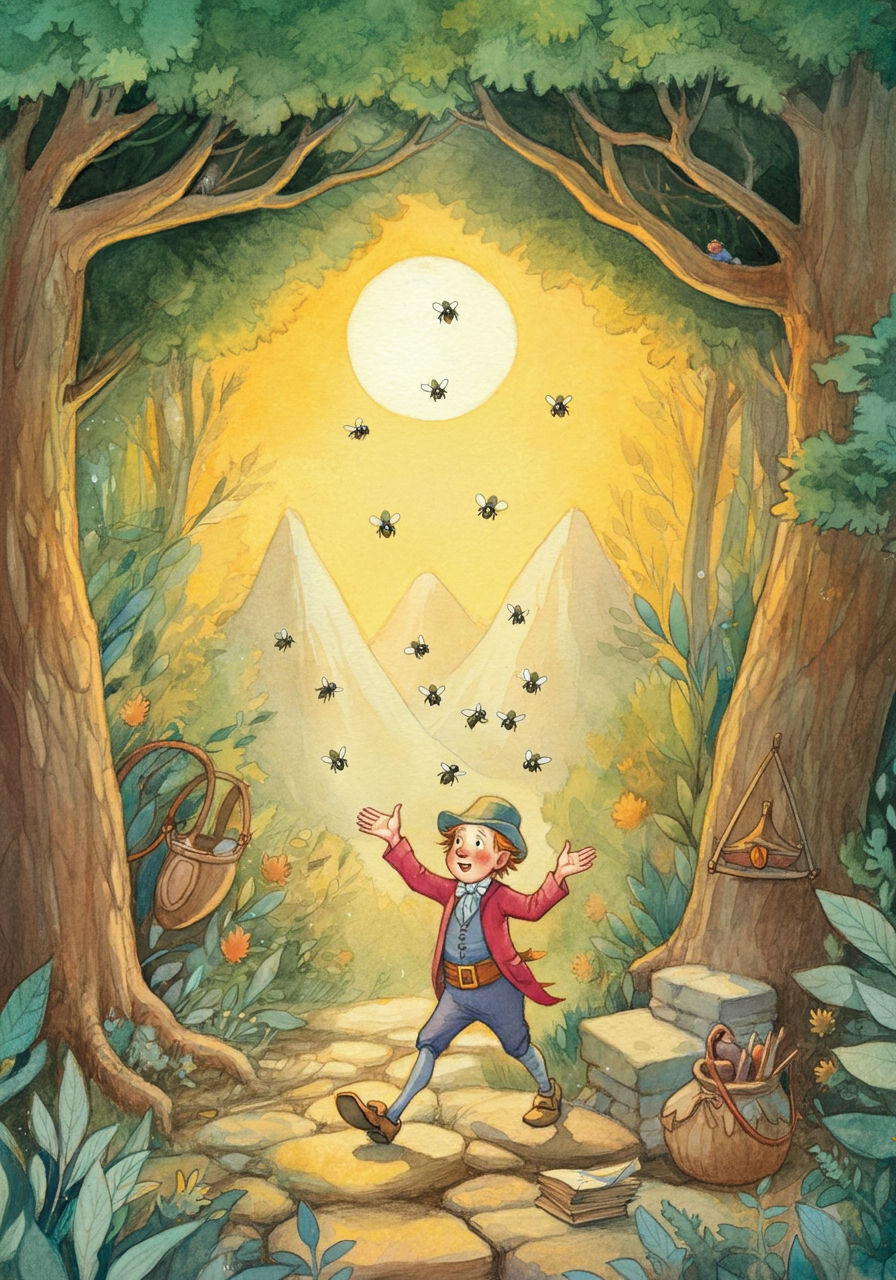
Once, a little tailor scared away seven flies with one clap. He put a belt on. It said, "Seven at one blow!" The Tailor went for a walk. He met a big Giant. "I am strong!" said the Giant. "I am stronger!" said the Tailor. The Giant squeezed a stone. Water came out. The Tailor squeezed cheese. Milk came out. The Giant threw a bird far. The Tailor threw a bird. It flew away! The Giant carried a tree. The Tailor jumped over it. The Giant ran away. The Tailor went to the King. He showed his belt. "Seven at one blow!" The King gave him a job. Other officers were scared of him. The King wanted him to go away. "Please scare two Giants," said the King. "You can marry my daughter." "Okay!" said the Tailor. The Tailor found the Giants sleeping. He threw stones at them. "Stop hitting me!" one Giant said. "I did not!" said the other Giant. They argued. They got very scared. They ran far away. The Tailor told the King. "Now catch a Unicorn," said the King. The Unicorn ran at the Tailor. The Tailor hid behind a tree. The Unicorn's horn got stuck in the tree. The Tailor tied a rope to it. He brought the Unicorn to the King. "Now catch a wild Boar," said the King. The Boar ran at the Tailor. The Tailor ran into a church. He ran out the window. The Boar ran in. The Tailor shut the door. The Boar was trapped! The King had to keep his promise. The Tailor married the Princess. He became a Prince. The Queen heard him talk in his sleep. "Make my coat!" he said. "Oh no! He is just a Tailor!" she said. She told the King. "Let's send him away," said the King. Some bad men listened. They waited outside the door at night. The Tailor was not asleep. "I am not scared!" he shouted. "I scared seven flies! I tricked Giants! I caught a Unicorn! I trapped a Boar! Why should I be scared of you?" The bad men heard him. They were very scared. They ran away fast. The Tailor stayed the Prince. Being clever helped him a lot. He was happy and smart.
Original Story
in. But the other officers resented the success of the little tailor, and wished him a thousand miles away. “What’s to come of it all?” they asked each other; “if we quarrel with him, he’ll let out at us, and at every blow seven will fall. There’ll soon be an end of us.” So they resolved to go in a body to the King, and all to send in their papers. “We are not made,” they said, “to hold out against a man who kills seven at a blow.” The King was grieved at the thought of losing all his faithful servants for the sake of one man, and he wished heartily that he had never set eyes on him, or that he could get rid of him. But he didn’t dare to send him away, for he feared he might kill him along with his people, and place himself on the throne. He pondered long and deeply over the matter, and finally came to a conclusion. He sent to the tailor and told him that, seeing what a great and warlike hero he was, he was about to make him an offer. In a certain wood of his kingdom there dwelled two giants who did much harm; by the way they robbed, murdered, burned, and plundered everything about them; “no one could approach them without endangering his life. But if he could overcome and kill these two giants he should have his only daughter for a wife, and half his kingdom into the bargain; he might have a hundred horsemen, too, to back him up.” “That’s the very thing for a man like me,” thought the little tailor; “one doesn’t get the offer of a beautiful princess and half a kingdom every day.” “Done with you,” he answered; “I’ll soon put an end to the giants. But I haven’t the smallest need of your hundred horsemen; a fellow who can slay seven men at a blow need not be afraid of two.” The little tailor set out, and the hundred horsemen followed him. When he came to the outskirts of the wood he said to his followers: “You wait here, I’ll manage the giants by myself”; and he went on into the wood, casting his sharp little eyes right and left about him. After a while he spied the two giants lying asleep under a tree, and snoring till the very boughs bent with the breeze. The little tailor lost no time in filling his wallet with stones, and then climbed up the tree under which they lay. When he got to about the middle of it he slipped along a branch till he sat just above the sleepers, when he threw down one stone after the other on the nearest giant. The giant felt nothing for a long time, but at last he woke up, and pinching his companion said: “What did you strike me for?” “I didn’t strike you,” said the other, “you must be dreaming.” They both lay down to sleep again, and the tailor threw down a stone on the second giant, who sprang up and cried: “What’s that for? Why did you throw something at me?” “I didn’t throw anything,” growled the first one. They wrangled on for a time, till, as both were tired, they made up the matter and fell asleep again. The little tailor began his game once more, and flung the largest stone he could find in his wallet with all his force, and hit the first giant on the chest. “This is too much of a good thing!” he yelled, and springing up like a madman, he knocked his companion against the tree till he trembled. He gave, however, as good as he got, and they became so enraged that they tore up trees and beat each other with them, till they both fell dead at once on the ground. Then the little tailor jumped down. “It’s a mercy,” he said, “that they didn’t root up the tree on which I was perched, or I should have had to jump like a squirrel on to another, which, nimble though I am, would have been no easy job.” He drew his sword and gave each of the giants a very fine thrust or two on the breast, and then went to the horsemen and said: “The deed is done, I’ve put an end to the two of them; but I assure you it has been no easy matter, for they even tore up trees in their struggle to defend themselves; but all that’s of no use against one who slays seven men at a blow.” “Weren’t you wounded?” asked the horsemen. “No fear,” answered the tailor; “they haven’t touched a hair of my head.” But the horsemen wouldn’t believe him till they rode into the wood and found the giants weltering in their blood, and the trees lying around, torn up by the roots. The little tailor now demanded the promised reward from the King, but he repented his promise, and pondered once more how he could rid himself of the hero. “Before you obtain the hand of my daughter and half my kingdom,” he said to him, “you must do another deed of valor. A unicorn is running about loose in the wood, and doing much mischief; you must first catch it.” “I’m even less afraid of one unicorn than of two giants; seven at a blow, that’s my motto.” He took a piece of cord and an axe with him, went out to the wood, and again told the men who had been sent with him to remain outside. He hadn’t to search long, for the unicorn soon passed by, and, on perceiving the tailor, dashed straight at him as though it were going to spike him on the spot. “Gently, gently,” said he, “not so fast, my friend”; and standing still he waited till the beast was quite near, when he sprang lightly behind a tree; the unicorn ran with all its force against the tree, and rammed its horn so firmly into the trunk that it had no strength left to pull it out again, and was thus successfully captured. “Now I’ve caught my bird,” said the tailor, and he came out from behind the tree, placed the cord round its neck first, then struck the horn out of the tree with his axe, and when everything was in order led the beast before the King. Still the King didn’t want to give him the promised reward and made a third demand. The tailor was to catch a wild boar for him that did a great deal of harm in the wood; and he might have the huntsmen to help him. “Willingly,” said the tailor; “that’s mere child’s play.” But he didn’t take the huntsmen into the wood with him, and they were well enough pleased to remain behind, for the wild boar had often received them in a manner which did not make them desire its further acquaintance. As soon as the boar perceived the tailor it ran at him with foaming mouth and gleaming teeth, and tried to knock him down; but our alert little friend ran into a chapel that stood near, and got out of the window again with a jump. The boar pursued him into the church, but the tailor skipped round to the door, and closed it securely. So the raging beast was caught, for it was far too heavy and unwieldy to spring out of the window. The little tailor summoned the huntsmen together, that they might see the prisoner with their own eyes. Then the hero betook himself to the King, who was obliged now, whether he liked it or not, to keep his promise, and hand him over his daughter and half his kingdom. Had he known that no hero-warrior, but only a little tailor stood before him, it would have gone even more to his heart. So the wedding was celebrated with much splendor and little joy, and the tailor became a king. After a time the Queen heard her husband saying one night in his sleep: “My lad, make that waistcoat and patch these trousers, or I’ll box your ears.” Thus she learned in what rank the young gentleman had been born, and next day she poured forth her woes to her father, and begged him to help her to get rid of a husband who was nothing more nor less than a tailor. The King comforted her, and said: “Leave your bedroom door open to-night, my servants shall stand outside, and when your husband is fast asleep they shall enter, bind him fast, and carry him on to a ship, which shall sail away out into the wide ocean.” The Queen was well satisfied with the idea, but the armor-bearer, who had overheard everything, being much attached to his young master, went straight to him and revealed the whole plot. “I’ll soon put a stop to the business,” said the tailor. That night he and his wife went to bed at the usual time; and when she thought he had fallen asleep she got up, opened the door, and then lay down again. The little tailor, who had only pretended to be asleep, began to call out in a clear voice: “My lad, make that waistcoat and patch those trousers, or I’ll box your ears. I have killed seven at a blow, slain two giants, led a unicorn captive, and caught a wild boar, then why should I be afraid of those men standing outside my door?” The men, when they heard the tailor saying these words, were so terrified that they fled as if pursued by a wild army, and didn’t dare go near him again. So the little tailor was and remained a king all the days of his life.
Moral of the Story
Cleverness and a bold reputation can overcome physical strength and social barriers, but maintaining the illusion requires constant vigilance.
Characters

The Little Tailor ★ protagonist
Small and nimble
Attire: Tailor's garb initially, later royal attire
Clever, resourceful, boastful

The King ⚔ antagonist
Regal bearing, but indecisive
Attire: Royal robes and crown
Greedy, fearful, untrustworthy

The Queen ◆ supporting
Beautiful, but unhappy
Attire: Elegant gowns and jewelry
Spoiled, disdainful, class-conscious

The Giants ⚔ antagonist
Enormous, brutish
Attire: Rough, tattered clothing
Violent, easily provoked, dim-witted

The Unicorn ⚔ antagonist
Powerful, with a sharp horn
Aggressive, easily tricked

The Wild Boar ⚔ antagonist
Large, with tusks
Fierce, relentless

The Armor-Bearer ◆ supporting
Loyal
Attire: Armor
Loyal, brave
Locations

Royal Palace
A place of splendor where the King resides and makes promises he regrets. Later, the Queen's bedroom is located here.
Mood: Initially grand and powerful, later filled with deceit and fear
The King makes impossible demands, the Queen plots against the tailor, and the tailor outsmarts them.

Giants' Wood
A dense forest with large trees, where two giants dwell, causing harm and destruction.
Mood: Dangerous, wild, and chaotic
The tailor outwits the giants, causing them to fight each other to the death.

Unicorn Wood
A forest where a unicorn roams freely, causing mischief.
Mood: Wild, untamed
The tailor tricks the unicorn into getting its horn stuck in a tree.

Chapel in the Woods
A small chapel located near the woods.
Mood: A place of refuge, unexpectedly used as a trap
The tailor uses the chapel to trap the wild boar.
Story DNA
Moral
Cleverness and a bold reputation can overcome physical strength and social barriers, but maintaining the illusion requires constant vigilance.
Plot Summary
A little tailor accidentally kills seven flies and, boasting 'Seven at one blow!' on his belt, sets out to seek his fortune. His exaggerated reputation precedes him, causing a giant to fear him and a King to employ him, albeit reluctantly. The King sends the tailor on three impossible tasks: killing two giants, capturing a unicorn, and catching a wild boar, all of which the tailor accomplishes through cunning rather than strength. Forced to marry his daughter to the tailor, the King plots to have him killed, but the tailor overhears and uses his fearsome reputation one last time to scare off the assassins, securing his position as king.
Themes
Emotional Arc
underestimated to triumphant
Writing Style
Narrative Elements
Cultural Context
This is a variant of 'The Brave Little Tailor' (Der tapfere Schneiderlein) collected by the Brothers Grimm, reflecting common folk motifs of the clever underdog triumphing over powerful adversaries.
Plot Beats (14)
- A tailor kills seven flies with one blow and embroiders 'Seven at one blow!' on his belt.
- He leaves home to seek his fortune, encountering a giant who challenges his strength.
- The tailor outwits the giant in strength tests (squeezing water from a stone, throwing a bird, carrying a tree) and escapes.
- He enters the King's service, where his reputation for killing 'seven at a blow' makes other officers fear him.
- The King, wanting to get rid of him, sends him to kill two dangerous giants, offering his daughter and half the kingdom.
- The tailor finds the giants asleep, pelts them with stones, and tricks them into fighting and killing each other.
- The King, still reluctant, sends him to catch a unicorn.
- The tailor tricks the unicorn into impaling its horn in a tree, then captures it.
- The King, still unwilling, sends him to catch a wild boar.
- The tailor lures the boar into a chapel and traps it by closing the door.
- The King is forced to marry his daughter to the tailor and give him half the kingdom.
- The Queen overhears the tailor talking in his sleep, revealing his humble origins, and plots with her father to have him killed.
- The tailor, feigning sleep, overhears the plot and loudly reiterates his 'seven at a blow' boast, intimidating the would-be assassins.
- The assassins flee, and the tailor remains king, his secret safe.


