The Red Etin
by Andrew Lang

The Red Etin
Once upon a time, there were two mothers. They were poor.
One mother had two sons. She told her oldest son to get water. He brought a little water. She baked a small cake.
"Take half with my love," she said. "Or take all, and I am not happy."
The son took the whole cake. His mother was sad. He gave his brother a knife. "Look at it," he said. "If it is clean, I am safe."
Then he left. He walked for a long time. He saw some animals. A man said, "A bad monster lives here. He is the Red Etin."
The son walked more. He saw scary creatures. He ran away. He found a big house. He went inside.
An old woman sat by the fire. "Hide," she said. "The Red Etin is bad."
The Red Etin came home. "I smell a person!" he said. He found the son.
"Answer my questions," said the Red Etin. "Or you cannot move."
The son did not know the answers. The Red Etin made him stop. He could not move.
The brother looked at the knife. It was not clean. He was sad.
He also went to get water. He brought a little water. His mother baked a small cake.
"Take half with my love," she said. "Or take all, and I am not happy."
He took the whole cake. He left. The same things happened. The Red Etin made him stop. He could not move.
Now, another young man heard this. He was the Young Hero. His mother gave him a can.
He went to get water. The can had a hole. He fixed the hole. He brought lots of water.
His mother baked a big cake. "Take half with my love," she said. "Or take all, and I am not happy."
The Young Hero took half. His mother was happy. The half cake was big.
He left. He met an old woman. He shared his food with her.
"Thank you," she said. She was a fairy. "Take this magic stick," she said. "You will be brave. You will win."
The fairy went away. The Young Hero walked on. He saw some animals. A man said, "The Red Etin is scared. You will beat him."
The Young Hero walked more. He saw the scary creatures. He was brave. He used his magic stick. The creatures went away.
He found the big house. He went inside. The old woman was there.
"Hide," she said. "The Red Etin is bad."
"I am not scared," said the Young Hero.
The Red Etin came home. "I smell a person!" he said.
"Answer my questions," said the Red Etin. "Or you cannot move."
The fairy had told him the answers. The Young Hero answered all the questions.
The Red Etin was scared. The Young Hero made the monster go away.
The old woman was happy. She showed him many rooms. The Princess was there. "Thank you for saving me," she said.
The old woman showed him two stone statues. The Young Hero touched them with his stick. His two friends could move again. They were happy.
They all went to the King. The Young Hero married the Princess. His friends married other nice women.
They were all happy. Being kind, smart, and brave helps you win. Being selfish is not good. And they all lived happily ever after.
Original Story
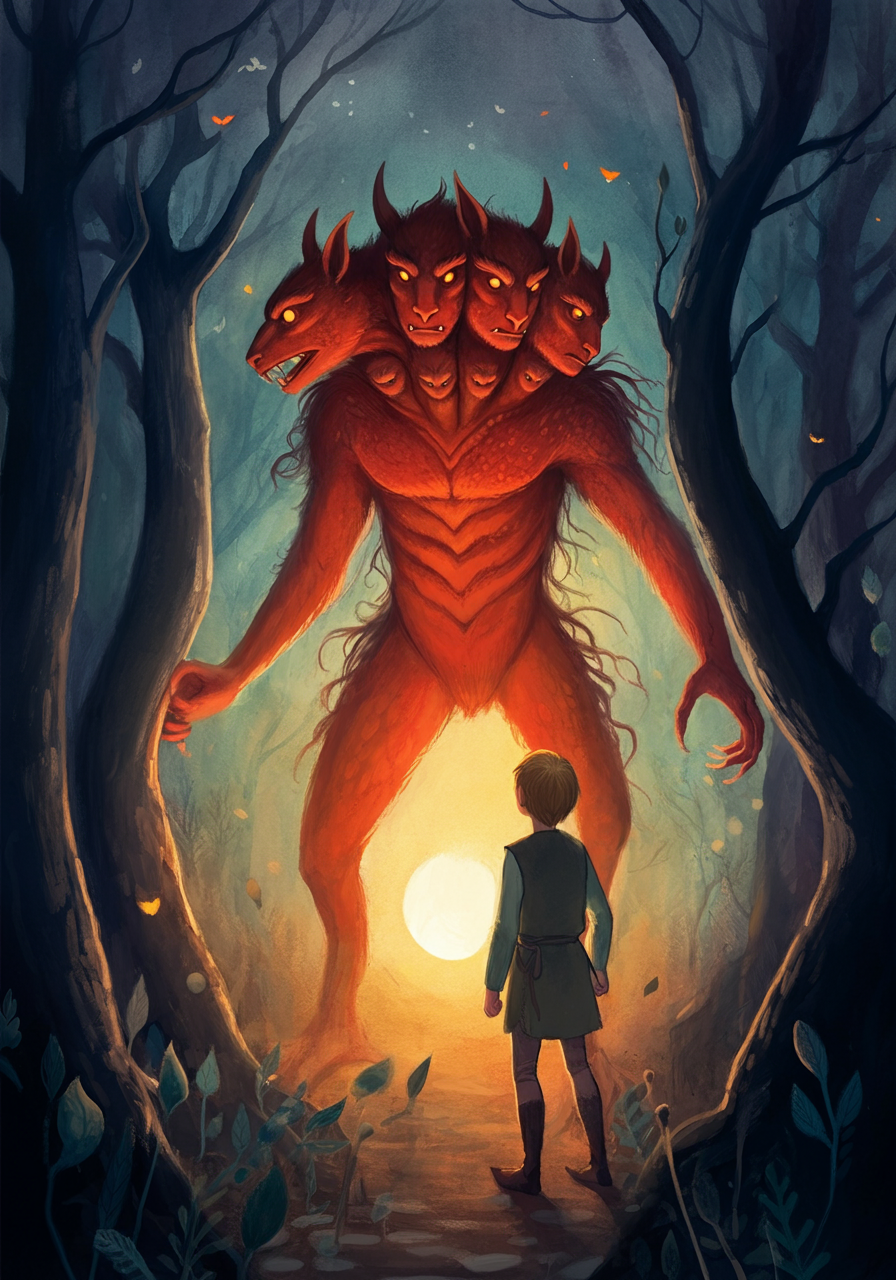
THE RED ETIN There were ance twa widows that lived on a small bit o’ ground, which they rented from a farmer. Ane of them had twa sons, and the other had ane; and by-and-by it was time for the wife that had twa sons to send them away to seeke their fortune. So she told her eldest son ae day to take a can and bring her water from the well, that she might bake a cake for him; and however much or however little water he might bring, the cake would be great or sma’ accordingly; and that cake was to be a’ that she could gie him when he went on his travels. The lad gaed away wi’ the can to the well, and filled it wi’ water, and then came away hame again; but the can being broken the maist part of the water had run out before he got back. So his cake was very sma’; yet sma’ as it was, his mother asked if he was willing to take the half of it with her blessing, telling him that, if he chose rather to have the hale, he would only get it wi’ her curse. The young man, thinking he might hae to travel a far way, and not knowing when or how he might get other provisions, said he would like to hae the hale cake, com of his mother’s malison what like; so she gave him the hale cake, and her malison alang wi’t. Then he took his brither aside, and gave him a knife to keep till he should come back, desiring him to look at it every morning, and as lang as it continued to be clear, then he might be sure that the owner of it was well; but if it grew dim and rusty, then for certain some ill had befallen him. So the young man set out to seek his fortune. And he gaed a’ that day, and a’ the next day; and on the third day, in the afternoon, he came up to where a shepherd was sitting with a flock o’ sheep. And he gaed up to the shepherd and asked him wha the sheep belanged to; and the man answered: “The Red Etin of Ireland Ance lived in Bellygan, And stole King Malcolm’s daughter, The King of fair Scotland. He beats her, he binds her, He lays her on a band; And every day he dings her With a bright silver wand Like Julian the Roman He’s one that fears no man. It’s said there’s ane predestinate To be his mortal foe; But that man is yet unborn And lang may it be so.” The young man then went on his journey; and he had not gone far when he espied an old man with white locks herding a flock of swine; and he gaed up to him and asked whose swine these were, when the man answered: “The Red Etin of Ireland”-- (Repeat the verses above.) Then the young man gaed on a bit farther, and came to another very old man herding goats; and when he asked whose goats they were, the answer was: “The Red Etin of Ireland”-- (Repeat the verses again.) This old man also told him to beware of the next beasts that he should meet, for they were of a very different kind from any he had yet seen. So the young man went on, and by-and-by he saw a multitude of very dreadfu’ beasts, ilk ane o’ them wi’ twa heads, and on every head four horns. And he was sore frightened, and ran away from them as fast as he could; and glad was he when he came to a castle that stood on a hillock, wi’ the door standing wide to the wa’. And he gaed into the castle for shelter, and there he saw an auld wife sitting beside the kitchen fire. He asked the wife if he might stay there for the night, as he was tired wi’ a lang journey; and the wife said he might, but it was not a good place for him to be in, as it belanged to the Red Etin, who was a very terrible beast, wi’ three heads, that spared no living man he could get hold of. The young man would have gone away, but he was afraid of the beasts on the outside of the castle; so he beseeched the old woman to conceal him as well as she could, and not to tell the Etin that he was there. He thought, if he could put over the night, he might get away in the morning without meeting wi’ the beasts, and so escape. But he had not been long in his hidy-hole before the awful Etin came in; and nae sooner was he in than he was heard crying: “Snouk but and snouk ben, I find the smell of an earthly man; Be he living, or be he dead, His heart this night shall kitchen(1) my bread.” (1) “Kitchen,” that is, “season.” The monster soon found the poor young man, and pulled him from his hole. And when he had got him out he told him that if he could answer him three questions his life should be spared. The first was: Whether Ireland or Scotland was first inhabited? The second was: Whether man was made for woman, or woman for man? The third was: Whether men or brutes were made first? The lad not being able to answer one of these questions, the Red Etin took a mace and knocked him on the head, and turned him into a pillar of stone. On the morning after this happened the younger brither took out the knife to look at it, and he was grieved to find it a’ brown wi’ rust. He told his mother that the time was now come for him to go away upon his travels also; so she requested him to take the can to the well for water, that she might bake a cake for him. The can being broken, he brought hame as little water as the other had done, and the cake was as little. She asked whether he would have the hale cake wi’ her malison, or the half wi’ her blessing; and, like his brither, he thought it best to have the hale cake, come o’ the malison what might. So he gaed away; and everything happened to him that had happened to his brother! The other widow and her son heard of a’ that had happened frae a fairy, and the young man determined that he would also go upon his travels, and see if he could do anything to relieve his twa friends. So his mother gave him a can to go to the well and bring home water, that she might bake him a cake for his journey. And he gaed, and as he was bringing hame the water, a raven owre abune his head cried to him to look, and he would see that the water was running out. And he was a young man of sense, and seeing the water running out, he took some clay and patched up the holes, so that he brought home enough water to bake a large cake. When his mother put it to him to take the half-cake wi’ her blessing, he took it in preference to having the hale wi’ her malison; and yet the half was bigger than what the other lads had got a’thegither. So he gaed away on his journey; and after he had traveled a far way he met wi’ an auld woman, that asked him if he would give her a bit of his bannock. And he said he would gladly do that, and so he gave her a piece of the bannock; and for that she gied him a magical wand, that she said might yet be of service to him if he took care to use it rightly. Then the auld woman, who was a fairy, told him a great deal that whould happen to him, and what he ought to do in a’ circumstances; and after that she vanished in an instant out o’ his sight. He gaed on a great way farther, and then he came up to the old man herding the sheep; and when he asked whose sheep these were, the answer was: “The Red Etin of Ireland Ance lived in Bellygan, And stole King Malcolm’s daughter, The King of fair Scotland. He beats her, he binds her, He lays her on a band; And every day he dings her With a bright silver wand. Like Julian the Roman, He’s one that fears no man, But now I fear his end is near, And destiny at hand; And you’re to be, I plainly see, The heir of all his land.” (Repeat the same inquiries to the man attending the swine and the man attending the goats, with the same answer in each case.) When he came to the place where the monstrous beasts were standing, he did not stop nor run away, but went boldly through among them. One came up roaring with open mouth to devour him, when he struck it with his wand, and laid it in an instant dead at his feet. He soon came to the Etin’s castle, where he knocked, and was admitted. The auld woman that sat by the fire warned him of the terrible Etin, and what had been the fate of the twa brithers; but he was not to be daunted. The monster soon came in, saying: “Snouk but and snouk ben, I find the smell of an earthly man; Be he living, or be he dead, His heart shall be kitchen to my bread.” He quickly espied the young man, and bade him come forth on the floor. And then he put the three questions to him, but the young man had been told everything by the good fairy, so he was able to answer all the questions. When the Etin found this he knew that his power was gone. The young man then took up the axe and hewed off the monster’s three heads. He next asked the old woman to show him where the King’s daughters lay; and the old woman took him upstairs and opened a great many doors, and out of every door came a beautiful lady who had been imprisoned there by the Etin; and ane o’ the ladies was the King’s daughter. She also took him down into a low room, and there stood two stone pillars that he had only to touch wi’ his wand, when his two friends and neighbors started into life. And the hale o’ the prisoners were overjoyed at their deliverance, which they all acknowledged to be owing to the prudent young man. Next day they a’ set out for the King’s Court, and a gallant company they made. And the King married his daughter to the young man that had delivered her, and gave a noble’s daughter to ilk ane o’ the other young men; and so they a’ lived happily a’ the rest o’ their days.(1) (1) Chambers, Popular Traditions of Scotland. *** END OF THE PROJECT GUTENBERG EBOOK THE BLUE FAIRY BOOK *** Updated editions will replace the previous one—the old editions will be renamed. Creating the works from print editions not protected by U.S. copyright law means that no one owns a United States copyright in these works, so the Foundation (and you!) can copy and distribute it in the United States without permission and without paying copyright royalties. Special rules, set forth in the General Terms of Use part of this license, apply to copying and distributing Project Gutenberg™ electronic works to protect the PROJECT GUTENBERG™ concept and trademark. Project Gutenberg is a registered trademark, and may not be used if you charge for an eBook, except by following the terms of the trademark license, including paying r
Moral of the Story
Good fortune often favors those who are wise, generous, and act with good intentions, while selfishness and foolishness can lead to ruin.
Characters

Red Etin ⚔ antagonist
Three heads
Attire: Unspecified, likely barbaric or fearsome
Terrible, merciless, riddle-obsessed

Youngest Son ★ protagonist
Not described, but implied to be strong and capable
Attire: Simple traveler's clothes, perhaps homespun
Prudent, brave, kind

King Malcolm's Daughter ◆ supporting
Beautiful
Attire: Fine dress, though perhaps worn from captivity
Distressed, regal

Old Wife ◆ supporting
Old and wizened
Attire: Simple, worn clothing
Helpful, fearful

Fairy ◆ supporting
Not described, but implied to be wise and powerful
Attire: Not described, but implied to be magical
Helpful, wise
Locations

The Well
A well where water is drawn, but the can is broken, leading to little water being brought back.
Mood: Neutral, a place of mundane tasks with fateful consequences.
The brothers fetch water, determining the size of their journey cakes; the hero patches the can.

Hillside Pasture
A hillside where an old shepherd, swineherd, and goatherd tend to flocks belonging to the Red Etin.
Mood: Ominous, foreboding, a place of warnings.
The hero learns about the Red Etin and his victims.

The Red Etin's Castle
A castle on a hillock with the door wide open, containing a kitchen with a fire and an old woman.
Mood: Dangerous, suspenseful, a prison.
The hero confronts the Red Etin, answers his riddles, and defeats him, freeing the prisoners.
Story DNA
Moral
Good fortune often favors those who are wise, generous, and act with good intentions, while selfishness and foolishness can lead to ruin.
Plot Summary
Two selfish brothers, seeking their fortune, are cursed by their mother and fall victim to the monstrous, three-headed Red Etin, who turns them to stone after they fail his riddles. A third, wise and generous young man, blessed by his mother and aided by a fairy with a magical wand, embarks on the same journey. Forewarned and prepared, he confronts the Red Etin, answers his riddles, and slays the monster. He then uses his wand to free the imprisoned ladies, including a King's daughter, and restore his friends, ultimately marrying the princess and living happily ever after.
Themes
Emotional Arc
suffering to triumph
Writing Style
Narrative Elements
Cultural Context
The story is presented as a traditional Scottish tale, likely passed down orally before being collected. The mention of King Malcolm grounds it loosely in Scottish history, though the events are fantastical.
Plot Beats (15)
- First widow's eldest son prepares for travel; his broken can yields little water, making a small cake. He chooses the whole cake with his mother's curse.
- He gives his brother a knife to monitor his well-being and sets off.
- He encounters three herders (sheep, swine, goats) who all recite a verse about the Red Etin's cruelty and the prophecy of his foe.
- He encounters two-headed beasts, flees to the Red Etin's castle, and is hidden by an old woman.
- The Red Etin arrives, smells an 'earthly man,' finds the son, and poses three riddles.
- Unable to answer, the first son is turned into a pillar of stone by the Red Etin.
- The second son's knife rusts, prompting him to leave. He repeats his brother's mistakes, choosing the whole cake with his mother's curse, and is also turned to stone by the Etin.
- The third widow's son prepares for travel; a raven warns him of his broken can, which he patches, securing enough water for a large cake.
- He chooses half the cake with his mother's blessing, which is still larger than the other brothers' full cakes.
- He shares his bannock with an old woman (a fairy) who gives him a magical wand and foretells his future, then vanishes.
- He encounters the same three herders, who now modify their verse to indicate the Red Etin's end is near and the hero is his destined foe.
- He bravely confronts the two-headed beasts, killing one with his wand, and enters the Red Etin's castle.
- The Red Etin arrives, smells him, and poses the three riddles, which the hero, forewarned by the fairy, answers correctly.
- The hero beheads the Red Etin with an axe, then uses his wand to free the imprisoned ladies (including the King's daughter) and restore his two friends from stone.
- The hero marries the King's daughter, his friends marry other noble daughters, and they all live happily ever after.


