The sleeping beauty in the wood
by Andrew Lang

The Sleeping Princess
A king and queen wanted a baby. They were sad for a long, long time. They wished and wished for a child. Then, one day, their wish came true! They had a baby girl. They were so very happy.
The king and queen had a big party. They invited seven kind fairies. Each fairy had a magic wand. They came to give the princess gifts. The first fairy said, "She will be pretty." The second fairy said, "She will be kind." The third fairy said, "She will be happy." The fourth fairy gave her a gift of song. The fifth fairy gave her a gift of dance. The sixth fairy gave her a gift of laughter. The seventh fairy gave her a gift of love. The other fairies gave more happy gifts.
Then a grumpy fairy came. She was not invited. She was very cross. "Hmph!" she said. "I have a gift too. The princess will prick her finger. Then she will sleep for a hundred years!"
All the people were scared. A kind fairy stepped forward. "Do not worry," she said. "My gift can help. The princess will not sleep for all time. A prince will come. He will wake her up."
The king wanted to be safe. He put all the spindles away. "No more spinning!" he said. The princess grew up. She was a happy child. She was pretty. She was kind. She was full of joy. One day, she found a room. An old woman was inside. She was spinning thread. "What is that?" asked the princess. She touched the spindle. It was a gentle touch. She felt very sleepy. She fell down. She was asleep.
The kind fairy came back. She waved her magic wand. She put the whole castle to sleep. The king slept. The queen slept. All the people slept. The cook slept. The dogs slept. The cats slept. The horses in the stable slept. A thick, magic forest grew around it. It grew fast. The trees and vines hid the castle. The princess slept and slept. Everyone slept for a long, long time.
A hundred years passed. A prince heard the story. He liked the story very much. He wanted to find the sleeping princess. He went to find the castle. He went to the forest. The vines and bushes moved for him. They made a path just for him. He found the old castle. It was quiet and still.
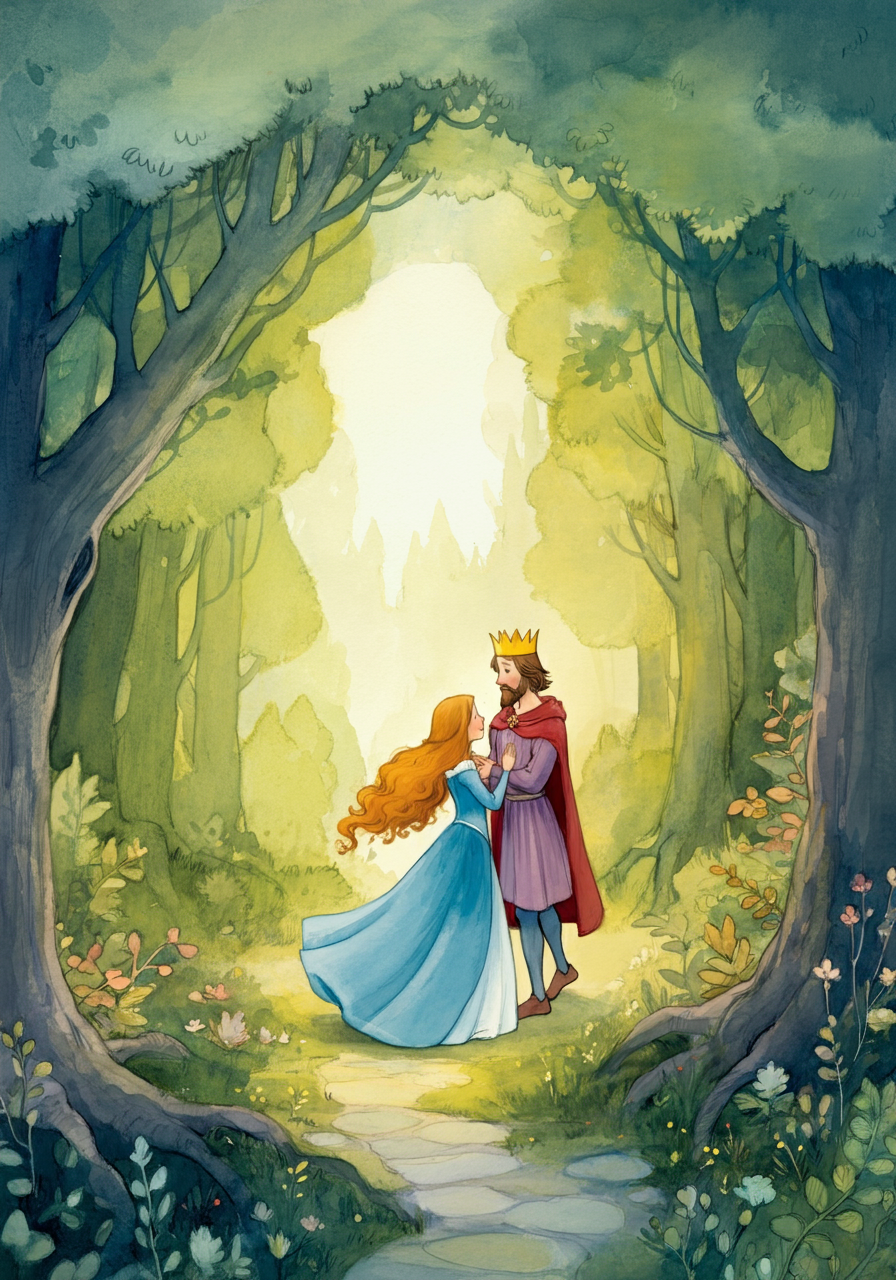
He went inside. He found the sleeping princess. She was so pretty. He leaned down. He kissed her on the head. She woke up! "Hello," she said. Everyone in the castle woke up too. The king woke up. The queen woke up. The cook woke up. The dogs barked. The cats meowed. The horses neighed. The prince and princess were happy. They got married. It was a beautiful wedding.
They had two children. Their names were Sunny and Sky. The prince's mother was the Queen Grandma. She was a strict grandma. The prince kept his family secret.
Then, the king had to go away. He went on a long trip. The prince had to go too. "Please care for my family," he said.
The Queen Grandma was not kind. She did not like the princess. She wanted to send Sunny away. The cook was a nice man. He heard her plan. He hid Sunny in his little house. He gave the grandma a doll instead. "Here is Sunny," he said.
Next, she wanted to send Sky away. The cook hid Sky too. He gave the grandma one more doll.
Then, the grandma wanted to send the princess away. The cook was worried. He told the princess the plan. He hid her with her children. They were all safe together in his little house.
The grandma found out. She was very angry. "Go to your rooms!" she shouted. "No supper for you!"
Just then, the prince came home. He saw everything. He looked at his mother. The grandma felt sorry. "I was wrong," she said. "I am sorry." She became nice. She hugged the princess. She hugged Sunny and Sky. She said she would be kind from now on.
They all lived together in the castle. They were happy and kind. Love and patience can fix everything. Being kind is always better than being mean. And they all lived happily ever after. The end.
Original Story
THE SLEEPING BEAUTY IN THE WOOD There were formerly a king and a queen, who were so sorry that they had no children; so sorry that it cannot be expressed. They went to all the waters in the world; vows, pilgrimages, all ways were tried, and all to no purpose. At last, however, the Queen had a daughter. There was a very fine christening; and the Princess had for her god-mothers all the fairies they could find in the whole kingdom (they found seven), that every one of them might give her a gift, as was the custom of fairies in those days. By this means the Princess had all the perfections imaginable. After the ceremonies of the christening were over, all the company returned to the King’s palace, where was prepared a great feast for the fairies. There was placed before every one of them a magnificent cover with a case of massive gold, wherein were a spoon, knife, and fork, all of pure gold set with diamonds and rubies. But as they were all sitting down at table they saw come into the hall a very old fairy, whom they had not invited, because it was above fifty years since she had been out of a certain tower, and she was believed to be either dead or enchanted. The King ordered her a cover, but could not furnish her with a case of gold as the others, because they had only seven made for the seven fairies. The old Fairy fancied she was slighted, and muttered some threats between her teeth. One of the young fairies who sat by her overheard how she grumbled; and, judging that she might give the little Princess some unlucky gift, went, as soon as they rose from table, and hid herself behind the hangings, that she might speak last, and repair, as much as she could, the evil which the old Fairy might intend. In the meanwhile all the fairies began to give their gifts to the Princess. The youngest gave her for gift that she should be the most beautiful person in the world; the next, that she should have the wit of an angel; the third, that she should have a wonderful grace in everything she did; the fourth, that she should dance perfectly well; the fifth, that she should sing like a nightingale; and the sixth, that she should play all kinds of music to the utmost perfection. The old Fairy’s turn coming next, with a head shaking more with spite than age, she said that the Princess should have her hand pierced with a spindle and die of the wound. This terrible gift made the whole company tremble, and everybody fell a-crying. At this very instant the young Fairy came out from behind the hangings, and spake these words aloud: “Assure yourselves, O King and Queen, that your daughter shall not die of this disaster. It is true, I have no power to undo entirely what my elder has done. The Princess shall indeed pierce her hand with a spindle; but, instead of dying, she shall only fall into a profound sleep, which shall last a hundred years, at the expiration of which a king’s son shall come and awake her.” The King, to avoid the misfortune foretold by the old Fairy, caused immediately proclamation to be made, whereby everybody was forbidden, on pain of death, to spin with a distaff and spindle, or to have so much as any spindle in their houses. About fifteen or sixteen years after, the King and Queen being gone to one of their houses of pleasure, the young Princess happened one day to divert herself in running up and down the palace; when going up from one apartment to another, she came into a little room on the top of the tower, where a good old woman, alone, was spinning with her spindle. This good woman had never heard of the King’s proclamation against spindles. “What are you doing there, goody?” said the Princess. “I am spinning, my pretty child,” said the old woman, who did not know who she was. “Ha!” said the Princess, “this is very pretty; how do you do it? Give it to me, that I may see if I can do so.” She had no sooner taken it into her hand than, whether being very hasty at it, somewhat unhandy, or that the decree of the Fairy had so ordained it, it ran into her hand, and she fell down in a swoon. The good old woman, not knowing very well what to do in this affair, cried out for help. People came in from every quarter in great numbers; they threw water upon the Princess’s face, unlaced her, struck her on the palms of her hands, and rubbed her temples with Hungary-water; but nothing would bring her to herself. And now the King, who came up at the noise, bethought himself of the prediction of the fairies, and, judging very well that this must necessarily come to pass, since the fairies had said it, caused the Princess to be carried into the finest apartment in his palace, and to be laid upon a bed all embroidered with gold and silver. One would have taken her for a little angel, she was so very beautiful; for her swooning away had not diminished one bit of her complexion; her cheeks were carnation, and her lips were coral; indeed, her eyes were shut, but she was heard to breathe softly, which satisfied those about her that she was not dead. The King commanded that they should not disturb her, but let her sleep quietly till her hour of awaking was come. The good Fairy who had saved her life by condemning her to sleep a hundred years was in the kingdom of Matakin, twelve thousand leagues off, when this accident befell the Princess; but she was instantly informed of it by a little dwarf, who had boots of seven leagues, that is, boots with which he could tread over seven leagues of ground in one stride. The Fairy came away immediately, and she arrived, about an hour after, in a fiery chariot drawn by dragons. The King handed her out of the chariot, and she approved everything he had done, but as she had very great foresight, she thought when the Princess should awake she might not know what to do with herself, being all alone in this old palace; and this was what she did: she touched with her wand everything in the palace (except the King and Queen)--governesses, maids of honor, ladies of the bedchamber, gentlemen, officers, stewards, cooks, undercooks, scullions, guards, with their beefeaters, pages, footmen; she likewise touched all the horses which were in the stables, pads as well as others, the great dogs in the outward court and pretty little Mopsey too, the Princess’s little spaniel, which lay by her on the bed. Immediately upon her touching them they all fell asleep, that they might not awake before their mistress and that they might be ready to wait upon her when she wanted them. The very spits at the fire, as full as they could hold of partridges and pheasants, did fall asleep also. All this was done in a moment. Fairies are not long in doing their business. And now the King and the Queen, having kissed their dear child without waking her, went out of the palace and put forth a proclamation that nobody should dare to come near it. This, however, was not necessary, for in a quarter of an hour’s time there grew up all round about the park such a vast number of trees, great and small, bushes and brambles, twining one within another, that neither man nor beast could pass through; so that nothing could be seen but the very top of the towers of the palace; and that, too, not unless it was a good way off. Nobody; doubted but the Fairy gave herein a very extraordinary sample of her art, that the Princess, while she continued sleeping, might have nothing to fear from any curious people. When a hundred years were gone and passed the son of the King then reigning, and who was of another family from that of the sleeping Princess, being gone a-hunting on that side of the country, asked: What those towers were which he saw in the middle of a great thick wood? Everyone answered according as they had heard. Some said: That it was a ruinous old castle, haunted by spirits. Others, That all the sorcerers and witches of the country kept there their sabbath or night’s meeting. The common opinion was: That an ogre lived there, and that he carried thither all the little children he could catch, that he might eat them up at his leisure, without anybody being able to follow him, as having himself only the power to pass through the wood. The Prince was at a stand, not knowing what to believe, when a very good countryman spake to him thus: “May it please your royal highness, it is now about fifty years since I heard from my father, who heard my grandfather say, that there was then in this castle a princess, the most beautiful was ever seen; that she must sleep there a hundred years, and should be waked by a king’s son, for whom she was reserved.” The young Prince was all on fire at these words, believing, without weighing the matter, that he could put an end to this rare adventure; and, pushed on by love and honor, resolved that moment to look into it. Scarce had he advanced toward the wood when all the great trees, the bushes, and brambles gave way of themselves to let him pass through; he walked up to the castle which he saw at the end of a large avenue which he went into; and what a little surprised him was that he saw none of his people could follow him, because the trees closed again as soon as he had passed through them. However, he did not cease from continuing his way; a young and amorous prince is always valiant. He came into a spacious outward court, where everything he saw might have frozen the most fearless person with horror. There reigned all over a most frightful silence; the image of death everywhere showed itself, and there was nothing to be seen but stretched-out bodies of men and animals, all seeming to be dead. He, however, very well knew, by the ruby faces and pimpled noses of the beefeaters, that they were only asleep; and their goblets, wherein still remained some drops of wine, showed plainly that they fell asleep in their cups. He then crossed a court paved with marble, went up the stairs and came into the guard chamber, where guards were standing in their ranks, with their muskets upon their shoulders, and snoring as loud as they could. After that he went through several rooms full of gentlemen and ladies, all asleep, some standing, others sitting. At last he came into a chamber all gilded with gold, where he saw upon a bed, the curtains of which were all open, the finest sight was ever beheld--a princess, who appeared to be about fifteen or sixteen years of age, and whose bright and, in a manner, resplendent beauty, had somewhat in it divine. He approached with trembling and admiration, and fell down before her upon his knees. And now, as the enchantment was at an end, the Princess awaked, and looking on him with eyes more tender than the first view might seem to admit of: “Is it you, my Prince?” said she to him. “You have waited a long while.” The Prince, charmed with these words, and much more with the manner in which they were spoken, knew not how to show his joy and gratitude; he assured her that he loved her better than he did himself; their discourse was not well connected, they did weep more than talk--little eloquence, a great deal of love. He was more at a loss than she, and we need not wonder at it; she had time to think on what to say to him; for it is very probable (though history mentions nothing of it) that the good Fairy, during so long a sleep, had given her very agreeable dreams. In short, they talked four hours together, and yet they said not half what they had to say. In the meanwhile all the palace awaked; everyone thought upon their particular business, and as all of them were not in love they were ready to die for hunger. The chief lady of honor, being as sharp set as other folks, grew very impatient, and told the Princess aloud that supper was served up. The Prince helped the Princess to rise; she was entirely dressed, and very magnificently, but his royal highness took care not to tell her that she was dressed like his great-grandmother, and had a point band peeping over a high collar; she looked not a bit less charming and beautiful for all that. They went into the great hall of looking-glasses, where they supped, and were served by the Princess’s officers, the violins and hautboys played old tunes, but very excellent, though it was now above a hundred years since they had played; and after supper, without losing any time, the lord almoner married them in the chapel of the castle, and the chief lady of honor drew the curtains. They had but very little sleep--the Princess had no occasion; and the Prince left her next morning to return to the city, where his father must needs have been in pain for him. The Prince told him: That he lost his way in the forest as he was hunting, and that he had lain in the cottage of a charcoal-burner, who gave him cheese and brown bread. The King, his father, who was a good man, believed him; but his mother could not be persuaded it was true; and seeing that he went almost every day a-hunting, and that he always had some excuse ready for so doing, though he had lain out three or four nights together, she began to suspect that he was married, for he lived with the Princess above two whole years, and had by her two children, the eldest of which, who was a daughter, was named Morning, and the youngest, who was a son, they called Day, because he was a great deal handsomer and more beautiful than his sister. The Queen spoke several times to her son, to inform herself after what manner he did pass his time, and that in this he ought in duty to satisfy her. But he never dared to trust her with his secret; he feared her, though he loved her, for she was of the race of the Ogres, and the King would never have married her had it not been for her vast riches; it was even whispered about the Court that she had Ogreish inclinations, and that, whenever she saw little children passing by, she had all the difficulty in the world to avoid falling upon them. And so the Prince would never tell her one word. But when the King was dead, which happened about two years afterward, and he saw himself lord and master, he openly declared his marriage; and he went in great ceremony to conduct his Queen to the palace. They made a magnificent entry into the capital city, she riding between her two children. Soon after the King went to make war with the Emperor Contalabutte, his neighbor. He left the government of the kingdom to the Queen his mother, and earnestly recommended to her care his wife and children. He was obliged to continue his expedition all the summer, and as soon as he departed the Queen-mother sent her daughter-in-law to a country house among the woods, that she might with the more ease gratify her horrible longing. Some few days afterward she went thither herself, and said to her clerk of the kitchen: “I have a mind to eat little Morning for my dinner to-morrow.” “Ah! madam,” cried the clerk of the kitchen. “I will have it so,” replied the Queen (and this she spoke in the tone of an Ogress who had a strong desire to eat fresh meat), “and will eat her with a sauce Robert.” The poor man, knowing very well that he must not play tricks with Ogresses, took his great knife and went up into little Morning’s chamber. She was then four years old, and came up to him jumping and laughing, to take him about the neck, and ask him for some sugar-candy. Upon which he began to weep, the great knife fell out of his hand, and he went into the back yard, and killed a little lamb, and dressed it with such good sauce that his mistress assured him that she had never eaten anything so good in her life. He had at the same time taken up little Morning, and carried her to his wife, to conceal her in the lodging he had at the bottom of the courtyard. About eight days afterward the wicked Queen said to the clerk of the kitchen, “I will sup on little Day.” He answered not a word, being resolved to cheat her as he had done before. He went to find out little Day, and saw him with a little foil in his hand, with which he was fencing with a great monkey, the child being then only three years of age. He took him up in his arms and carried him to his wife, that she might conceal him in her chamber along with his sister, and in the room of little Day cooked up a young kid, very tender, which the Ogress found to be wonderfully good. This was hitherto all mighty well; but one evening this wicked Queen said to her clerk of the kitchen: “I will eat the Queen with the same sauce I had with her children.” It was now that the poor clerk of the kitchen despaired of being able to deceive her. The young Queen was turned of twenty, not reckoning the hundred years she had been asleep; and how to find in the yard a beast so firm was what puzzled him. He took then a resolution, that he might save his own life, to cut the Queen’s throat; and going up into her chamber, with intent to do it at once, he put himself into as great fury as he could possibly, and came into the young Queen’s room with his dagger in his hand. He would not, however, surprise her, but told her, with a great deal of respect, the orders he had received from the Queen-mother. “Do it; do it” (said she, stretching out her neck). “Execute your orders, and then I shall go and see my children, my poor children, whom I so much and so tenderly loved.” For she thought them dead ever since they had been taken away without her knowledge. “No, no, madam” (cried the poor clerk of the kitchen, all in tears); “you shall not die, and yet you shall see your children again; but then you must go home with me to my lodgings, where I have concealed them, and I shall deceive the Queen once more, by giving her in your stead a young hind.” Upon this he forthwith conducted her to his chamber, where, leaving her to embrace her children, and cry along with them, he went and dressed a young hind, which the Queen had for her supper, and devoured it with the same appetite as if it had been the young Queen. Exceedingly was she delighted with her cruelty, and she had invented a story to tell the King, at his return, how the mad wolves had eaten up the Queen his wife and her two children. One evening, as she was, according to her custom, rambling round about the courts and yards of the palace to see if she could smell any fresh meat, she heard, in a ground room, little Day crying, for his mamma was going to whip him, because he had been naughty; and she heard, at the same time, little Morning begging pardon for her brother. The Ogress presently knew the voice of the Queen and her children, and being quite mad that she had been thus deceived, she commanded next morning, by break of day (with a most horrible voice, which made everybody tremble), that they should bring into the middle of the great court a large tub, which she caused to be filled with toads, vipers, snakes, and all sorts of serpents, in order to have thrown into it the Queen and her children, the clerk of the kitchen, his wife and maid; all whom she had given orders should be brought thither with their hands tied behind them. They were brought out accordingly, and the executioners were just going to throw them into the tub, when the King (who was not so soon expected) entered the court on horseback (for he came post) and asked, with the utmost astonishment, what was the meaning of that horrible spectacle. No one dared to tell him, when the Ogress, all enraged to see what had happened, threw herself head foremost into the tub, and was instantly devoured by the ugly creatures she had ordered to be thrown into it for others. The King could not but be very sorry, for she was his mother; but he soon comforted himself with his beautiful wife and his pretty children.
Moral of the Story
Even the most dire curses can be overcome by love and the passage of time, but evil, when unchecked, will ultimately consume itself.
Characters

Princess ★ protagonist
Exceedingly beautiful, cheeks were carnation, and her lips were coral
Attire: Royal garments befitting a princess of the time, embroidered with gold and silver
Curious, hasty, trusting

Old Fairy ⚔ antagonist
Head shaking with spite
Attire: Traditional fairy robes, perhaps tattered or old-fashioned
Spiteful, resentful, vengeful

Young Fairy ◆ supporting
Implied beauty and grace
Attire: Elegant fairy gown, possibly shimmering or iridescent
Kind, compassionate, resourceful

King ◆ supporting
Regal bearing
Attire: Royal attire, crown, scepter
Anxious, protective, decisive

Queen-Mother ⚔ antagonist
Described as an Ogress
Attire: Regal garments, but perhaps disheveled or ill-fitting
Cruel, monstrous, deceitful

Clerk of the Kitchen ◆ supporting
Likely stout from his profession
Attire: Kitchen apron, working clothes
Kind, resourceful, conflicted

Prince ◆ supporting
Brave and handsome
Attire: Princely attire, armor
Brave, determined, initially foolish

Little Morning ○ minor
Young and innocent
Attire: Simple children's clothes
Sweet, innocent
Locations

King's Palace Feast Hall
A magnificent hall with a long table set for a feast. Each fairy has a cover with a case of massive gold, containing a spoon, knife, and fork of pure gold set with diamonds and rubies.
Mood: grand, celebratory, tense
The fairies bestow gifts upon the Princess, and the old fairy curses her.

Tower Room
A little room on the top of the tower, containing a good old woman spinning with her spindle.
Mood: isolated, fateful
The Princess pricks her finger on the spindle and falls into a deep sleep.

Finest Apartment
The finest apartment in the palace, containing a bed all embroidered with gold and silver.
Mood: peaceful, still, magical
The Princess is laid to rest for 100 years.

Country House Among the Woods
A secluded house surrounded by dense woods.
Mood: isolated, ominous
The Queen and her children are sent here by the Queen-mother.

Palace Courtyard
A large courtyard in the middle of the palace.
Mood: horrific, tense
The Queen-mother is about to execute the Queen and her children when the King arrives.
Story DNA
Moral
Even the most dire curses can be overcome by love and the passage of time, but evil, when unchecked, will ultimately consume itself.
Plot Summary
A King and Queen's long-awaited daughter is cursed by an uninvited old fairy to die by spindle, a fate mitigated by a good fairy to a hundred-year sleep. At 15, the Princess pricks her finger and the entire castle falls asleep, protected by a magical forest. A century later, a Prince discovers and awakens her with a kiss. They secretly marry and have two children, but the Prince's Ogress mother attempts to devour them. The loyal clerk of the kitchen repeatedly thwarts her, until the King returns, and the Ogress, enraged, falls into her own trap, allowing the family to live happily.
Themes
Emotional Arc
suffering to triumph
Writing Style
Narrative Elements
Cultural Context
This version, collected by Andrew Lang, is a translation of Charles Perrault's 'La Belle au bois dormant' (1697), which itself draws on earlier oral traditions and Giambattista Basile's 'Sole, Luna, e Talia' (1634). The second part of the story, involving the Ogress mother-in-law, is a distinct feature of Perrault's version and older variants, often omitted in more modern retellings.
Plot Beats (15)
- A King and Queen, after much sorrow, have a daughter.
- Seven good fairies are invited to the christening to bestow gifts; an eighth, old and uninvited, arrives.
- The good fairies bestow gifts of beauty, wit, grace, dancing, singing, and musical talent.
- The old fairy curses the princess to die by pricking her hand on a spindle.
- The youngest good fairy modifies the curse: the princess will fall into a 100-year sleep, to be awakened by a king's son.
- The King bans all spindles, but at 15 or 16, the Princess finds an old woman spinning in a tower, pricks her finger, and falls asleep.
- The good fairy returns and puts the entire castle, including all inhabitants and animals, to sleep, and a dense, thorny forest grows around the castle.
- After 100 years, a Prince hears the legend of the sleeping castle and braves the now-parted thorny forest.
- The Prince finds the sleeping Princess, kisses her, and she awakens, along with the entire castle.
- The Prince and Princess marry in secret and have two children, Morning and Day, while the Prince keeps his marriage hidden from his Ogress mother.
- Upon the King's death, the Prince brings his family to the palace, but then leaves for war, entrusting them to his Ogress mother.
- The Ogress Queen-mother orders the clerk of the kitchen to prepare Morning, then Day, and finally the Queen herself, for her to eat.
- The clerk of the kitchen substitutes a lamb, a kid, and a hind for the family, hiding the Queen and children in his lodging.
- The Ogress Queen-mother overhears the children and discovers the deception, ordering the family and the clerk's household to be thrown into a tub of venomous creatures.
- The King returns unexpectedly, and the Ogress, in a rage, throws herself into the tub and is devoured, allowing the King, Queen, and children to live in peace.


