The terrible head
by Andrew Lang

Perseus and the Magic Stone Head
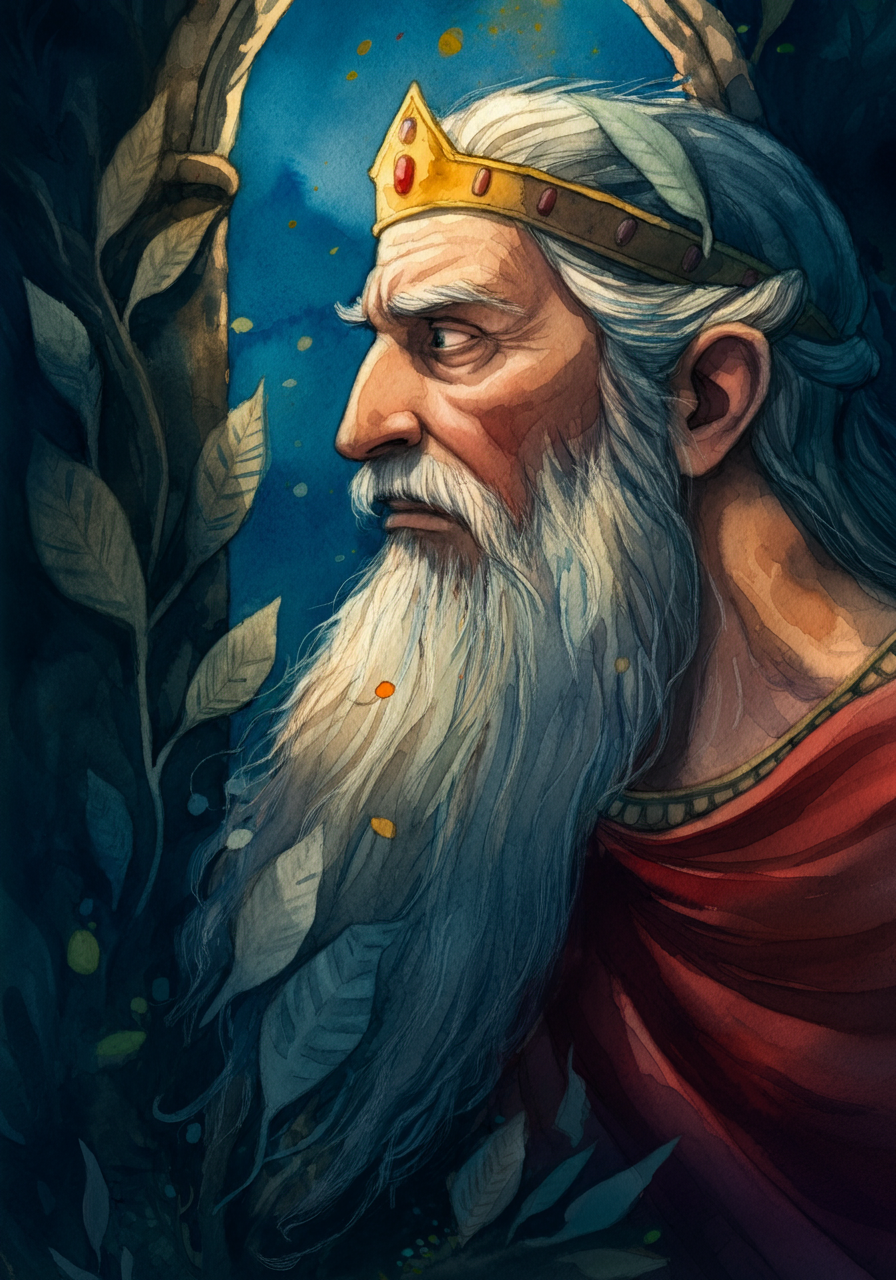
Once upon a time, there was a king. He had a scary dream one night. In the dream, he saw trouble. He dreamed her baby would be a problem. So he put her in a tall tower. He wanted to keep her safe. The tower was very tall and strong. It had one big window. The princess could see the sky. She felt lonely sometimes.
One day, a golden light filled the room. It was warm and bright. Soon, the mother had a baby boy. She named him Perseus. The king was very scared. He remembered his dream. He put them in a small boat. He sent them away on the sea. They sailed for a long time. The waves were big and blue.
A kind fish man found them. He was fishing in his boat. He took them to his island home. The island was green and sunny. He was very nice to them. He gave them food and shelter. Perseus grew up happy and strong. He played on the beach. He grew up kind and brave. He helped the fish man every day.
The island king liked Perseus's mother. He wanted to marry her. He made a sneaky plan. He told Perseus to bring a magic head. "Bring it to prove bravery," said the king. The king smiled slyly. Perseus said he would do it. He wanted to help his mother. He promised to be brave.
Perseus felt worried. He walked by the sea. The water was calm. Two magic friends appeared. They were kind and helpful. They had shiny wings. They gave him flying shoes. They gave him a hidden cap. They gave him a shiny shield. "Use these to help you," they said. "You can do it," they added. Perseus thanked them.
Perseus flew to find the stone monster. He flew over mountains and clouds. He used his shiny shield. He looked at the monster in the shield. He did not look right at it. That was important. He saw the magic stone head. It was glowing softly. He took it with care. He put it in his bag. He was very careful.
The other monsters woke up. They were loud and scary. They made hissing sounds. Perseus put on his hidden cap. He wore his flying shoes. He flew away very fast. The monsters could not find him. He was safe in the sky. He flew back towards the island.
Perseus flew over the sea. The sun was setting. He saw a girl tied to a rock. She was the Saved Princess. She looked scared. A big sea dragon was coming. It had big teeth. Perseus flew down quickly. He cut the rope with his shiny shield. He stood in front of the princess. He was brave. He told her not to worry.
The sea dragon jumped out of the water. Perseus showed it the magic stone head. The dragon became still. It turned into a stone statue. The Saved Princess was safe. She was very happy. She thanked Perseus. Perseus was happy too. They became good friends. They talked and laughed. Later, they got married with joy. It was a sunny day.
Perseus and his wife returned to the island. They sailed on a blue boat. They found Perseus's mother. She was hiding from the island king. She was in a small cave. The island king was mean. He tried to hurt her. She was scared. She was glad to see Perseus.
Perseus stood in front of his mother. He showed the island king the magic head. The king became still. He turned into a stone statue. Everyone was free. Everyone was happy. They all smiled. They had a big party. There was food and music.
They sailed to the first kingdom. The sea was calm and blue. They visited the old king. The old king was Perseus's grandpa. He was having games in the garden. There were many people. Perseus played a ring game. He threw a ring. It accidentally bumped the old king's hat. The hat fell off.
The old king laughed loudly. "My scary dream is over!" he said. "It happened in a good way." Everyone was happy. They clapped their hands. The old story was finished. There was no more fear. They all felt safe.
Perseus, his mother, and his wife went home. They lived in a big house. They lived in peace. They were very kind. They were very brave. They helped others every day. They shared food and stories. They were happy every day. And they all lived happily ever after. The end.
Original Story
THE TERRIBLE HEAD Once upon a time there was a king whose only child was a girl. Now the King had been very anxious to have a son, or at least a grandson, to come after him, but he was told by a prophet whom he consulted that his own daughter’s son should kill him. This news terrified him so much that he determined never to let his daughter be married, for he thought it was better to have no grandson at all than to be killed by his grandson. He therefore called his workmen together, and bade them dig a deep round hole in the earth, and then he had a prison of brass built in the hole, and then, when it was finished, he locked up his daughter. No man ever saw her, and she never saw even the fields and the sea, but only the sky and the sun, for there was a wide open window in the roof of the house of brass. So the Princess would sit looking up at the sky, and watching the clouds float across, and wondering whether she should ever get out of her prison. Now one day it seemed to her that the sky opened above her, and a great shower of shining gold fell through the window in the roof, and lay glittering in her room. Not very long after, the Princess had a baby, a little boy, but when the King her father heard of it he was very angry and afraid, for now the child was born that should be his death. Yet, cowardly as he was, he had not quite the heart to kill the Princess and her baby outright, but he had them put in a huge brass-bound chest and thrust out to sea, that they might either be drowned or starved, or perhaps come to a country where they would be out of his way. So the Princess and the baby floated and drifted in the chest on the sea all day and night, but the baby was not afraid of the waves nor of the wind, for he did not know that they could hurt him, and he slept quite soundly. And the Princess sang a song over him, and this was her song: “Child, my child, how sound you sleep! Though your mother’s care is deep, You can lie with heart at rest In the narrow brass-bound chest; In the starless night and drear You can sleep, and never hear Billows breaking, and the cry Of the night-wind wandering by; In soft purple mantle sleeping With your little face on mine, Hearing not your mother weeping And the breaking of the brine.” Well, the daylight came at last, and the great chest was driven by the waves against the shore of an island. There the brass-bound chest lay, with the Princess and her baby in it, till a man of that country came past, and saw it, and dragged it on to the beach, and when he had broken it open, behold! there was a beautiful lady and a little boy. So he took them home, and was very kind to them, and brought up the boy till he was a young man. Now when the boy had come to his full strength the King of that country fell in love with his mother, and wanted to marry her, but he knew that she would never part from her boy. So he thought of a plan to get rid of the boy, and this was his plan: A great Queen of a country not far off was going to be married, and this king said that all his subjects must bring him wedding presents to give her. And he made a feast to which he invited them all, and they all brought their presents; some brought gold cups, and some brought necklaces of gold and amber, and some brought beautiful horses; but the boy had nothing, though he was the son of a princess, for his mother had nothing to give him. Then the rest of the company began to laugh at him, and the King said: “If you have nothing else to give, at least you might go and fetch the Terrible Head.” The boy was proud, and spoke without thinking: “Then I swear that I _will_ bring the Terrible Head, if it may be brought by a living man. But of what head you speak I know not.” Then they told him that somewhere, a long way off, there dwelt three dreadful sisters, monstrous ogrish women, with golden wings and claws of brass, and with serpents growing on their heads instead of hair. Now these women were so awful to look on that whoever saw them was turned at once into stone. And two of them could not be put to death, but the youngest, whose face was very beautiful, could be killed, and it was _her_ head that the boy had promised to bring. You may imagine it was no easy adventure. When he heard all this he was perhaps sorry that he had sworn to bring the Terrible Head, but he was determined to keep his oath. So he went out from the feast, where they all sat drinking and making merry, and he walked alone beside the sea in the dusk of the evening, at the place where the great chest, with himself and his mother in it, had been cast ashore. There he went and sat down on a rock, looking toward the sea, and wondering how he should begin to fulfill his vow. Then he felt some one touch him on the shoulder; and he turned, and saw a young man like a king’s son, having with him a tall and beautiful lady, whose blue eyes shone like stars. They were taller than mortal men, and the young man had a staff in his hand with golden wings on it, and two golden serpents twisted round it, and he had wings on his cap and on his shoes. He spoke to the boy, and asked him why he was so unhappy; and the boy told him how he had sworn to bring the Terrible Head, and knew not how to begin to set about the adventure. Then the beautiful lady also spoke, and said that “it was a foolish oath and a hasty, but it might be kept if a brave man had sworn it.” Then the boy answered that he was not afraid, if only he knew the way. Then the lady said that to kill the dreadful woman with the golden wings and the brass claws, and to cut off her head, he needed three things: first, a Cap of Darkness, which would make him invisible when he wore it; next, a Sword of Sharpness, which would cleave iron at one blow; and last, the Shoes of Swiftness, with which he might fly in the air. The boy answered that he knew not where such things were to be procured, and that, wanting them, he could only try and fail. Then the young man, taking off his own shoes, said: “First, you shall use these shoes till you have taken the Terrible Head, and then you must give them back to me. And with these shoes you will fly as fleet as a bird, or a thought, over the land or over the waves of the sea, wherever the shoes know the way. But there are ways which they do not know, roads beyond the borders of the world. And these roads have you to travel. Now first you must go to the Three Gray Sisters, who live far off in the north, and are so very cold that they have only one eye and one tooth among the three. You must creep up close to them, and as one of them passes the eye to the other you must seize it, and refuse to give it up till they have told you the way to the Three Fairies of the Garden, and _they_ will give you the Cap of Darkness and the Sword of Sharpness, and show you how to wing beyond this world to the land of the Terrible Head.” Then the beautiful lady said: “Go forth at once, and do not return to say good-by to your mother, for these things must be done quickly, and the Shoes of Swiftness themselves will carry you to the land of the Three Gray Sisters--for they know the measure of that way.” So the boy thanked her, and he fastened on the Shoes of Swiftness, and turned to say good-by to the young man and the lady. But, behold! they had vanished, he knew not how or where! Then he leaped in the air to try the Shoes of Swiftness, and they carried him more swiftly than the wind, over the warm blue sea, over the happy lands of the south, over the northern peoples who drank mare’s milk and lived in great wagons, wandering after their flocks. Across the wide rivers, where the wild fowl rose and fled before him, and over the plains and the cold North Sea he went, over the fields of snow and the hills of ice, to a place where the world ends, and all water is frozen, and there are no men, nor beasts, nor any green grass. There in a blue cave of the ice he found the Three Gray Sisters, the oldest of living things. Their hair was as white as the snow, and their flesh of an icy blue, and they mumbled and nodded in a kind of dream, and their frozen breath hung round them like a cloud. Now the opening of the cave in the ice was narrow, and it was not easy to pass in without touching one of the Gray Sisters. But, floating on the Shoes of Swiftness, the boy just managed to steal in, and waited till one of the sisters said to another, who had their one eye: “Sister, what do you see? do you see old times coming back?” “No, sister.” “Then give _me_ the eye, for perhaps I can see farther than you.” Then the first sister passed the eye to the second, but as the second groped for it the boy caught it cleverly out of her hand. “Where is the eye, sister?” said the second gray woman. “You have taken it yourself, sister,” said the first gray woman. “Have you lost the eye, sister? have you lost the eye?” said the third gray woman; “shall we _never_ find it again, and see old times coming back?” Then the boy slipped from behind them out of the cold cave into the air, and he laughed aloud. When the gray women heard that laugh they began to weep, for now they knew that a stranger had robbed them, and that they could not help themselves, and their tears froze as they fell from the hollows where no eyes were, and rattled on the icy ground of the cave. Then they began to implore the boy to give them their eye back again, and he could not help being sorry for them, they were so pitiful. But he said he would never give them the eye till they told him the way to the Fairies of the Garden. Then they wrung their hands miserably, for they guessed why he had come, and how he was going to try to win the Terrible Head. Now the Dreadful Women were akin to the Three Gray Sisters, and it was hard for them to tell the boy the way. But at last they told him to keep always south, and with the land on his left and the sea on his right, till he reached the Island of the Fairies of the Garden. Then he gave them back the eye, and they began to look out once more for the old times coming back again. But the boy flew south between sea and land, keeping the land always on his left hand, till he saw a beautiful island crowned with flowering trees. There he alighted, and there he found the Three Fairies of the Garden. They were like three very beautiful young women, dressed one in green, one in white, and one in red, and they were dancing and singing round an apple tree with apples of gold, and this was their song: THE SONG OF THE WESTERN FAIRIES Round and round the apples of gold, Round and round dance we; Thus do we dance from the days of old About the enchanted tree; Round, and round, and round we go, While the spring is green, or the stream shall flow, Or the wind shall stir the sea! There is none may taste of the golden fruit Till the golden new time come Many a tree shall spring from shoot, Many a blossom be withered at root, Many a song be dumb; Broken and still shall be many a lute Or ever the new times come! Round and round the tree of gold, Round and round dance we, So doth the great world spin from of old, Summer and winter, and fire and cold, Song that is sung, and tale that is told, Even as we dance, that fold and unfold Round the stem of the fairy tree! These grave dancing fairies were very unlike the Grey Women, and they were glad to see the boy, and treated him kindly. Then they asked him why he had come; and he told them how he was sent to find the Sword of Sharpness and the Cap of Darkness. And the fairies gave him these, and a wallet, and a shield, and belted the sword, which had a diamond blade, round his waist, and the cap they set on his head, and told him that now even they could not see him though they were fairies. Then he took it off, and they each kissed him and wished him good fortune, and then they began again their eternal dance round the golden tree, for it is their business to guard it till the new times come, or till the world’s ending. So the boy put the cap on his head, and hung the wallet round his waist, and the shining shield on his shoulders, and flew beyond the great river that lies coiled like a serpent round the whole world. And by the banks of that river, there he found the three Terrible Women all asleep beneath a poplar tree, and the dead poplar leaves lay all about them. Their golden wings were folded and their brass claws were crossed, and two of them slept with their hideous heads beneath their wings like birds, and the serpents in their hair writhed out from under the feathers of gold. But the youngest slept between her two sisters, and she lay on her back, with her beautiful sad face turned to the sky; and though she slept her eyes were wide open. If the boy had seen her he would have been changed into stone by the terror and the pity of it, she was so awful; but he had thought of a plan for killing her without looking on her face. As soon as he caught sight of the three from far off he took his shining shield from his shoulders, and held it up like a mirror, so that he saw the Dreadful Women reflected in it, and did not see the Terrible Head itself. Then he came nearer and nearer, till he reckoned that he was within a sword’s stroke of the youngest, and he guessed where he should strike a back blow behind him. Then he drew the Sword of Sharpness and struck once, and the Terrible Head was cut from the shoulders of the creature, and the blood leaped out and struck him like a blow. But he thrust the Terrible Head into his wallet, and flew away without looking behind. Then the two Dreadful Sisters who were left wakened, and rose in the air like great birds; and though they could not see him because of his Cap of Darkness, they flew after him up the wind, following by the scent through the clouds, like hounds hunting in a wood. They came so close that he could hear the clatter of their golden wings, and their shrieks to each other: “_here, here,_” “_no, there; this way he went,_” as they chased him. But the Shoes of Swiftness flew too fast for them, and at last their cries and the rattle of their wings died away as he crossed the great river that runs round the world. Now when the horrible creatures were far in the distance, and the boy found himself on the right side of the river, he flew straight eastward, trying to seek his own country. But as he looked down from the air he saw a very strange sight--a beautiful girl chained to a stake at the high-water mark of the sea. The girl was so frightened or so tired that she was only prevented from falling by the iron chain about her waist, and there she hung, as if she were dead. The boy was very sorry for her and flew down and stood beside her. When he spoke she raised her head and looked round, but his voice only seemed to frighten her. Then he remembered that he was wearing the Cap of Darkness, and that she could only hear him, not see him. So he took it off, and there he stood before her, the handsomest young man she had ever seen in all her life, with short curly yellow hair, and blue eyes, and a laughing face. And he thought her the most beautiful girl in the world. So first with one blow of the Sword of Sharpness he cut the iron chain that bound her, and then he asked her what she did there, and why men treated her so cruelly. And she told him that she was the daughter of the King of that country, and that she was tied there to be eaten by a monstrous beast out of the sea; for the beast came and devoured a girl every day. Now the lot had fallen on her; and as she was just saying this a long fierce head of a cruel sea creature rose out of the waves and snapped at the girl. But the beast had been too greedy and too hurried, so he missed his aim the first time. Before he could rise and bite again the boy had whipped the Terrible Head out of his wallet and held it up. And when the sea beast leaped out once more its eyes fell on the head, and instantly it was turned into a stone. And the stone beast is there on the sea-coast to this day. Then the boy and the girl went to the palace of the King, her father, where everyone was weeping for her death, and they could hardly believe their eyes when they saw her come back well. And the King and Queen made much of the boy, and could not contain themselves for delight when they found he wanted to marry their daughter. So the two were married with the most splendid rejoicings, and when they had passed some time at court they went home in a ship to the boy’s own country. For he could not carry his bride through the air, so he took the Shoes of Swiftness, and the Cap of Darkness, and the Sword of Sharpness up to a lonely place in the hills. There he left them, and there they were found by the man and woman who had met him at home beside the sea, and had helped him to start on his journey. When this had been done the boy and his bride set forth for home, and landed at the harbor of his native land. But whom should he meet in the very street of the town but his own mother, flying for her life from the wicked King, who now wished to kill her because he found that she would never marry him! For if she had liked the King ill before, she liked him far worse now that he had caused her son to disappear so suddenly. She did not know, of course, where the boy had gone, but thought the King had slain him secretly. So now she was running for her very life, and the wicked King was following her with a sword in his hand. Then, behold! she ran into her son’s very arms, but he had only time to kiss her and step in front of her, when the King struck at him with his sword. The boy caught the blow on his shield, and cried to the King: “I swore to bring you the Terrible Head, and see how I keep my oath!” Then he drew forth the head from his wallet, and when the King’s eyes fell on it, instantly he was turned into stone, just as he stood there with his sword lifted! Now all the people rejoiced, because the wicked King should rule them no longer. And they asked the boy to be their king, but he said no, he must take his mother home to her father’s house. So the people chose for king the man who had been kind to his mother when first she was cast on the island in the great chest. Presently the boy and his mother and his wife set sail for his mother’s own country, from which she had been driven so unkindly. But on the way they stayed at the court of a king, and it happened that he was holding games, and giving prizes to the best runners, boxers, and quoit-throwers. Then the boy would try his strength with the rest, but he threw the quoit so far that it went beyond what had ever been thrown before, and fell in the crowd, striking a man so that he died. Now this man was no other than the father of the boy’s mother, who had fled away from his own kingdom for fear his grandson should find him and kill him after all. Thus he was destroyed by his own cowardice and by chance, and thus the prophecy was fulfilled. But the boy and his wife and his mother went back to the kingdom that was theirs, and lived long and happily after all their troubles.
Moral of the Story
Prophecies, even those born of fear, often find a way to be fulfilled, sometimes through the very actions taken to avoid them.
Characters

The King ⚔ antagonist
Not described, but implied to be physically fit enough to wield a sword.
Attire: Royal attire, likely including a crown and fine robes, and carries a sword.
Cowardly, paranoid, cruel

The Princess ◆ supporting
Beautiful
Attire: Initially imprisoned in simple garments, later in fine clothing befitting her status.
Patient, loving, resilient

The Boy ★ protagonist
Handsome, strong
Attire: Starts with nothing, later gains magical items and eventually royal attire.
Brave, determined, honorable

The King of the Island ⚔ antagonist
Not described.
Attire: Royal attire.
Deceitful, manipulative, lustful

The Beautiful Lady and Young Man ◆ supporting
Taller than mortal men, beautiful lady with blue eyes that shine like stars.
Attire: Not described
Helpful, wise

The Youngest Gorgon ⚔ antagonist
Golden wings, brass claws, serpents for hair, beautiful face
Deadly, terrifying

The Princess (rescued) ◆ supporting
Beautiful
Attire: Royal attire
Kind, grateful
Locations

Brass Prison
A deep, round hole in the earth with a brass prison built inside. Only a wide open window in the roof allows light and sky to be seen.
Mood: isolated, oppressive, hopeless
The princess is imprisoned and later impregnated by a shower of gold.

Brass-Bound Chest at Sea
A large, brass-bound chest adrift on the sea.
Mood: precarious, uncertain, fearful
The princess and her baby are cast out to sea.

Island Shore
A beach where the brass-bound chest washes ashore.
Mood: hopeful, fortunate
The princess and her baby are rescued.

Gorgon's Lair
Implied to be a remote, desolate place where the three monstrous sisters dwell.
Mood: terrifying, dangerous, deadly
The hero slays the youngest Gorgon and obtains the Terrible Head.

Sea Coast with Chained Princess
A coastline where a princess is chained to a stake at the high-water mark, awaiting a sea monster.
Mood: desperate, fearful, suspenseful
The hero rescues the princess by turning the sea monster to stone.
Story DNA
Moral
Prophecies, even those born of fear, often find a way to be fulfilled, sometimes through the very actions taken to avoid them.
Plot Summary
A king, fearing a prophecy that his grandson will kill him, imprisons his daughter and later casts her and her miraculously conceived son, Perseus, out to sea. Rescued and raised on an island, Perseus is challenged by a jealous king to retrieve the head of the monstrous Medusa. Aided by divine beings and magical artifacts, Perseus successfully beheads Medusa, using her head to save a princess from a sea monster and later to turn the wicked island king to stone. Returning to his mother's original kingdom, Perseus accidentally kills his grandfather during a game, fulfilling the prophecy, and then lives happily with his mother and wife.
Themes
Emotional Arc
suffering to triumph
Writing Style
Narrative Elements
Cultural Context
This story is a retelling of the Greek myth of Perseus, a foundational hero myth in Western culture. The specific elements like the brass prison, the chest at sea, Medusa, Andromeda, and the accidental killing of Acrisius are all direct adaptations from the original myth.
Plot Beats (15)
- A king imprisons his daughter to prevent a prophecy of being killed by his grandson.
- The princess conceives a son miraculously and is cast out to sea with the infant in a brass-bound chest.
- They are rescued by a kind man on an island, and the boy (Perseus) grows up.
- The island king, desiring Perseus's mother, challenges Perseus to bring the Terrible Head (Medusa's head) to get rid of him.
- Perseus, determined to keep his oath, is visited by divine beings (Hermes and Athena) who offer guidance and magical items.
- Perseus travels to the Three Grey Sisters, steals their shared eye, and forces them to reveal the path to the Fairies of the Garden.
- The Fairies of the Garden provide Perseus with the Cap of Darkness, the Sword of Sharpness, and a shield.
- Perseus finds the Gorgons, uses the shield as a mirror to avoid Medusa's gaze, and beheads her, placing the head in his wallet.
- He escapes Medusa's pursuing sisters using the Shoes of Swiftness and Cap of Darkness.
- On his journey home, Perseus encounters a princess chained to a rock, destined to be sacrificed to a sea monster.
- Perseus saves the princess by turning the sea monster to stone with Medusa's head, then marries her.
- Perseus and his wife return to his homeland, where he finds his mother fleeing the wicked king.
- Perseus turns the wicked king to stone with Medusa's head, saving his mother and liberating the people.
- Perseus, his mother, and his wife travel to his mother's original kingdom, where he accidentally kills his grandfather (the first king) with a quoit during games, fulfilling the prophecy.
- Perseus, his mother, and his wife return to their kingdom and live happily ever after.


