The water-lily
by Andrew Lang

The Prince and the Lily Maiden
Once, a prince heard a sad flower singing. The flower was a water-lily. It sang a very sad song. The prince was brave. He wanted to help. He listened to the song carefully.
He put mud on himself. He said, "Be a crab!" He became a crab. He jumped in the cold water. The water was very cold. He swam to the lily. He swam down deep. He was brave.
The crab reached the lily. The roots were stuck in mud. He pulled and pulled. The roots were very strong. He pulled very hard. He pulled again and again. Finally, the roots came free.
He swam up with the lily. He reached the top. He said, "Be a prince! Be a maiden!" He became a prince. The lily became a maiden. She was very pretty. She smiled. She said, "Thank you!"
Suddenly, a big coach appeared. It was golden. The coach took them home. They rode in the coach. The coach was fast.
The king and queen were very sad. They missed their son. Then they saw him. They were so happy. They hugged him. They met the maiden. They were happy together.
There was a big party. Everyone celebrated. The prince and the maiden married. They had a beautiful wedding. All the people came.
One day, a crow came. It sat on a wall. The crow spoke. It said, "Remember! You forgot the sisters. They helped you. You must help them now. Go quickly."
The prince felt sorry. He remembered his promise. He went to the witch's hut. He walked fast. He wanted to help.
The witch was not at home. The sisters were ready. They had a dream. They made a cake. It was a trick cake. The cake would make the witch sleep. They worked together. They were clever.
The witch came home. She saw the cake. She was hungry. She ate it all up. She felt sleepy. She fell asleep. She was carried away. Her magic was gone forever.
They looked around. They found lots of treasure. It was gold and jewels. They took the treasure. They broke the hut. They left nothing behind.
The prince, maiden, and sisters lived happily. They were good friends. They helped each other. They had joy every day. Remember, always keep your promises and help others.
Original Story
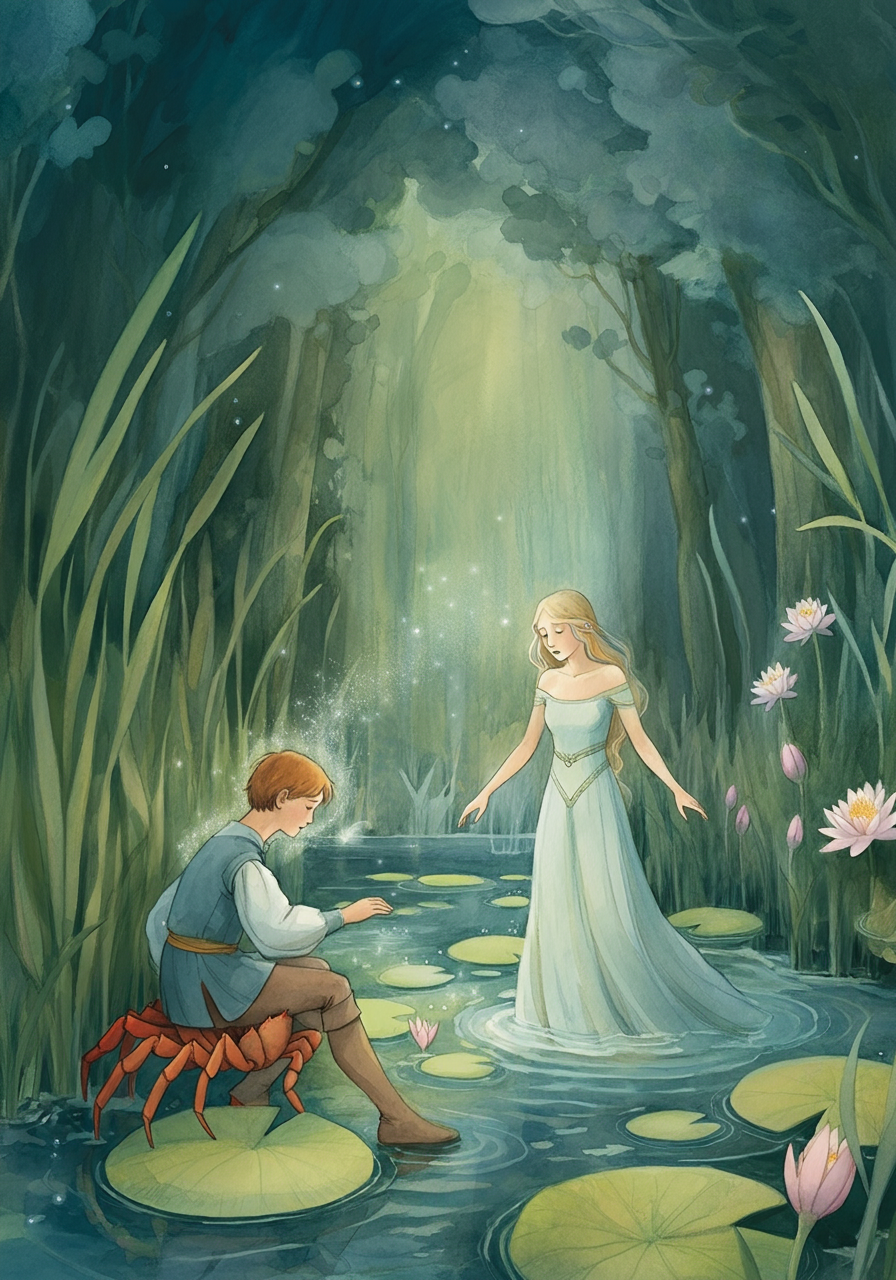
the bridge. Again he heard the water-lily’s lament, and, hesitating no longer, smeared himself all over with mud, and, saying: “From a man into a crab,” plunged into the river. For one moment the water hissed in his ears, and then all was silent. He swam up to the plant and began to loosen its roots, but so firmly were they fixed in the mud and reeds that this took him a long time. He then grasped them and rose to the surface, letting the water flow over the flower. The current carried them down the stream, but nowhere could he see the mountain ash. At last he saw it, and close by the large stone. Here he stopped and said: “From a crab into a man, from a water-lily into a maiden,” and to his delight found himself once more a prince, and the maiden was by his side. She was ten times more beautiful than before, and wore a magnificent pale yellow robe, sparkling with jewels. She thanked him for having freed her from the cruel witch’s power, and willingly consented to marry him. But when they came to the bridge where he had left his horse it was nowhere to be seen, for, though the Prince thought he had been a crab only a few hours, he had in reality been under the water for more than ten days. While they were wondering how they should reach his father’s court, they saw a splendid coach driven by six gaily caparisoned horses coming along the bank. In this they drove to the palace. The King and Queen were at church, weeping for their son, whom they had long mourned for dead. Great was their delight and astonishment when the Prince entered, leading the beautiful maiden by the hand. The wedding was at once celebrated and there was feasting and merry-making throughout the kingdom for six weeks. Some time afterward the Prince and his bride were sitting in the garden, when a crow said to them: “Ungrateful creatures! Have you forgotten the two poor maidens who helped you in your distress? Must they spin gold flax for ever? Have no pity on the old witch. The three maidens are princesses, whom she stole away when they were children together, with all the silver utensils, which she turned into gold flax. Poison were her fittest punishment.” The Prince was ashamed of having forgotten his promise and set out at once, and by great good fortune reached the hut when the old woman was away. The maidens had dreamed that he was coming, and were ready to go with him, but first they made a cake in which they put poison, and left it on a table where the old woman was likely to see it when she returned. She _did_ see it, and thought it looked so tempting that she greedily ate it up and at once died. In the secret chamber were found fifty wagon-loads of gold flax, and as much more was discovered buried. The hut was razed to the ground, and the Prince and his bride and her two sisters lived happily ever after.
Moral of the Story
Promises made in times of distress should be kept, and true gratitude extends beyond immediate salvation.
Characters

The Prince ★ protagonist
Handsome, brave
Attire: Initially fine princely attire, later mud-covered, then princely attire again
Brave, forgetful but ultimately good-hearted, determined

The Water-Lily Maiden ★ protagonist
Extremely beautiful
Attire: Magnificent pale yellow robe sparkling with jewels
Kind, grateful, gentle

The Witch ⚔ antagonist
Implied to be ugly and cruel
Attire: Drab, tattered clothing
Cruel, greedy, wicked

First Maiden ◆ supporting
Fair
Attire: Simple peasant dress
Helpful, resourceful

Second Maiden ◆ supporting
Fair
Attire: Simple peasant dress
Helpful, resourceful

The Crow ◆ supporting
Black feathers
Reminding, observant
Locations

Riverbank by the Bridge
A river flowing under a bridge, with a water-lily growing in the water. Muddy banks.
Mood: Melancholy, mysterious, then hopeful
The prince first hears the water-lily's lament and transforms into a crab to free her.

Underwater Reeds near Mountain Ash
Murky river bottom with firmly fixed water-lily roots, reeds, and a large stone near a mountain ash tree.
Mood: Silent, laborious, magical
The prince, as a crab, struggles to free the water-lily, then transforms back into a prince with the maiden.

Royal Palace Garden
A garden where the Prince and his bride are sitting.
Mood: Peaceful, domestic
A crow reminds the Prince of his promise to the two maidens.

Witch's Hut
A hut where the witch lives and forces two maidens to spin gold flax. Contains a secret chamber.
Mood: Eerie, oppressive, secretive
The Prince rescues the maidens, and the witch is poisoned.
Story DNA
Moral
Promises made in times of distress should be kept, and true gratitude extends beyond immediate salvation.
Plot Summary
A prince hears a water-lily's lament and transforms into a crab to free the enchanted maiden within. After successfully breaking her spell and returning to his kingdom, they marry. However, a crow reminds the prince of his forgotten promise to free two other maidens. He returns to the witch's hut, where the maidens, having anticipated his arrival, poison the witch. With the witch dead and her treasures recovered, the prince, his bride, and her sisters live happily ever after.
Themes
Emotional Arc
suffering to triumph
Writing Style
Narrative Elements
Cultural Context
Andrew Lang collected and retold fairy tales from various European traditions, making this a compilation rather than a single origin.
Plot Beats (13)
- A prince hears a water-lily's lament and learns it is an enchanted maiden.
- He smears himself with mud, transforms into a crab, and plunges into the river to free her.
- As a crab, he struggles to loosen the water-lily's roots, which are firmly fixed.
- He succeeds, rises to the surface, and transforms himself back into a prince and the water-lily into a beautiful maiden.
- They discover that ten days have passed, and the prince's horse is gone, but a splendid coach appears to take them to the palace.
- The King and Queen, who had mourned their son as dead, are overjoyed by his return with the maiden.
- The prince and the maiden marry, and the kingdom celebrates for six weeks.
- A crow reminds the prince that he forgot his promise to the two other maidens who helped him.
- Ashamed, the prince immediately sets out for the witch's hut, finding her away.
- The maidens, having dreamed of his arrival, prepare a poisoned cake for the witch.
- The witch returns, greedily eats the cake, and dies.
- Fifty wagon-loads of gold flax and other treasures are found in the secret chamber and buried around the hut.
- The hut is razed, and the prince, his bride, and her two sisters live happily ever after.


