The wonderful sheep
by Andrew Lang

Miranda and the Sheep King
Once, a king had three daughters. The youngest was Miranda. She was very kind.
The king came home from a big fight. He won the fight. He was very happy. He smiled at his daughters. His daughters wore pretty dresses. One daughter wore green. The green dress was pretty. One daughter wore blue. The blue dress was pretty. Miranda wore white. The white dress was simple.
“Why did you wear white?” asked the king.
“It is my favorite color,” said Miranda.
The king felt a little sad. He asked about their dreams.
Miranda said, “I dreamed of a golden cup.”
This made the king worried. He thought it was a strange dream. He did not understand.
The next morning, the king was still worried. He could not sleep. He thought about Miranda's dream. He called the Captain. The Captain came quickly.
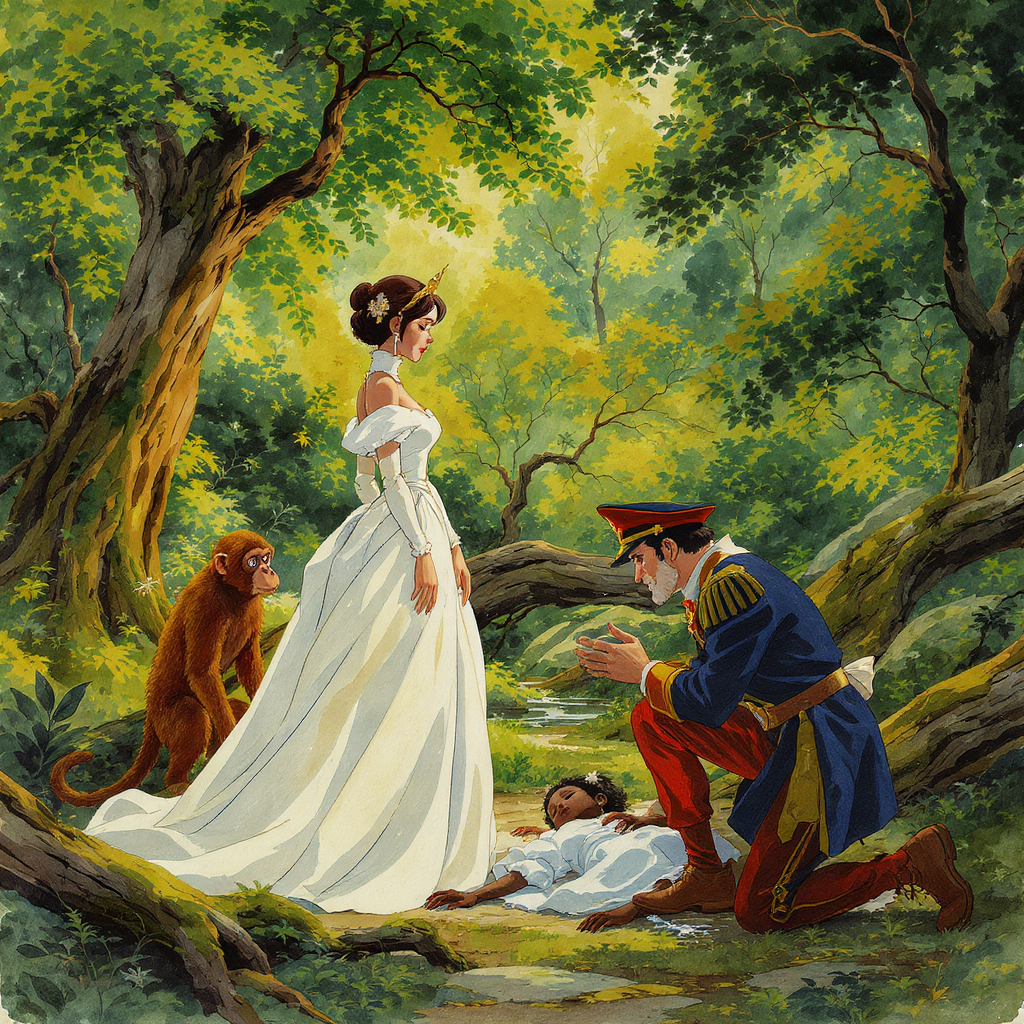
“Take Miranda to the forest,” said the king. “Find her a new home. She must go away.”
The Captain was sad. He liked Miranda. But he obeyed the king.
The Captain told Miranda. Miranda was sad. Her friends Paty, Grabi, and Tin came.
“I will help,” said Paty.
“Me too,” said Grabi.
“Woof!” said Tin.
They made a plan together. Paty packed food. Grabi gathered fruits. Tin dug a hole. They worked together. They helped Miranda. Grabi hid in a tree. Paty helped Miranda pack. Tin watched for danger.
The Captain took a shiny stone. He gave it to the king.
“Miranda is safe,” he said. “She is in a new home.”
The king was glad. He held the shiny stone. He thought Miranda was okay.
Miranda walked in the forest. She walked for a long time. She felt tired. Then she found a big house. It was very big. The big house had a red door. A friendly sheep lived there. He was the Sheep King.
“Hello,” said the Sheep King. “Will you be my friend?”
“Yes, please,” said Miranda. She was happy to meet him.
They became good friends. They played together. They ate together. They were happy together. The Sheep King was kind. Miranda was kind too. They played games. They told stories. They shared food. Every day was fun.
Miranda heard her sister had a party. “Can I go?” she asked.
“Yes,” said the Sheep King. “But please come back soon.”
“I promise,” said Miranda.
Miranda went to the party. The party was loud. Miranda saw many people. She saw her father. She was happy. She found her sister. She left a pretty box for her sister. The box was a gift. Her sister was happy. Then she went back to the Sheep King.
“I kept my promise,” she said.
The Sheep King was happy. He smiled. He hugged Miranda. He said, “I missed you.” Miranda said, “I missed you too.”
They were happy again. They played more. The Sheep King said, “I am glad you came back.” Miranda said, “I always keep my promises.”
Later, Miranda heard her other sister had a party. “Can I go?” she asked.
“Yes,” said the Sheep King. “But please come back soon.”
“I promise,” said Miranda.
At the party, Miranda saw her father. He was very glad. He held a golden cup for her to wash her hands. Miranda washed her hands. The golden cup was shiny. Miranda remembered her dream. She felt joy. Her dream was real.
“My dream came true!” said Miranda. She was very happy.
She told her father who she was. “I am Miranda,” she said.
The king said he was sorry. “I made a mistake,” he said. “Stay with me. Be my princess again.”
Miranda stayed. She forgot her promise to the Sheep King.
The Sheep King waited. He waited for many days. Miranda did not come back. He was sad. He missed Miranda. He walked far to the palace. He was tired. But he wanted to find Miranda.
The guards did not know him. “You cannot come in,” they said.
The Sheep King waited outside. He felt very lonely. He sat by the gate. He looked at the palace. He hoped to see Miranda.
Miranda saw him from a window. She remembered her promise. She ran outside.
“I am so sorry,” she said. “I forgot. I will keep my promise now.”
The Sheep King was happy again. They were friends. Miranda held the Sheep King's hand. She said, “Let's go home.” They walked together. They were happy. They promised to always keep their word.
Always keep your promises. Or you might make your friends sad.
Original Story
THE WONDERFUL SHEEP Once upon a time--in the days when the fairies lived--there was a king who had three daughters, who were all young, and clever, and beautiful; but the youngest of the three, who was called Miranda, was the prettiest and the most beloved. The King, her father, gave her more dresses and jewels in a month than he gave the others in a year; but she was so generous that she shared everything with her sisters, and they were all as happy and as fond of one another as they could be. Now, the King had some quarrelsome neighbors, who, tired of leaving him in peace, began to make war upon him so fiercely that he feared he would be altogether beaten if he did not make an effort to defend himself. So he collected a great army and set off to fight them, leaving the Princesses with their governess in a castle where news of the war was brought every day--sometimes that the King had taken a town, or won a battle, and, at last, that he had altogether overcome his enemies and chased them out of his kingdom, and was coming back to the castle as quickly as possible, to see his dear little Miranda whom he loved so much. The three Princesses put on dresses of satin, which they had had made on purpose for this great occasion, one green, one blue, and the third white; their jewels were the same colors. The eldest wore emeralds, the second turquoises, and the youngest diamonds, and thus adorned they went to meet the King, singing verses which they had composed about his victories. When he saw them all so beautiful and so gay he embraced them tenderly, but gave Miranda more kisses than either of the others. Presently a splendid banquet was served, and the King and his daughters sat down to it, and as he always thought that there was some special meaning in everything, he said to the eldest: “Tell me why you have chosen a green dress.” “Sire,” she answered, “having heard of your victories I thought that green would signify my joy and the hope of your speedy return.” “That is a very good answer,” said the King; “and you, my daughter,” he continued, “why did you take a blue dress?” “Sire,” said the Princess, “to show that we constantly hoped for your success, and that the sight of you is as welcome to me as the sky with its most beautiful stars.” “Why,” said the King, “your wise answers astonish me, and you, Miranda. What made you dress yourself all in white? “Because, sire,” she answered, “white suits me better than anything else.” “What!” said the King angrily, “was that all you thought of, vain child?” “I thought you would be pleased with me,” said the Princess; “that was all.” The King, who loved her, was satisfied with this, and even pretended to be pleased that she had not told him all her reasons at first. “And now,” said he, “as I have supped well, and it is not time yet to go to bed, tell me what you dreamed last night.” The eldest said she had dreamed that he brought her a dress, and the precious stones and gold embroidery on it were brighter than the sun. The dream of the second was that the King had brought her a spinning wheel and a distaff, that she might spin him some shirts. But the youngest said: “I dreamed that my second sister was to be married, and on her wedding-day, you, father, held a golden ewer and said: ‘Come, Miranda, and I will hold the water that you may dip your hands in it.’” The King was very angry indeed when he heard this dream, and frowned horribly; indeed, he made such an ugly face that everyone knew how angry he was, and he got up and went off to bed in a great hurry; but he could not forget his daughter’s dream. “Does the proud girl wish to make me her slave?” he said to himself. “I am not surprised at her choosing to dress herself in white satin without a thought of me. She does not think me worthy of her consideration! But I will soon put an end to her pretensions!” He rose in a fury, and although it was not yet daylight, he sent for the Captain of his Bodyguard, and said to him: “You have heard the Princess Miranda’s dream? I consider that it means strange things against me, therefore I order you to take her away into the forest and kill her, and, that I may be sure it is done, you must bring me her heart and her tongue. If you attempt to deceive me you shall be put to death!” The Captain of the Guard was very much astonished when he heard this barbarous order, but he did not dare to contradict the King for fear of making him still more angry, or causing him to send someone else, so he answered that he would fetch the Princess and do as the King had said. When he went to her room they would hardly let him in, it was so early, but he said that the King had sent for Miranda, and she got up quickly and came out; a little black girl called Patypata held up her train, and her pet monkey and her little dog ran after her. The monkey was called Grabugeon, and the little dog Tintin. The Captain of the Guard begged Miranda to come down into the garden where the King was enjoying the fresh air, and when they got there, he pretended to search for him, but as he was not to be found, he said: “No doubt his Majesty has strolled into the forest,” and he opened the little door that led to it and they went through. By this time the daylight had begun to appear, and the Princess, looking at her conductor, saw that he had tears in his eyes and seemed too sad to speak. “What is the matter?” she said in the kindest way. “You seem very sorrowful.” “Alas! Princess,” he answered, “who would not be sorrowful who was ordered to do such a terrible thing as I am? The King has commanded me to kill you here, and carry your heart and your tongue to him, and if I disobey I shall lose my life.” The poor Princess was terrified, she grew very pale and began to cry softly. Looking up at the Captain of the Guard with her beautiful eyes, she said gently: “Will you really have the heart to kill me? I have never done you any harm, and have always spoken well of you to the King. If I had deserved my father’s anger I would suffer without a murmur, but, alas! he is unjust to complain of me, when I have always treated him with love and respect.” “Fear nothing, Princess,” said the Captain of the Guard. “I would far rather die myself than hurt you; but even if I am killed you will not be safe: we must find some way of making the King believe that you are dead.” “What can we do?” said Miranda; “unless you take him my heart and my tongue he will never believe you.” The Princess and the Captain of the Guard were talking so earnestly that they did not think of Patypata, but she had overheard all they said, and now came and threw herself at Miranda’s feet. “Madam,” she said, “I offer you my life; let me be killed, I shall be only too happy to die for such a kind mistress.” “Why, Patypata,” cried the Princess, kissing her, “that would never do; your life is as precious to me as my own, especially after such a proof of your affection as you have just given me.” “You are right, Princess,” said Grabugeon, coming forward, “to love such a faithful slave as Patypata; she is of more use to you than I am, I offer you my tongue and my heart most willingly, especially as I wish to make a great name for myself in Goblin Land.” “No, no, my little Grabugeon,” replied Miranda, “I cannot bear the thought of taking your life.” “Such a good little dog as I am,” cried Tintin, “could not think of letting either of you die for his mistress. If anyone is to die for her it must be me.” And then began a great dispute between Patypata, Grabugeon, and Tintin, and they came to high words, until at last Grabugeon, who was quicker than the others, ran up to the very top of the nearest tree, and let herself fall, head first, to the ground, and there she lay--quite dead! The Princess was very sorry, but as Grabugeon was really dead, she allowed the Captain of the Guard to take her tongue; but, alas! it was such a little one--not bigger than the Princess’s thumb--that they decided sorrowfully that it was of no use at all: the King would not have been taken in by it for a moment! “Alas! my little monkey,” cried the Princess, “I have lost you, and yet I am no better off than I was before.” “The honor of saving your life is to be mine,” interrupted Patypata, and, before they could prevent her, she had picked up a knife and cut her head off in an instant. But when the Captain of the Guard would have taken her tongue it turned out to be quite black, so that would not have deceived the King either. “Am I not unlucky?” cried the poor Princess; “I lose everything I love, and am none the better for it.” “If you had accepted my offer,” said Tintin, “you would only have had me to regret, and I should have had all your gratitude.” Miranda kissed her little dog, crying so bitterly, that at last she could bear it no longer, and turned away into the forest. When she looked back the Captain of the Guard was gone, and she was alone, except for Patypata, Grabugeon, and Tintin, who lay upon the ground. She could not leave the place until she had buried them in a pretty little mossy grave at the foot of a tree, and she wrote their names upon the bark of the tree, and how they had all died to save her life. And then she began to think where she could go for safety--for this forest was so close to her father’s castle that she might be seen and recognized by the first passer-by, and, besides that, it was full of lions and wolves, who would have snapped up a princess just as soon as a stray chicken. So she began to walk as fast as she could, but the forest was so large and the sun was so hot that she nearly died of heat and terror and fatigue; look which way she would there seemed to be no end to the forest, and she was so frightened that she fancied every minute that she heard the King running after her to kill her. You may imagine how miserable she was, and how she cried as she went on, not knowing which path to follow, and with the thorny bushes scratching her dreadfully and tearing her pretty frock to pieces. At last she heard the bleating of a sheep, and said to herself: “No doubt there are shepherds here with their flocks; they will show me the way to some village where I can live disguised as a peasant girl. Alas! it is not always kings and princes who are the happiest people in the world. Who could have believed that I should ever be obliged to run away and hide because the King, for no reason at all, wishes to kill me?” So saying she advanced toward the place where she heard the bleating, but what was her surprise when, in a lovely little glade quite surrounded by trees, she saw a large sheep; its wool was as white as snow, and its horns shone like gold; it had a garland of flowers round its neck, and strings of great pearls about its legs, and a collar of diamonds; it lay upon a bank of orange-flowers, under a canopy of cloth of gold which protected it from the heat of the sun. Nearly a hundred other sheep were scattered about, not eating the grass, but some drinking coffee, lemonade, or sherbet, others eating ices, strawberries and cream, or sweetmeats, while others, again, were playing games. Many of them wore golden collars with jewels, flowers, and ribbons. Miranda stopped short in amazement at this unexpected sight, and was looking in all directions for the shepherd of this surprising flock, when the beautiful sheep came bounding toward her. “Approach, lovely Princess,” he cried; “have no fear of such gentle and peaceable animals as we are.” “What a marvel!” cried the Princess, starting back a little. “Here is a sheep that can talk.” “Your monkey and your dog could talk, madam,” said he; “are you more astonished at us than at them?” “A fairy gave them the power to speak,” replied Miranda. “So I was used to them.” “Perhaps the same thing has happened to us,” he said, smiling sheepishly. “But, Princess, what can have led you here?” “A thousand misfortunes, Sir Sheep,” she answered. “I am the unhappiest princess in the world, and I am seeking a shelter against my father’s anger.” “Come with me, madam,” said the Sheep; “I offer you a hiding-place which you only will know of, and where you will be mistress of everything you see.” “I really cannot follow you,” said Miranda, “for I am too tired to walk another step.” The Sheep with the golden horns ordered that his chariot should be fetched, and a moment after appeared six goats, harnessed to a pumpkin, which was so big that two people could quite well sit in it, and was all lined with cushions of velvet and down. The Princess stepped into it, much amused at such a new kind of carriage, the King of the Sheep took his place beside her, and the goats ran away with them at full speed, and only stopped when they reached a cavern, the entrance to which was blocked by a great stone. This the King touched with his foot, and immediately it fell down, and he invited the Princess to enter without fear. Now, if she had not been so alarmed by everything that had happened, nothing could have induced her to go into this frightful cave, but she was so afraid of what might be behind her that she would have thrown herself even down a well at this moment. So, without hesitation, she followed the Sheep, who went before her, down, down, down, until she thought they must come out at the other side of the world--indeed, she was not sure that he wasn’t leading her into Fairyland. At last she saw before her a great plain, quite covered with all sorts of flowers, the scent of which seemed to her nicer than anything she had ever smelled before; a broad river of orange-flower water flowed round it and fountains of wine of every kind ran in all directions and made the prettiest little cascades and brooks. The plain was covered with the strangest trees, there were whole avenues where partridges, ready roasted, hung from every branch, or, if you preferred pheasants, quails, turkeys, or rabbits, you had only to turn to the right hand or to the left and you were sure to find them. In places the air was darkened by showers of lobster-patties, white puddings, sausages, tarts, and all sorts of sweetmeats, or with pieces of gold and silver, diamonds and pearls. This unusual kind of rain, and the pleasantness of the whole place, would, no doubt, have attracted numbers of people to it, if the King of the Sheep had been of a more sociable disposition, but from all accounts it is evident that he was as grave as a judge. As it was quite the nicest time of the year when Miranda arrived in this delightful land the only palace she saw was a long row of orange trees, jasmines, honeysuckles, and musk-roses, and their interlacing branches made the prettiest rooms possible, which were hung with gold and silver gauze, and had great mirrors and candlesticks, and most beautiful pictures. The Wonderful Sheep begged that the Princess would consider herself queen over all that she saw, and assured her that, though for some years he had been very sad and in great trouble, she had it in her power to make him forget all his grief. “You are so kind and generous, noble Sheep,” said the Princess, “that I cannot thank you enough, but I must confess that all I see here seems to me so extraordinary that I don’t know what to think of it.” As she spoke a band of lovely fairies came up and offered her amber baskets full of fruit, but when she held out her hands to them they glided away, and she could feel nothing when she tried to touch them. “Oh!” she cried, “what can they be? Whom am I with?” and she began to cry. At this instant the King of the Sheep came back to her, and was so distracted to find her in tears that he could have torn his wool. “What is the matter, lovely Princess?” he cried. “Has anyone failed to treat you with due respect?” “Oh! no,” said Miranda; “only I am not used to living with sprites and with sheep that talk, and everything here frightens me. It was very kind of you to bring me to this place, but I shall be even more grateful to you if you will take me up into the world again.” “Do not be afraid,” said the Wonderful Sheep; “I entreat you to have patience, and listen to the story of my misfortunes. I was once a king, and my kingdom was the most splendid in the world. My subjects loved me, my neighbors envied and feared me. I was respected by everyone, and it was said that no king ever deserved it more. “I was very fond of hunting, and one day, while chasing a stag, I left my attendants far behind; suddenly I saw the animal leap into a pool of water, and I rashly urged my horse to follow it, but before we had gone many steps I felt an extraordinary heat, instead of the coolness of the water; the pond dried up, a great gulf opened before me, out of which flames of fire shot up, and I fell helplessly to the bottom of a precipice. “I gave myself up for lost, but presently a voice said: ‘Ungrateful Prince, even this fire is hardly enough to warm your cold heart!’ “‘Who complains of my coldness in this dismal place?’ I cried. “‘An unhappy being who loves you hopelessly,’ replied the voice, and at the same moment the flames began to flicker and cease to burn, and I saw a fairy, whom I had known as long as I could remember, and whose ugliness had always horrified me. She was leaning upon the arm of a most beautiful young girl, who wore chains of gold on her wrists and was evidently her slave. “‘Why, Ragotte,’ I said, for that was the fairy’s name, ‘what is the meaning of all this? Is it by your orders that I am here?’ “‘And whose fault is it,’ she answered, ‘that you have never understood me until now? Must a powerful fairy like myself condescend to explain her doings to you who are no better than an ant by comparison, though you think yourself a great king?’ “‘Call me what you like,’ I said impatiently; ‘but what is it that you want--my crown, or my cities, or my treasures?’ “‘Treasures!’ said the fairy, disdainfully. ‘If I chose I could make any one of my scullions richer and more powerful than you. I do not want your treasures, but,’ she added softly, ‘if you will give me your heart--if you will marry me--I will add twenty kingdoms to the one you have already; you shall have a hundred castles full of gold and five hundred full of silver, and, in short, anything you like to ask me for.’ “‘Madam Ragotte,’ said I, ‘when one is at the bottom of a pit where one has fully expected to be roasted alive, it is impossible to think of asking such a charming person as you are to marry one! I beg that you will set me at liberty, and then I shall hope to answer you fittingly.’ “‘Ah!’ said she, ‘if you really loved me you would not care where you were--a cave, a wood, a fox-hole, a desert, would please you equally well. Do not think that you can deceive me; you fancy you are going to escape, but I assure you that you are going to stay here and the first thing I shall give you to do will be to keep my sheep--they are very good company and speak quite as well as you do. “As she spoke she advanced, and led me to this plain where we now stand, and showed me her flock, but I paid little attention to it or to her. “To tell the truth, I was so lost in admiration of her beautiful slave that I forgot everything else, and the cruel Ragotte, perceiving this, turned upon her so furious and terrible a look that she fell lifeless to the ground. “At this dreadful sight I drew my sword and rushed at Ragotte, and should certainly have cut off her head had she not by her magic arts chained me to the spot on which I stood; all my efforts to move were useless, and at last, when I threw myself down on the ground in despair, she said to me, with a scornful smile: “‘I intend to make you feel my power. It seems that you are a lion at present, I mean you to be a sheep.’ “So saying, she touched me with her wand, and I became what you see. I did not lose the power of speech, or of feeling the misery of my present state. “‘For five years,’ she said, ‘you shall be a sheep, and lord of this pleasant land, while I, no longer able to see your face, which I loved so much, shall be better able to hate you as you deserve to be hated.’ “She disappeared as she finished speaking, and if I had not been too unhappy to care about anything I should have been glad that she was gone. “The talking sheep received me as their king, and told me that they, too, were unfortunate princes who had, in different ways, offended the revengeful fairy, and had been added to her flock for a certain number of years; some more, some less. From time to time, indeed, one regains his own proper form and goes back again to his place in the upper world; but the other beings whom you saw are the rivals or the enemies of Ragotte, whom she has imprisoned for a hundred years or so; though even they will go back at last. The young slave of whom I told you about is one of these; I have seen her often, and it has been a great pleasure to me. She never speaks to me, and if I were nearer to her I know I should find her only a shadow, which would be very annoying. However, I noticed that one of my companions in misfortune was also very attentive to this little sprite, and I found out that he had been her lover, whom the cruel Ragotte had taken away from her long before; since then I have cared for, and thought of, nothing but how I might regain my freedom. I have often been in the forest; that is where I have seen you, lovely Princess, sometimes driving your chariot, which you did with all the grace and skill in the world; sometimes riding to the chase on so spirited a horse that it seemed as if no one but yourself could have managed it, and sometimes running races on the plain with the Princesses of your Court--running so lightly that it was you always who won the prize. Oh! Princess, I have loved you so long, and yet how dare I tell you of my love! what hope can there be for an unhappy sheep like myself?” Miranda was so surprised and confused by all that she had heard that she hardly knew what answer to give to the King of the Sheep, but she managed to make some kind of little speech, which certainly did not forbid him to hope, and said that she should not be afraid of the shadows now she knew that they would some day come to life again. “Alas!” she continued, “if my poor Patypata, my dear Grabugeon, and pretty little Tintin, who all died for my sake, were equally well off, I should have nothing left to wish for here!” Prisoner though he was, the King of the Sheep had still some powers and privileges. “Go,” said he to his Master of the Horse, “go and seek the shadows of the little black girl, the monkey, and the dog: they will amuse our Princess.” And an instant afterward Miranda saw them coming toward her, and their presence gave her the greatest pleasure, though they did not come near enough for her to touch them. The King of the Sheep was so kind and amusing, and loved Miranda so dearly, that at last she began to love him too. Such a handsome sheep, who was so polite and considerate, could hardly fail to please, especially if one knew that he was really a king, and that his strange imprisonment would soon come to an end. So the Princess’s days passed very gaily while she waited for the happy time to come. The King of the Sheep, with the help of all the flock, got up balls, concerts, and hunting parties, and even the shadows joined in all the fun, and came, making believe to be their own real selves. One evening, when the couriers arrived (for the King sent most carefully for news--and they always brought the very best kinds), it was announced that the sister of the Princess Miranda was going to be married to a great Prince, and that nothing could be more splendid than all the preparations for the wedding. “Ah!” cried the young Princess, “how unlucky I am to miss the sight of so many pretty things! Here am I imprisoned under the earth, with no company but sheep and shadows, while my sister is to be adorned like a queen and surrounded by all who love and admire her, and everyone but myself can go to wish her joy!” “Why do you complain, Princess?” said the King of the Sheep. “Did I say that you were not to go to the wedding? Set out as soon as you please; only promise me that you will come back, for I love you too much to be able to live without you.” Miranda was very grateful to him, and promised faithfully that nothing in the world should keep her from coming back. The King caused an escort suitable to her rank to be got ready for her, and she dressed herself splendidly, not forgetting anything that could make her more beautiful. Her chariot was of mother-of-pearl, drawn by six dun-colored griffins just brought from the other side of the world, and she was attended by a number of guards in splendid uniforms, who were all at least eight feet high and had come from far and near to ride in the Princess’s train. Miranda reached her father’s palace just as the wedding ceremony began, and everyone, as soon as she came in, was struck with surprise at her beauty and the splendor of her jewels. She heard exclamations of admiration on all sides; and the King her father looked at her so attentively that she was afraid he must recognize her; but he was so sure that she was dead that the idea never occurred to him. However, the fear of not getting away made her leave before the marriage was over. She went out hastily, leaving behind her a little coral casket set with emeralds. On it was written in diamond letters: “Jewels for the Bride,” and when they opened it, which they did as soon as it was found, there seemed to be no end to the pretty things it contained. The King, who had hoped to join the unknown Princess and find out who she was, was dreadfully disappointed when she disappeared so suddenly, and gave orders that if she ever came again the doors were to be shut that she might not get away so easily. Short as Miranda’s absence had been, it had seemed like a hundred years to the King of the Sheep. He was waiting for her by a fountain in the thickest part of the forest, and the ground was strewn with splendid presents which he had prepared for her to show his joy and gratitude at her coming back. As soon as she was in sight he rushed to meet her, leaping and bounding like a real sheep. He caressed her tenderly, throwing himself at her feet and kissing her hands, and told her how uneasy he had been in her absence, and how impatient for her return, with an eloquence which charmed her. After some time came the news that the King’s second daughter was going to be married. When Miranda heard it she begged the King of the Sheep to allow her to go and see the wedding as before. This request made him feel very sad, as if some misfortune must surely come of it, but his love for the Princess being stronger than anything else he did not like to refuse her. “You wish to leave me, Princess,” said he; “it is my unhappy fate--you are not to blame. I consent to your going, but, believe me, I can give you no stronger proof of my love than by so doing.” The Princess assured him that she would only stay a very short time, as she had done before, and begged him not to be uneasy, as she would be quite as much grieved if anything detained her as he could possibly be. So, with the same escort, she set out, and reached the palace as the marriage ceremony began. Everybody was delighted to see her; she was so pretty that they thought she must be some fairy princess, and the Princes who were there could not take their eyes off her. The King was more glad than anyone else that she had come again, and gave orders that the doors should all be shut and bolted that very minute. When the wedding was all but over the Princess got up quickly, hoping to slip away unnoticed among the crowd, but, to her great dismay, she found every door fastened. She felt more at ease when the King came up to her, and with the greatest respect begged her not to run away so soon, but at least to honor him by staying for the splendid feast which was prepared for the Princes and Princesses. He led her into a magnificent hall, where all the Court was assembled, and himself taking up the golden bowl full of water, he offered it to her that she might dip her pretty fingers into it. At this the Princess could no longer contain herself; throwing herself at the King’s feet, she cried out: “My dream has come true after all--you have offered me water to wash my hands on my sister’s wedding day, and it has not vexed you to do it.” The King recognized her at once--indeed, he had already thought several times how much like his poor little Miranda she was. “Oh! my dear daughter,” he cried, kissing her, “can you ever forget my cruelty? I ordered you to be put to death because I thought your dream portended the loss of my crown. And so it did,” he added, “for now your sisters are both married and have kingdoms of their own--and mine shall be for you.” So saying he put his crown on the Princess’s head and cried: “Long live Queen Miranda!” All the Court cried: “Long live Queen Miranda!” after him, and the young Queen’s two sisters came running up, and threw their arms round her neck, and kissed her a thousand times, and then there was such a laughing and crying, talking and kissing, all at once, and Miranda thanked her father, and began to ask after everyone--particularly the Captain of the Guard, to whom she owed so much; but, to her great sorrow, she heard that he was dead. Presently they sat down to the banquet, and the King asked Miranda to tell them all that had happened to her since the terrible morning when he had sent the Captain of the Guard to fetch her. This she did with so much spirit that all the guests listened with breathless interest. But while she was thus enjoying herself with the King and her sisters, the King of the Sheep was waiting impatiently for the time of her return, and when it came and went, and no Princess appeared, his anxiety became so great that he could bear it no longer. “She is not coming back any more,” he cried. “My miserable sheep’s face displeases her, and without Miranda what is left to me, wretched creature that I am! Oh! cruel Ragotte; my punishment is complete.” For a long time he bewailed his sad fate like this, and then, seeing that it was growing dark, and that still there was no sign of the Princess, he set out as fast as he could in the direction of the town. When he reached the palace he asked for Miranda, but by this time everyone had heard the story of her adventures, and did not want her to go back again to the King of the Sheep, so they refused sternly to let him see her. In vain he begged and prayed them to let him in; though his entreaties might have melted hearts of stone they did not move the guards of the palace, and at last, quite broken-hearted, he fell dead at their feet. In the meantime the King, who had not the least idea of the sad thing that was happening outside the gate of his palace, proposed to Miranda that she should be driven in her chariot all round the town, which was to be illuminated with thousands and thousands of torches, placed in windows and balconies, and in all the grand squares. But what a sight met her eyes at the very entrance of the palace! There lay her dear, kind sheep, silent and motionless, upon the pavement! She threw herself out of the chariot and ran to him, crying bitterly, for she realized that her broken promise had cost him his life, and for a long, long time she was so unhappy that they thought she would have died too. So you see that even a princess is not always happy--especially if she forgets to keep her word; and the greatest misfortunes often happen to people just as they think they have obtained their heart’s desires!(1) (1) Madame d’Aulnoy.
Moral of the Story
Even a princess is not always happy, especially if she forgets to keep her word, and the greatest misfortunes often happen to people just as they think they have obtained their heart's desires.
Characters

Miranda ★ protagonist
Prettiest of the three princesses
Attire: White satin dress, diamonds
Generous, kind, initially perceived as vain but ultimately loyal and remorseful

King ⚔ antagonist
Powerful, easily angered
Attire: Royal robes, crown
Paranoid, quick to anger, regretful

King of the Sheep ◆ supporting
A sheep
Loving, devoted, eloquent, anxious

Captain of the Guard ◆ supporting
Loyal, easily moved to tears
Attire: Guard's uniform
Compassionate, obedient, conflicted

Patypata ○ minor
Black girl
Attire: Servant's clothing
Obedient
Locations

Royal Castle Garden
A garden with a small door leading to a dense forest.
Mood: Initially peaceful, then turns ominous and fearful.
The Captain of the Guard leads Miranda into the forest under false pretenses.

Deep Forest Clearing with Fountain
A thick part of the forest with a fountain, ground strewn with splendid presents.
Mood: Magical, loving, filled with anticipation.
The King of the Sheep awaits Miranda's return with gifts.

Magnificent Palace Hall
A hall where the court is assembled, prepared for a splendid feast.
Mood: Festive, celebratory, tense with anticipation.
The King offers Miranda water to wash her hands, fulfilling her dream.

Palace Gate
The entrance to the palace, a paved area outside the doors.
Mood: Initially celebratory, then tragic and heartbreaking.
The King of the Sheep dies of a broken heart at Miranda's feet.
Story DNA
Moral
Even a princess is not always happy, especially if she forgets to keep her word, and the greatest misfortunes often happen to people just as they think they have obtained their heart's desires.
Plot Summary
A king, angered by his youngest daughter Miranda's dream and perceived vanity, orders her execution. Her loyal companions sacrifice themselves to save her, and she flees into a forest, discovering a cursed King of the Sheep who falls in love with her. Miranda visits her sisters' weddings, eventually being recognized by her father, who crowns her queen. However, her delayed return causes the King of the Sheep to die of a broken heart at the palace gates, leaving Miranda to mourn the tragic consequence of her broken promise.
Themes
Emotional Arc
innocence to suffering to triumph, then to sorrow and regret
Writing Style
Narrative Elements
Cultural Context
This story is attributed to Madame d'Aulnoy, a French writer who popularized literary fairy tales in the late 17th century, often characterized by elaborate plots, magical transformations, and a focus on courtly love and manners.
Plot Beats (13)
- King returns from war, celebrates with his three daughters, but is angered by Miranda's 'white dress' answer and her dream.
- King orders the Captain of the Guard to kill Miranda and bring her heart and tongue.
- Captain of the Guard spares Miranda; her black servant Patypata, monkey Grabugeon, and dog Tintin offer to sacrifice themselves.
- Grabugeon the monkey is killed, and his heart and tongue are taken to the King as proof of Miranda's death.
- Miranda wanders the forest, finds a magnificent castle, and meets the King of the Sheep, who is a man by night and a sheep by day due to a curse.
- The King of the Sheep falls in love with Miranda and asks her to marry him, which she accepts.
- Miranda attends her eldest sister's wedding, leaving a coral casket, and the King is captivated by her beauty.
- Miranda returns to the King of the Sheep, who is overjoyed.
- Miranda attends her second sister's wedding, where the King, recognizing her resemblance, holds a golden ewer for her to wash her hands, fulfilling her dream.
- Miranda reveals her identity to her father, who is remorseful, crowns her queen, and celebrates her return.
- The King of the Sheep, distraught by Miranda's prolonged absence, travels to the palace.
- The palace guards, knowing Miranda's story, refuse the King of the Sheep entry, and he dies of a broken heart at the gates.
- Miranda discovers the dead King of the Sheep, realizing her broken promise caused his death, and is consumed by grief.


