The yellow dwarf
by Andrew Lang

Little Red Riding-Hood
Little Red Riding-Hood lived in a small village. She wore a red cloak with a hood. The cloak was bright and warm.
One day, mother said, "Take food to grandmother. She is sick and needs it. Do not talk to strangers. Stay on the path." Mother looked serious.
Little Red Riding-Hood walked into the woods. The woods were dark and full of tall trees. She met a big, gray wolf. "Where are you going?" asked the wolf.
"I go to grandmother's house," she said. "I am bringing her food."
The wolf had a bad idea. He smiled with big teeth. "Let's race!" he said. "You go the long way. I will go the short way," he said. He wanted to arrive first.
Little Red Riding-Hood forgot her mother's warning. She picked pretty flowers. She chased colorful butterflies. She took the long path through the woods.
The wolf ran fast down the short path. He got to the grandmother's house quickly. The house was small and wooden. He knocked on the door. "Who is there?" asked the grandmother.
"It is me, Little Red Riding-Hood," said the wolf in a soft voice. The grandmother opened the door. The wolf gobbled her up.
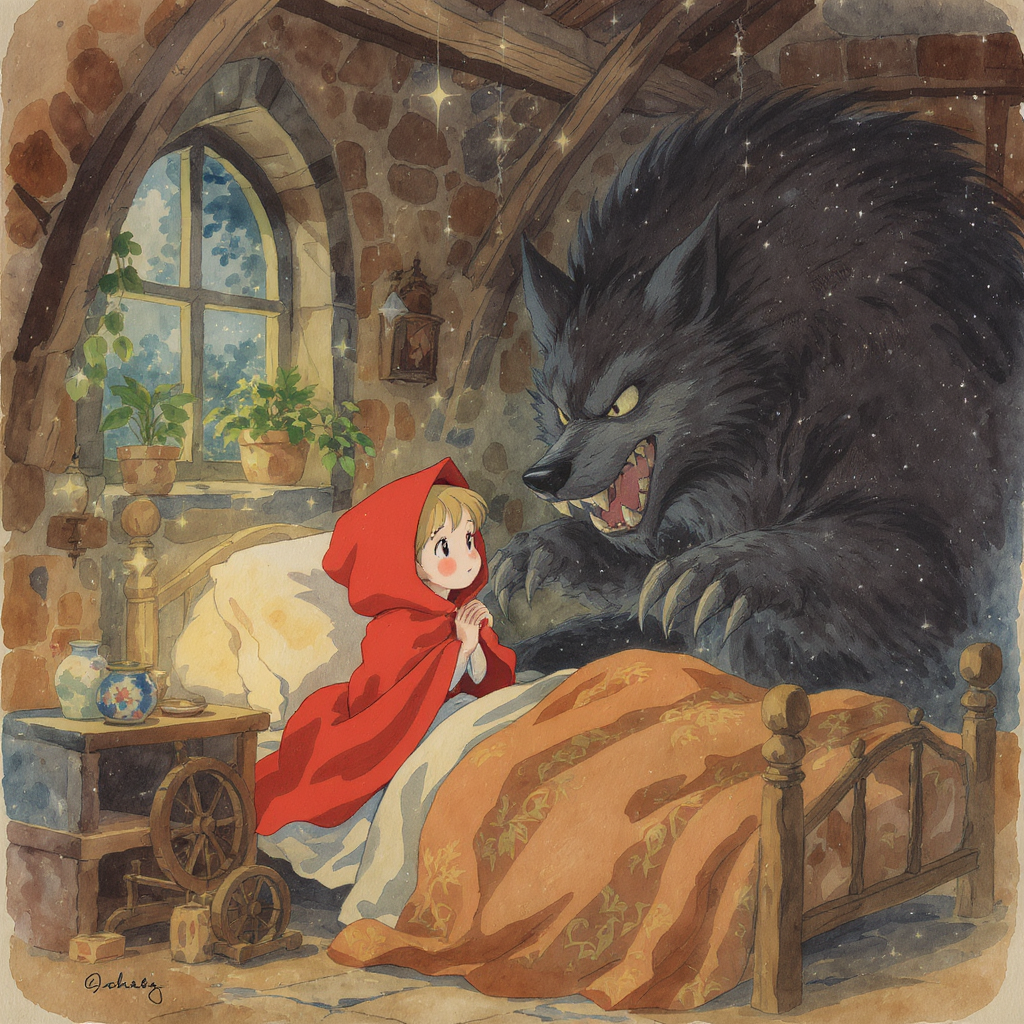
Then the wolf put on the grandmother's cap. He got into her bed and waited.
Little Red Riding-Hood knocked on the door. "Who is there?" said the wolf in a gruff voice.
"It is me," she said. She thought her grandmother had a cold. She went inside the dark room.
"Put the food down and come join me in bed," said the wolf in a soft voice.
Little Red Riding-Hood put the food down. She went to the bed.
"What big arms you have!" said Little Red Riding-Hood.
"The better to hug you with," said the wolf.
"What big legs you have!"
"The better to run with."
"What big ears you have!"
"The better to hear with."
"What big eyes you have!"
"The better to see with."
"What big teeth you have!"
"The better to eat you with!" The wolf gobbled her up.
Remember, do not talk to strangers and always listen to your parents. This story teaches us to be careful and stay safe.
Original Story
the Yellow Dwarf. “Ah! Princess,” he cried, “do not be angry with me. Let me explain everything. I am not faithless or to blame for what has happened. I am a miserable wretch who has displeased you without being able to help himself.” “Ah!” cried Bellissima, “did I not see you flying through the air with the loveliest being imaginable? Was that against your will?” “Indeed it was, Princess,” he answered; “the wicked Fairy of the Desert, not content with chaining me to a rock, carried me off in her chariot to the other end of the earth, where I should even now be a captive but for the unexpected help of a friendly mermaid, who brought me here to rescue you, my Princess, from the unworthy hands that hold you. Do not refuse the aid of your most faithful lover.” So saying, he threw himself at her feet and held her by her robe. But, alas! in so doing he let fall the magic sword, and the Yellow Dwarf, who was crouching behind a lettuce, no sooner saw it than he sprang out and seized it, well knowing its wonderful power. The Princess gave a cry of terror on seeing the Dwarf, but this only irritated the little monster; muttering a few magical words he summoned two giants, who bound the King with great chains of iron. “Now,” said the Dwarf, “I am master of my rival’s fate, but I will give him his life and permission to depart unharmed if you, Princess, will consent to marry me.” “Let me die a thousand times rather,” cried the unhappy King. “Alas!” cried the Princess, “must you die? Could anything be more terrible?” “That you should marry that little wretch would be far more terrible,” answered the King. “At least,” continued she, “let us die together.” “Let me have the satisfaction of dying for you, my Princess,” said he. “Oh, no, no!” she cried, turning to the Dwarf; “rather than that I will do as you wish.” “Cruel Princess!” said the King, “would you make my life horrible to me by marrying another before my eyes?” “Not so,” replied the Yellow Dwarf; “you are a rival of whom I am too much afraid; you shall not see our marriage.” So saying, in spite of Bellissima’s tears and cries, he stabbed the King to the heart with the diamond sword. The poor Princess, seeing her lover lying dead at her feet, could no longer live without him; she sank down by him and died of a broken heart. So ended these unfortunate lovers, whom not even the Mermaid could help, because all the magic power had been lost with the diamond sword. As to the wicked Dwarf, he preferred to see the Princess dead rather than married to the King of the Gold Mines; and the Fairy of the Desert, when she heard of the King’s adventures, pulled down the grand monument which she had built, and was so angry at the trick that had been played her that she hated him as much as she had loved him before. The kind Mermaid, grieved at the sad fate of the lovers, caused them to be changed into two tall palm trees, which stand always side by side, whispering together of their faithful love and caressing one another with their interlacing branches.(1) (1) Madame d’Aulnoy. LITTLE RED RIDING HOOD Once upon a time there lived in a certain village a little country girl, the prettiest creature was ever seen. Her mother was excessively fond of her; and her grandmother doted on her still more. This good woman had made for her a little red riding-hood; which became the girl so extremely well that everybody called her Little Red Riding-Hood. One day her mother, having made some custards, said to her: “Go, my dear, and see how thy grandmamma does, for I hear she has been very ill; carry her a custard, and this little pot of butter.” Little Red Riding-Hood set out immediately to go to her grandmother, who lived in another village. As she was going through the wood, she met with Gaffer Wolf, who had a very great mind to eat her up, but he dared not, because of some faggot-makers hard by in the forest. He asked her whither she was going. The poor child, who did not know that it was dangerous to stay and hear a wolf talk, said to him: “I am going to see my grandmamma and carry her a custard and a little pot of butter from my mamma.” “Does she live far off?” said the Wolf. “Oh! ay,” answered Little Red Riding-Hood; “it is beyond that mill you see there, at the first house in the village.” “Well,” said the Wolf, “and I’ll go and see her too. I’ll go this way and you go that, and we shall see who will be there soonest.” The Wolf began to run as fast as he could, taking the nearest way, and the little girl went by that farthest about, diverting herself in gathering nuts, running after butterflies, and making nosegays of such little flowers as she met with. The Wolf was not long before he got to the old woman’s house. He knocked at the door--tap, tap. “Who’s there?” “Your grandchild, Little Red Riding-Hood,” replied the Wolf, counterfeiting her voice; “who has brought you a custard and a little pot of butter sent you by mamma.” The good grandmother, who was in bed, because she was somewhat ill, cried out: “Pull the bobbin, and the latch will go up.” The Wolf pulled the bobbin, and the door opened, and then presently he fell upon the good woman and ate her up in a moment, for it was above three days that he had not touched a bit. He then shut the door and went into the grandmother’s bed, expecting Little Red Riding-Hood, who came some time afterward and knocked at the door--tap, tap. “Who’s there?” Little Red Riding-Hood, hearing the big voice of the Wolf, was at first afraid; but believing her grandmother had got a cold and was hoarse, answered: “‘Tis your grandchild, Little Red Riding-Hood, who has brought you a custard and a little pot of butter mamma sends you.” The Wolf cried out to her, softening his voice as much as he could: “Pull the bobbin, and the latch will go up.” Little Red Riding-Hood pulled the bobbin, and the door opened. The Wolf, seeing her come in, said to her, hiding himself under the bed-clothes: “Put the custard and the little pot of butter upon the stool, and come and lie down with me.” Little Red Riding-Hood undressed herself and went into bed, where, being greatly amazed to see how her grandmother looked in her night-clothes, she said to her: “Grandmamma, what great arms you have got!” “That is the better to hug thee, my dear.” “Grandmamma, what great legs you have got!” “That is to run the better, my child.” “Grandmamma, what great ears you have got!” “That is to hear the better, my child.” “Grandmamma, what great eyes you have got!” “It is to see the better, my child.” “Grandmamma, what great teeth you have got!” “That is to eat thee up.” And, saying these words, this wicked wolf fell upon Little Red Riding-Hood, and ate her all up.
Moral of the Story
Children should not talk to strangers or stray from the path their parents set for them, as doing so can lead to grave danger.
Characters

Yellow Dwarf ⚔ antagonist
Small stature, implied to be grotesque
Attire: Not described, but likely wears clothing befitting his status and the story's setting
Cruel, possessive, vengeful

Bellissima ★ protagonist
Implied to be beautiful
Attire: Princess attire, fine gowns, jewels
Faithful, loving, ultimately passive

King of the Gold Mines ★ protagonist
Implied to be handsome and strong
Attire: Royal attire, fine fabrics, gold embellishments
Brave, devoted, honorable

Fairy of the Desert ⚔ antagonist
Powerful and imposing
Attire: Desert-themed attire, flowing robes, jeweled accessories
Wicked, manipulative, easily angered

Mermaid ◆ supporting
Fish tail, human upper body
Attire: None specified
Kind, helpful, magical
Locations

Desert Rock
A desolate rock in the middle of a vast desert, where the King was chained.
Mood: desolate, lonely, hopeless
The King is held captive by the Fairy of the Desert.

Lettuce Patch
A garden patch filled with large lettuce plants, providing cover for the Yellow Dwarf.
Mood: deceptive, tense, dangerous
The Yellow Dwarf ambushes the King and Bellissima.

Palm Tree Grove
A grove of tall palm trees, standing side by side, their branches intertwined.
Mood: melancholy, romantic, eternal
The transformed King and Bellissima exist forever.
Story DNA
Moral
Children should not talk to strangers or stray from the path their parents set for them, as doing so can lead to grave danger.
Plot Summary
Little Red Riding-Hood is sent by her mother to deliver food to her sick grandmother, with a strict warning not to stray from the path. In the woods, she encounters a cunning wolf, who tricks her into taking a longer route while he races to the grandmother's house. The wolf devours the grandmother, disguises himself, and then waits for Little Red Riding-Hood. Upon her arrival, after a series of questions about her 'grandmother's' large features, the wolf reveals himself and devours the innocent girl, ending the story tragically.
Themes
Emotional Arc
innocence to tragedy
Writing Style
Narrative Elements
Cultural Context
This version by Charles Perrault is one of the earliest recorded and is notably darker than later adaptations, lacking a huntsman or happy ending. It served as a direct cautionary tale for young girls.
Plot Beats (13)
- Little Red Riding-Hood, named for her red cloak, lives in a village.
- Her mother asks her to take custard and butter to her sick grandmother in another village, warning her to stay on the path.
- In the woods, Little Red Riding-Hood meets a wolf who asks where she's going.
- She innocently tells the wolf about her grandmother's house and her errand.
- The wolf suggests they each take a different path to see who arrives first, secretly planning to take the shortest route.
- Little Red Riding-Hood gets distracted by flowers and butterflies, taking the longer path.
- The wolf arrives at the grandmother's house, imitates Little Red Riding-Hood's voice, and tricks the grandmother into letting him in.
- The wolf immediately devours the grandmother and then puts on her nightcap, getting into bed to await Little Red Riding-Hood.
- Little Red Riding-Hood arrives, knocks, and hears the wolf's gruff voice, which she attributes to a cold.
- She enters the house, and the wolf, still disguised, tells her to put the food down and join him in bed.
- Little Red Riding-Hood notices her 'grandmother's' unusually large features (arms, legs, ears, eyes, teeth) and questions them.
- The wolf reveals his true intention, stating his big teeth are 'to eat thee up.'
- The wolf devours Little Red Riding-Hood.


