Toads and diamonds
by Andrew Lang

The Kind Girl and the Fairy
Once, there was a kind girl named Lily. She lived with her mother and sister. Her sister was named Fanny. Mother liked Fanny more. Lily was not treated well. She had to work all day.
Each day, Lily went to get water. The fountain was not too far away. She carried a big pitcher.
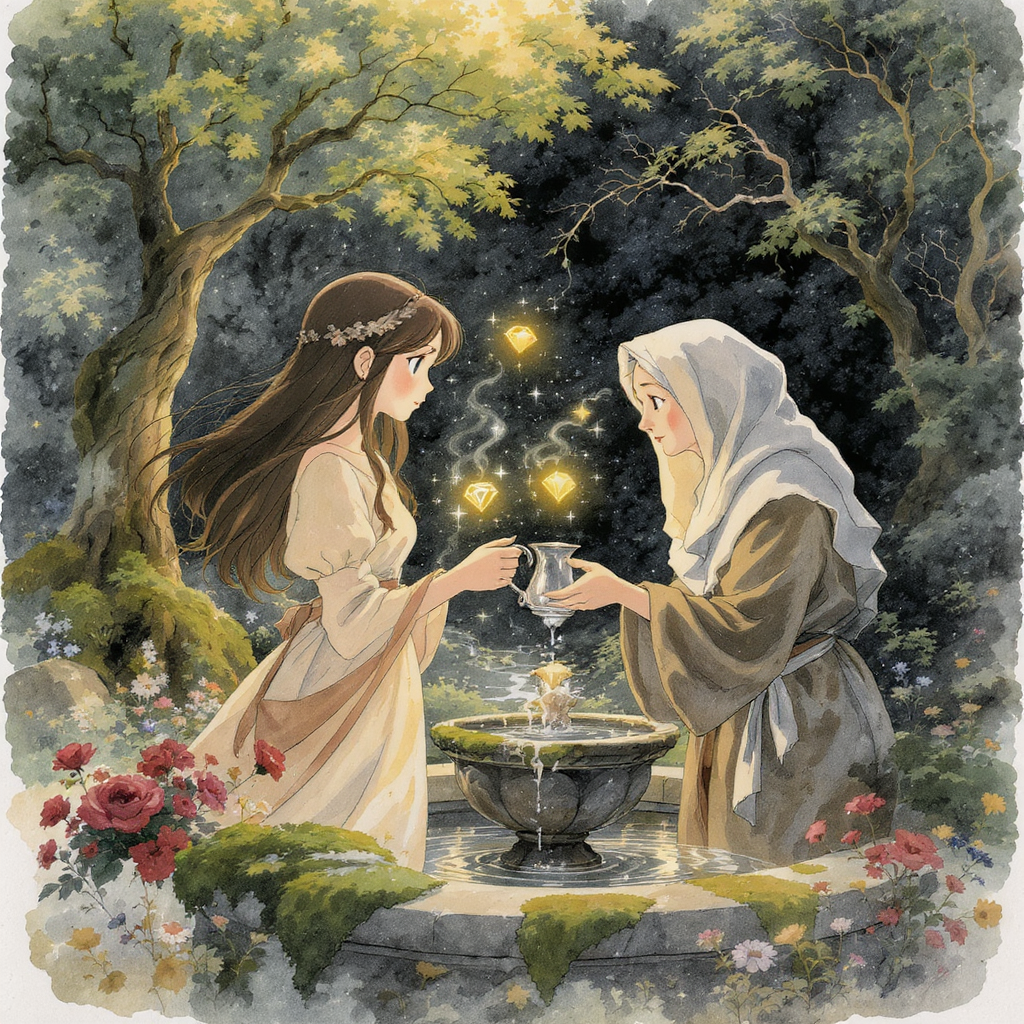
A poor woman came to the fountain. "May I have some water?" asked the woman. "Yes, please," said Lily kindly. She cleaned the pitcher. She gave the woman fresh water.
The woman smiled. She was a Good Fairy. "You are very kind," said the Fairy. "I will give you a gift. When you speak, flowers and stones will come."
Lily went home. "You were slow!" said Mother. "I am sorry," said Lily. Two roses and diamonds fell from her mouth. "What is this?" cried Mother. She was very happy. "Tell me all!" she said.
Mother wanted more gifts. "Fanny, go to the fountain," she said. "Take this silver cup." Fanny did not want to go. But she went.
A lady in a pretty dress came. "Give me water," said the lady. It was the Good Fairy again. "No! Get your own water," said Fanny meanly. "You are not polite," said the Fairy. "Now bugs and worms will come out."
Fanny went home. "Well?" said Mother. "Well," said Fanny. Bugs and worms fell from her mouth. "Oh no!" cried Mother. She was very upset. "This is Lily's fault!" she shouted.
Mother ran to scold Lily. Lily was scared. She ran away into the forest.
A Prince was walking in the forest. He saw Lily crying. "Why are you sad?" he asked. "My mother was angry with me," said Lily. Pretty pearls fell from her mouth. The Prince was amazed. He liked her words and magic jewels.
The Prince married Lily. They were happy in the palace.
Fanny was rude to all. Mother sent her away. Fanny lived alone and was very sad.
Kind people get good things. Rude people get bad things. Always be kind and polite.
Original Story
TOADS AND DIAMONDS THERE was once upon a time a widow who had two daughters. The eldest was so much like her in the face and humor that whoever looked upon the daughter saw the mother. They were both so disagreeable and so proud that there was no living with them. The youngest, who was the very picture of her father for courtesy and sweetness of temper, was withal one of the most beautiful girls ever seen. As people naturally love their own likeness, this mother even doted on her eldest daughter and at the same time had a horrible aversion for the youngest--she made her eat in the kitchen and work continually. Among other things, this poor child was forced twice a day to draw water above a mile and a-half off the house, and bring home a pitcher full of it. One day, as she was at this fountain, there came to her a poor woman, who begged of her to let her drink. “Oh! ay, with all my heart, Goody,” said this pretty little girl; and rinsing immediately the pitcher, she took up some water from the clearest place of the fountain, and gave it to her, holding up the pitcher all the while, that she might drink the easier. The good woman, having drunk, said to her: “You are so very pretty, my dear, so good and so mannerly, that I cannot help giving you a gift.” For this was a fairy, who had taken the form of a poor country woman, to see how far the civility and good manners of this pretty girl would go. “I will give you for a gift,” continued the Fairy, “that, at every word you speak, there shall come out of your mouth either a flower or a jewel.” When this pretty girl came home her mother scolded her for staying so long at the fountain. “I beg your pardon, mamma,” said the poor girl, “for not making more haste.” And in speaking these words there came out of her mouth two roses, two pearls, and two diamonds. “What is it I see there?” said the mother, quite astonished. “I think I see pearls and diamonds come out of the girl’s mouth! How happens this, child?” This was the first time she had ever called her child. The poor creature told her frankly all the matter, not without dropping out infinite numbers of diamonds. “In good faith,” cried the mother, “I must send my child thither. Come hither, Fanny; look what comes out of thy sister’s mouth when she speaks. Wouldst not thou be glad, my dear, to have the same gift given thee? Thou hast nothing else to do but go and draw water out of the fountain, and when a certain poor woman asks you to let her drink, to give it to her very civilly.” “It would be a very fine sight indeed,” said this ill-bred minx, “to see me go draw water.” “You shall go, hussy!” said the mother; “and this minute.” So away she went, but grumbling all the way, taking with her the best silver tankard in the house. She was no sooner at the fountain than she saw coming out of the wood a lady most gloriously dressed, who came up to her, and asked to drink. This was, you must know, the very fairy who appeared to her sister, but now had taken the air and dress of a princess, to see how far this girl’s rudeness would go. “Am I come hither,” said the proud, saucy one, “to serve you with water, pray? I suppose the silver tankard was brought purely for your ladyship, was it? However, you may drink out of it, if you have a fancy.” “You are not over and above mannerly,” answered the Fairy, without putting herself in a passion. “Well, then, since you have so little breeding, and are so disobliging, I give you for a gift that at every word you speak there shall come out of your mouth a snake or a toad.” So soon as her mother saw her coming she cried out: “Well, daughter?” “Well, mother?” answered the pert hussy, throwing out of her mouth two vipers and two toads. “Oh! mercy,” cried the mother; “what is it I see? Oh! it is that wretch her sister who has occasioned all this; but she shall pay for it”; and immediately she ran to beat her. The poor child fled away from her, and went to hide herself in the forest, not far from thence. The King’s son, then on his return from hunting, met her, and seeing her so very pretty, asked her what she did there alone and why she cried. “Alas! sir, my mamma has turned me out of doors.” The King’s son, who saw five or six pearls and as many diamonds come out of her mouth, desired her to tell him how that happened. She thereupon told him the whole story; and so the King’s son fell in love with her, and, considering himself that such a gift was worth more than any marriage portion, conducted her to the palace of the King his father, and there married her. As for the sister, she made herself so much hated that her own mother turned her off; and the miserable wretch, having wandered about a good while without finding anybody to take her in, went to a corner of the wood, and there died.(1) (1) Charles Perrault.
Moral of the Story
Kindness and good manners are rewarded, while rudeness and ill-temper lead to misfortune.
Characters

The youngest daughter ★ protagonist
Very beautiful, picture of her father
Attire: Simple, peasant-style dress, perhaps a bit worn from her chores; wooden shoes
Kind, courteous, sweet-tempered

The Fairy ◆ supporting
Initially appears as a poor woman, then as a gloriously dressed lady/princess
Attire: Ragged clothes as the poor woman; elaborate gown and jewels as the princess
Wise, observant, just

The mother ⚔ antagonist
Resembles her eldest daughter in face and humor (implying an unpleasant appearance)
Attire: Plain, practical clothing, reflecting her status as a widow; perhaps a dark, severe dress
Disagreeable, proud, cruel

Fanny ⚔ antagonist
Resembles her mother, implying an unpleasant appearance
Attire: Finer clothes than her sister, reflecting her mother's favoritism; perhaps a silk ribbon or two
Ill-bred, saucy, disobliging

The King's son ◆ supporting
Handsome, regal
Attire: Hunting attire, appropriate for a prince; fine fabrics, boots, perhaps a feathered hat
Kind, discerning, romantic
Locations

Widow's Kitchen
A place where the younger daughter is forced to eat and work, separate from the rest of the family.
Mood: Oppressive, unfair, filled with aversion.
The younger daughter is mistreated and forced to eat separately.

Fountain in the Field
A fountain located a mile and a half from the widow's house, with a clear water source.
Mood: Magical, transformative, a place of encounter.
The younger daughter meets the fairy and receives her gift; the older daughter is cursed.

Forest Edge
The edge of a forest, not far from the widow's house, where the younger daughter hides.
Mood: Desolate, lonely, a place of refuge.
The younger daughter meets the King's son.

Royal Palace
The King's palace, presumably grand and opulent.
Mood: Grand, secure, a place of love and acceptance.
The younger daughter marries the King's son.
Story DNA
Moral
Kindness and good manners are rewarded, while rudeness and ill-temper lead to misfortune.
Plot Summary
A kind and beautiful daughter, mistreated by her mother and rude sister, encounters a disguised fairy at a fountain. Her courtesy earns her a magical gift: flowers and jewels fall from her mouth when she speaks. Her mother, seeking the same for her favored but ill-mannered daughter, sends her to the fountain. The rude daughter's disdain for the fairy results in a curse: snakes and toads fall from her mouth. The kind daughter eventually marries a prince, while the rude daughter is cast out by her mother and dies alone, illustrating the consequences of their respective characters.
Themes
Emotional Arc
suffering to triumph
Writing Style
Narrative Elements
Cultural Context
This story is a variant of Charles Perrault's 'Les Fées' (The Fairies), first published in 1697, reflecting 17th-century French societal values regarding proper conduct and the consequences of good vs. bad behavior.
Plot Beats (13)
- A widow lives with two daughters: one kind and beautiful, but abused; the other proud and disagreeable, but favored.
- The kind daughter is forced to fetch water daily from a distant fountain.
- At the fountain, she encounters a poor woman (a disguised fairy) and politely offers her water.
- The fairy, pleased by her civility, gifts her with flowers and jewels falling from her mouth when she speaks.
- The kind daughter returns home, and her mother is astonished and delighted by the jewels and flowers.
- The mother, greedy for more, forces her rude daughter to go to the fountain with a silver tankard.
- The rude daughter encounters the same fairy, now disguised as a princess, and treats her with extreme rudeness.
- The fairy, angered by her ill manners, curses the rude daughter: snakes and toads fall from her mouth when she speaks.
- The rude daughter returns home, and her mother is horrified by the toads and vipers, blaming the kind sister.
- The mother attempts to beat the kind daughter, who flees into the forest.
- The King's son, returning from hunting, finds the kind daughter, hears her story (with jewels falling), and falls in love.
- The King's son marries the kind daughter, valuing her gift and character.
- The rude sister, hated by all, is eventually cast out by her mother and dies alone in the woods.


