Ball-Carrier and the Bad One
by Andrew Lang

The Clever Boy and the Magic Ball
A shiny magic ball rolled into the forest.
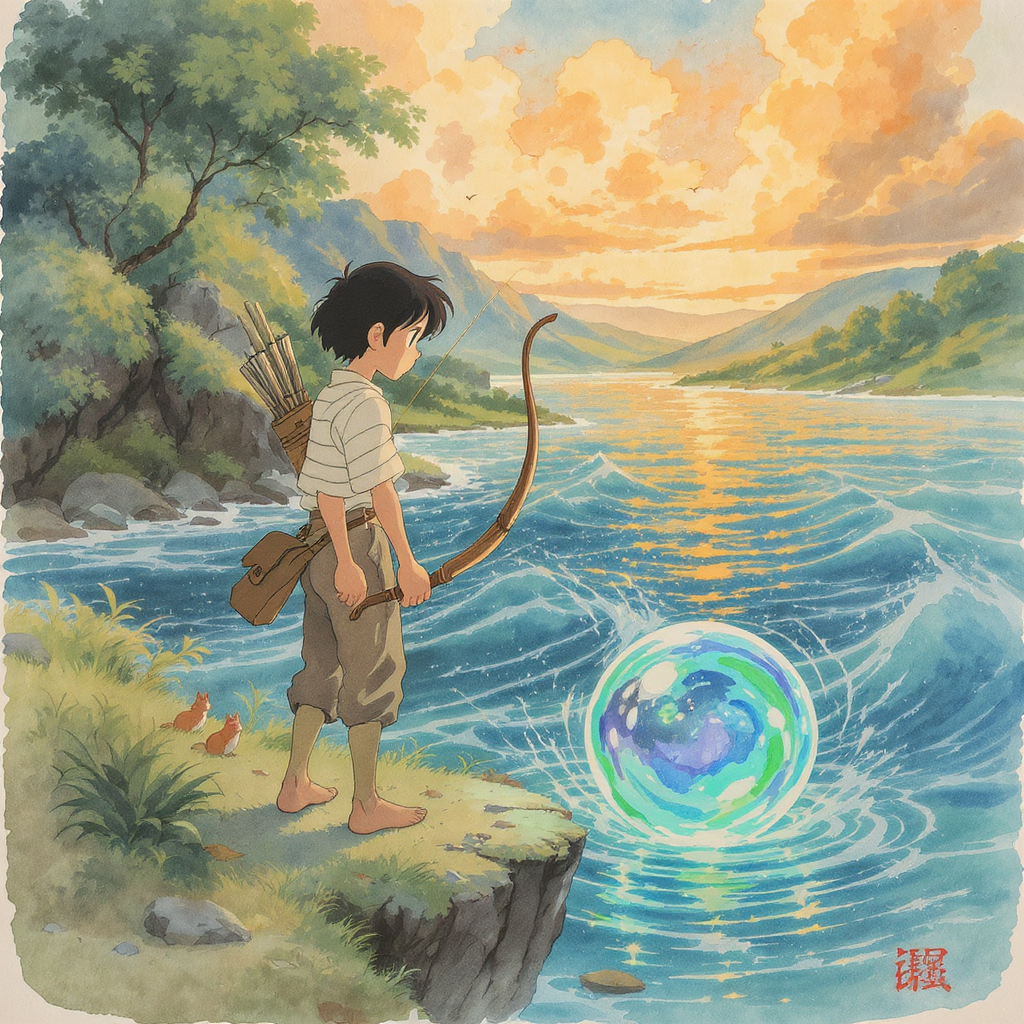
The ball was blue and green and white. It rolled near a little hut. A boy named Ball-Carrier saw it. He was playing with his bow. The ball looked so pretty! He wanted to pick it up. But it rolled too fast.
But the ball rolled away. It rolled down a hill. Ball-Carrier ran after it. He tried once, twice, three times. He ran as fast as he could. He could not catch it. The ball rolled into a house. Ball-Carrier followed it inside.
An old woman was there. "Hello, grandson!" she said. "You must be tired. Sit and eat." Ball-Carrier sat down. She gave him good food. He ate it all up. It tasted very good.
"You must learn magic," said the old woman. "Lie down on these skins. Good spirits will come. They will teach you." Ball-Carrier lay down. He practiced his lessons. He learned for many days. He practiced every day.
The spirits taught him magic. They taught him to make himself small. They taught him to make himself big. They taught him to talk to animals. Ball-Carrier learned it all. He was ready for his quest.
"Good job!" said the old woman. "Now I have a quest for you. Far away, the Bad One had a magic bridge. He had shiny gold. They did not belong to him. Will you take them back?"
"Yes!" said Ball-Carrier. "I can do it!"
"Take this magic ball," she said. "It will help you cross the river."
Ball-Carrier took the ball. He walked to the river. The water was fast. He tied the ball to his foot. The ball floated! He walked across the water safely. The ball kept him floating.
He found the Bad One's house. The Bad One was inside. Ball-Carrier used his magic. He wished the Bad One felt very hungry. The Bad One went for a snack. He did not see Ball-Carrier.
Ball-Carrier went inside. He took a bag of gold. He took the magic bridge. He made himself very small. He hid behind some skins. He was very quiet.
The Servant came in. She saw the gold was gone! She looked and looked. She found Ball-Carrier. "I found him!" she cried. She was very surprised.
The Bad One was angry. "You took my things!" he shouted.
"Yes," said Ball-Carrier. "I took them back. They are not yours."
"We'll lock you up!" said the Bad One. "You will stay here forever! You cannot escape."
Ball-Carrier had an idea. "I am very small," he said. "Let me rest for two days. I will be better then. I need to rest."
The Bad One agreed. He put Ball-Carrier in a little room. For two days, Ball-Carrier rested.
"Now I am ready," said the Bad One. He came to get Ball-Carrier.
Ball-Carrier had another idea. "Wait!" he said. "The Servant looks very tired. She should rest first."
The Servant sat down. She was very tired. Soon, she fell fast asleep. She was very sleepy.
Ball-Carrier used his magic. He made himself big and strong. He picked up the gold and the bridge. He ran out of the house. He ran to the river. He ran very fast.
He used the magic bridge. He crossed the water. He was on the other side! He was safe now.
The Bad One woke up. He saw Ball-Carrier across the river. "Please!" he called. "Can we be friends? I am sorry! I will be good."
Ball-Carrier was clever. He made the bridge very small. The Bad One could not cross. He could not get the gold back. He ran away into the forest. He was very sad.
Ball-Carrier was safe. He had the gold. He had the magic bridge. He smiled a big smile. He was clever and brave. He never gave up. He was very happy.
Being clever and never giving up helps solve problems.
Original Story
Ball-carrier and the Bad One Far, far in the forest there were two little huts, and in each of them lived a man who was a famous hunter, his wife, and three or four children. Now the children were forbidden to play more than a short distance from the door, as it was known that, away on the other side of the wood near the great river, there dwelt a witch who had a magic ball that she used as a means of stealing children. Her plan was a very simple one, and had never yet failed. When she wanted a child she just flung her ball in the direction of the child’s home, and however far off it might be, the ball was sure to reach it. Then, as soon as the child saw it, the ball would begin rolling slowly back to the witch, just keeping a little ahead of the child, so that he always thought that he could catch it the next minute. But he never did, and, what was more, his parents never saw him again. Of course you must not suppose that all the fathers and mothers who had lost children made no attempts to find them, but the forest was so large, and the witch was so cunning in knowing exactly where they were going to search, that it was very easy for her to keep out of the way. Besides, there was always the chance that the children might have been eaten by wolves, of which large herds roamed about in winter. One day the old witch happened to want a little boy, so she threw her ball in the direction of the hunters’ huts. A child was standing outside, shooting at a mark with his bow and arrows, but the moment he saw the ball, which was made of glass whose blues and greens and whites, all frosted over, kept changing one into the other, he flung down his bow, and stooped to pick the ball up. But as he did so it began to roll very gently downhill. The boy could not let it roll away, when it was so close to him, so he gave chase. The ball seemed always within his grasp, yet he could never catch it; it went quicker and quicker, and the boy grew more and more excited. That time he almost touched it—no, he missed it by a hair’s breadth! Now, surely, if he gave a spring he could get in front of it! He sprang forward, tripped and fell, and found himself in the witch’s house! “Welcome! welcome! grandson!” said she; “get up and rest yourself, for you have had a long walk, and I am sure you must be tired!” So the boy sat down, and ate some food which she gave him in a bowl. It was quite different from anything he had tasted before, and he thought it was delicious. When he had eaten up every bit, the witch asked him if he had ever fasted. “No,” replied the boy, “at least I have been obliged to sometimes, but never if there was any food to be had.” “You will have to fast if you want the spirits to make you strong and wise, and the sooner you begin the better.” “Very well,” said the boy, “what do I do first?” “Lie down on those buffalo skins by the door of the hut,” answered she; and the boy lay down, and the squirrels and little bears and the birds came and talked to him. At the end of ten days the old woman came to him with a bowl of the same food that he had eaten before. “Get up, my grandson, you have fasted long enough. Have the good spirits visited you, and granted you the strength and wisdom that you desire?” “Some of them have come, and have given me a portion of both,” answered the boy, “but many have stayed away from me.” “Then,” said she, “you must fast ten days more.” So the boy lay down again on the buffalo skins, and fasted for ten days, and at the end of that time he turned his face to the wall, and fasted for twenty days longer. At length the witch called to him, and said: “Come and eat something, my grandson.” At the sound of her voice the boy got up and ate the food she gave him. When he had finished every scrap she spoke as before: “Tell me, my grandson, have not the good spirits visited you all these many days that you have fasted?” “Not all, grandmother,” answered he; “there are still some who keep away from me and say that I have not fasted long enough.” “Then you must fast again,” replied the old woman, “and go on fasting till you receive the gifts of all the good spirits. Not one must be missing.” The boy said nothing, but lay down for the third time on the buffalo skins, and fasted for twenty days more. And at the end of that time the witch thought he was dead, his face was so white and his body so still. But when she had fed him out of the bowl he grew stronger, and soon was able to sit up. “You have fasted a long time,” said she, “longer than anyone ever fasted before. Surely the good spirits must be satisfied now?” “Yes, grandmother,” answered the boy, “they have all come, and have given me their gifts.” This pleased the old woman so much that she brought him another basin of food, and while he was eating it she talked to him, and this is what she said: “Far away, on the other side of the great river, is the home of the Bad One. In his house is much gold, and what is more precious even than the gold, a little bridge, which lengthens out when the Bad One waves his hand, so that there is no river or sea that he cannot cross. Now I want that bridge and some of the gold for myself, and that is the reason that I have stolen so many boys by means of my ball. I have tried to teach them how to gain the gifts of the good spirits, but none of them would fast long enough, and at last I had to send them away to perform simple, easy little tasks. But you have been strong and faithful, and you can do this thing if you listen to what I tell you! When you reach the river tie this ball to your foot, and it will take you across—you cannot manage it in any other way. But do not be afraid; trust to the ball, and you will be quite safe!” The boy took the ball and put it in a bag. Then he made himself a club and a bow, and some arrows which would fly further than anyone else’s arrows, because of the strength the good spirits had given him. They had also bestowed on him the power of changing his shape, and had increased the quickness of his eyes and ears so that nothing escaped him. And in some way or other they made him understand that if he needed more help they would give it to him. When all these things were ready the boy bade farewell to the witch and set out. He walked through the forest for several days without seeing anyone but his friends the squirrels and the bears and the birds, but though he stopped and spoke to them all, he was careful not to let them know where he was going. At last, after many days, he came to the river, and beyond it he noticed a small hut standing on a hill which he guessed to be the home of the Bad One. But the stream flowed so quickly that he could not see how he was ever to cross it, and in order to test how swift the current really was, he broke a branch from a tree and threw it in. It seemed hardly to touch the water before it was carried away, and even his magic sight could not follow it. He could not help feeling frightened, but he hated giving up anything that he had once undertaken, and, fastening the ball on his right foot, he ventured on the river. To his surprise he was able to stand up; then a panic seized him, and he scrambled up the bank again. In a minute or two he plucked up courage to go a little further into the river, but again its width frightened him, and a second time he turned back. However, he felt rather ashamed of his cowardice, as it was quite clear that his ball could support him, and on his third trial he got safely to the other side. Once there he replaced the ball in the bag, and looked carefully round him. The door of the Bad One’s hut was open, and he saw that the ceiling was supported by great wooden beams, from which hung the bags of gold and the little bridge. He saw, too, the Bad One sitting in the midst of his treasures eating his dinner, and drinking something out of a horn. It was plain to the boy that he must invent some plan of getting the Bad One out of the way, or else he would never be able to steal the gold or the bridge. What should he do? Give horrible shrieks as if he were in pain? But the Bad One would not care whether he were murdered or not! Call him by his name? But the Bad One was very cunning, and would suspect some trick. He must try something better than that! Then suddenly an idea came to him, and he gave a little jump of joy. “Oh, how stupid of me not to think of that before!” said he, and he wished with all his might that the Bad One should become very hungry—so hungry that he could not wait a moment for fresh food to be brought to him. And sure enough at that instant the Bad One called out to his servant, “You did not bring food that would satisfy a sparrow Fetch some more at once, for I am perfectly starving.” Then, without giving the woman time to go to the larder, he got up from his chair, and rolled, staggering from hunger, towards the kitchen. Directly the door had closed on the Bad One the boy ran in, pulled down a bag of gold from the beam, and tucked it under his left arm. Next he unhooked the little bridge and put it under his right. He did not try to escape, as most boys of his age would have done, for the wisdom put into his mind by the good spirits taught him that before he could reach the river and make use of the bridge the Bad One would have tracked him by his footsteps and been upon him. So, making himself very small and thin, he hid himself behind a pile of buffalo skins in the corner, first tearing a slit through one of them, so that he could see what was going on. He had hardly settled himself when the servant entered the room, and, as she did so, the last bag of gold on the beam fell to the ground—for they had begun to fall directly the boy had taken the first one. She cried to her master that someone had stolen both the bag and the bridge, and the Bad One rushed in, mad with anger, and bade her go and seek for footsteps outside, that they might find out where the thief had gone. In a few minutes she returned, saying that he must be in the house, as she could not see any footsteps leading to the river, and began to move all the furniture in the room, without discovering Ball Carrier. “But he must be here somewhere,” she said to herself, examining for the second time the pile of buffalo skins; and Ball-Carrier, knowing that he could not possibly escape now, hastily wished that the Bad One should be unable to eat any more food at present. “Ah, there is a slit in this one,” cried the servant, shaking the skin; “and here he is.” And she pulled out Ball-Carrier, looking so lean and small that he would hardly have made a mouthful for a sparrow. “Was it you who took my gold and bridge?” asked the Bad One. “Yes,” answered Ball-Carrier, “it was I who took them.” The Bad One made a sign to the woman, who inquired where he had hidden them. He lifted his left arm where the gold was, and she picked up a knife and scraped his skin so that no gold should be left sticking to it. “What have you done with the bridge?” said she. And he lifted his right arm, from which she took the bridge, while the Bad One looked on, well pleased. “Be sure that he does not run away,” chuckled he. “Boil some water, and get him ready for cooking, while I go and invite my friends the water-demons to the feast.” The woman seized Ball-Carrier between her finger and thumb, and was going to carry him to the kitchen, when the boy spoke: “I am very lean and small now,” he said, “hardly worth the trouble of cooking; but if you were to keep me two days, and gave me plenty of food, I should get big and fat. As it is, your friends the water-demons would think you meant to laugh at them, when they found that I was the feast.” “Well, perhaps you are right,” answered the Bad One; “I will keep you for two days.” And he went out to visit the water-demons. Meanwhile the servant, whose name was Lung Woman, led him into a little shed, and chained him up to a ring in the wall. But food was given him every hour, and at the end of two days he was as fat and big as a Christmas turkey, and could hardly move his head from one side to the other. “He will do now,” said the Bad One, who came constantly to see how he was getting on. “I shall go and tell the water-demons that we expect them to dinner to-night. Put the kettle on the fire, but be sure on no account to taste the broth.” Lung-Woman lost no time in obeying her orders. She built up the fire, which had got very low, filled the kettle with water, and passing a rope which hung from the ceiling through the handle, swung it over the flames. Then she brought in Ball-Carrier, who, seeing all these preparations, wished that as long as he was in the kettle the water might not really boil, though it would hiss and bubble, and also, that the spirits would turn the water into fat. The kettle soon began to sing and bubble, and Ball Carrier was lifted in. Very soon the fat which was to make the sauce rose to the surface, and Ball-Carrier, who was bobbing about from one side to the other, called out that Lung-Woman had better taste the broth, as he though that some salt should be added to it. The servant knew quite well that her master had forbidden her to do any thing of the kind, but when once the idea was put into her head, she found the smell from the kettle so delicious that she unhooked a long ladle from the wall and plunged it into the kettle. “You will spill it all, if you stand so far off,” said the boy; “why don’t you come a little nearer?” And as she did so he cried to the spirits to give him back his usual size and strength and to make the water scalding hot Then he gave the kettle a kick, which upset all the boiling water upon her, and jumping over her body he seized once more the gold and the bridge, picked up his club and bow and arrows, and after setting fire to the Bad One’s hut, ran down to the river, which he crossed safely by the help of the bridge. The hut, which was made of wood, was burned to the ground before the Bad One came back with a large crowd of water-demons. There was not a sign of anyone or anything, so he started for the river, where he saw Ball Carrier sitting quietly on the other side. Then the Bad One knew what had happened, and after telling the water demons that there would be no feast after all, he called to Ball-Carrier, who was eating an apple. “I know your name now,” he said, “and as you have ruined me, and I am not rich any more, will you take me as your servant?” “Yes, I will, though you have tried to kill me,” answered Ball-Carrier, throwing the bridge across the water as he spoke. But when the Bad One was in the midst of the stream, the boy wished it to become small; and the Bad One fell into the water and was drowned, and the world was rid of him. [U.S.. Bureau of Ethnology.]
Moral of the Story
With cleverness and perseverance, even the smallest can overcome powerful adversaries.
Characters

Ball-Carrier ★ protagonist
Lean and small initially, becomes fat after being fed, then returns to normal size
Attire: Simple tunic and leggings appropriate for a hunter's child
Brave, clever, resourceful, patient

The Witch ◆ supporting
Old and cunning
Attire: Simple, dark robes
Deceptive, manipulative, greedy

The Bad One ⚔ antagonist
Implied to be large and imposing
Attire: Richly decorated robes
Cruel, greedy, easily angered

Lung-Woman ◆ supporting
Strong enough to lift Ball-Carrier
Attire: Simple servant's clothing
Obedient, curious, easily tempted
Locations

Hunters' Huts
Two small huts located far apart in a deep forest.
Mood: peaceful, but with underlying fear of the witch
The children are warned not to stray too far, setting up the conflict.

Witch's Hut
A hut in the woods, containing buffalo skins near the door.
Mood: eerie, deceptive
Ball-Carrier is tricked into entering and begins his fast.

Bad One's House
A house containing bags of gold hanging from a beam, and a pile of buffalo skins in the corner.
Mood: dangerous, opulent
Ball-Carrier steals the gold and bridge, and tricks Lung-Woman.

Great River
A wide river separating the witch and the Bad One's territories from the hunters.
Mood: dangerous, final
Ball-Carrier escapes and defeats the Bad One.
Story DNA
Moral
With cleverness and perseverance, even the smallest can overcome powerful adversaries.
Plot Summary
A witch uses a magic ball to lure a boy to her home, where she forces him to fast, granting him strength and wisdom from good spirits. She then tasks him with stealing a magic bridge and gold from the fearsome 'Bad One'. The boy, using his newfound powers and cunning, successfully steals the treasures, outwits the Bad One's servant to escape being cooked, and ultimately drowns the Bad One by shrinking the magic bridge as he attempts to cross it, ridding the world of his evil.
Themes
Emotional Arc
innocence to wisdom
Writing Style
Narrative Elements
Cultural Context
Andrew Lang's 'Brown Fairy Book' compiled stories from various global cultures, including Native American folklore. The mention of 'U.S. Bureau of Ethnology' at the end of the story indicates its source is likely an Indigenous American tale, adapted by Lang.
Plot Beats (14)
- A witch uses a magic ball to lure children from their homes, and they are never seen again.
- A boy is playing near his hut when the witch's magic ball appears; he chases it and is led to her house.
- The witch welcomes the boy and instructs him to fast to gain strength and wisdom from spirits.
- The boy fasts repeatedly, gaining various magical abilities, including shape-shifting and enhanced senses.
- The witch reveals her plan: she wants the boy to steal a magic bridge and gold from the 'Bad One'.
- The boy travels to the Bad One's hut, struggles to cross a swift river, but eventually succeeds using the magic ball.
- Inside the hut, the boy uses his powers to make the Bad One intensely hungry, sending him to the kitchen.
- The boy steals a bag of gold and the magic bridge, then hides, making himself small.
- The servant discovers the theft, and the boy is found and captured.
- The Bad One and his servant plan to cook the boy, but the boy tricks them into waiting two days to fatten him up.
- After two days, the boy is fat; he tricks the servant into tasting the broth while he's in the kettle, then scalds her.
- The boy escapes with the gold and bridge, sets the hut on fire, and crosses the river.
- The Bad One returns to his burning hut, sees the boy across the river, and asks to become his servant.
- The boy agrees, but as the Bad One crosses the bridge, the boy shrinks it, drowning the Bad One.


