Fortune and the Wood-Cutter
by Andrew Lang

The Wood-cutter Who Waited
A wood-cutter worked hard every day. He was poor. He had a wife and children. He had an axe and two mules. He worked and worked. But he stayed poor.
One day, he felt very sad. "I will not work," he said. "I will wait in bed. Maybe Fortune will come to me."
The next morning, he did not get up. His wife came in. "Get up!" she said. "We have no food." "No," he said. "I will wait for Fortune."
A neighbor came to the door. "Can I borrow your mules?" he asked. The wood-cutter was in bed. "Yes," he said. "Take them."
The neighbor took the mules. He walked far into the forest. There, he found a treasure of gold. It was shiny and bright. He put the gold in sacks. He put the heavy sacks on the mules.
Then he saw some men. They were coming his way. He was scared. He ran away fast. The mules stood alone. They turned and walked home.
The wife saw the mules. They carried heavy sacks. "Look!" she called to her husband. "Get up! The mules are back!"
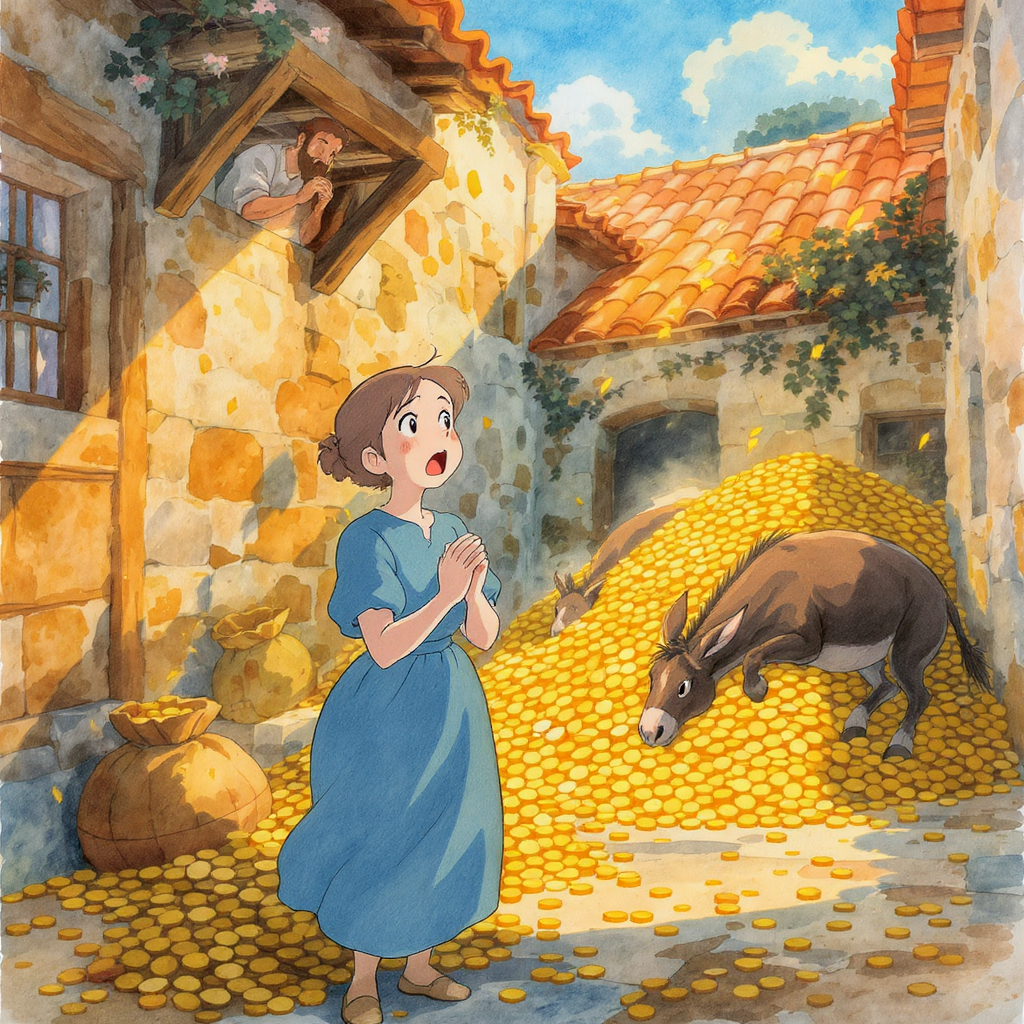
He did not get up. The wife took a knife. She cut the sacks open. Gold coins fell out! Lots and lots of gold! They sparkled on the ground.
"Come see!" she cried. "Fortune is here! We are rich!" The wood-cutter jumped out of bed. He ran to the gold.
"You see," he said. "I was right to wait for Fortune!" He smiled a big smile. They were happy and rich. Good things come when we least expect them.
Original Story
Fortune and the Wood-Cutter Several hundreds of years ago there lived in a forest a wood-cutter and his wife and children. He was very poor, having only his axe to depend upon, and two mules to carry the wood he cut to the neighbouring town; but he worked hard, and was always out of bed by five o’clock, summer and winter. This went on for twenty years, and though his sons were now grown up, and went with their father to the forest, everything seemed to go against them, and they remained as poor as ever. In the end the wood-cutter lost heart, and said to himself: “What is the good of working like this if I never am a penny the richer at the end? I shall go to the forest no more! And perhaps, if I take to my bed, and do not run after Fortune, one day she may come to me.” So the next morning he did not get up, and when six o’clock struck, his wife, who had been cleaning the house, went to see what was the matter. “Are you ill?” she asked wonderingly, surprised at not finding him dressed. “The cock has crowed ever so often. It is high time for you to get up.” “Why should I get up?” asked the man, without moving. “Why? to go to the forest, of course.” “Yes; and when I have toiled all day I hardly earn enough to give us one meal.” “But what can we do, my poor husband?” said she. “It is just a trick of Fortune’s, who would never smile upon us.” “Well, I have had my fill of Fortune’s tricks,” cried he. “If she wants me she can find me here. But I have done with the wood for ever.” “My dear husband, grief has driven you mad! Do you think Fortune will come to anybody who does not go after her? Dress yourself, and saddle the mules, and begin your work. Do you know that there is not a morsel of bread in the house?” “I don’t care if there isn’t, and I am not going to the forest. It is no use your talking; nothing will make me change my mind.” The distracted wife begged and implored in vain; her husband persisted in staying in bed, and at last, in despair, she left him and went back to her work. An hour or two later a man from the nearest village knocked at her door, and when she opened it, he said to her: “Good-morning, mother. I have got a job to do, and I want to know if your husband will lend me your mules, as I see he is not using them, and can lend me a hand himself?” “He is upstairs; you had better ask him,” answered the woman. And the man went up, and repeated his request. “I am sorry, neighbour, but I have sworn not to leave my bed, and nothing will make me break my vow.” “Well, then, will you lend me your two mules? I will pay you something for them.” “Certainly, neighbour. Take them and welcome.” So the man left the house, and leading the mules from the stable, placed two sacks on their back, and drove them to a field where he had found a hidden treasure. He filled the sacks with the money, though he knew perfectly well that it belonged to the sultan, and was driving them quietly home again, when he saw two soldiers coming along the road. Now the man was aware that if he was caught he would be condemned to death, so he fled back into the forest. The mules, left to themselves, took the path that led to their master’s stable. The wood-cutter’s wife was looking out of the window when the mules drew up before the door, so heavily laden that they almost sank under their burdens. She lost no time in calling her husband, who was still lying in bed. “Quick! quick! get up as fast as you can. Our two mules have returned with sacks on their backs, so heavily laden with something or other that the poor beasts can hardly stand up.” “Wife, I have told you a dozen times already that I am not going to get up. Why can’t you leave me in peace?” As she found she could get no help from her husband the woman took a large knife and cut the cords which bound the sacks on to the animals’ backs. They fell at once to the ground, and out poured a rain of gold pieces, till the little court-yard shone like the sun. “A treasure!” gasped the woman, as soon as she could speak from surprise. “A treasure!” And she ran off to tell her husband. “Get up! get up!” she cried. “You were quite right not to go to the forest, and to await Fortune in your bed; she has come at last! Our mules have returned home laden with all the gold in the world, and it is now lying in the court. No one in the whole country can be as rich as we are!” In an instant the wood-cutter was on his feet, and running to the court, where he paused dazzled by the glitter of the coins which lay around him. “You see, my dear wife, that I was right,” he said at last. “Fortune is so capricious, you can never count on her. Run after her, and she is sure to fly from you; stay still, and she is sure to come.” [Traditions Populaires de l’Asie Mineure.]
Moral of the Story
Fortune is capricious and may come to those who wait, but often through the actions of others or unexpected circumstances, rather than direct effort.
Characters

Wood-cutter ★ protagonist
Strong, but weary from years of hard labor
Attire: Simple tunic and trousers, leather belt, worn wooden clogs
Hardworking, initially diligent, then becomes passive and superstitious, ultimately opportunistic

Wood-cutter's Wife ◆ supporting
Thin but strong from physical labor
Attire: Simple, patched dress of coarse fabric, apron, bare feet
Practical, hardworking, initially skeptical but adaptable, loyal

Neighbor ○ minor
Sturdy build
Attire: Simple village clothing
Resourceful, opportunistic, and dishonest

Mules ◆ supporting
Sturdy working animals, heavily laden
Attire: Sacks tied to their backs
Docile, obedient, follow their usual path
Locations

Forest
A dense forest where the woodcutter and his sons work, suggesting a place of hard labor and potential danger.
Mood: Tiring, unrewarding
The woodcutter toils for years without improving his family's fortune.

Woodcutter's House - Bedroom
Upstairs bedroom where the woodcutter stubbornly remains in bed, refusing to work.
Mood: Stubborn, lazy
The woodcutter decides to stay in bed, hoping Fortune will come to him.

Woodcutter's House - Courtyard
A small courtyard outside the house, suddenly filled with gold coins.
Mood: Surprised, dazzling, fortunate
The mules return laden with gold, transforming the family's life.

Field near the forest
A field near the forest where a treasure was hidden.
Mood: Secretive, dangerous
A man finds the sultan's treasure and loads it onto the woodcutter's mules.
Story DNA
Moral
Fortune is capricious and may come to those who wait, but often through the actions of others or unexpected circumstances, rather than direct effort.
Plot Summary
A poor wood-cutter, tired of his lifelong struggle, decides to stop working and wait for Fortune to come to him. Despite his wife's pleas, he remains in bed, even allowing a neighbor to borrow his mules. The neighbor, after finding a hidden treasure and loading it onto the mules, abandons them when soldiers approach. The mules return home, and the wood-cutter's wife discovers the sacks are filled with gold, making them rich. The wood-cutter then proudly claims his passive strategy was correct, attributing their new wealth to his decision to wait for Fortune.
Themes
Emotional Arc
suffering to triumph
Writing Style
Narrative Elements
Cultural Context
The reference to 'Traditions Populaires de l’Asie Mineure' suggests an origin in folk tales from Asia Minor (modern-day Turkey), collected and retold in French.
Plot Beats (12)
- A wood-cutter, his wife, and children live in poverty despite his diligent work for twenty years.
- The wood-cutter becomes disheartened, deciding to stop working and wait for Fortune to come to him.
- The next morning, he refuses to get out of bed, despite his wife's pleas and their lack of food.
- A neighbor arrives, asking to borrow the wood-cutter's mules and for his help with a job.
- The wood-cutter refuses to get out of bed but allows the neighbor to take his mules.
- The neighbor uses the mules to transport a hidden treasure he found, which belongs to the sultan.
- Upon seeing soldiers, the neighbor flees into the forest, abandoning the mules with the treasure.
- The mules return to the wood-cutter's home, heavily laden with sacks.
- The wife calls for her husband to help, but he again refuses to get out of bed.
- The wife cuts the cords on the sacks, revealing a shower of gold coins.
- The wife excitedly tells her husband that Fortune has arrived, and he immediately gets up.
- The wood-cutter is dazzled by the gold and declares that his strategy of waiting for Fortune was correct.


