How Ball-Carrier finished his Task
by Andrew Lang

Ball-Carrier's Journey
Once, there was a boy called Ball who loved adventures. He found a home. He met a kind girl who became Mother. They had two children. They were happy.
One day, Mother's sister came to visit. She was the Aunt Witch. "Let's have a race!" she said. "Let's see who is the fastest."
"That sounds fun," said Ball.
They stood together. "When the sun hits the tree, we go," said the Aunt Witch.
They started to run. Ball ran fast. He changed into a wolf. He ran ahead. Then the Aunt Witch caught up. She ran past him.
Ball changed into a pigeon. He flew fast. He flew past her. Soon, she was ahead again.
Ball changed into a crow. He flew very fast. He flew past her. He was winning!
The Aunt Witch tried hard. She ran faster. She passed him again.
Ball was tired. He changed into a hummingbird. He was very, very fast. He flew like a flash. He flew into his house. He won the race!
The Aunt Witch was sad. She had lost. She went away quietly.
Ball was happy to be home. He played with his children. He hunted for food. One day, he felt very, very sleepy. He could not stay awake.
"When I sleep forever," he said, "put me in the special place in the trees."
His family was sad. They put him in his resting place. As they walked home, they saw his magic ball. It rolled away down the path. It rolled all the way to Grandma's house.
Ball's family had little food. One morning, his daughter went to find berries. She saw a new little hut. She looked inside. There was lots of food! A little robin bird sat on a beam. "Tweet tweet!" it sang.
The robin chirped happily.
From then on, the family got food from the hut. The robin was their friend.
One day, the girl's husband came. He saw the food. He was curious. "How do you get this food?" he asked.
"A kind robin helps us," said his wife.
The man wanted to see the robin. He went to the hut. The robin was there. "Tweet tweet!" it sang. The man reached out. The robin flew away. It flew high into the sky. It was gone.
The family was sad. The robin did not come back.
Far away, the magic ball rolled into Grandma's house. Grandma knew Ball was asleep. Grandma used her magic. "Go back," she said to the ball. "Show me the way."
The ball rolled. Grandma followed. They went to the special resting place.
"Wake up, my grandson," said Grandma. "It is time to go home."
Ball woke up. He was happy to see Grandma. He took his club and his bow.
They went to Grandma's hut. "Did you get the gold from the Bad Man?" asked Grandma.
"Yes, Grandma," said Ball. "It is here."
Grandma took the gold. "This gold must be hidden," she said. "People must work hard to find it." She put it in a deep, deep hole. The gold went into the earth. Now, people dig to find gold.
"Did you get the bridge?" asked Grandma.
"Yes," said Ball. "It is here."
Grandma took the bridge. "This bridge must be hidden too," she said. "People must learn to build their own bridges." She buried it deep in the ground.
"Now, go to your mother and father," said Grandma. "They are old. They need you. Your work is done."
Ball went to his parents. They were so happy to see him. They hugged him. They were all together again.
The end. Working hard and being clever is good. Try hard, be smart.
Original Story
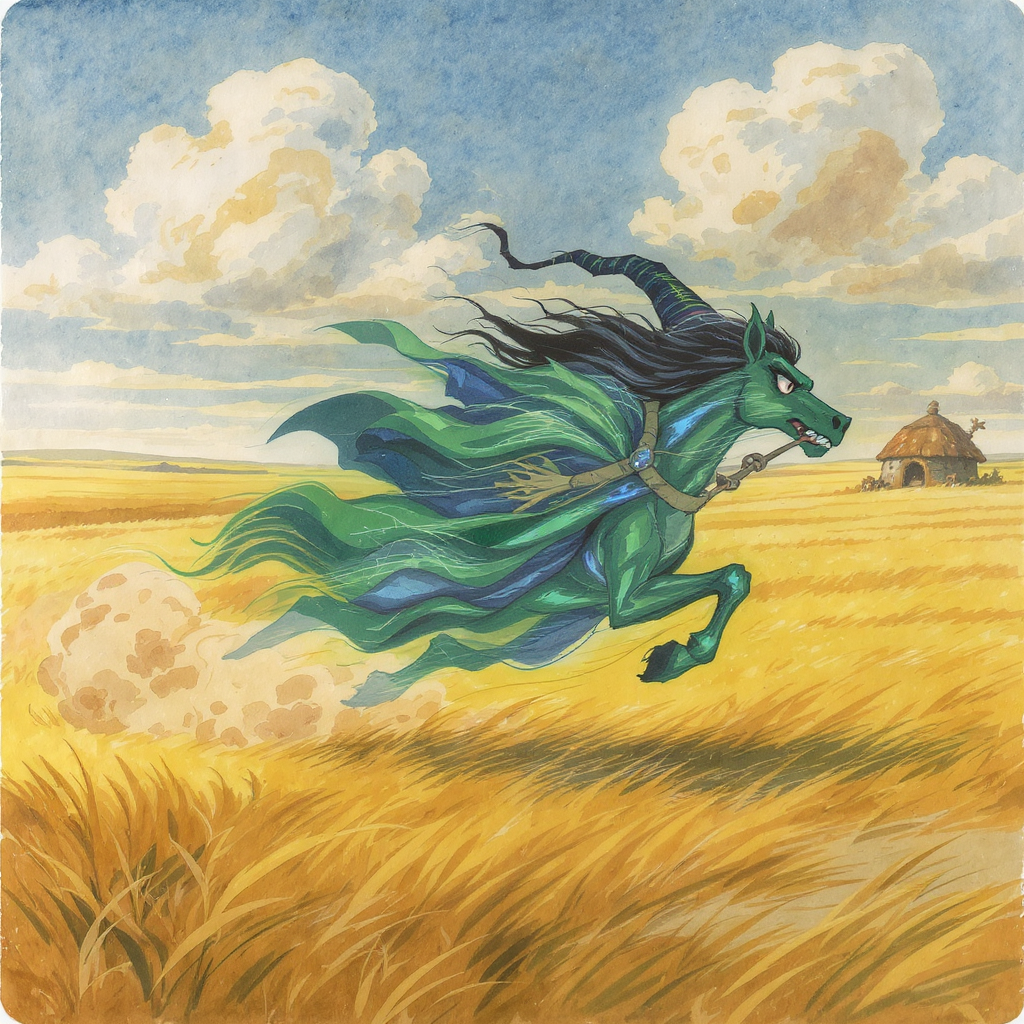
How Ball-carrier Finished His Task After Ball-Carrier had managed to drown the Bad One so that he could not do any more mischief, he forgot the way to his grandmother’s house, and could not find it again, though he searched everywhere. During this time he wandered into many strange places, and had many adventures; and one day he came to a hut where a young girl lived. He was tired and hungry and begged her to let him in and rest, and he stayed a long while, and the girl became his wife. One morning he saw two children playing in front of the hut, and went out to speak to them. But as soon as they saw him they set up cries of horror and ran away. “They are the children of my sister who has been on a long journey,” replied his wife, “and now that she knows you are my husband she wants to kill you.” “Oh, well, let her try,” replied Ball-Carrier. “It is not the first time people have wished to do that. And here I am still, you see!” “Be careful,” said the wife, “she is very cunning.” But at this moment the sister-in-law came up. “How do you do, brother-in-law? I have heard of you so often that I am very glad to meet you. I am told that you are more powerful than any man on earth, and as I am powerful too, let us try which is the strongest.” “That will be delightful,” answered he. “Suppose we begin with a short race, and then we will go on to other things.” “That will suit me very well,” replied the woman, who was a witch. “And let us agree that the one who wins shall have the right to kill the other.” “Oh, certainly,” said Ball-Carrier; and I don’t think we shall find a flatter course than the prairie itself—no one knows how many miles it stretches. We will run to the end and back again.” This being settled they both made ready for the race, and Ball-Carrier silently begged the good spirits to help him, and not to let him fall into the hands of this wicked witch. “When the sun touches the trunk of that tree we will start,” said she, as they both stood side by side. But with the first step Ball-Carrier changed himself into a wolf and for a long way kept ahead. Then gradually he heard her creeping up behind him, and soon she was in front. So Ball-Carrier took the shape of a pigeon and flew rapidly past her, but in a little while she was in front again and the end of the prairie was in sight. “A crow can fly faster than a pigeon,” thought he, and as a crow he managed to pass her and held his ground so long that he fancied she was quite beaten. The witch began to be afraid of it too, and putting out all her strength slipped past him. Next he put on the shape of a hawk, and in this form he reached the bounds of the prairie, he and the witch turning homewards at the moment. Bird after bird he tried, but every time the witch gained on him and took the lead. At length the goal was in sight, and Ball-Carrier knew that unless he could get ahead now he would be killed before his own door, under the eyes of his wife. His eyes had grown dim from fatigue, his wings flapped wearily and hardly bore him along, while the witch seemed as fresh as ever. What bird was there whose flight was swifter than his? Would not the good spirits tell him? Ah, of course he knew; why had he not thought of it at first and spared himself all that fatigue? And the next instant a humming bird, dressed in green and blue, flashed past the woman and entered the house. The witch came panting up, furious at having lost the race which she felt certain of winning; and Ball-Carrier, who had by this time changed back into his own shape, struck her on the head and killed her. For a long while Ball-Carrier was content to stay quietly at home with his wife and children, for he was tired of adventures, and only did enough hunting to supply the house with food. But one day he happened to eat some poisonous berries that he had found in the forest, and grew so ill that he felt he was going to die. “When I am dead do not bury me in the earth,” he said, “but put me over there, among that clump of trees.” So his wife and her three children watched by him as long as he was alive, and after he was dead they took him up and laid the body on a platform of stakes which they had prepared in the grove. And as they returned weeping to the hut they caught a glimpse of the ball rolling away down the path back to the old grandmother. One of the sons sprang forward to stop it, for Ball-Carrier had often told them the tale of how it had helped him to cross the river, but it was too quick for him, and they had to content themselves with the war club and bow and arrows, which were put carefully away. By-and-by some travellers came past, and the chief among them asked leave to marry Ball-Carrier’s daughter. The mother said she must have a little time to think over it, as her daughter was still very young; so it was settled that the man should go away for a month with his friends, and then come back to see if the girl was willing. Now ever since Ball-Carrier’s death the family had been very poor, and often could not get enough to eat. One morning the girl, who had had no supper and no breakfast, wandered off to look for cranberries, and though she was quite near home was astonished at noticing a large hut, which certainly had not been there when last she had come that way. No one was about, so she ventured to peep in, and her surprise was increased at seeing, heaped up in one corner, a quantity of food of all sorts, while a little robin redbreast stood perched on a beam looking down upon her. “It is my father, I am sure,” she cried; and the bird piped in answer. From that day, whenever they wanted food they went to the hut, and though the robin could not speak, he would hop on their shoulders and let them feed him with the food they knew he liked best. When the man came back he found the girl looking so much prettier and fatter than when he had left her, that he insisted that they should be married on the spot. And the mother, who did not know how to get rid of him, gave in. The husband spent all his time in hunting, and the family had never had so much meat before; but the man, who had seen for himself how poor they were, noticed with amazement that they did not seem to care about it, or to be hungry. “They must get food from somewhere,” he thought, and one morning, when he pretended to be going out to hunt, he hid in a thicket to watch. Very soon they all left the house together, and walked to the other hut, which the girl’s husband saw for the first time, as it was hid in a hollow. He followed, and noticed that each one went up to the redbreast, and shook him by the claw; and he then entered boldly and shook the bird’s claw too. The whole party afterwards sat down to dinner, after which they all returned to their own hut. The next day the husband declared that he was very ill, and could not eat anything; but this was only a presence so that he might get what he wanted. The family were all much distressed, and begged him to tell them what food he fancied. “Oh! I could not eat any food,” he answered every time, and at each answer his voice grew fainter and fainter, till they thought he would die from weakness before their eyes. “There must be some thing you could take, if you would only say what it is,” implored his wife. “No, nothing, nothing; except, perhaps—but of course that is impossible!” “No, I am sure it is not,” replied she; “you shall have it, I promise—only tell me what it is.” “I think—but I could not ask you to do such a thing. Leave me alone, and let me die quietly.” “You shall not die,” cried the girl, who was very fond of her husband, for he did not beat her as most girls’ husbands did. “Whatever it is, I will manage to get it for you.” “Well, then, I think, if I had that—redbreast, nicely roasted, I could eat a little bit of his wing!” The wife started back in horror at such a request; but the man turned his face to the wall, and took no notice, as he thought it was better to leave her to herself for a little. Weeping and wringing her hands, the girl went down to her mother. The brothers were very angry when they heard the story, and declared that, if any one were to die, it certainly should not be the robin. But all that night the man seemed getting weaker and weaker, and at last, quite early, the wife crept out, and stealing to the hut, killed the bird, and brought him home to her husband. Just as she was going to cook it her two brothers came in. They cried out in horror at the sight, and, rushing out of the hut, declared they would never see her any more. And the poor girl, with a heavy heart, took the body of the redbreast up to her husband. But directly she entered the room the man told her that he felt a great deal better, and that he would rather have a piece of bear’s flesh, well boiled, than any bird, however tender. His wife felt very miserable to think that their beloved redbreast had been sacrificed for nothing, and begged him to try a little bit. “You felt so sure that it would do you good before,” said she, “that I can’t help thinking it would quite cure you now.” But the man only flew into a rage, and flung the bird out of the window. Then he got up and went out. Now all this while the ball had been rolling, rolling, rolling to the old grandmother’s hut on the other side of the world, and directly it rolled into her hut she knew that her grandson must be dead. Without wasting any time she took a fox skin and tied it round her forehead, and fastened another round her waist, as witches always do when they leave their own homes. When she was ready she said to the ball: “Go back the way you came, and lead me to my grandson.” And the ball started with the old woman following. It was a long journey, even for a witch, but, like other things, it ended at last; and the old woman stood before the platform of stakes, where the body of Ball-Carrier lay. “Wake up, my grandson, it is time to go home,” the witch said. And Ball-Carrier stepped down oft the platform, and brought his club and bow and arrows out of the hut, and set out, for the other side of the world, behind the old woman. When they reached the hut where Ball-Carrier had fasted so many years ago, the old woman spoke for the first time since they had started on their way. “My grandson, did you ever manage to get that gold from the Bad One?” “Yes, grandmother, I got it.” “Where is it?” she asked. “Here, in my left arm-pit,” answered he. So she picked up a knife and scraped away all the gold which had stuck to his skin, and which had been sticking there ever since he first stole it. After she had finished she asked again: “My grandson, did you manage to get that bridge from the Bad One?” “Yes, grandmother, I got that too,” answered he. “Where is it?” she asked, and Ball-Carrier lifted his right arm, and pointed to his arm-pit. “Here is the bridge, grandmother,” said he. Then the witch did something that nobody in the world could have guessed that she would do. First, she took the gold and said to Ball-carrier: “My grandson, this gold must be hidden in the earth, for if people think they can get it when they choose, they will become lazy and stupid. But if we take it and bury it in different parts of the world they will have to work for it if they want it, and then will only find a little at a time.” And as she spoke, she pulled up one of the poles of the hut, and Ball-Carrier saw that underneath was a deep, deep hole, which seemed to have no bottom. Down this hole she poured all the gold, and when it was out of sight it ran about all over the world, where people that dig hard sometimes find it. And after that was done she put the pole back again. Next she lifted down a spade from a high shelf, where it had grown quite rusty, and dug a very small hole on the opposite side of the hut—very small, but very deep. “Give me the bridge,” said she, “for I am going to bury it here. If anyone was to get hold of it, and find that they could cross rivers and seas without any trouble, they would never discover how to cross them for themselves. I am a witch, and if I had chosen I could easily have cast my spells over the Bad One, and have made him deliver them to you the first day you came into my hut. But then you would never have fasted, and never have planned how to get what you wanted, and never have known the good spirits, and would have been fat and idle to the end of your days. And now go; in that hut, which you can just see far away, live your father and mother, who are old people now, and need a son to hunt for them. You have done what you were set to do, and I need you no more.” Then Ball-Carrier remembered his parents and went back to them. [From Bureau of Ethnology. “Indian Folklore.“]
Moral of the Story
True wisdom and strength come from effort and ingenuity, not from easily acquired power or wealth.
Characters

Ball-Carrier ★ protagonist
Strong, capable of transforming into various animals
Attire: Traditional Native American clothing, including a war club and bow and arrows
Determined, resourceful, initially forgetful but ultimately fulfills his task

Wife ◆ supporting
Not described
Attire: Traditional Native American clothing
Loving, supportive, willing to sacrifice for her husband

Sister-in-law ⚔ antagonist
Powerful, cunning
Attire: Not described
Cunning, aggressive, power-hungry

Grandmother ◆ supporting
Witch-like, powerful
Attire: Fox skins tied around her forehead and waist
Wise, demanding, focused on the greater good

Redbreast ◆ supporting
Small bird with a red breast
Helpful, kind, linked to Ball-Carrier's spirit

The Bad One ⚔ antagonist
Implied to be monstrous and evil
Attire: Not described
Mischievous, evil
Locations

Hut in the Prairie
A simple dwelling where Ball-Carrier lives with his wife and children; seemingly isolated on the vast prairie.
Mood: Initially peaceful and domestic, but becomes tense and dangerous with the arrival of the witch.
The race against the witch begins and ends here; Ball-Carrier kills the witch.

The Prairie
A seemingly endless flat expanse of grassland, used as the race track between Ball-Carrier and the witch.
Mood: Vast, open, and unforgiving; represents the challenge and endurance required to overcome the witch.
The race takes place here, with Ball-Carrier transforming into various birds to try and outpace the witch.

Platform of Stakes in a Grove of Trees
A raised platform constructed among a clump of trees, where Ball-Carrier's body is placed after his death.
Mood: Solemn, mournful, and transitional; a place of death and temporary rest before Ball-Carrier's resurrection.
Ball-Carrier's body is placed here, and the grandmother witch revives him.

Hidden Hut with Food
A mysterious hut filled with an abundance of food, appearing suddenly near the family's home.
Mood: Magical, helpful, and slightly eerie; a source of sustenance provided by Ball-Carrier's spirit.
The daughter discovers the hut and the robin, which provides food for the family.

Old Grandmother's Hut
A remote hut on the other side of the world, the home of the powerful grandmother witch.
Mood: Mystical, ancient, and powerful; a place of hidden knowledge and transformative actions.
The grandmother buries the gold and the bridge, then sends Ball-Carrier back to his parents.
Story DNA
Moral
True wisdom and strength come from effort and ingenuity, not from easily acquired power or wealth.
Plot Summary
After defeating a great evil, Ball-Carrier settles down, but is challenged by his wife's witch sister to a deadly shapeshifting race, which he wins. He later dies from poisonous berries, and his spirit becomes a robin guarding a magical food hut for his impoverished family. His daughter's suspicious husband tricks her into killing the robin. Ball-Carrier's grandmother, alerted by a magical ball, resurrects him and reveals the true purpose of the gold and bridge he stole from the Bad One, burying them to ensure humanity's effort and ingenuity. She then sends him to his long-lost parents, his task complete.
Themes
Emotional Arc
suffering to triumph
Writing Style
Narrative Elements
Cultural Context
This story is presented as 'Indian Folklore' from the Bureau of Ethnology, indicating it's a collected tale from Native American oral traditions, likely adapted by Andrew Lang. The themes of resourcefulness, respect for nature, and the role of elders are common in many indigenous cultures.
Plot Beats (12)
- Ball-Carrier, having drowned the Bad One, gets lost and settles down, marrying and having children.
- His wife's witch sister challenges him to a race with a death wager.
- Ball-Carrier wins the race by shapeshifting into various birds, finally a hummingbird, and kills the witch.
- Ball-Carrier falls ill from poisonous berries and dies, instructing his family to place his body on a platform.
- His magical ball rolls away to his grandmother, signaling his death.
- Ball-Carrier's family becomes poor, but his daughter discovers a magical hut with food, guarded by a robin (Ball-Carrier's spirit).
- The daughter marries, and her husband, suspicious of their food source, tricks her into killing the robin.
- The grandmother, guided by the ball, arrives at Ball-Carrier's death platform and resurrects him.
- The grandmother extracts the stolen gold and bridge from Ball-Carrier's armpits.
- The grandmother explains that the gold must be buried to make people work for it, and buries it.
- The grandmother explains that the bridge must be buried so people learn to cross rivers themselves, and buries it.
- The grandmother reveals Ball-Carrier's parents are alive and sends him to them, his task complete.


