How Geirald the Coward was Punished
by Andrew Lang

The Brave Boy and the Cowardly Friend
Once, a brave boy named Rosald lived. He was poor but very kind. One day, he met a rich boy, Geirald. "Let us go on a trip," said Geirald. "I have no money," said Rosald. "I have money for both," said Geirald. "But you must promise me a thing," said Geirald. "If we are brave, you must say I was brave." Rosald said, "That is fine. I promise." Rosald went home. He told his father and mother. His father said, "Keep your promise. Be good." His mother said, "Be good and keep your promise." Rosald was happy. He went with Geirald.
They traveled far. They saw some bad men in the woods. The men were robbers. There were twelve of them. Geirald was scared. "Let us run away!" he said. Rosald said, "No. We can be brave." He had an idea. They climbed up some big rocks. They rolled many big stones down the hill. The stones made loud noises. The robbers got scared. They ran away fast. They did not come back. Rosald found a shiny ring on the ground. He put the ring on his finger. Geirald took the ring. "I was brave," he told people. People said, "Good job, Geirald!" They did not know Rosald helped.
They went to a new land. They met a king. The king said, "I hear you are brave." "There is a giant in the hills," said the king. "He is big and sad. His house is broken." "Can you help him?" asked the king. Geirald was scared. Rosald said, "We will try." They found the giant. He was very big. But he was not mean. He was crying. "My roof is broken," said the giant. Rosald helped him fix his roof. They used big logs. The giant was happy. "Thank you!" he said. He gave Rosald a big, pretty feather. Geirald took the feather. He went to the king. "I helped the giant," said Geirald. The king was happy. "You are very brave!" he said.
The queen was smart. She watched them. She said, "I want to see more." "Let us have a race," said the queen. Geirald was scared. He did not want to race. Rosald said, "I will help you." They switched clothes. Rosald wore Geirald's fine coat. Rosald ran the race. He ran very fast. He won the race! All cheered. Geirald went to the queen. "I won," he said. "I want to marry you," said Geirald. The queen smiled. "One more test," she said. "The next day, you will have one more race." Geirald was very scared all night. He did not sleep. He hid under his bed. In the morning, the trumpets sounded. All came to the race. Geirald was not there. The king sent people to find him. They found him hiding under his bed. All saw him. They knew he was not brave.
The queen spoke. "I saw the ring," she said. "Rosald has the ring. He is the brave one." "I was the runner in the race. I saw him." "Rosald keeps his promises. He is honest." "I will marry Rosald," said the queen. Rosald and the queen were very happy. They ruled the land well and with kindness. Geirald was sad. He learned a lesson. Being brave and honest is good. Cheating is bad. And they all lived happily ever after. Remember to be brave and true.
Original Story
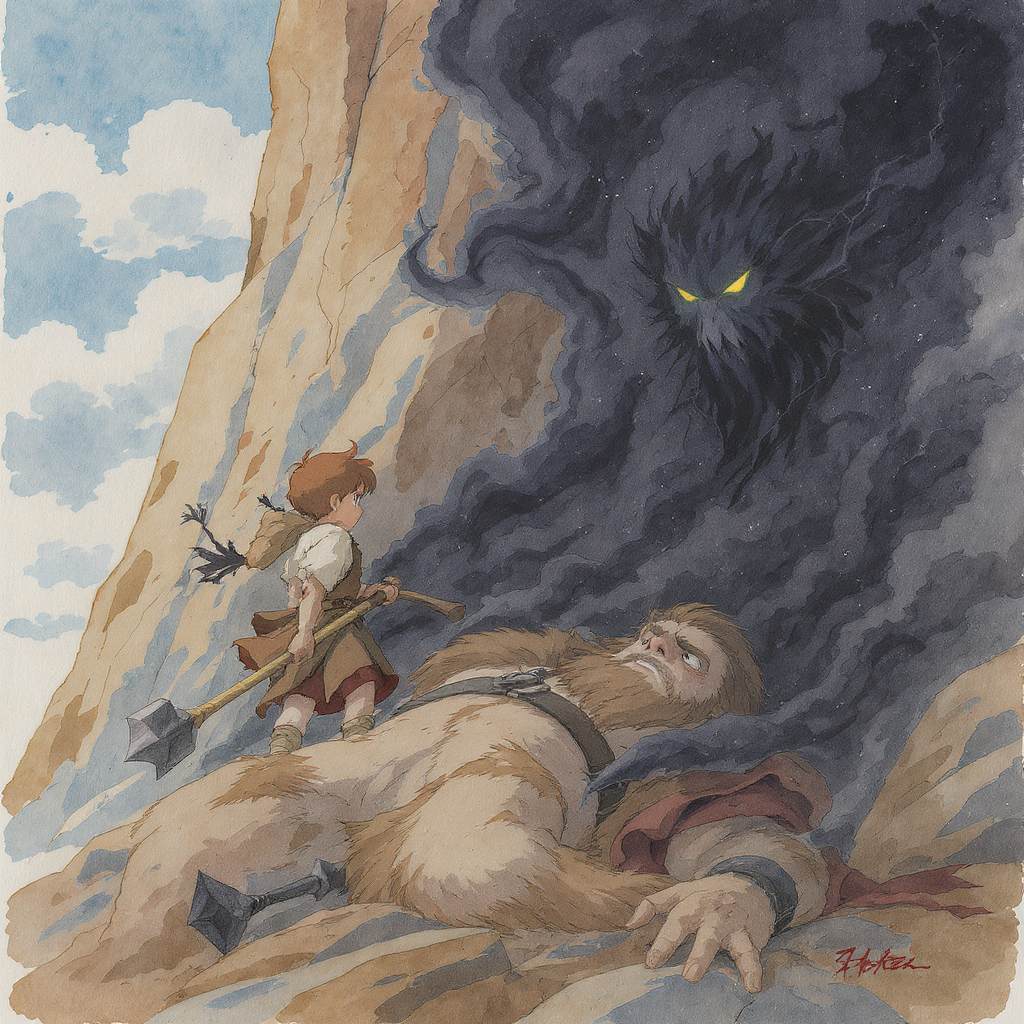
How Geirald The Coward Was Punished Once upon a time there lived a poor knight who had a great many children, and found it very hard to get enough for them to eat. One day he sent his eldest son, Rosald, a brave and honest youth, to the neighbouring town to do some business, and here Rosald met a young man named Geirald, with whom he made friends. Now Geirald was the son of a rich man, who was proud of the boy, and had all his life allowed him to do whatever he fancied, and, luckily for the father, he was prudent and sensible, and did not waste money, as many other rich young men might have done. For some time he had set his heart on travelling into foreign countries, and after he had been talking for a little while to Rosald, he asked if his new friend would be his companion on his journey. “There is nothing I should like better,” answered Rosald, shaking his head sorrowfully; “but my father is very poor, and he could never give me the money.” “Oh, if that is your only difficulty, it is all right,” cried Geirald. “My father has more money than he knows what to do with, and he will give me as much as I want for both of us; only, there is one thing you must promise me, Rosald, that, supposing we have any adventures, you will let the honour and glory of them fall to me.” “Yes, of course, that is only fair,” answered Rosald, who never cared about putting himself forward. “But I cannot go without telling my parents. I am sure they will think me lucky to get such a chance.” As soon as the business was finished, Rosald hastened home. His parents were delighted to hear of his good fortune, and his father gave him his own sword, which was growing rusty for want of use, while his mother saw that his leather jerkin was in order. “Be sure you keep the promise you made to Geirald,” said she, as she bade him good-bye, “and, come what may, see that you never betray him.” Full of joy Rosald rode off, and the next day he and Geirald started off to seek adventures. To their disappointment their own land was so well governed that nothing out of the common was very likely to happen, but directly they crossed the border into another kingdom all seemed lawlessness and confusion. They had not gone very far, when, riding across a mountain, they caught a glimpse of several armed men hiding amongst some trees in their path, and remembered suddenly some talk they had heard of a band of twelve robbers who lay in wait for rich travellers. The robbers were more like savage beasts than men, and lived somewhere at the top of the mountain in caves and holes in the ground. They were all called “Hankur,” and were distinguished one from another by the name of a colour—blue, grey, red, and so on, except their chief, who was known as Hankur the Tall. All this and more rushed into the minds of the two young men as they saw the flash of their swords in the moonlight. “It is impossible to fight them—they are twelve to two,” whispered Geirald, stopping his horse in the path. “We had much better ride back and take the lower road. It would be stupid to throw away our lives like this.” “Oh, we can’t turn back,” answered Rosald, “we should be ashamed to look anyone in the face again! And, besides, it is a grand opportunity to show what we are made of. Let us tie up our horses here, and climb up the rocks so that we can roll stones down on them.” “Well, we might try that, and then we shall always have our horses,” said Geirald. So they went up the rocks silently and carefully. The robbers were lying all ready, expecting every moment to see their victims coming round the corner a few yards away, when a shower of huge stones fell on their heads, killing half the band. The others sprang up the rock, but as they reached the top the sword of Rosald swung round, and one man after another rolled down into the valley. At last the chief managed to spring up, and, grasping Rosald by the waist, flung away his sword, and the two fought desperately, their bodies swaying always nearer the edge. It seemed as if Rosald, being the smaller of the two, MUST fall over, when, with his left hand, he drew the robber’s sword out of its sheath and plunged it into his heart. Then he took from the dead man a beautiful ring set with a large stone, and put it on his own finger. The fame of this wonderful deed soon spread through the country, and people would often stop Geirald’s horse, and ask leave to see the robber’s ring, which was said to have been stolen from the father of the reigning king. And Geirald showed them the ring with pride, and listened to their words of praise, and no one would ever have guessed anyone else had destroyed the robbers. In a few days they left the kingdom and rode on to another, where they thought they would stop through the remainder of the winter, for Geirald liked to be comfortable, and did not care about travelling through ice and snow. But the king would only grant them leave to stop on condition that, before the winter was ended, they should give him some fresh proof of the courage of which he had heard so much. Rosald’s heart was glad at the king’s message, and as for Geirald, he felt that as long as Rosald was there all would go well. So they both bowed low and replied that it was the king’s place to command and theirs to obey. “Well, then,” said his Majesty, “this is what I want you to do: In the north-east part of my kingdom there dwells a giant, who has an iron staff twenty yards long, and he is so quick in using it, that even fifty knights have no chance against him. The bravest and strongest young men of my court have fallen under the blows of that staff; but, as you overcame the twelve robbers so easily, I feel that I have reason to hope that you may be able to conquer the giant. In three days from this you will set out.” “We will be ready, your Majesty,” answered Rosald; but Geirald remained silent. “How can we possibly fight against a giant that has killed fifty knights?” cried Geirald, when they were outside the castle. “The king only wants to get rid of us! He won’t think about us for the next three days—that is one comfort—so we shall have plenty of time to cross the borders of the kingdom and be out of reach.” “We mayn’t be able to kill the giant, but we certainly can’t run away till we have tried,” answered Rosald. “Besides, think how glorious it will be if we DO manage to kill him! I know what sort of weapon I shall use. Come with me now, and I will see about it.” And, taking his friend by the arm, he led him into a shop where he bought a huge lump of solid iron, so big that they could hardly lift it between them. However, they just managed to carry it to a blacksmith’s where Rosald directed that it should be beaten into a thick club, with a sharp spike at one end. When this was done to his liking he took it home under his arm. Very early on the third morning the two young men started on their journey, and on the fourth day they reached the giant’s cave before he was out of bed. Hearing the sound of footsteps, the giant got up and went to the entrance to see who was coming, and Rosald, expecting something of the sort, struck him such a blow on the forehead that he fell to the ground. Then, before he could rise to his feet again, Rosald drew out his sword and cut off his head. “It was not so difficult after all, you see,” he said, turning to Geirald. And placing the giant’s head in a leathern wallet which was slung over his back, they began their journey to the castle. As they drew near the gates, Rosald took the head from the wallet and handed it to Geirald, whom he followed into the king’s presence. “The giant will trouble you no more,” said Geirald, holding out the head. And the king fell on his neck and kissed him, and cried joyfully that he was the “bravest knight in all the world, and that a feast should be made for him and Rosald, and that the great deed should be proclaimed throughout the kingdom.” And Geirald’s heart swelled with pride, and he almost forgot that it was Rosald and not he, who had slain the giant. By-and-by a whisper went round that a beautiful lady who lived in the castle would be present at the feast, with twenty-four lovely maidens, her attendants. The lady was the queen of her own country, but as her father and mother had died when she was a little girl, she had been left in the care of this king who was her uncle. She was now old enough to govern her own kingdom, but her subjects did not like being ruled by a woman, and said that she must find a husband to help her in managing her affairs. Prince after prince had offered himself, but the young queen would have nothing to say to any of them, and at last told her ministers that if she was to have a husband at all she must choose him for herself, as she would certainly not marry any of those whom they had selected for her. The ministers replied that in that case she had better manage her kingdom alone, and the queen, who knew nothing about business, got things into such a confusion that at last she threw them up altogether, and went off to her uncle. Now when she heard how the two young men had slain the giant, her heart was filled with admiration of their courage, and she declared that if a feast was held she would certainly be present at it. And so she was; and when the feast was over she asked the king, her guardian, if he would allow the two heroes who had killed the robbers and slain the giant to fight a tourney the next day with one of her pages. The king gladly gave his consent, and ordered the lists to be made ready, never doubting that two great champions would be eager for such a chance of adding to their fame. Little did he guess that Geirald had done all he could to persuade Rosald to steal secretly out of the castle during the night, “for,” said he, “I don’t believe they are pages at all, but well-proved knights, and how can we, so young and untried, stand up against them?” “The honour will be all the higher if we gain the day,” answered Rosald; but Geirald would listen to nothing, and only declared that he did not care about honour, and would rather be alive than have every honour in the world heaped upon him. Go he would, and as Rosald had sworn to give him his company, he must come with him. Rosald was much grieved when he heard these words, but he knew that it was useless attempting to persuade Geirald, and turned his thoughts to forming some plan to prevent this disgraceful flight. Suddenly his face brightened. “Let us change clothes,” he said, “and I will do the fighting, while you shall get the glory. Nobody will ever know.” And to this Geirald readily consented. Whether Geirald was right or not in thinking that the so-called page was really a well-proved knight, it is certain that Rosald’s task was a very hard one. Three times they came together with a crash which made their horses reel; once Rosald knocked the helmet off his foe, and received in return such a blow that he staggered in his saddle. Shouts went up from the lookers-on, as first one and then the other seemed gaining the victory; but at length Rosald planted his spear in the armour which covered his adversary’s breast and bore him steadily backward. “Unhorsed! unhorsed!” cried the people; and Rosald then himself dismounted and helped his adversary to rise. In the confusion that followed it was easy for Rosald to slip away and return Geirald his proper clothes. And in these, torn and dusty with the fight, Geirald answered the king’s summons to come before him. “You have done what I expected you to do,” said he, “and now, choose your reward.” “Grant me, sire, the hand of the queen, your niece,” replied the young man, bowing low, “and I will defend her kingdom against all her enemies.” “She could choose no better husband,” said the king, “and if she consents I do.” And he turned towards the queen, who had not been present during the fight, but had just slipped into a seat by his right hand. Now the queen’s eyes were very sharp, and it seemed to her that the man who stood before her, tall and handsome though he might be, was different in many slight ways, and in one in particular, from the man who had fought the tourney. How there could be any trickery she could not understand, and why the real victor should be willing to give up his prize to another was still stranger; but something in her heart warned her to be careful. She answered: “You may be satisfied, uncle, but I am not. One more proof I must have; let the two young men now fight against each other. The man I marry must be the man who killed the robbers and the giant, and overcame my page.” Geirald’s face grew pale as he heard these words. He knew there was no escape from him now, though he did not doubt for one moment that Rosald would keep his compact loyally to the last. But how would it be possible that even Rosald should deceive the watchful eyes of the king and his court, and still more those of the young queen whom he felt uneasily had suspected him from the first? The tourney was fought, and in spite of Geirald’s fears Rosald managed to hang back to make attacks which were never meant to succeed, and to allow strokes which he could easily have parried to attain their end. At length, after a great show of resistance, he fell heavily to the ground. And as he fell he knew that it was not alone the glory that was his rightfully which he gave up, but the hand of the queen that was more precious still. But Geirald did not even wait to see if he was wounded; he went straight to the wall where the royal banner waved and claimed the reward which was now his. The crowd of watchers turned towards the queen, expecting to see her stoop and give some token to the victor. Instead, to the surprise of everyone, she merely smiled gracefully, and said that before she bestowed her hand one more test must be imposed, but this should be the last. The final tourney should be fought; Geirald and Rosald should meet singly two knights of the king’s court, and he who could unhorse his foe should be master of herself and of her kingdom. The combat was fixed to take place at ten o’clock the following day. All night long Geirald walked about his room, not daring to face the fight that lay in front of him, and trying with all his might to discover some means of escaping it. All night long he moved restlessly from door to window; and when the trumpets sounded, and the combatants rode into the field, he alone was missing. The king sent messengers to see what had become of him, and he was found, trembling with fear, hiding under his bed. After that there was no need of any further proof. The combat was declared unnecessary, and the queen pronounced herself quite satisfied, and ready to accept Rosald as her husband. “You forgot one thing,” she said, when they were alone. “I recognized my father’s ring which Hankur the Tall had stolen, on the finger of your right hand, and I knew that it was you and not Geirald who had slain the robber band. I was the page who fought you, and again I saw the ring on your finger, though it was absent from his when he stood before me to claim the prize. That was why I ordered the combat between you, though your faith to your word prevented my plan being successful, and I had to try another. The man who keeps his promise at all costs to himself is the man I can trust, both for myself and for my people.” So they were married, and returned to their own kingdom, which they ruled well and happily. And many years after a poor beggar knocked at the palace gates and asked for money, for the sake of days gone by—and this was Geirald. [From Neuislandischem Volksmärchen.] Hábogi Once upon a time there lived two peasants who had three daughters, and, as generally happens, the youngest was the most beautiful and the best tempered, and when her sisters wanted to go out she was always ready to stay at home and do their work. Years passed quickly with the whole family, and one day the parents suddenly perceived that all three girls were grown up, and that very soon they would be thinking of marriage. “Have you decided what your husband’s name is to be?” said the father, laughingly, to his eldest daughter, one evening when they were all sitting at the door of their cottage. “You know that is a very important point!” “Yes; I will never wed any man who is not called Sigmund,” answered she. “Well, it is lucky for you that there are a great many Sigmunds in this part of the world,” replied her father, “so that you can take your choice! And what do YOU say?” he added, turning to the second. “Oh, I think that there is no name so beautiful as Sigurd,” cried she. “Then you won’t be an old maid either,” answered he. “There are seven Sigurds in the next village alone! And you, Helga?” Helga, who was still the prettiest of the three, looked up. She also had her favourite name, but, just as she was going to say it, she seemed to hear a voice whisper: “Marry no one who is not called
Moral of the Story
True honor and courage are revealed through actions and integrity, not through false claims or outward appearances, and those who are truly brave will be rewarded.
Characters

Rosald ★ protagonist
Brave and honest youth, smaller than Geirald
Attire: Leather jerkin, father's rusty sword, practical riding clothes
Brave, selfless, loyal, keeps his promises

Geirald ⚔ antagonist
Son of a rich man, tall and handsome
Attire: Fine travelling clothes befitting his wealth, later torn and dusty armor
Cowardly, boastful, deceitful, comfort-loving

Hankur the Tall ⚔ antagonist
Chief of the twelve robbers, physically strong
Attire: Rough, practical clothing suitable for a robber
Violent, ruthless

The Queen ◆ supporting
Sharp eyes, observant
Attire: Royal garments, befitting her status
Intelligent, perceptive, just, values honesty

The King ◆ supporting
Majestic
Attire: Royal robes and crown
Wants to protect his kingdom
Locations

Mountain Pass
A narrow path winding through a mountain, with trees providing cover for ambushes and rocks suitable for rolling stones.
Mood: dangerous, tense, suspenseful
Rosald and Geirald encounter and defeat the twelve robbers.

King's Court
A grand hall where the king holds court, with space for tournaments and audiences.
Mood: formal, expectant, judgmental
Geirald attempts to claim the queen's hand, and the final test reveals his cowardice.

Geirald's Room
A private chamber where Geirald paces restlessly, consumed by fear and plotting escape.
Mood: anxious, claustrophobic, desperate
Geirald's cowardice is fully revealed as he hides under his bed instead of facing the final combat.
Story DNA
Moral
True honor and courage are revealed through actions and integrity, not through false claims or outward appearances, and those who are truly brave will be rewarded.
Plot Summary
Rosald, a brave but poor knight's son, journeys with the rich and cowardly Geirald, agreeing to let Geirald take credit for their adventures. Rosald repeatedly defeats formidable foes like robbers and a giant, while Geirald, terrified, claims all the glory. A discerning queen, suspicious of Geirald's boasts, devises a series of tests, including a tournament where she fights Rosald in disguise. Ultimately, when faced with a real combat challenge, Geirald's cowardice is exposed, and the queen reveals her knowledge of Rosald's true heroism. Rosald marries the queen and rules justly, while Geirald ends up a penniless beggar.
Themes
Emotional Arc
struggle to triumph
Writing Style
Narrative Elements
Cultural Context
Reflects a societal value system where bravery, honor, and keeping one's word were paramount, especially for knights and nobility.
Plot Beats (14)
- Rosald, a poor knight's son, meets and befriends Geirald, a rich man's son, agreeing to let Geirald claim glory for their adventures.
- Rosald's parents approve of his journey with Geirald, reminding him to keep his promise.
- The two encounter twelve robbers; Geirald wants to flee, but Rosald devises a plan to defeat them with stones and then kills the chief in single combat, taking a ring.
- Geirald proudly displays the ring and accepts praise for defeating the robbers.
- In a new kingdom, the king challenges them to defeat a giant; Geirald is terrified, but Rosald creates a spiked club and slays the giant.
- Geirald presents the giant's head to the king, claiming victory, and is praised.
- The queen, suspicious, arranges a tournament against her 'page'; Geirald tries to flee, but Rosald convinces him to switch clothes and fights in his stead.
- Rosald wins the tournament against the 'page' (the queen in disguise), allowing Geirald to claim the victory and ask for the queen's hand.
- The queen, still unconvinced, demands a final test: a tournament between Rosald and Geirald, then against two knights.
- Geirald, terrified of real combat, hides under his bed on the day of the final tournament.
- Geirald's cowardice is exposed to the court.
- The queen reveals she was the 'page' and recognized her father's ring on Rosald, confirming his true courage and integrity.
- Rosald marries the queen and they rule happily.
- Years later, Geirald is found as a poor beggar, having lost everything due to his cowardice and deceit.


