Pivi and Kabo
by Andrew Lang

Pivi's Good Luck
Once, two bird-men loved to play. Pivi and Kabo are friends. They have wings and fly. They play a slinging game. They laugh and have fun. Kabo throws a stone. It hurts Pivi's leg. Pivi falls into the water.
Pivi goes into a bamboo stick. The bamboo floats to shore. A kind lady finds him. She takes him to her shed. She puts him on a mat. The lady is very kind. She gives him food and water. She cares for him like a son.
The lady gives Pivi steps. She speaks softly to him. First, a small ant comes. Pivi must lie very still. Next, a big ant comes. Then he must shake his body. Pivi hears close. He follows her words. He trusts the lady.
He lies still for the small ant. He shakes for the big ant. He turns into a handsome man! The lady smiles at him. She is glad for him. "You did well," she says.
She asks him to climb a tree. Pivi climbs up high. He gets two nuts. He puts them in the shed. The nuts turn into two pretty wives. Pivi is very glad. He has two laughing wives. They smile and play side by side. They cook and sing for him. They are a glad group.
Kabo sees this. He wants to be handsome too. He is jealous of Pivi. He asks Pivi to hurt his leg. Pivi agrees to help him. Kabo does not hear the lady. He shakes for the small ant. He feels sick and looks funny. His nuts turn into horrid wives. Kabo is very sad. He cries and feels bad. He has no wives now. He regrets his actions.
Kabo tricks Pivi. He says there is a big shellfish. "It is very big," he says. Pivi goes to see it. The shellfish traps him inside. Kabo goes to Pivi's wives. He lies about Pivi. He says Pivi is gone. He tries to take them. The wives say no. They are loyal to Pivi. They wait for him. They hope Pivi returns.
Pivi uses his spear. He gets out of the shellfish. He comes back with his friends. Kabo runs away scared. He never comes back. Pivi is safe now. He is glad to be free.
Pivi tells the lady how he escaped. He and his wives live gladly. Being kind and hearing brings good things. Being mean and not hearing brings trouble. It is key to be good and kind. Always hear and be nice. This story teaches us a lesson.
Original Story
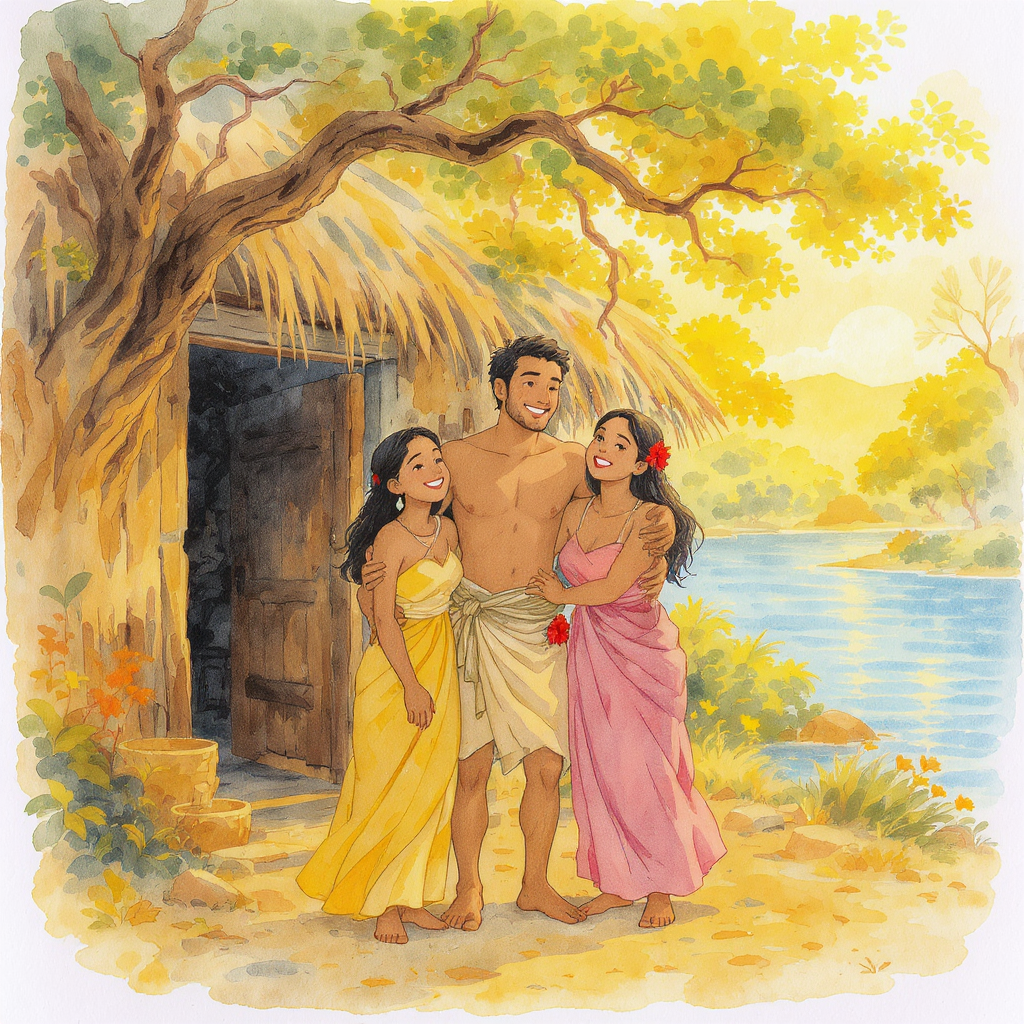
Pivi and Kabo When birds were men, and men were birds, Pivi and Kabo lived in an island far away, called New Claledonia. Pivi was a cheery little bird that chirps at sunset; Kabo was an ugly black fowl that croaks in the darkness. One day Pivi and Kabo thought that they would make slings, and practice slinging, as the people of the island still do. So they went to a banyan tree, and stripped the bark to make strings for their slings, and next they repaired to the river bank to find stones. Kabo stood on the bank of the river, and Pivi went into the water. The game was for Kabo to sling at Pivi, and for Pivi to dodge the stones, if he could. For some time he dodged them cleverly, but at last a stone from Kabo’s sling hit poor Pivi on the leg and broke it. Down went Pivi into the stream, and floated along it, till he floated into a big hollow bamboo, which a woman used for washing her sweet potatoes. “What is that in my bamboo?” said the woman. And she blew in at one end, and blew little Pivi out at the other, like a pea from a pea-shooter. “Oh!” cried the woman, “what a state you are in! What have you been doing?” “It was Kabo who broke my leg at the slinging game,” said Pivi. “Well, I am sorry for you,” said the woman; “will you come with me, and do what I tell you?” “I will!” said Pivi, for the woman was very kind and pretty. She took Pivi into a shed where she kept her fruit laid him on a bed of mats, and made him as comfortable as she could, and attended to his broken leg without cutting off the flesh round the bone, as these people usually do. “You will be still, won’t you, Pivi?” she said. “If you hear a little noise you will pretend to be dead. It is the Black Ant who will come and creep from your feet up to your head. Say nothing, and keep quiet, won’t you, Pivi?” “Certainly, kind lady,” said Pivi, “I will lie as still as can be.” “Next will come the big Red Ant—you know him?” “Yes, I know him, with his feet like a grasshopper’s.” “He will walk over your body up to your head. Then you must shake all your body. Do you understand, Pivi?” “Yes, dear lady, I shall do just as you say.” “Very good,” said the woman, going out and shutting the door. Pivi lay still under his coverings, then a tiny noise was heard, and the Black Ant began to march over Pivi, who lay quite still. Then came the big Red Ant skipping along his body, and then Pivi shook himself all over. He jumped up quite well again, he ran to the river, he looked into the water and saw that he was changed from a bird into a fine young man! “Oh, lady,” he cried, “look at me now! I am changed into a man, and so handsome!” “Will you obey me again?” said the woman. “Always; whatever you command I will do it,” said Pivi, politely. “Then climb up that cocoa-nut tree, with your legs only, not using your hands,” said the woman. Now the natives can run up cocoa-nut trees like squirrels, some using only one hand; the girls can do that. But few can climb without using their hands at all. “At the top of the tree you will find two cocoa-nuts. You must not throw them down, but carry them in your hands; and you must descend as you went up, using your legs only.” “I shall try, at least,” said Pivi. And up he went, but it was very difficult, and down he came. “Here are your cocoa-nuts,” he said, presenting them to the woman. “Now, Pivi, put them in the shed where you lay, and when the sun sets to cool himself in the sea and rise again not so hot in the dawn you must go and take the nuts.” All day Pivi played about in the river, as the natives do, throwing fruit and silvery showers of water at each other. When the sun set he went into the hut. But as he drew near he heard sweet voices talking and laughing within. “What is that? People chattering in the hut! Perhaps they have taken my cocoa-nuts,” said Pivi to himself. In he went, and there he found two pretty, laughing, teasing girls. He hunted for his cocoanuts, but none were there. Down he ran to the river. “Oh, lady, my nuts have been stolen!” he cried. “Come with me, Pivi, and there will be nuts for you,” said the woman. They went back to the hut, where the girls were laughing and playing. “Nuts for you?” said the woman, “there are two wives for you, Pivi, take them to your house.” “Oh, good lady,” cried Pivi, “how kind you are!” So they were married and very happy, when in came cross old Kabo. “Is this Pivi?” said he. “Yes, it is—no, it isn’t. It is not the same Pivi—but there is a kind of likeness. Tell me, are you Pivi?” “Oh, yes!” said Pivi. “But I am much better looking, and there are my two wives, are they not beautiful?” “You are mocking me, Pivi! Your wives? How? Where did you get them? You, with wives!” Then Pivi told Kabo about the kind woman, and all the wonderful things that had happened to him. “Well, well!” said Kabo, “but I want to be handsome too, and to have pretty young wives.” “But how can we manage that?” asked Pivi. “Oh, we shall do all the same things over again—play at slinging, and, this time, you shall break my leg, Pivi!” “With all the pleasure in life,” said Pivi, who was always ready to oblige. So they went slinging, and Pivi broke Kabo’s leg, and Kabo fell into the river, and floated into the bamboo, and the woman blew him out, just as before. Then she picked up Kabo, and put him in the shed, and told him what to do when the Black Ant came, and what to do when the Red Ant came. But he didn’t! When the Black Ant came, he shook himself, and behold, he had a twisted leg, and a hump back, and was as black as the ant. Then he ran to the woman. “Look, what a figure I am!” he said; but she only told him to climb the tree, as she had told Pivi. But Kabo climbed with both hands and feet, and he threw down the nuts, instead of carrying them down, and he put them in the hut. And when he went back for them there he found two horrid old black hags, wrangling, and scolding, and scratching! So back he went to Pivi with his two beautiful wives, and Pivi was very sorry, but what could he do? Nothing, but sit and cry. So, one day, Kabo came and asked Pivi to sail in his canoe to a place where he knew of a great big shell-fish, enough to feed on for a week. Pivi went, and deep in the clear water they saw a monstrous shell-fish, like an oyster, as big as a rock, with the shell wide open. “We shall catch it, and dry it, and kipper it,” said Pivi, “and give a dinner to all our friends!” “I shall dive for it, and break it off the rock,” said Kabo, “and then you must help me to drag it up into the canoe.” There the shell-fish lay and gaped, but Kabo, though he dived in, kept well out of the way of the beast. Up he came, puffing and blowing: “Oh, Pivi,” he cried, “I cannot move it. Jump in and try yourself!” Pivi dived, with his spear, and the shell-fish opened its shell wider yet, and sucked, and Pivi disappeared into its mouth, and the shell shut up with a snap! Kabo laughed like a fiend, and then went home. “Where is Pivi?” asked the two pretty girls. Kabo pretended to cry, and told how Pivi had been swallowed. “But dry your tears, my darlings,” said Kabo, “I will be your husband, and my wives shall be your slaves. Everything is for the best, in the best of all possible worlds.” “No, no!” cried the girls, “we love Pivi. We do not love anyone else. We shall stay at home, and weep for Pivi!” “Wretched idiots!” cried Kabo; “Pivi was a scoundrel who broke my leg, and knocked me into the river.” Then a little cough was heard at the door, and Kabo trembled, for he knew it was the cough of Pivi! “Ah, dear Pivi!” cried Kabo, rushing to the door. “What joy! I was trying to console your dear wives.” Pivi said not one word. He waved his hand, and five and twenty of his friends came trooping down the hill. They cut up Kabo into little pieces. Pivi turned round, and there was the good woman of the river. “Pivi,” she said, “how did you get out of the living tomb into which Kabo sent you?” “I had my spear with me,” said Pivi. “It was quite dry inside the shell, and I worked away at the fish with my spear, till he saw reason to open his shell, and out I came.” Then the good woman laughed; and Pivi and his two wives lived happy ever afterwards. [Moncelon. Bulletin de la Societe d’Anthropologie. Series iii. vol. ix., pp. 613-365.]
Moral of the Story
Good deeds and obedience are rewarded, while malice and disobedience lead to misfortune and punishment.
Characters

Pivi ★ protagonist
Initially a small bird, later a handsome young man
Attire: Initially none (as a bird), later likely wears a simple loincloth or traditional island attire
Cheerful, obedient, resourceful

Kabo ⚔ antagonist
Initially an ugly black fowl, later a twisted, hunchbacked man
Attire: Initially none (as a bird), later likely wears a simple loincloth or traditional island attire, but poorly
Jealous, malicious, foolish

The Woman ◆ supporting
Kind and pretty
Attire: Traditional island attire, perhaps with woven mats
Kind, helpful, magical

Wife 1 ◆ supporting
Pretty and laughing
Attire: Traditional island attire
Happy, teasing

Wife 2 ◆ supporting
Pretty and laughing
Attire: Traditional island attire
Happy, teasing
Locations

River bank
A river bank with stones for slinging
Mood: Playful, competitive
Pivi and Kabo play a slinging game, leading to Pivi's injury

Woman's shed
A shed where the woman keeps her fruit, with mats for a bed
Mood: Safe, healing, magical
Pivi is healed by the woman and transformed into a man

Cocoa-nut tree
A tall cocoa-nut tree
Mood: Challenging, transformative
Pivi climbs the tree as a test of obedience and retrieves the cocoa-nuts that become his wives

The sea with a giant shell-fish
Clear, deep water with a monstrous shell-fish, like an oyster, as big as a rock, with the shell wide open
Mood: Treacherous, deceptive
Pivi is tricked by Kabo and swallowed by the shell-fish
Story DNA
Moral
Good deeds and obedience are rewarded, while malice and disobedience lead to misfortune and punishment.
Plot Summary
Pivi, a bird-man, has his leg broken by his envious friend Kabo during a game. He is rescued by a kind woman who, through a magical transformation involving ants and coconuts, turns him into a handsome man with two beautiful wives. Kabo attempts to replicate Pivi's success but disobeys the woman's instructions, resulting in his disfigurement and horrid wives. Seeking revenge, Kabo tricks Pivi into being swallowed by a giant shellfish. Pivi escapes, returns, and with the help of his friends, exacts justice on Kabo, living happily ever after with his wives.
Themes
Emotional Arc
suffering to triumph
Writing Style
Narrative Elements
Cultural Context
The story is attributed to Moncelon, suggesting it was collected by an anthropologist, reflecting indigenous oral traditions.
Plot Beats (12)
- Pivi and Kabo, bird-men, play a slinging game, and Kabo breaks Pivi's leg.
- Pivi floats into a bamboo, is found by a kind woman, and is placed in her shed.
- The woman instructs Pivi to lie still for the Black Ant and then shake for the Red Ant.
- Pivi obeys, transforms into a handsome man, and is asked to climb a coconut tree without hands.
- Pivi successfully climbs the tree, retrieves two coconuts, and places them in the shed.
- The coconuts transform into two beautiful wives for Pivi.
- Envious Kabo attempts to replicate Pivi's transformation by having Pivi break his leg.
- Kabo disobeys the woman's instructions regarding the ants, is disfigured, and his coconuts turn into horrid wives.
- Kabo, seeking revenge, tricks Pivi into diving into a giant shellfish, which swallows Pivi.
- Kabo returns to Pivi's wives, lies about Pivi's death, and tries to claim them.
- Pivi, having speared his way out of the shellfish, returns with friends and has Kabo killed.
- Pivi explains his escape to the kind woman, and he and his wives live happily ever after.


