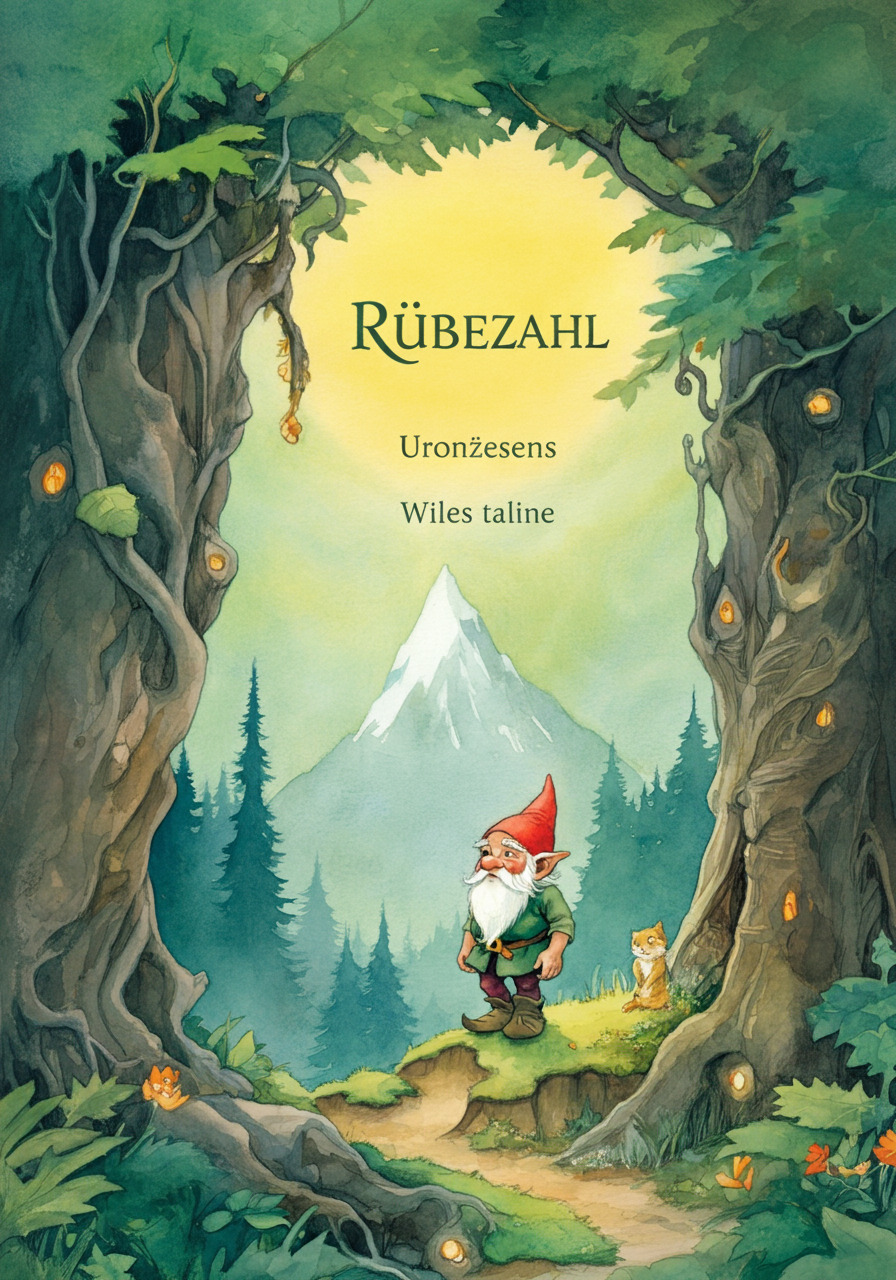
Rubezahl
by Andrew Lang

The Mountain Spirit and the Princess
Once upon a time, a spirit lived high in the mountains. His name was Rube. He lived in a big, quiet cave. He liked to watch the world above. He watched the trees and the clouds. He saw birds fly. He was a kind spirit. He was curious about the world.
One sunny day, Rube saw a girl. Her name was Princess Rose. She was playing in a green meadow. Her friends were there too. They laughed and ran. Rube watched them from his cave. He thought Princess Rose was very nice. He liked her happy smile. He wanted to meet her. He wanted to be her friend.
So Rube had an idea. He changed into a young man. He looked friendly and kind. He also made a pretty garden. It was a magic garden. It had a shiny, clear pond. The water sparkled in the sun. It had many bright flowers. The flowers were red, yellow, and blue. It was a beautiful place. He made it to share with her.
Princess Rose found the garden. "How pretty!" she said. She was surprised. She stepped into the pond. The water was cool and nice. Then, a magic thing happened. The water shimmered. Princess Rose was in Rube's cave home. It was a big cave. It was full of shiny rocks and treasures. Gold and gems glittered.
"I am Rube," said the spirit. He was in his young man shape. "I like you. Do you want to be my friend?" Princess Rose looked around. The cave was amazing. But she missed her home. She felt a little sad. "I will stay a little," she said. She thought of a clever plan. She needed to be smart.
Rube wanted to make her happy. He brought her a basket of turnips. The turnips were orange and round. "Let's count them!" said Princess Rose. "It will be fun." Rube smiled. "Okay! Let's count!" he said.
"One, two, three..." Rube counted each turnip. He was very busy counting. He did not look up. He focused on the numbers. Four, five, six... He liked the counting game.
While Rube was busy, Princess Rose walked softly. She was very quiet. She went out of the cave. She found the path home. The path went down the mountain. She walked quickly and quietly.
Rube looked up. He finished counting. "Ten!" he said. But Princess Rose was gone. He felt a little sad. He was alone again. But then he smiled. He understood. She wanted to be with her family.
Rube learned to be happy. He helped lost creatures in the mountains. He helped birds find their nests. He helped rabbits find food. He was a kind and helpful spirit. He watched over everyone.
Princess Rose went home to her family. "Welcome back!" said the King Father. He hugged her. She was safe and happy. She told them about the magic garden. She told them about Rube. She thought of Rube as a friend. A kind mountain friend.
And so, Princess Rose was safe at home. Rube smiled as he watched over the mountains. He was always ready to help. He was happy being a kind spirit.
Original Story
Rübezahl Over all the vast under-world the mountain Gnome Rübezahl was lord; and busy enough the care of his dominions kept him. There were the endless treasure chambers to be gone through, and the hosts of gnomes to be kept to their tasks. Some built strong barriers to hold back the fiery rivers in the earth’s heart, and some had scalding vapours to change dull stones to precious metal, or were hard at work filling every cranny of the rocks with diamonds and rubies; for Rübezahl loved all pretty things. Sometimes the fancy would take him to leave those gloomy regions, and come out upon the green earth for a while, and bask in the sunshine and hear the birds sing. And as gnomes live many hundreds of years he saw strange things. For, the first time he came up, the great hills were covered with thick forests, in which wild animals roamed, and Rübezahl watched the fierce fights between bear and bison, or chased the grey wolves, or amused himself by rolling great rocks down into the desolate valleys, to hear the thunder of their fall echoing among the hills. But the next time he ventured above ground, what was his surprise to find everything changed! The dark woods were hewn down, and in their place appeared blossoming orchards surrounding cosy-looking thatched cottages; from every chimney the blue smoke curled peacefully into the air, sheep and oxen fed in the flowery meadows, while from the shade of the hedges came the music of the shepherd’s pipe. The strangeness and pleasantness of the sight so delighted the gnome that he never thought of resenting the intrusion of these unexpected guests, who, without saying “by your leave” or “with your leave,” had made themselves so very much at home upon his hills; nor did he wish to interfere with their doings, but left them in quiet possession of their homes, as a good householder leaves in peace the swallows who have built their nests under his eaves. He was indeed greatly minded to make friends with this being called “man,” so, taking the form of an old field labourer, he entered the service of a farmer. Under his care all the crops flourished exceedingly, but the master proved to be wasteful and ungrateful, and Rübezahl soon left him, and went to be shepherd to his next neighbour. He tended the flock so diligently, and knew so well where to lead the sheep to the sweetest pastures, and where among the hills to look for any who strayed away, that they too prospered under his care, and not one was lost or torn by wolves; but this new master was a hard man, and begrudged him his well-earned wages. So he ran away and went to serve the judge. Here he upheld the law with might and main, and was a terror to thieves and evildoers; but the judge was a bad man, who took bribes, and despised the law. Rübezahl would not be the tool of an unjust man, and so he told his master, who thereupon ordered him to be thrown into prison. Of course that did not trouble the gnome at all, he simply got out through the keyhole, and went away down to his underground palace, very much disappointed by his first experience of mankind. But, as time went on, he forgot the disagreeable things that had happened to him, and thought he would take another look at the upper world. So he stole into the valley, keeping himself carefully hidden in copse or hedgerow, and very soon met with an adventure; for, peeping through a screen of leaves, he saw before him a green lawn where stood a charming maiden, fresh as the spring, and beautiful to look upon. Around her upon the grass lay her young companions, as if they had thrown themselves down to rest after some merry game. Beyond them flowed a little brook, into which a waterfall leapt from a high rock, filling the air with its pleasant sound, and making a coolness even in the sultry noontide. The sight of the maiden so pleased the gnome that, for the first time, he wished himself a mortal; and, longing for a better view of the gay company, he changed himself into a raven and perched upon an oaktree which overhung the brook. But he soon found that this was not at all a good plan. He could only see with a raven’s eyes, and feel as a raven feels; and a nest of field-mice at the foot of the tree interested him far more than the sport of the maidens. When he understood this he flew down again in a great hurry into the thicket, and took the form of a handsome young man—that was the best way—and he fell in love with the girl then and there. The fair maiden was the daughter of the king of the country, and she often wandered in the forest with her play fellows gathering the wild flowers and fruits, till the midday heat drove the merry band to the shady lawn by the brook to rest, or to bathe in the cool waters. On this particular morning the fancy took them to wander off again into the wood. This was Master Rübezahl’s opportunity. Stepping out of his hiding-place he stood in the midst of the little lawn, weaving his magic spells, till slowly all about him changed, and when the maidens returned at noon to their favourite resting-place they stood lost in amazement, and almost fancied that they must be dreaming. The red rocks had become white marble and alabaster; the stream that murmured and struggled before in its rocky bed, flowed in silence now in its smooth channel, from which a clear fountain leapt, to fall again in showers of diamond drops, now on this side now on that, as the wandering breeze scattered it. Daisies and forget-me-nots fringed its brink, while tall hedges of roses and jasmine ringed it round, making the sweetest and daintiest bower imaginable. To the right and left of the waterfall opened out a wonderful grotto, its walls and arches glittering with many-coloured rock-crystals, while in every niche were spread out strange fruits and sweetmeats, the very sight of which made the princess long to taste them. She hesitated a while, however, scarcely able to believe her eyes, and not knowing if she should enter the enchanted spot or fly from it. But at length curiosity prevailed, and she and her companions explored to their heart’s content, and tasted and examined everything, running hither and thither in high glee, and calling merrily to each other. At last, when they were quite weary, the princess cried out suddenly that nothing would content her but to bathe in the marble pool, which certainly did look very inviting; and they all went gaily to this new amusement. The princess was ready first, but scarcely had she slipped over the rim of the pool when down—down—down she sank, and vanished in its depths before her frightened playmates could seize her by so much as a lock of her floating golden hair! Loudly did they weep and wail, running about the brink of the pool, which looked so shallow and so clear, but which had swallowed up their princess before their eyes. They even sprang into the water and tried to dive after her, but in vain; they only floated like corks in the enchanted pool, and could not keep under water for a second. They saw at last that there was nothing for it but to carry to the king the sad tidings of his beloved daughter’s disappearance. And what great weeping and lamentation there was in the palace when the dreadful news was told! The king tore his robes, dashed his golden crown from his head, and hid his face in his purple mantle for grief and anguish at the loss of the princess. After the first outburst of wailing, however, he took heart and hurried off to see for himself the scene of this strange adventure, thinking, as people will in sorrow, that there might be some mistake after all. But when he reached the spot, behold, all was changed again! The glittering grotto described to him by the maidens had completely vanished, and so had the marble bath, the bower of jasmine; instead, all was a tangle of flowers, as it had been of old. The king was so much perplexed that he threatened the princess’s playfellows with all sorts of punishments if they would not confess something about her disappearance; but as they only repeated the same story he presently put down the whole affair to the work of some sprite or goblin, and tried to console himself for his loss by ordering a grand hunt; for kings cannot bear to be troubled about anything long. Meanwhile the princess was not at all unhappy in the palace of her elfish lover. When the water-nymphs, who were hiding in readiness, had caught her and dragged her out of the sight of her terrified maidens, she herself had not had time to be frightened. They swam with her quickly by strange underground ways to a palace so splendid that her father’s seemed but a poor cottage in comparison with it, and when she recovered from her astonishment she found herself seated upon a couch, wrapped in a wonderful robe of satin fastened with a silken girdle, while beside her knelt a young man who whispered the sweetest speeches imaginable in her ear. The gnome, for he it was, told her all about himself and his great underground kingdom, and presently led her through the many rooms and halls of the palace, and showed her the rare and wonderful things displayed in them till she was fairly dazzled at the sight of so much splendour. On three sides of the castle lay a lovely garden with masses of gay, sweet flowers, and velvet lawns all cool and shady, which pleased the eye of the princess. The fruit trees were hung with golden and rosy apples, and nightingales sang in every bush, as the gnome and the princess wandered in the leafy alleys, sometimes gazing at the moon, sometimes pausing to gather the rarest flowers for her adornment. And all the time he was thinking to himself that never, during the hundreds of years he had lived, had he seen so charming a maiden. But the princess felt no such happiness; in spite of all the magic delights around her she was sad, though she tried to seem content for fear of displeasing the gnome. However, he soon perceived her melancholy, and in a thousand ways strove to dispel the cloud, but in vain. At last he said to himself: “Men are sociable creatures, like bees or ants. Doubtless this lovely mortal is pining for company. Who is there I can find for her to talk to?” Thereupon he hastened into the nearest field and dug up a dozen or so of different roots—carrots, turnips, and radishes—and laying them carefully in an elegant basket brought them to the princess, who sat pensive in the shade of the rose-bower. “Loveliest daughter of earth,” said the gnome, “banish all sorrow; no more shall you be lonely in my dwelling. In this basket is all you need to make this spot delightful to you. Take this little many-coloured wand, and with a touch give to each root the form you desire to see.” With this he left her, and the princess, without an instant’s delay, opened the basket, and touching a turnip, cried eagerly: “Brunhilda, my dear Brunhilda! come to me quickly!” And sure enough there was Brunhilda, joyfully hugging and kissing her beloved princess, and chattering as gaily as in the old days. This sudden appearance was so delightful that the princess could hardly believe her own eyes, and was quite beside herself with the joy of having her dear playfellow with her once more. Hand in hand they wandered about the enchanted garden, and gathered the golden apples from the trees, and when they were tired of this amusement the princess led her friend through all the wonderful rooms of the palace, until at last they came to the one in which were kept all the marvellous dresses and ornaments the gnome had given to his hoped-for bride. There they found so much to amuse them that the hours passed like minutes. Veils, girdles, and necklaces were tried on and admired, the imitation Brunhilda knew so well how to behave herself, and showed so much taste that nobody would ever have suspected that she was nothing but a turnip after all. The gnome, who had secretly been keeping an eye upon them, was very pleased with himself for having so well understood the heart of a woman; and the princess seemed to him even more charming than before. She did not forget to touch the rest of the roots with her magic wand, and soon had all her maidens about her, and even, as she had two tiny radishes to spare, her favourite cat, and her little dog whose name was Beni. And now all went cheerfully in the castle. The princess gave to each of the maidens her task, and never was mistress better served. For a whole week she enjoyed the delight of her pleasant company undisturbed. They all sang, they danced, they played from morning to night; only the princess noticed that day by day the fresh young faces of her maidens grew pale and wan, and the mirror in the great marble hall showed her that she alone still kept her rosy bloom, while Brunhilda and the rest faded visibly. They assured her that all was well with them; but, nevertheless, they continued to waste away, and day by day it became harder to them to take part in the games of the princess, till at last, one fine morning, when the princess started from bed and hastened out to join her gay playfellows, she shuddered and started back at the sight of a group of shrivelled crones, with bent backs and trembling limbs, who supported their tottering steps with staves and crutches, and coughed dismally. A little nearer to the hearth lay the once frolicsome Beni, with all four feet stretched stiffly out, while the sleek cat seemed too weak to raise his head from his velvet cushion. The horrified princess fled to the door to escape from the sight of this mournful company, and called loudly for the gnome, who appeared at once, humbly anxious to do her bidding. “Malicious Sprite,” she cried, “why do you begrudge me my playmates—the greatest delight of my lonely hours? Isn’t this solitary life in such a desert bad enough without your turning the castle into a hospital for the aged? Give my maidens back their youth and health this very minute, or I will never love you!” “Sweetest and fairest of damsels,” cried the gnome, “do not be angry; everything that is in my power I will do—but do not ask the impossible. So long as the sap was fresh in the roots the magic staff could keep them in the forms you desired, but as the sap dried up they withered away. But never trouble yourself about that, dearest one, a basket of fresh turnips will soon set matters right, and you can speedily call up again every form you wish to see. The great green patch in the garden will provide you with a more lively company.” So saying the gnome took himself off. And the princess with her magic wand touched the wrinkled old women, and left them the withered roots they really were, to be thrown upon the rubbish heap; and with light feet skipped off across to the meadow to take possession of the freshly filled basket. But to her surprise she could not find it anywhere. Up and down the garden she searched, spying into every corner, but not a sign of it was to be found. By the trellis of grape vines she met the gnome, who was so much embarrassed at the sight of her that she became aware of his confusion while he was still quite a long way off. “You are trying to tease me,” she cried, as soon as she saw him. “Where have you hidden the basket? I have been looking for it at least an hour.” “Dear queen of my heart,” answered he, “I pray you to forgive my carelessness. I promised more than I could perform. I have sought all over the land for the roots you desire; but they are gathered in, and lie drying in musty cellars, and the fields are bare and desolate, for below in the valley winter reigns, only here in your presence spring is held fast, and wherever your foot is set the gay flowers bloom. Have patience for a little, and then without fail you shall have your puppets to play with.” Almost before the gnome had finished, the disappointed princess turned away, and marched off to her own apartments, without deigning to answer him. The gnome, however, set off above ground as speedily as possible, and disguising himself as a farmer, bought an ass in the nearest market-town, and brought it back loaded with sacks of turnip, carrot, and radish seed. With this he sowed a great field, and sent a vast army of his goblins to watch and tend it, and to bring up the fiery rivers from the heart of the earth near enough to warm and encourage the sprouting seeds. Thus fostered they grew and flourished marvellously, and promised a goodly crop. The princess wandered about the field day by day, no other plants or fruits in all her wonderful garden pleased her as much as these roots; but still her eyes were full of discontent. And, best of all, she loved to while away the hours in a shady fir-wood, seated upon the bank of a little stream, into which she would cast the flowers she had gathered and watch them float away. The gnome tried hard by every means in his power to please the princess and win her love, but little did he guess the real reason of his lack of success. He imagined that she was too young and inexperienced to care for him; but that was a mistake, for the truth was that another image already filled her heart. The young Prince Ratibor, whose lands joined her father’s, had won the heart of the princess; and the lovers had been looking forward to the coming of their wedding-day when the bride’s mysterious disappearance took place. The sad news drove Ratibor distracted, and as the days went on, and nothing could be heard of the princess, he forsook his castle and the society of men, and spent his days in the wild forests, roaming about and crying her name aloud to the trees and rocks. Meanwhile, the maiden, in her gorgeous prison, sighed in secret over her grief, not wishing to arouse the gnome’s suspicions. In her own mind she was wondering if by any means she might escape from her captivity, and at last she hit upon a plan. By this time spring once more reigned in the valley, and the gnome sent the fires back to their places in the deeps of the earth, for the roots which they had kept warm through all the cruel winter had now come to their full size. Day by day the princess pulled up some of them, and made experiments with them, conjuring up now this longed-for person, and now that, just for the pleasure of seeing them as they appeared; but she really had another purpose in view. One day she changed a tiny turnip into a bee, and sent him off to bring her some news of her lover. “Fly, dear little bee, towards the east,” said she, “to my beloved Ratibor, and softly hum into his ear that I love him only, but that I am a captive in the gnome’s palace under the mountains. Do not forget a single word of my greeting, and bring me back a message from my beloved.” So the bee spread his shining wings and flew away to do as he was bidden; but before he was out of sight a greedy swallow made a snatch at him, and to the great grief of the princess her messenger was eaten up then and there. After that, by the power of the wonderful wand she summoned a cricket, and taught him this greeting: “Hop, little cricket, to Ratibor, and chirp in his ear that I love him only, but that I am held captive by the gnome in his palace under the mountains.” So the cricket hopped off gaily, determined to do his best to deliver his message; but, alas! a long-legged stork who was prancing along the same road caught him in her cruel beak, and before he could say a word he had disappeared down her throat. These two unlucky ventures did not prevent the princess from trying once more. This time she changed the turnip into a magpie. “Flutter from tree to tree, chattering bird,” said she, “till you come to Ratibor, my love. Tell him that I am a captive, and bid him come with horses and men, the third day from this, to the hill that rises from the Thorny Valley.” The magpie listened, hopped awhile from branch to branch, and then darted away, the princess watching him anxiously as far as she could see. Now Prince Ratibor was still spending his life in wandering about the woods, and not even the beauty of the spring could soothe his grief. One day, as he sat in the shade of an oak tree, dreaming of his lost princess, and sometimes crying her name aloud, he seemed to hear another voice reply to his, and, starting up, he gazed around him, but he could see no one, and he had just made up his mind that he must be mistaken, when the same voice called again, and, looking up sharply, he saw a magpie which hopped to and fro among the twigs. Then Ratibor heard with surprise that the bird was indeed calling him by name. “Poor chatterpie,” said he; “who taught you to say that name, which belongs to an unlucky mortal who wishes the earth would open and swallow up him and his memory for ever?” Thereupon he caught up a great stone, and would have hurled it at the magpie, if it had not at that moment uttered the name of the princess. This was so unexpected that the prince’s arm fell helplessly to his side at the sound, and he stood motionless. But the magpie in the tree, who, like all the rest of his family, was not happy unless he could be for ever chattering, began to repeat the message the princess had taught him; and as soon as he understood it, Prince Ratibor’s heart was filled with joy. All his gloom and misery vanished in a moment, and he anxiously questioned the welcome messenger as to the fate of the princess. But the magpie knew no more than the lesson he had learnt, so he soon fluttered away; while the prince hurried back to his castle to gather together a troop of horsemen, full of courage for whatever might befall. The princess meanwhile was craftily pursuing her plan of escape. She left off treating the gnome with coldness and indifference; indeed, there was a look in her eyes which encouraged him to hope that she might some day return his love, and the idea pleased him mightily. The next day, as soon as the sun rose, she made her appearance decked as a bride, in the wonderful robes and jewels which the fond gnome had prepared for her. Her golden hair was braided and crowned with myrtle blossoms, and her flowing veil sparkled with gems. In these magnificent garments she went to meet the gnome upon the great terrace. “Loveliest of maidens,” he stammered, bowing low before her, “let me gaze into your dear eyes, and read in them that you will no longer refuse my love, but will make me the happiest being the sun shines upon.” So saying he would have drawn aside her veil; but the princess only held it more closely about her. “Your constancy has overcome me,” she said; “I can no longer oppose your wishes. But believe my words, and suffer this veil still to hide my blushes and tears.” “Why tears, beloved one?” cried the gnome anxiously; “every tear of yours falls upon my heart like a drop of molten gold. Greatly as I desire your love, I do not ask a sacrifice.” “Ah!” cried the false princess, “why do you misunderstand my tears? My heart answers to your tenderness, and yet I am fearful. A wife cannot always charm, and though YOU will never alter, the beauty of mortals is as a flower that fades. How can I be sure that you will always be as loving and charming as you are now?” “Ask some proof, sweetheart,” said he. “Put my obedience and my patience to some test by which you can judge of my unalterable love.” “Be it so,” answered the crafty maiden. “Then give me just one proof of your goodness. Go! count the turnips in yonder meadow. My wedding feast must not lack guests. They shall provide me with bride-maidens too. But beware lest you deceive me, and do not miss a single one. That shall be the test of your truth towards me.” Unwilling as the gnome was to lose sight of his beautiful bride for a moment, he obeyed her commands without delay, and hurried off to begin his task. He skipped along among the turnips as nimbly as a grasshopper, and had soon counted them all; but, to be quite certain that he had made no mistake, he thought he would just run over them again. This time, to his great annoyance, the number was different; so he reckoned them for the third time, but now the number was not the same as either of the previous ones! And this was hardly to be wondered at, as his mind was full of the princess’s pretty looks and words. As for the maiden, no sooner was her deluded lover fairly out of sight than she began to prepare for flight. She had a fine fresh turnip hidden close at hand, which she changed into a spirited horse, all saddled and bridled, and, springing upon its back, she galloped away over hill and dale till she reached the Thorny Valley, and flung herself into the arms of her beloved Prince Ratibor. Meanwhile the toiling gnome went through his task over and over again till his back ached and his head swam, and he could no longer put two and two together; but as he felt tolerably certain of the exact number of turnips in the field, big and little together, he hurried back eager to prove to his beloved one what a delightful and submissive husband he would be. He felt very well satisfied with himself as he crossed the mossy lawn to the place where he had left her; but, alas! she was no longer there. He searched every thicket and path, he looked behind every tree, and gazed into every pond, but without success; then he hastened into the palace and rushed from room to room, peering into every hole and corner and calling her by name; but only echo answered in the marble halls—there was neither voice nor footstep. Then he began to perceive that something was amiss, and, throwing off the mortal form that encumbered him, he flew out of the palace, and soared high into the air, and saw the fugitive princess in the far distance just as the swift horse carried her across the boundary of his dominions. Furiously did the enraged gnome fling two great clouds together, and hurl a thunderbolt after the flying maiden, splintering the rocky barriers which had stood a thousand years. But his fury was vain, the thunderclouds melted away into a soft mist, and the gnome, after flying about for a while in despair, bewailing to the four winds his unhappy fate, went sorrowfully back to the palace, and stole once more through every room, with many sighs and lamentations. He passed through the gardens which for him had lost their charm, and the sight of the princess’s footprints on the golden sand of the pathway renewed his grief. All was lonely, empty, sorrowful; and the forsaken gnome resolved that he would have no more dealings with such false creatures as he had found men to be. Thereupon he stamped three times upon the earth, and the magic palace, with all its treasures, vanished away into the nothingness out of which he had called it; and the gnome fled once more to the depths of his underground kingdom. While all this was happening, Prince Ratibor was hurrying away with his prize to a place of safety. With great pomp and triumph he restored the lovely princess to her father, and was then and there married to her, and took her back with him to his own castle. But long after she was dead, and her children too, the villagers would tell the tale of her imprisonment underground, as they sat carving wood in the winter nights. [Volksmärchen der Deutschen.] Story Of The King Who Would Be Stronger Than Fate Once upon a time, far away in the east country, there lived a king who loved hunting so much that, when once there was a deer in sight, he was careless of his own safety. Indeed, he often became quite separated from his nobles and attendants, and in fact was particularly fond of lonely adventures. Another of his favourite amusements was to give out that he was not well, and could not be seen; and then, with the knowledge only of his faithful Grand Wazeer, to disguise himself as a pedlar, load a donkey with cheap wares, and travel about. In this way he found out what the common people said about him, and how his judges and governors fulfilled their duties. One day his queen presented him with a baby daughter as beautiful as the dawn, and the king himself was so happy and delighted that, for a whole week, he forgot to hunt, and spent the time in public and private rejoicing. Not long afterwards, however, he went out after some deer which were to be found in a far corner of his forests. In the course of the beat his dogs disturbed a beautiful snow-white stag, and directly he saw it the king determined that he would have it at any cost. So he put the spurs to his horse, and followed it as hard as he could gallop. Of course all his attendants followed at the best speed that they could manage; but the king was so splendidly mounted, and the stag was so swift, that, at the end of an hour, the king found that only his favourite hound and himself were in the chase; all the rest were far, far behind and out of sight. Nothing daunted, however, he went on and on, till he perceived that he was entering a valley with great rocky mountains on all sides, and that his horse was getting very tired and trembled at every stride. Worse than all evening was already drawing on, and the sun would soon set. In vain had he sent arrow after arrow at the beautiful stag. Every shot fell short, or went wide of the mark; and at last, just as darkness was setting in, he lost sight altogether of the beast. By this time his horse could hardly move from fatigue, his hound staggered panting along beside him, he was far away amongst mountains where he had never been before, and had quite missed his way, and not a human creature or dwelling was in sight. All this was very discouraging, but the king would not have minded if he had not lost that beautiful stag. That troubled him a good deal, but he never worried over what he could not help, so he got down from his horse, slipped his arm through the bridle, and led the animal along the rough path in hopes of discovering some shepherd’s hut, or, at least, a cave or shelter under some rock, where he might pass the night. Presently he heard the sound of rushing water, and made towards it. He toiled over a steep rocky shoulder of a hill, and there, just below him, was a stream dashing down a precipitous glen, and, almost beneath his feet, twinkling and flickering from the level of the torrent, was a dim light as of a lamp. Towards this light the king with his horse and hound made his way, sliding and stumbling down a steep, stony path. At the bottom the king found a narrow grassy ledge by the brink of the stream, across which the light from a rude lantern in the mount of a cave shed a broad beam of uncertain light. At the edge of the stream sat an old hermit with a long white beard, who neither spoke nor moved as the king approached, but sat throwing into the stream dry leaves which lay scattered about the ground near him. “Peace be upon you,” said the king, giving the usual country salutation. “And upon you peace,” answered the hermit; but still he never looked up, nor stopped what he was doing. For a minute or two the king stood watching him. He noticed that the hermit threw two leaves in at a time, and watched them attentively. Sometimes both were carried rapidly down by the stream; sometimes only one leaf was carried off, and the other, after whirling slowly round and round on the edge of the current, would come circling back on an eddy to the hermit’s feet. At other times both leaves were held in the backward eddy, and failed to reach the main current of the noisy stream. “What are you doing?” asked the king at last, and the hermit replied that he was reading the fates of men; every one’s fate, he said, was settled from the beginning, and, whatever it were, there was no escape from it. The king laughed. “I care little,” he said, “what my fate may be; but I should be curious to know the fate of my little daughter.” “I cannot say,” answered the hermit. “Do you not know, then?” demanded the king. “I might know,” returned the hermit, “but it is not always wisdom to know much.” But the king was not content with this reply, and began to press the old man to say what he knew, which for a long time he would not do. At last, however, the king urged him so greatly that he said: “The king’s daughter will marry the son of a poor slave-girl called Puruna, who belongs to the king of the land of the north. There is no escaping from Fate.” The king was wild with anger at hearing these words, but he was also very tired; so he only laughed, and answered that he hoped there would be a way out of THAT fate anyhow. Then he asked if the hermit could shelter him and his beasts for the night, and the hermit said “Yes”; so, very soon the king had watered and tethered his horse, and, after a supper of bread and parched peas, lay down in the cave, with the hound at his feet, and tried to go to sleep. But instead of sleeping he only lay awake and thought of the hermit’s prophecy; and the more he thought of it the angrier he felt, until he gnashed his teeth and declared that it should never, never come true. Morning came, and the king got up, pale and sulky, and, after learning from the hermit which path to take, was soon mounted and found his way home without much difficulty. Directly he reached his palace he wrote a letter to the king of the land of the north, begging him, as a favour, to sell him his slave girl Puruna and her son, and saying that, if he consented, he would send a messenger to receive them at the river which divided the kingdoms. For five days he awaited the reply, and hardly slept or ate, but was as cross as could be all the time. On the fifth day his messenger returned with a letter to say that the king of the land of the north would not sell, but he would give, the king the slave girl and her son. The king was overjoyed. He sent for his Grand Wazeer and told him that he was going on one of his lonely expeditions, and that the Wazeer must invent some excuse to account for his absence. Next he disguised himself as an ordinary messenger, mounted a swift camel, and sped away to the place where the slave girl was to be handed over to him. When he got there he gave the messengers who brought her a letter of thanks and a handsome present for their master and rewards for themselves; and then without delay he took the poor woman and her tiny baby-boy up on to his camel and rode off to a wild desert. After riding for a day and a night, almost without stopping, he came to a great cave where he made the woman dismount, and, taking her and the baby into the cave, he drew his sword and with one blow chopped her head off. But although his anger made him cruel enough for anything so dreadful, the king felt that he could not turn his great sword on the helpless baby, who he was sure must soon die in this solitary place without its mother; so he left it in the cave where it was, and, mounting his camel, rode home as fast as he could. Now, in a small village in his kingdom there lived an old widow who had no children or relations of any kind. She made her living mostly by selling the milk of a flock of goats; but she was very, very poor, and not very strong, and often used to wonder how she would live if she got too weak or ill to attend to her goats. Every morning she drove the goats out into the desert to graze on the shrubs and bushes which grew there, and every evening they came home of themselves to be milked and to be shut up safely for the night. One evening the old woman was astonished to find that her very best nanny-goat returned without a drop of milk. She thought that some naughty boy or girl was playing a trick upon her and had caught the goat on its way home and stolen all the milk. But when evening after evening the goat remained almost dry she determined to find out who the thief was. So the next day she followed the goats at a distance and watched them while they grazed. At length, in the afternoon, the old woman noticed this particular nanny-goat stealing off by herself away from the herd and she at once went after her. On and on the goat walked for some way, and then disappeared into a cave in the rocks. The old woman followed the goat into the cave and then, what should she see but the animal giving her milk to a little boy-baby, whilst on the ground near by lay the sad remains of the baby’s dead mother! Wondering and frightened, the old woman thought at last that this little baby might be a son to her in her old age, and that he would grow up and in time to come be her comfort and support. So she carried home the baby to her hut, and next day she took a spade to the cave and dug a grave where she buried the poor mother. Years passed by, and the baby grew up into a find handsome lad, as daring as he was beautiful, and as industrious as he was brave. One day, when the boy, whom the old woman had named Nur Mahomed, was about seventeen years old, he was coming from his day’s work in the fields, when he saw a strange donkey eating the cabbages in the garden which surround their little cottage. Seizing a big stick, he began to beat the intruder and to drive him out of his garden. A neighbour passing by called out to him—“Hi! I say! why are you beating the pedlar’s donkey like that?” “The pedlar should keep him from eating my cabbages,” said Nur Mahomed; “if he comes this evening here again I’ll cut off his tail for him!” Whereupon he went off indoors, whistling cheerfully. It happened that this neighbour was one of those people who make mischief by talking too much; so, meeting the pedlar in the “serai,” or inn, that evening, he told him what had occurred, and added: “Yes; and the young spitfire said that if beating the donkey would not do, he would beat you also, and cut your nose off for a thief!” A few days later, the pedlar having moved on, two men appeared in the village inquiring who it was who had threatened to ill-treat and to murder an innocent pedlar. They declared that the pedlar, in fear of his life, had complained to the king; and that they had been sent to bring the lawless person who had said these things before the king himself. Of course they soon found out about the donkey eating Nur Mahomed’s cabbages, and about the young man’s hot words; but although the lad assured them that he had never said anything about murdering anyone, they replied they were ordered to arrest him, and bring him to take his trial before the king. So, in spite of his protests, and the wails of his mother, he was carried off, and in due time brought before the king. Of course Nur Mahomed never guessed that the supposed pedlar happened to have been the king himself, although nobody knew it. But as he was very angry at what he had been told, he declared that he was going to make an example of this young man, and intended to teach him that even poor travelling pedlars could get justice in HIS country, and be protected from such lawlessness. However, just as he was going to pronounce some very heavy sentence, there was a stir in the court, and up came Nur Mahomed’s old mother, weeping and lamenting, and begging to be heard. The king ordered her to speak, and she began to plead for the boy, declaring how good he was, and how he was the support of her old age, and if he were put in prison she would die. The king asked her who she was. She replied that she was his mother. “His mother?” said the king; “you are too old, surely, to have so young a son!” Then the old woman, in her fright and distress, confessed the whole story of how she found the baby, and how she rescued and brought him up, and ended by beseeching the king for mercy. It is easy to guess how, as the story came out, the king looked blacker and blacker, and more and more grim, until at last he was half fainting with rage and astonishment. This, then, was the baby he had left to die, after cruelly murdering his mother! Surely fate might have spared him this! He wished he had sufficient excuse to put the boy to death, for the old hermit’s prophecy came back to him as strongly as ever; and yet the young man had done nothing bad enough to deserve such a punishment. Everyone would call him a tyrant if he were to give such an order—in fact, he dared not try it! At length he collected himself enough to say:—“If this young man will enlist in my army I will let him off. We have need of such as him, and a little discipline will do him good.” Still the old woman pleaded that she could not live without her son, and was nearly as terrified at the idea of his becoming a soldier as she was at the thought of his being put in prison. But at length the king—determined to get the youth into his clutches—pacified her by promising her a pension large enough to keep her in comfort; and Nur Mahomed, to his own great delight, was duly enrolled in the king’s army. As a soldier Nur Mahomed seemed to be in luck. He was rather surprised, but much pleased, to find that he was always one of those chosen when any difficult or dangerous enterprise was afoot; and, although he had the narrowest escapes on some occasions, still, the very desperateness of the situations in which he found himself gave him special chances of displaying his courage. And as he was also modest and generous, he became a favourite with his officers and his comrades. Thus it was not very surprising that, before very long, he became enrolled amongst the picked men of the king’s bodyguard. The fact is, that the king had hoped to have got him killed in some fight or another; but, seeing that, on the contrary, he throve on hard knocks, he was now determined to try more direct and desperate methods. One day, soon after Nur Mahomed had entered the bodyguard, he was selected to be one of the soldiers told off to escort the king through the city. The procession was marching on quite smoothly, when a man, armed with a dagger, rushed out of an alley straight towards the king. Nur Mahomed, who was the nearest of the guards, threw himself in the way, and received the stab that had been apparently intended for the king. Luckily the blow was a hurried one, and the dagger glanced on is breastbone, so that, although he received a severe wound, his youth and strength quickly got the better of it. The king was, of course, obliged to take some notice of this brave deed, and as a reward made him one of his own attendants. After this the strange adventures the young man passed through were endless. Officers of the bodyguard were often sent on all sorts of secret and difficult errands, and such errands had a curious way of becoming necessary when Nur Mahomed was on duty. Once, while he was taking a journey, a foot-bridge gave way under him; once he was attacked by armed robbers; a rock rolled down upon him in a mountain pass; a heavy stone coping fell from a roof at his feet in a narrow city alley. Altogether, Nur Mahomed began to think that, somewhere or other, he had made an enemy; but he was light-hearted, and the thought did not much trouble him. He escaped somehow every time, and felt amused rather than anxious about the next adventure. It was the custom of that city that the officer for the day of the palace guards should receive all his food direct from the king’s kitchen. One day, when Nur Mahomed’s turn came to be on duty, he was just sitting down to a delicious stew that had been sent in from the palace, when one of those gaunt, hungry dogs, which, in eastern countries, run about the streets, poked his nose in at the open guard-room door, and looked at Nur Mahomed with mouth watering and nostrils working. The kind-hearted young man picked out a lump of meat, went to the door, and threw it outside to him. The dog pounced upon it, and gulped it down greedily, and was just turning to go, when it staggered, fell, rolled over, and died. Nur Mahomed, who had been lazily watching him, stood still for a moment, then he came back whistling softly. He gathered up the rest of his dinner and carefully wrapped it up to carry away and bury somewhere; and then he sent back the empty plates. How furious the king was when, at the next morning’s durbar, Nur Mahomed appeared before him fresh, alert and smiling as usual. He was determined, however, to try once more, and bidding the young man come into his presence that evening, gave orders that he was to carry a secret despatch to the governor of a distant province. “Make your preparations at once,” added he, “and be ready to start in the morning. I myself will deliver you the papers at the last moment.” Now this province was four or five days’ journey from the palace, and the governor of it was the most faithful servant the king had. He could be silent as the grave, and prided himself on his obedience. Whilst he was an old and tried servant of the king’s, his wife had been almost a mother to the young princess ever since the queen had died some years before. It happened that, a little before this time, the princess had been sent away for her health to another remote province; and whilst she was there her old friend, the governor’s wife, had begged her to come and stay with them as soon as she could. The princess accepted gladly, and was actually staying in the governor’s house at the very time when the king made up his mind to send Nur Mahomed there with the mysterious despatch. According to orders Nur Mahomed presented himself early the next morning at the king’s private apartments. His best horse was saddled, food placed in is saddle-bag, and with some money tied up in his waist-band, he was ready to start. The king handed over to him a sealed packet, desiring him to give it himself only into the hands of the governor, and to no one else. Nur Mahomed hid it carefully in his turban, swung himself into the saddle, and five minutes later rode out of the city gates, and set out on his long journey. The weather was very hot; but Nur Mahomed thought that the sooner his precious letter was delivered the better; so that, by dint of riding most of each night and resting only in the hottest part of the day, he found himself, by noon on the third day, approaching the town which was his final destination. Not a soul was to be seen anywhere; and Nur Mahomed, stiff, dry, thirsty, and tired, looked longingly over the wall into the gardens, and marked the fountains, the green grass, the shady apricot orchards, and giant mulberry trees, and wished he were there. At length he reached the castle gates, and was at once admitted, as he was in the uniform of the king’s bodyguard. The governor was resting, the soldier said, and could not see him until the evening. So Nur Mahomed handed over his horse to an attendant, and wandered down into the lovely gardens he had seen from the road, and sat down in the shade to rest himself. He flung himself on his back and watched the birds twittering and chattering in the trees above him. Through the branches he could see great patches of sky where the kites wheeled and circled incessantly, with shrill whistling cried. Bees buzzed over the flowers with a soothing sound, and in a few minutes Nur Mahomed was fast asleep. Every day, through the heat of the afternoon, the governor, and his wife also, used to lie down for two or three hours in their own rooms, and so, for the matter of that, did most people in the palace. But the princess, like many other girls, was restless, and preferred to wander about the garden, rather than rest on a pile of soft cushions. What a torment her stout old attendants and servants sometime thought her when she insisted on staying awake, and making them chatter or do something, when they could hardly keep their eyes open! Sometimes, however, the princess would pretend to go to sleep, and then, after all her women had gladly followed her example, she would get up and go out by herself, her veil hanging loosely about her. If she was discovered her old hostess scolded her severely; but the princess only laughed, and did the same thing next time. This very afternoon the princess had left all her women asleep, and, after trying in vain to amuse herself indoors, she had slipped out into the great garden, and rambled about in all her favourite nooks and corners, feeling quite safe as there was not a creature to be seen. Suddenly, on turning a corner, she stopped in surprise, for before her lay a man fast asleep! In her hurry she had almost tripped over him. But there he was, a young man, tanned and dusty with travel, in the uniform of an officer of the king’s guard. One of the few faults of this lovely princess was a devouring curiosity, and she lived such an idle life that she had plenty of time to be curious. Out of one of the folds of this young man’s turban there peeped the corner of a letter! She wondered what the letter was—whom it was for! She drew her veil a little closer, and stole across on tip-toe and caught hold of the corner of the letter. Then she pulled it a little, and just a little more! A great big seal came into view, which she saw to be her father’s, and at the sight of it she paused for a minute half ashamed of what she was doing. But the pleasure of taking a letter which was not meant for her was more than she could resist, and in another moment it was in her hand. All at once she remembered that it would be death to this poor officer if he lost the letter, and that at all hazards she must put it back again. But this was not so easy; and, moreover, the letter in her hand burnt her with longing to read it, and see what was inside. She examined the seal. It was sticky with being exposed to the hot sun, and with a very little effort it parted from the paper. The letter was open and she read it! And this was what was written: “Behead the messenger who brings this letter secretly and at once. Ask no questions.” The girl grew pale. What a shame! she thought. SHE would not let a handsome young fellow like that be beheaded; but how to prevent it was not quite clear at the moment. Some plan must be invented, and she wished to lock herself in where no one could interrupt her, as might easily happen in the garden. So she crept softly to her room, and took a piece of paper and wrote upon it: “Marry the messenger who brings this letter to the princess openly at once. Ask no questions.” And even contrived to work the seals off the original letter and to fix them to this, so that no one could tell, unless they examined it closely, that it had ever been opened. Then she slipped back, shaking with fear and excitement, to where the young officer still lay asleep, thrust the letter into the fold so his turban, and hurried back to her room. It was done! Late in the afternoon Nur Mahomed woke, and, making sure that the precious despatch was still safe, went off to get ready for his audience with the governor. As soon as he was ushered into his presence he took the letter from his turban and placed it in the governor’s hands according to orders. When he had read it the governor was certainly a little astonished; but he was told in the letter to “ask no questions,” and he knew how to obey orders. He sent for his wife and told her to get the princess ready to be married at once. “Nonsense!” said his wife, “what in the world do you mean?” “These are the king’s commands,” he answered; “go and do as I bid you. The letter says ‘at once,’ and ‘ask no questions.’ The marriage, therefore, must take place this evening.” In vain did his wife urge every objection; the more she argued, the more determined was her husband. “I know how to obey orders,” he said, “and these are as plain as the nose on my face!” So the princess was summoned, and, somewhat to their surprise, she seemed to take the news very calmly; next Nur Mahomed was informed, and he was greatly startled, but of course he could but be delighted at the great and unexpected honour which he thought the king had done him. Then all the castle was turned upside down; and when the news spread in the town, THAT was turned upside down too. Everybody ran everywhere, and tried to do everything at once; and, in the middle of it all, the old governor went about with his hair standing on end, muttering something about “obeying orders.” And so the marriage was celebrated, and there was a great feast in the castle, and another in the soldiers’ barracks, and illuminations all over the town and in the beautiful gardens. And all the people declared that such a wonderful sight had never been seen, and talked about it to the ends of their lives. The next day the governor despatched the princess and her bridegroom to the king, with a troop of horsemen, splendidly dressed, and he sent a mounted messenger on before them, with a letter giving the account of the marriage to the king. When the king got the governor’s letter, he grew so red in the face that everyone thought he was going to have apoplexy. They were all very anxious to know what had happened, but he rushed off and locked himself into a room, where he ramped and raved until he was tired. Then, after awhile, he began to think he had better make the best of it, especially as the old governor had been clever enough to send him back his letter, and the king was pretty sure that this was in the princess’s handwriting. He was fond of his daughter, and though she had behaved badly, he did not wish to cut HER head off, and he did not want people to know the truth because it would make him look foolish. In fact, the more he considered the matter, the more he felt that he would be wise to put a good face on it, and to let people suppose that he had really brought about the marriage of his own free will. So, when the young couple arrived, the king received them with all state, and gave his son-in-law a province to govern. Nur Mahomed soon proved himself as able and honourable a governor as he was a brave soldier; and, when the old king died, he became king in his place, and reigned long and happily. Nur Mahomed’s old mother lived for a long time in her “son’s” palace, and died in peace. The princess, his wife, although she had got her husband by a trick, found that she could not trick HIM, and so she never tried, but busied herself in teaching her children and scolding her maids. As for the old hermit, no trace of him was ever discovered; but the cave is there, and the leaves lie thick in front of it unto this day. [Told the writer by an Indian.]
Moral of the Story
Even powerful beings can be swayed by love and curiosity, and cleverness can overcome rigid authority.
Characters

Rübezahl ★ protagonist
Capable of shapeshifting, typically appears as an old field laborer or a handsome young man.
Attire: Varied depending on form: peasant clothes as a laborer, fine garments as a handsome man.
Curious, easily disappointed, prone to meddling, but ultimately not malicious.

Princess ◆ supporting
Charming and beautiful.
Attire: Fine silk gowns appropriate for a princess, adorned with jewels.
Curious, impulsive, mischievous, but ultimately kind-hearted.

Nur Mahomed ◆ supporting
Handsome.
Attire: Uniform of a soldier, including a turban.
Brave, honorable, obedient.

King ◆ supporting
Not explicitly described.
Attire: Royal robes and crown.
Easily angered, concerned with appearances, ultimately pragmatic.
Locations

Underground Treasure Chambers
Endless chambers filled with treasures, fiery rivers held back by barriers, gnomes changing stones to precious metals, rocks filled with diamonds and rubies.
Mood: Gloomy, busy, industrious
Rübezahl oversees his dominion and the work of the gnomes.

Green Lawn by the Brook
A green lawn with a little brook, a waterfall leaping from a high rock, a screen of leaves, an oak tree overhanging the brook.
Mood: Peaceful, refreshing, magical
Rübezahl first sees the princess and falls in love.

Magical Bower
Red rocks transformed into white marble and alabaster, a stream flowing silently in a smooth channel, a clear fountain leaping and falling in diamond drops, daisies, forget-me-nots, tall hedges of roses and jasmine, a wonderful grotto with walls and arches glittering with many-coloured rock-crystals, niches with strange fruits and sweetmeats.
Mood: Magical, enchanting, luxurious
Rübezahl transforms the lawn into a magical bower to impress the princess.

The Princess's Room
Implied to be within the castle, a private space where the princess can be alone.
Mood: Secretive, anxious, decisive
The princess secretly opens and rewrites the king's letter.
Story DNA
Moral
Even powerful beings can be swayed by love and curiosity, and cleverness can overcome rigid authority.
Plot Summary
Rübezahl, a powerful mountain gnome, observes humanity's changing world and, after failed attempts to live among them, falls in love with a beautiful princess. He abducts her into his magical underground palace, showering her with wonders to win her love. However, the princess, longing for her home, cleverly tricks Rübezahl into counting a pile of turnips, allowing her to escape back to the surface. Heartbroken, Rübezahl retreats into his mountain, becoming a capricious spirit, while the princess returns to her kingdom and lives happily, forever marked by her extraordinary experience.
Themes
Emotional Arc
disappointment to infatuation to triumph
Writing Style
Narrative Elements
Cultural Context
Rübezahl is a well-known folklore character from the Giant Mountains (Krkonoše/Karkonosze) region of Central Europe, often depicted as a trickster or benevolent spirit.
Plot Beats (13)
- Rübezahl, a powerful mountain gnome, oversees his underground kingdom and occasionally visits the surface world.
- He observes the transformation of the land from wild forests to human settlements, initially with curiosity, then disappointment after three failed attempts to live among humans.
- He sees a beautiful princess and her companions, falls in love, and transforms into a handsome young man.
- Rübezahl magically transforms the natural landscape into an enchanted grotto and marble pool to entice the princess.
- The princess and her friends explore the grotto; the princess bathes in the pool and is pulled into Rübezahl's underground palace.
- Rübezahl reveals himself as a powerful gnome and declares his love, promising her a life of luxury and wonders if she will marry him.
- The princess, homesick and fearful, agrees to marry him in a year and a day, secretly planning her escape.
- Rübezahl provides her with all manner of magical gifts and entertainment, but she remains sad and longs for her home.
- She discovers a magic root that can make her invisible and uses it to visit her old home, but is caught by Rübezahl and returned.
- Rübezahl, still trying to win her affection, brings her a basket of turnips, which she uses to trick him into counting them one by one.
- While Rübezahl is engrossed in counting, the princess uses her invisibility root to escape his palace and return to the surface.
- Rübezahl, realizing her escape, is heartbroken and retreats into his mountain, becoming a benevolent or mischievous spirit depending on human actions.
- The princess returns to her kingdom, marries a prince, and lives happily, never forgetting her time with Rübezahl.


