The Bunyip
by Andrew Lang

The Boy and the Bunyip
Once upon a time, some boys went to find food. They were lazy. They did not want to work hard. They wanted to fish for fun. They walked to the river. The sun was warm.
One boy used meat for his hook. He did not tell his friends. He threw his line in the water. He waited quietly. The water was still.
He felt a strong pull. It was very heavy. His friends came to help him. They pulled and pulled together. Their arms were tired.
They saw a baby Bunyip. It was small and scared. Its eyes were wide. The boy wanted to keep it. He thought it was cute.
The mother Bunyip came. She made sad sounds. She wanted her baby back. She looked at the boy. Her sounds were low.
The boy did not listen. He ignored her cries. He ran away with the baby. He held it tight. His friends followed him.
A big wave of water came. It followed them fast. The water was angry. It made a loud sound. The ground got wet.
They ran fast to their camp. The water followed them. It came very close. They were very scared. Their hearts beat fast.
The water came to the camp. Everyone was surprised. They were all very scared. The water was everywhere. It was cold.
The boy tried to save the girl. He held her hand. They started to change. They began to change into birds. Their arms became wings.
They became black swans. They could not be boys again. They flew away. They went into the sky. They were quiet.
The mother Bunyip found her baby. She was happy. She made soft sounds. The water went away. The ground was dry.
The boys were swans now. They lived by the water. This is why we must be kind to animals and nature.
Original Story
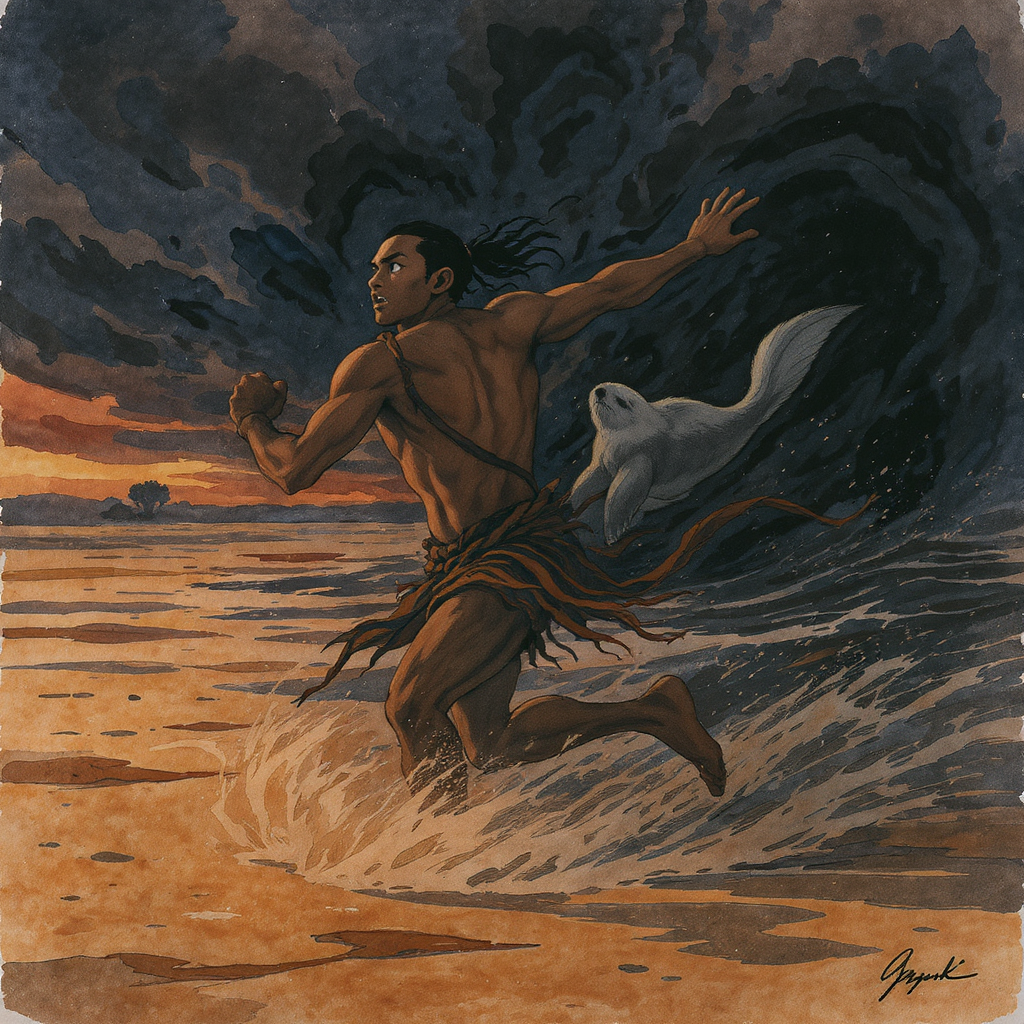
The Bunyip Long, long ago, far, far away on the other side of the world, some young men left the camp where they lived to get some food for their wives and children. The sun was hot, but they liked heat, and as they went they ran races and tried who could hurl his spear the farthest, or was cleverest in throwing a strange weapon called a boomerang, which always returns to the thrower. They did not get on very fast at this rate, but presently they reached a flat place that in time of flood was full of water, but was now, in the height of summer, only a set of pools, each surrounded with a fringe of plants, with bulrushes standing in the inside of all. In that country the people are fond of the roots of bulrushes, which they think as good as onions, and one of the young men said that they had better collect some of the roots and carry them back to the camp. It did not take them long to weave the tops of the willows into a basket, and they were just going to wade into the water and pull up the bulrush roots when a youth suddenly called out: “After all, why should we waste our time in doing work that is only fit for women and children? Let them come and get the roots for themselves; but we will fish for eels and anything else we can get.” This delighted the rest of the party, and they all began to arrange their fishing lines, made from the bark of the yellow mimosa, and to search for bait for their hooks. Most of them used worms, but one, who had put a piece of raw meat for dinner into his skin wallet, cut off a little bit and baited his line with it, unseen by his companions. For a long time they cast patiently, without receiving a single bite; the sun had grown low in the sky, and it seemed as if they would have to go home empty-handed, not even with a basket of roots to show; when the youth, who had baited his hook with raw meat, suddenly saw his line disappear under the water. Something, a very heavy fish he supposed, was pulling so hard that he could hardly keep his feet, and for a few minutes it seemed either as if he must let go or be dragged into the pool. He cried to his friends to help him, and at last, trembling with fright at what they were going to see, they managed between them to land on the bank a creature that was neither a calf nor a seal, but something of both, with a long, broad tail. They looked at each other with horror, cold shivers running down their spines; for though they had never beheld it, there was not a man amongst them who did not know what it was—the cub of the awful Bunyip! All of a sudden the silence was broken by a low wail, answered by another from the other side of the pool, as the mother rose up from her den and came towards them, rage flashing from her horrible yellow eyes. “Let it go! let it go!” whispered the young men to each other; but the captor declared that he had caught it, and was going to keep it. “He had promised his sweetheart,” he said, “that he would bring back enough meat for her father’s house to feast on for three days, and though they could not eat the little Bunyip, her brothers and sisters should have it to play with.” So, flinging his spear at the mother to keep her back, he threw the little Bunyip on to his shoulders, and set out for the camp, never heeding the poor mother’s cries of distress. By this time it was getting near sunset, and the plain was in shadow, though the tops of the mountains were still quite bright. The youths had all ceased to be afraid, when they were startled by a low rushing sound behind them, and, looking round, saw that the pool was slowly rising, and the spot where they had landed the Bunyip was quite covered. “What could it be?” they asked one of another; “there was not a cloud in the sky, yet the water had risen higher already than they had ever known it do before.” For an instant they stood watching as if they were frozen, then they turned and ran with all their might, the man with the Bunyip running faster than all. When he reached a high peak over-looking all the plain he stopped to take breath, and turned to see if he was safe yet. Safe! why only the tops of the trees remained above that sea of water, and these were fast disappearing. They must run fast indeed if they were to escape. So on they flew, scarcely feeling the ground as they went, till they flung themselves on the ground before the holes scooped out of the earth where they had all been born. The old men were sitting in front, the children were playing, and the women chattering together, when the little Bunyip fell into their midst, and there was scarcely a child among them who did not know that something terrible was upon them. “The water! the water!” gasped one of the young men; and there it was, slowly but steadily mounting the ridge itself. Parents and children clung together, as if by that means they could drive back the advancing flood; and the youth who had caused all this terrible catastrophe, seized his sweetheart, and cried: “I will climb with you to the top of that tree, and there no waters can reach us.” But, as he spoke, something cold touched him, and quickly he glanced down at his feet. Then with a shudder he saw that they were feet no longer, but bird’s claws. He looked at the girl he was clasping, and beheld a great black bird standing at his side; he turned to his friends, but a flock of great awkward flapping creatures stood in their place He put up his hands to cover his face, but they were no more hands, only the ends of wings; and when he tried to speak, a noise such as he had never heard before seemed to come from his throat, which had suddenly become narrow and slender. Already the water had risen to his waist, and he found himself sitting easily upon it, while its surface reflected back the image of a black swan, one of many. Never again did the swans become men; but they are still different from other swans, for in the night-time those who listen can hear them talk in a language that is certainly not swan’s language; and there are even sounds of laughing and talking, unlike any noise made by the swans whom we know. The little Bunyip was carried home by its mother, and after that the waters sank back to their own channels. The side of the pool where she lives is always shunned by everyone, as nobody knows when she may suddenly put out her head and draw him into her mighty jaws. But people say that underneath the black waters of the pool she has a house filled with beautiful things, such as mortals who dwell on the earth have no idea of. Though how they know I cannot tell you, as nobody has ever seen it. [From Journal of Anthropological-Institute.]
Moral of the Story
Disrespecting nature and its creatures, especially for selfish gain, can lead to severe and irreversible consequences.
Characters

The Youth ★ protagonist
Strong, athletic, skilled with spears and boomerangs
Attire: Simple loincloth or wrap made of animal skin, possibly adorned with feathers or beads
Impulsive, boastful, selfish

The Bunyip Mother ⚔ antagonist
A creature that was neither a calf nor a seal, but something of both, with a long, broad tail, horrible yellow eyes
Protective, vengeful, powerful

The Little Bunyip ○ minor
Neither a calf nor a seal, but something of both, with a long, broad tail
Vulnerable, helpless

The Sweetheart ◆ supporting
Likely attractive to the Youth, healthy
Attire: Simple dress made of woven plant fibers or animal skin, adorned with natural elements
Trusting, dependent

The Other Youths ◆ supporting
Strong, athletic
Attire: Simple loincloths or wraps made of animal skin
Easily swayed, fearful
Locations

Flat plain with pools
A flat area that floods seasonally, now in summer with scattered pools fringed with plants and bulrushes.
Mood: Initially peaceful and abundant, later menacing and dangerous
The young men catch the baby Bunyip, enraging the mother and triggering the flood.

High peak overlooking the plain
A high point offering a panoramic view of the now-flooded plain.
Mood: Desperate, hopeless, terrifying
The young men realize the extent of the flood and the imminent danger.

Camp/Village
Holes scooped out of the earth, where the people live. Located on a ridge.
Mood: Initially peaceful and communal, then filled with dread and chaos
The flood engulfs the camp, and the young men are transformed into black swans.

Bunyip's Pool
A dark pool of water, the home of the Bunyip.
Mood: Eerie, mysterious, dangerous
The Bunyip returns home with her cub, and the pool is forever feared.
Story DNA
Moral
Disrespecting nature and its creatures, especially for selfish gain, can lead to severe and irreversible consequences.
Plot Summary
A group of young men, shirking work, catch a Bunyip cub. One youth refuses to release it despite the mother's distress, even attacking her. As they return to camp, a mysterious flood rises and pursues them. The flood engulfs their camp, and the cruel youth and his companions are transformed into black swans as punishment. The Bunyip mother retrieves her cub, the waters recede, and the swans are forever marked by their past, while the Bunyip's pool remains a place of fear and mystery.
Themes
Emotional Arc
carefree to terror to despair
Writing Style
Narrative Elements
Cultural Context
Andrew Lang was a Scottish poet, novelist, and literary critic, known for collecting and retelling fairy tales from various cultures in his 'Fairy Books' series. This story is presented as an Aboriginal legend, reflecting early European attempts to document indigenous folklore, though often with their own interpretations.
Plot Beats (13)
- Young men leave camp to gather food, but decide to fish instead of collecting bulrush roots, deeming it 'women's work'.
- One youth baits his line with raw meat, secretly from his companions.
- He catches a heavy creature, which his friends help him land, recognizing it as a Bunyip cub.
- The mother Bunyip appears, wailing, but the youth refuses to release the cub, intending to keep it as a trophy and for his sweetheart.
- He throws a spear at the mother and carries the cub away towards the camp.
- A mysterious flood begins to rise rapidly, following the men.
- The men run back to their camp, the flood relentlessly pursuing them.
- The flood reaches the camp, terrifying the families.
- The youth tries to save his sweetheart by climbing a tree, but he and his companions begin to transform into black swans.
- The transformation is complete; they are now black swans, unable to speak or act as men.
- The Bunyip mother retrieves her cub from the floodwaters.
- The floodwaters recede, leaving the transformed men as swans.
- The swans retain a human-like language at night, and the Bunyip's pool remains a feared and mysterious place.


