The Cunning Hare
by Andrew Lang

The Clever Hare
Once, a little hare lived with his grandmother. They were very hungry. They lived in a cold, snowy place. They had no food. It was very cold. They were very hungry.
"I will go fishing," said Little Hare. "We need food." Grandmother was worried. "You are too small," she said. "And we have no fire to cook." "I will get fish," he said. "Then I will get fire."
Little Hare went to the river. The water was cold. He put his net in the cold water. He waited all night. It was very long and cold. But he did not sleep. He waited and waited.
In the morning, he looked. He saw many fish! His net was full. He was so happy. "Look, Grandmother!" he shouted in his heart. He was so happy.
He took some fish home. "Look, Grandmother!" he said. "Now I will get fire." He went back to the river. It was very wide. He could not jump across. He was small. The river was big. He remembered some magic words. He said them quietly. He said the words.
Big fish came! They made a path across the water. Little Hare jumped on them. He crossed the river. On the other side, some children saw him. "A hare!" they said. They picked him up. They took him to their tent. "Let's play with him!" a boy said. "Let's keep him!"
Little Hare was scared. He wanted to go home. He saw a small hole in the tent. He had his net with him. He wished for a spark of fire. He wished and wished. A spark fell on his net! It started to burn. The net was on fire!
Little Hare jumped through the hole. He ran fast. The children ran after him. He jumped back onto the big fish. He crossed the river again. He was safe. He ran home to Grandmother. He gave her the burning net.
"Fire!" said Grandmother. "You are very clever, Little Hare!" They were warm and happy. They had food and fire. Cleverness helped them. They were safe and warm.
Original Story
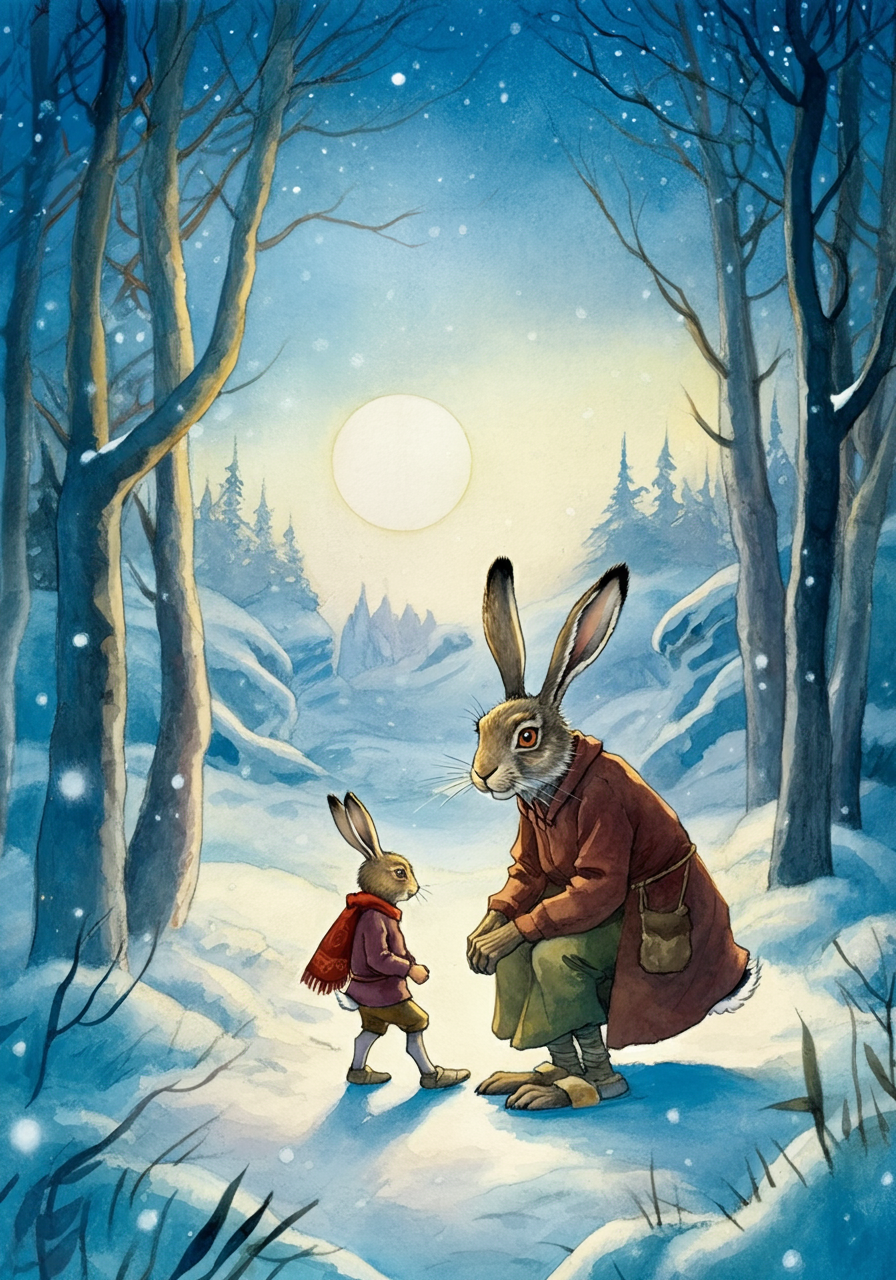
The Cunning Hare In a very cold country, far across the seas, where ice and snow cover the ground for many months in the year, there lived a little hare, who, as his father and mother were both dead, was brought up by his grandmother. As he was too young, and she was too old, to work, they were very poor, and often did not have enough to eat. One day, when the little fellow was hungrier than usual, he asked his grandmother if he might go down to the river and catch a fish for their breakfast, as the thaw had come and the water was flowing freely again. She laughed at him for thinking that any fish would let itself be caught by a hare, especially such a young one; but as she had the rheumatism very badly, and could get no food herself, she let him go. “If he does not catch a fish he may find something else,” she said to herself. So she told her grandson where to look for the net, and how he was to set it across the river; but just as he was starting, feeling himself quite a man, she called him back. “After all, I don’t know what is the use of your going, my boy! For even if you should catch a fish, I have no fire to cook it with.” “Let me catch my fish, and I will soon make you a fire,” he answered gaily, for he was young, and knew nothing about the difficulties of fire-making. It took him some time to haul the net through bushes and over fields, but at length he reached a pool in the river which he had often heard was swarming with fish, and here he set the net, as his grandmother had directed him. He was so excited that he hardly slept all night, and at the very first streak of dawn he ran as fast as ever he could down to the river. His heart beat as quickly as if he had had dogs behind him, and he hardly dared to look, lest he should be disappointed. Would there be even one fish? And at this thought the pangs of hunger made him feel quite sick with fear. But he need not have been afraid; in every mesh of the net was a fine fat fish, and of course the net itself was so heavy that he could only lift one corner. He threw some of the fish back into the water, and buried some more in a hole under a stone, where he would be sure to find them. Then he rolled up the net with the rest, put it on his back and carried it home. The weight of the load caused his back to ache, and he was thankful to drop it outside their hut, while he rushed in, full of joy, to tell his grandmother. “Be quick and clean them!” he said, “and I will go to those people’s tents on the other side of the water.” The old woman stared at him in horror as she listened to his proposal. Other people had tried to steal fire before, and few indeed had come back with their lives; but as, contrary to all her expectations, he had managed to catch such a number of fish, she thought that perhaps there was some magic about him which she did not know of, and did not try to hinder him. When the fish were all taken out, he fetched the net which he had laid out to dry, folded it up very small, and ran down to the river, hoping that he might find a place narrow enough for him to jump over; but he soon saw that it was too wide for even the best jumper in the world. For a few moments he stood there, wondering what was to be done, then there darted into his head some words of a spell which he had once heard a wizard use, while drinking from the river. He repeated them, as well as he could remember, and waited to see what would happen. In five minutes such a grunting and a puffing was heard, and columns of water rose into the air, though he could not tell what had made them. Then round the bend of the stream came fifteen huge whales, which he ordered to place themselves heads to tails, like stepping stones, so that he could jump from one to the other till he landed on the opposite shore. Directly he got there he told the whales that he did not need them any more, and sat down in the sand to rest. Unluckily some children who were playing about caught sight of him, and one of them, stealing softly up behind him, laid tight hold of his ears. The hare, who had been watching the whales as they sailed down the river, gave a violent start, and struggled to get away; but the boy held on tight, and ran back home, as fast as he could go. “Throw it in the pot,” said the old woman, as soon as he had told his story; “put it in that basket, and as soon as the water boils in the pot we will hang it over the fire!” “Better kill it first,” said the old man; and the hare listened, horribly frightened, but still looking secretly to see if there was no hole through which he could escape, if he had a chance of doing so. Yes, there was one, right in the top of the tent, so, shaking himself, as if with fright, he let the end of his net unroll itself a little. “I wish that a spark of fire would fall on my net,” whispered he; and the next minute a great log fell forward into the midst of the tent, causing every one to spring backwards. The sparks were scattered in every direction, and one fell on the net, making a little blaze. In an instant the hare had leaped through the hole, and was racing towards the river, with men, women, and children after him. There was no time to call back the whales, so, holding the net tight in his mouth, he wished himself across the river. Then he jumped high into the air, and landed safe on the other side, and after turning round to be sure that there was no chance of anyone pursuing him, trotted happily home to his grandmother. “Didn’t I tell you I would bring you fire?” said he, holding up his net, which was now burning briskly. “But how did you cross the water?” inquired the old woman. “Oh, I just jumped!” said he. And his grandmother asked him no more questions, for she saw that he was wiser than she. [“Indian Folk Tales.” Bureau of Ethnology.]
Moral of the Story
Resourcefulness and quick thinking can overcome seemingly impossible obstacles.
Characters

The Cunning Hare ★ protagonist
Small, young
Attire: None (animal)
Resourceful, clever

Hare's Grandmother ◆ supporting
Old, suffering from rheumatism
Attire: None (animal)
Worried, cautious

The Boy ○ minor
Not specified
Attire: Inuit child's clothing appropriate for cold climate
Playful, opportunistic

The Old Woman ⚔ antagonist
Not specified
Attire: Inuit woman's clothing appropriate for cold climate
Practical, decisive

The Old Man ○ minor
Not specified
Attire: Inuit man's clothing appropriate for cold climate
Cautious

The Whales ◆ supporting
Fifteen huge whales
Attire: None (animal)
Obedient
Locations

Hare's Hut
A poor hut, suggesting sparseness and age, where the hare lives with his grandmother.
Mood: desolate
Hare returns with fish and later with fire.

River Pool
A pool in a river, described as swarming with fish after the thaw.
Mood: hopeful
Hare catches many fish in his net.

Riverbank (opposite shore)
Sandy area on the far side of the river, where children are playing near the tents.
Mood: dangerous
Hare is captured by a child.

People's Tent
A tent where people live, containing a pot, basket, and fire.
Mood: threatening
Hare escapes through a hole in the tent after setting his net on fire.
Story DNA
Moral
Resourcefulness and quick thinking can overcome seemingly impossible obstacles.
Plot Summary
A young, orphaned hare and his elderly grandmother face starvation in a cold land. Despite his grandmother's doubts, the hare successfully catches many fish but then needs fire to cook them. He cunningly uses a forgotten spell to summon whales as stepping stones to cross a wide river to a human encampment. Captured by children, he overhears their plans to cook him, but uses his net and a whispered wish to create a diversion, escaping through a hole in their tent. He then wishes himself back across the river with the burning net, bringing fire and proving his wisdom to his grandmother.
Themes
Emotional Arc
suffering to triumph
Writing Style
Narrative Elements
Cultural Context
The story is presented as an 'Indian Folk Tale' collected by the Bureau of Ethnology, indicating its roots in Indigenous American oral traditions. The specific tribe or region is not mentioned in this version, but the themes of animal tricksters and survival are common in many such traditions.
Plot Beats (14)
- A young hare and his old grandmother are poor and hungry in a cold land.
- The hare decides to go fishing, despite his grandmother's skepticism about his ability and their lack of fire.
- He successfully catches a huge number of fish, far more than expected.
- He decides to get fire from humans across a wide river.
- He uses a forgotten spell to summon fifteen whales to form a bridge across the river.
- After crossing, he is caught by human children and taken to their tent.
- The humans plan to cook him, and he overhears their conversation.
- He secretly notices a hole in the tent roof and begins to unroll his net.
- He whispers a wish for a spark to fall on his net, causing a log to fall and scatter sparks.
- A spark ignites his net, and he leaps through the hole in the roof, escaping the humans.
- He wishes himself back across the river, holding the burning net.
- He lands safely on his side of the river and trots home.
- He presents the burning net to his grandmother, fulfilling his promise of fire.
- His grandmother, impressed by his wisdom and resourcefulness, asks no more questions.


