The Elf Maiden
by Andrew Lang

The Boy and the Magic Girl
Once, a boy was alone on a small island. His name was Tom. He lived in a small village. He had a friend named Jack. They both liked a girl. They were kind friends. They tried to make her smile.
In summer, they all went to an island. They went in a boat. They sang happy songs. They would stay there for a long time. Tom, Jack, and the girl shared a small hut.
One day, it was time to go home. Jack was in the boat. "Tom, get my knife!" said Jack. Tom ran to the hut. He found the knife. He looked back. The boat was far away! Jack did not mean to leave him. It was a mistake.
Tom was alone. He was not sad for long. He found berries. He caught fish. He was brave. He waited for his friends.
One cold night, a boat came. It was a magical boat. Pretty lights shone on it. Tom hid behind some wood. Magical people got out. They were friendly. A girl named Lily was there. She saw Tom. She came to say hello. Tom moved his hand. A thorn touched her finger. "Ouch!" she said. The magical people got scared. They ran back to their boat. They left in a hurry. They forgot Lily.
Lily stood by Tom. "You helped me," she said. "I will stay with you." "Okay," said Tom. They became friends. Lily had magic. She made food appear. They had berries and fish. They were happy all winter.
Spring came. "Let's build a house," said Lily. They found a pretty spot. They slept under a tree. Tom heard loud noises. He stayed still, like Lily said. In the morning, a house was there! It was a nice house. Lily smiled. "Now we need a barn," she said. Tom made a space for it. The next day, a barn was there. It was magic!
They went to visit Lily's family. Her father was Elder Oak. He was kind. He gave them a gift. He gave them many cows. "Jump fast!" Lily said when they left. Tom jumped very fast. A big hammer hit the ground. It was a game. Elder Oak laughed.
They walked home with the cows. "Do not look back," said Lily. Tom tried not to look. He heard loud steps. He looked back. Some cows were gone. But many cows stayed. They had enough.
Tom and Lily were happy. Sometimes, Lily went for a short walk. She always came back. "Put a flower on the door," she said. "It will keep me here." Tom put a pretty flower on the door. Lily stayed with him. They were kind friends. Tom and Lily lived happily with magic all around.
Original Story
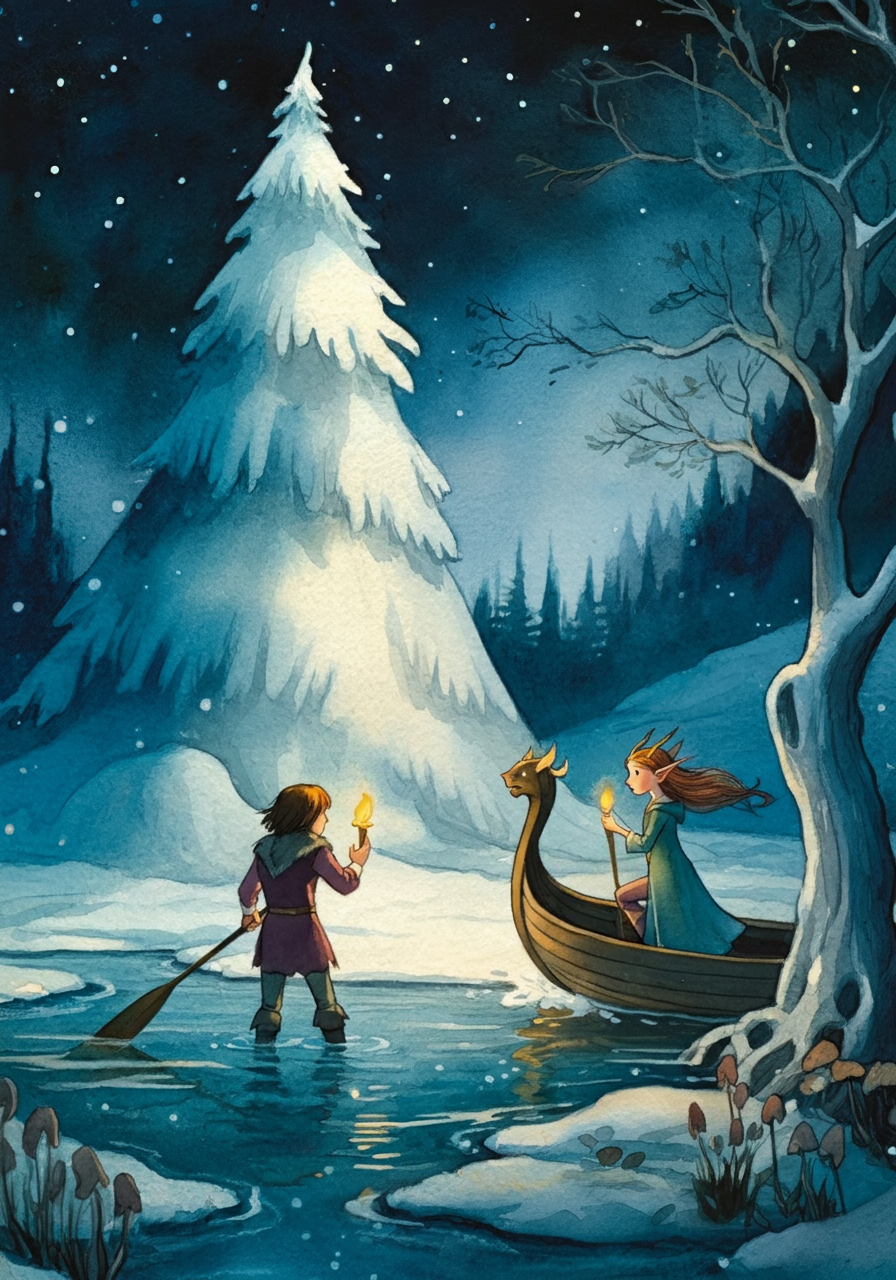
The Elf Maiden Once upon a time two young men living in a small village fell in love with the same girl. During the winter, it was all night except for an hour or so about noon, when the darkness seemed a little less dark, and then they used to see which of them could tempt her out for a sleigh ride with the Northern Lights flashing above them, or which could persuade her to come to a dance in some neighbouring barn. But when the spring began, and the light grew longer, the hearts of the villagers leapt at the sight of the sun, and a day was fixed for the boats to be brought out, and the great nets to be spread in the bays of some islands that lay a few miles to the north. Everybody went on this expedition, and the two young men and the girl went with them. They all sailed merrily across the sea chattering like a flock of magpies, or singing their favourite songs. And when they reached the shore, what an unpacking there was! For this was a noted fishing ground, and here they would live, in little wooden huts, till autumn and bad weather came round again. The maiden and the two young men happened to share the same hut with some friends, and fished daily from the same boat. And as time went on, one of the youths remarked that the girl took less notice of him than she did of his companion. At first he tried to think that he was dreaming, and for a long while he kept his eyes shut very tight to what he did not want to see, but in spite of his efforts, the truth managed to wriggle through, and then the young man gave up trying to deceive himself, and set about finding some way to get the better of his rival. The plan that he hit upon could not be carried out for some months; but the longer the young man thought of it, the more pleased he was with it, so he made no sign of his feelings, and waited patiently till the moment came. This was the very day that they were all going to leave the islands, and sail back to the mainland for the winter. In the bustle and hurry of departure, the cunning fisherman contrived that their boat should be the last to put off, and when everything was ready, and the sails about to be set, he suddenly called out: “Oh, dear, what shall I do! I have left my best knife behind in the hut. Run, like a good fellow, and get it for me, while I raise the anchor and loosen the tiller.” Not thinking any harm, the youth jumped back on shore and made his way up the steep hank. At the door of the hut he stopped and looked back, then started and gazed in horror. The head of the boat stood out to sea, and he was left alone on the island. Yes, there was no doubt of it—he was quite alone; and he had nothing to help him except the knife which his comrade had purposely dropped on the ledge of the window. For some minutes he was too stunned by the treachery of his friend to think about anything at all, but after a while he shook himself awake, and determined that he would manage to keep alive somehow, if it were only to revenge himself. So he put the knife in his pocket and went off to a part of the island which was not so bare as the rest, and had a small grove of trees. From one of these he cut himself a bow, which he strung with a piece of cord that had been left lying about the huts. When this was ready the young man ran down to the shore and shot one or two sea-birds, which he plucked and cooked for supper. In this way the months slipped by, and Christmas came round again. The evening before, the youth went down to the rocks and into the copse, collecting all the drift wood the sea had washed up or the gale had blown down, and he piled it up in a great stack outside the door, so that he might not have to fetch any all the next day. As soon as his task was done, he paused and looked out towards the mainland, thinking of Christmas Eve last year, and the merry dance they had had. The night was still and cold, and by the help of the Northern Lights he could almost sea across to the opposite coast, when, suddenly, he noticed a boat, which seemed steering straight for the island. At first he could hardly stand for joy, the chance of speaking to another man was so delightful; but as the boat drew near there was something, he could not tell what, that was different from the boats which he had been used to all his life, and when it touched the shore he saw that the people that filled it were beings of another world than ours. Then he hastily stepped behind the wood stack, and waited for what might happen next. The strange folk one by one jumped on to the rocks, each bearing a load of something that they wanted. Among the women he remarked two young girls, more beautiful and better dressed than any of the rest, carrying between them two great baskets full of provisions. The young man peeped out cautiously to see what all this crowd could be doing inside the tiny hut, but in a moment he drew back again, as the girls returned, and looked about as if they wanted to find out what sort of a place the island was. Their sharp eyes soon discovered the form of a man crouching behind the bundles of sticks, and at first they felt a little frightened, and started as if they would run away. But the youth remained so still, that they took courage and laughed gaily to each other. “What a strange creature, let us try what he is made of,” said one, and she stooped down and gave him a pinch. Now the young man had a pin sticking in the sleeve of his jacket, and the moment the girl’s hand touched him she pricked it so sharply that the blood came. The girl screamed so loudly that the people all ran out of their huts to see what was the matter. But directly they caught sight of the man they turned and fled in the other direction, and picking up the goods they had brought with them scampered as fast as they could down to the shore. In an instant, boat, people, and goods had vanished completely. In their hurry they had, however, forgotten two things: a bundle of keys which lay on the table, and the girl whom the pin had pricked, and who now stood pale and helpless beside the wood stack. “You will have to make me your wife,” she said at last, “for you have drawn my blood, and I belong to you.” “Why not? I am quite willing,” answered he. “But how do you suppose we can manage to live till summer comes round again?” “Do not be anxious about that,” said the girl; “if you will only marry me all will be well. I am very rich, and all my family are rich also.” Then the young man gave her his promise to make her his wife, and the girl fulfilled her part of the bargain, and food was plentiful on the island all through the long winter months, though he never knew how it got there. And by-and-by it was spring once more, and time for the fisher-folk to sail from the mainland. “Where are we to go now?” asked the girl, one day, when the sun seemed brighter and the wind softer than usual. “I do not care where I go,” answered the young man; “what do you think?” The girl replied that she would like to go somewhere right at the other end of the island, and build a house, far away from the huts of the fishing-folk. And he consented, and that very day they set off in search of a sheltered spot on the banks of a stream, so that it would be easy to get water. In a tiny bay, on the opposite side of the island they found the very thing, which seemed to have been made on purpose for them; and as they were tired with their long walk, they laid themselves down on a bank of moss among some birches and prepared to have a good night’s rest, so as to be fresh for work next day. But before she went to sleep the girl turned to her husband, and said: “If in your dreams you fancy that you hear strange noises, be sure you do not stir, or get up to see what it is.” “Oh, it is not likely we shall hear any noises in such a quiet place,” answered he, and fell sound asleep. Suddenly he was awakened by a great clatter about his ears, as if all the workmen in the world were sawing and hammering and building close to him. He was just going to spring up and go to see what it meant, when he luckily remembered his wife’s words and lay still. But the time till morning seemed very long, and with the first ray of sun they both rose, and pushed aside the branches of the birch trees. There, in the very place they had chosen, stood a beautiful house—doors and windows, and everything all complete! “Now you must fix on a spot for your cow-stalls,” said the girl, when they had breakfasted off wild cherries; “and take care it is the proper size, neither too large nor too small.” And the husband did as he was bid, though he wondered what use a cow-house could be, as they had no cows to put in it. But as he was a little afraid of his wife, who knew so much more than he, he asked no questions. This night also he was awakened by the same sounds as before, and in the morning they found, near the stream, the most beautiful cow-house that ever was seen, with stalls and milk-pails and stools all complete, indeed, everything that a cow-house could possibly want, except the cows. Then the girl bade him measure out the ground for a storehouse, and this, she said, might be as large as he pleased; and when the storehouse was ready she proposed that they should set off to pay her parents a visit. The old people welcomed them heartily, and summoned their neighbours, for many miles round, to a great feast in their honour. In fact, for several weeks there was no work done on the farm at all; and at length the young man and his wife grew tired of so much play, and declared that they must return to their own home. But, before they started on the journey, the wife whispered to her husband: “Take care to jump over the threshold as quick as you can, or it will be the worse for you.” The young man listened to her words, and sprang over the threshold like an arrow from a bow; and it was well he did, for, no sooner was he on the other side, than his father-in-law threw a great hammer at him, which would have broken both his legs, if it had only touched them. When they had gone some distance on the road home, the girl turned to her husband and said: “Till you step inside the house, be sure you do not look back, whatever you may hear or see.” And the husband promised, and for a while all was still; and he thought no more about the matter till he noticed at last that the nearer he drew to the house the louder grew the noise of the trampling of feet behind him. As he laid his hand upon the door he thought he was safe, and turned to look. There, sure enough, was a vast herd of cattle, which had been sent after him by his father-in-law when he found that his daughter had been cleverer than he. Half of the herd were already through the fence and cropping the grass on the banks of the stream, but half still remained outside and faded into nothing, even as he watched them. However, enough cattle were left to make the young man rich, and he and his wife lived happily together, except that every now and then the girl vanished from his sight, and never told him where she had been. For a long time he kept silence about it; but one day, when he had been complaining of her absence, she said to him: “Dear husband, I am bound to go, even against my will, and there is only one way to stop me. Drive a nail into the threshold, and then I can never pass in or out.” And so he did. [Lapplandische Mahrchen.]
Characters

The Elf Maiden ★ protagonist
Beautiful, well-dressed, but otherwise not specifically described
Attire: Finely made clothing, appropriate for a wealthy magical being, possibly with silver or ice-like details
Resourceful, loyal, secretive

The Young Man (Protagonist) ★ protagonist
Not specifically described, but likely fit from fishing and outdoor work
Attire: Simple fisherman's clothing: tunic, trousers, sturdy boots, perhaps a knitted cap
Naive, trusting, eventually resourceful

The Rival Fisherman ⚔ antagonist
Not specifically described, but likely fit from fishing and outdoor work
Attire: Simple fisherman's clothing: tunic, trousers, sturdy boots, perhaps a knitted cap
Deceitful, jealous, cunning

The Elf Maiden's Father ◆ supporting
Not specifically described, but likely imposing and regal
Attire: Richly decorated clothing, befitting a leader of magical beings, perhaps with furs and jewels
Protective, testing, powerful
Locations

Village Barn
A barn in a neighboring village, used for dances.
Mood: festive, social
The young men compete for the maiden's attention at dances.

Island Shore Fishing Camp
Shore with little wooden huts, where the villagers live temporarily during the fishing season.
Mood: busy, communal
The maiden lives in a hut with the two young men, and one is abandoned here.

Secluded Bay
A tiny bay on the opposite side of the island, with a stream, mossy banks, and birch trees.
Mood: peaceful, secluded
The elf maiden and the young man choose this spot to build their home.

Magical House
A beautiful, fully furnished house that appears overnight.
Mood: magical, comfortable
The elf maiden uses her magic to provide a home for herself and her husband.
Story DNA
Plot Summary
A jealous rival abandons a young man on a remote island. The youth survives the winter, and on Christmas Eve, encounters a boat of strange beings. He accidentally pricks one of the maidens, binding her to him as his wife. She provides for them magically, and they build a home. After visiting her supernatural family, where her father attempts to harm the youth, they return with magical cattle, though the youth's curiosity causes some to vanish. They live happily, but the wife occasionally disappears, eventually revealing that a nail in their threshold will prevent her from leaving.
Themes
Emotional Arc
betrayal to wonder to contentment
Writing Style
Narrative Elements
Cultural Context
The story reflects elements of Sami folklore, particularly the interaction between humans and nature spirits, and the harsh realities of life in the Arctic regions.
Plot Beats (13)
- Two young men in a village are rivals for a girl's affection.
- They all go on a summer fishing expedition to an island.
- One jealous youth tricks his rival into being abandoned on the island during departure.
- The abandoned youth survives the winter by hunting and gathering, fueled by a desire for revenge.
- On Christmas Eve, a boat of strange, non-human beings lands on the island.
- The youth, hiding, pricks one of the maidens with a pin, causing her to scream and the others to flee in panic, leaving her behind.
- The maiden declares herself bound to the youth as his wife because he drew her blood.
- They live together, and the maiden mysteriously provides food and wealth throughout the winter.
- In spring, they move to a new part of the island, and the maiden magically builds a house and a cow-house overnight while the youth sleeps.
- They visit the maiden's parents, who are also strange beings, and the father-in-law attempts to harm the youth as they leave.
- On the way home, the maiden warns the youth not to look back, but he does, causing half of the magically provided cattle to vanish.
- They live happily and prosperously, but the wife occasionally vanishes without explanation.
- The wife reveals that a nail in the threshold will prevent her disappearances, and the husband complies.


