The Enchanted Head
by Andrew Lang

The Magic Head's Wish
An old woman lived by the sea. She lived with her daughter. They were very poor. They made veils all day. Each morning, she sold veils in the city.
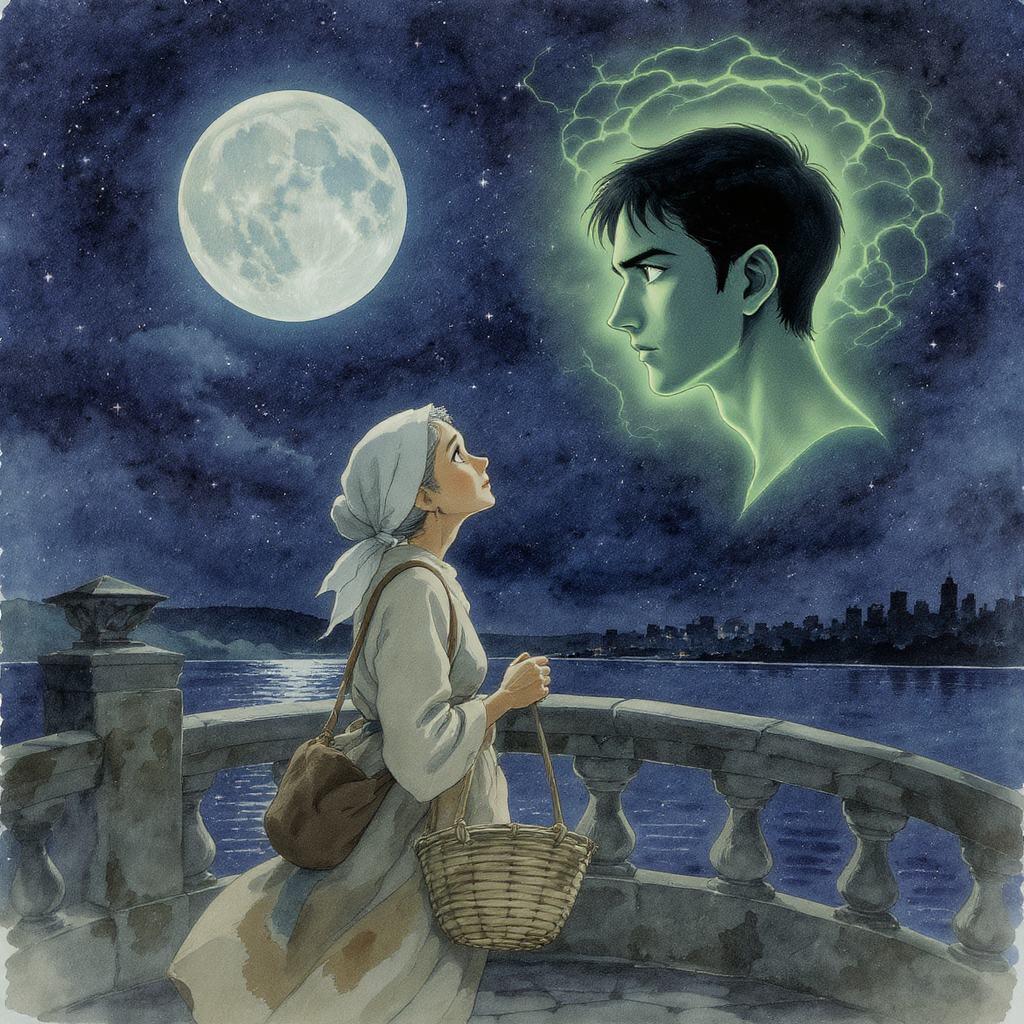
One morning, she crossed the bridge. She saw a head on the ground. It was a magic head. "Take me home!" it said. The old woman was scared. She ran home. The magic head followed her.
That day, she did not sell the veils. There was no food. They were very hungry. The magic head saw this. "Why is there no food?" it asked. "We have no money," said the old woman.
"I can help," said the magic head. "Go to the bridge at night. Call 'First Spirit' three times." The old woman did this. A magic spirit appeared. He gave her a green purse. It was full of money!
They were very happy. They bought food and new dresses. Soon, the money was all gone. The magic head spoke again. "Go to the bridge. Call 'Second Spirit' three times." The old woman did this. A new spirit gave her a red purse. It had even more money.
They built a new house. They had many nice things. Then the magic head said, "Go to the Sultan. Ask for his daughter to be my wife."
The old woman was scared. But she went to the palace. "Please, can your daughter marry my son?" she asked. The Sultan was angry. "Your son must do magic things first!" he said. "Make a big garden in a few days."
The old woman told the magic head. "Easy!" it said. "Call 'Third Spirit'." She did. The spirit made a pretty garden at night. The Sultan was surprised.
"Build a palace in a few days!" said the Sultan. The magic head said, "Call 'Fourth Spirit'." The spirit built a shiny blue palace. The Sultan was very surprised.
"Fill the palace with helpers!" said the Sultan. The magic head said, "Call 'Fifth Spirit'." The spirit filled the palace with many helpers. The Sultan was happy. "Your son can marry my daughter!" he said.
The old woman was worried. She put the magic head on a silver dish. She took it to the palace. The Sultan was angry. "I will not let my daughter marry a head!" he cried.
But the Princess was kind. "I will marry him," she said softly. "I love him." So they had a wedding.
That night, a magical thing happened. The magic head changed! A handsome man stood there. "A bad fairy put a spell on me," he said. "I was only a head for others. But for my wife, I am a man."
The Princess smiled. "I am happy," she said. And they learned that true love sees beyond how someone looks.
Original Story
The Enchanted Head Once upon a time an old woman lived in a small cottage near the sea with her two daughters. They were very poor, and the girls seldom left the house, as they worked all day long making veils for the ladies to wear over their faces, and every morning, when the veils were finished, the other took them over the bridge and sold them in the city. Then she bought the food that they needed for the day, and returned home to do her share of veil-making. One morning the old woman rose even earlier than usual, and set off for the city with her wares. She was just crossing the bridge when, suddenly, she knocked up against a human head, which she had never seen there before. The woman started back in horror; but what was her surprise when the head spoke, exactly as if it had a body joined on to it. “Take me with you, good mother!” it said imploringly; “take me with you back to your house.” At the sound of these words the poor woman nearly went mad with terror. Have that horrible thing always at home? Never! never! And she turned and ran back as fast as she could, not knowing that the head was jumping, dancing, and rolling after her. But when she reached her own door it bounded in before her, and stopped in front of the fire, begging and praying to be allowed to stay. All that day there was no food in the house, for the veils had not been sold, and they had no money to buy anything with. So they all sat silent at their work, inwardly cursing the head which was the cause of their misfortunes. When evening came, and there was no sign of supper, the head spoke, for the first time that day: “Good mother, does no one ever eat here? During all the hours I have spent in your house not a creature has touched anything.” “No,” answered the old woman, “we are not eating anything.” “And why not, good mother?” “Because we have no money to buy any food.” “Is it your custom never to eat?” “No, for every morning I go into the city to sell my veils, and with the few shillings I get for them I buy all we want. To-day I did not cross the bridge, so of course I had nothing for food.” “Then I am the cause of your having gone hungry all day?” asked the head. “Yes, you are,” answered the old woman. “Well, then, I will give you money and plenty of it, if you will only do as I tell you. In an hour, as the clock strikes twelve, you must be on the bridge at the place where you met me. When you get there call out ‘Ahmed,’ three times, as loud as you can. Then a negro will appear, and you must say to him: ‘The head, your master, desires you to open the trunk, and to give me the green purse which you will find in it.’” “Very well, my lord,” said the old woman, “I will set off at once for the bridge.” And wrapping her veil round her she went out. Midnight was striking as she reached the spot where she had met the head so many hours before. “Ahmed! Ahmed! Ahmed!” cried she, and immediately a huge negro, as tall as a giant, stood on the bridge before her. “What do you want?” asked he. “The head, your master, desires you to open the trunk, and to give me the green purse which you will find in it.” “I will be back in a moment, good mother,” said he. And three minutes later he placed a purse full of sequins in the old woman’s hand. No one can imagine the joy of the whole family at the sight of all this wealth. The tiny, tumble-down cottage was rebuilt, the girls had new dresses, and their mother ceased selling veils. It was such a new thing to them to have money to spend, that they were not as careful as they might have been, and by-and-by there was not a single coin left in the purse. When this happened their hearts sank within them, and their faces fell. “Have you spent your fortune?” asked the head from its corner, when it saw how sad they looked. “Well, then, go at midnight, good mother, to the bridge, and call out ‘Mahomet!’ three times, as loud as you can. A negro will appear in answer, and you must tell him to open the trunk, and to give you the red purse which he will find there.” The old woman did not need twice telling, but set off at once for the bridge. “Mahomet! Mahomet! Mahomet!” cried she, with all her might; and in an instant a negro, still larger than the last, stood before her. “What do you want?” asked he. “The head, your master, bids you open the trunk, and to give me the red purse which you will find in it.” “Very well, good mother, I will do so,” answered the negro, and, the moment after he had vanished, he reappeared with the purse in his hand. This time the money seemed so endless that the old woman built herself a new house, and filled it with the most beautiful things that were to be found in the shops. Her daughters were always wrapped in veils that looked as if they were woven out of sunbeams, and their dresses shone with precious stones. The neighbours wondered where all this sudden wealth had sprung from, but nobody knew about the head. “Good mother,” said the head, one day, “this morning you are to go to the city and ask the sultan to give me his daughter for my bride.” “Do what?” asked the old woman in amazement. “How can I tell the sultan that a head without a body wishes to become his son-in-law? They will think that I am mad, and I shall be hooted from the palace and stoned by the children.” “Do as I bid you,” replied the head; “it is my will.” The old woman was afraid to say anything more, and, putting on her richest clothes, started for the palace. The sultan granted her an audience at once, and, in a trembling voice, she made her request. “Are you mad, old woman?” said the sultan, staring at her. “The wooer is powerful, O Sultan, and nothing is impossible to him.” “Is that true?” “It is, O Sultan; I swear it,” answered she. “Then let him show his power by doing three things, and I will give him my daughter.” “Command, O gracious prince,” said she. “Do you see that hill in front of the palace?” asked the sultan. “I see it,” answered she. “Well, in forty days the man who has sent you must make that hill vanish, and plant a beautiful garden in its place. That is the first thing. Now go, and tell him what I say.” So the old woman returned and told the head the sultan’s first condition. “It is well,” he replied; and said no more about it. For thirty-nine days the head remained in its favourite corner. The old woman thought that the task set before was beyond his powers, and that no more would be heard about the sultan’s daughter. But on the thirty-ninth evening after her visit to the palace, the head suddenly spoke. “Good mother,” he said, “you must go to-night to the bridge, and when you are there cry ‘Ali! Ali! Ali!’ as loud as you can. A negro will appear before you, and you will tell him that he is to level the hill, and to make, in its place, the most beautiful garden that ever was seen.” “I will go at once,” answered she. It did not take her long to reach the bridge which led to the city, and she took up her position on the spot where she had first seen the head, and called loudly “Ali! Ali! Ali.” In an instant a negro appeared before her, of such a huge size that the old woman was half frightened; but his voice was mild and gentle as he said: “What is it that you want?” “Your master bids you level the hill that stands in front of the sultan’s palace and in its place to make the most beautiful garden in the world.” “Tell my master he shall be obeyed,” replied Ali; “it shall be done this moment.” And the old woman went home and gave Ali’s message to the head. Meanwhile the sultan was in his palace waiting till the fortieth day should dawn, and wondering that not one spadeful of earth should have been dug out of the hill. “If that old woman has been playing me a trick,” thought he, “I will hang her! And I will put up a gallows to-morrow on the hill itself.” But when to-morrow came there was no hill, and when the sultan opened his eyes he could not imagine why the room was so much lighter than usual, and what was the reason of the sweet smell of flowers that filled the air. “Can there be a fire?” he said to himself; “the sun never came in at this window before. I must get up and see.” So he rose and looked out, and underneath him flowers from every part of the world were blooming, and creepers of every colour hung in chains from tree to tree. Then he remembered. “Certainly that old woman’s son is a clever magician!” cried he; “I never met anyone as clever as that. What shall I give him to do next? Let me think. Ah! I know.” And he sent for the old woman, who by the orders of the head, was waiting below. “Your son has carried out my wishes very nicely,” he said. “The garden is larger and better than that of any other king. But when I walk across it I shall need some place to rest on the other side. In forty days he must build me a palace, in which every room shall be filled with different furniture from a different country, and each more magnificent than any room that ever was seen.” And having said this he turned round and went away. “Oh! he will never be able to do that,” thought she; “it is much more difficult than the hill.” And she walked home slowly, with her head bent. “Well, what am I to do next?” asked the head cheerfully. And the old woman told her story. “Dear me! is that all? why it is child’s play,” answered the head; and troubled no more about the palace for thirty-nine days. Then he told the old woman to go to the bridge and call for Hassan. “What do you want, old woman?” asked Hassan, when he appeared, for he was not as polite as the others had been. “Your master commands you to build the most magnificent palace that ever was seen,” replied she; “and you are to place it on the borders of the new garden.” “He shall be obeyed,” answered Hassan. And when the sultan woke he saw, in the distance, a palace built of soft blue marble, resting on slender pillars of pure gold. “That old woman’s son is certainly all-powerful,” cried he; “what shall I bid him do now?” And after thinking some time he sent for the old woman, who was expecting the summons. “The garden is wonderful, and the palace the finest in the world,” said he, “so fine, that my servants would cut but a sorry figure in it. Let your son fill it with forty slaves whose beauty shall be unequalled, all exactly like each other, and of the same height.” This time the king thought he had invented something totally impossible, and was quite pleased with himself for his cleverness. Thirty-nine days passed, and at midnight on the night of the last the old woman was standing on the bridge. “Bekir! Bekir! Bekir!” cried she. And a negro appeared, and inquired what she wanted. “The head, your master, bids you find forty slaves of unequalled beauty, and of the same height, and place them in the sultan’s palace on the other side of the garden.” And when, on the morning of the fortieth day, the sultan went to the blue palace, and was received by the forty slaves, he nearly lost his wits from surprise. “I will assuredly give my daughter to the old woman’s son,” thought he. “If I were to search all the world through I could never find a more powerful son-in-law.” And when the old woman entered his presence he informed her that he was ready to fulfil his promise, and she was to bid her son appear at the palace without delay. This command did not at all please the old woman, though, of course, she made no objections to the sultan. “All has gone well so far,” she grumbled, when she told her story to the head,” but what do you suppose the sultan will say, when he sees his daughter’s husband?” “Never mind what he says! Put me on a silver dish and carry me to the palace.” So it was done, though the old woman’s heart beat as she laid down the dish with the head upon it. At the sight before him the king flew into a violent rage. “I will never marry my daughter to such a monster,” he cried. But the princess placed her head gently on his arm. “You have given your word, my father, and you cannot break it,” said she. “But, my child, it is impossible for you to marry such a being,” exclaimed the sultan. “Yes, I will marry him. He had a beautiful head, and I love him already.” So the marriage was celebrated, and great feasts were held in the palace, though the people wept tears to think of the sad fate of their beloved princess. But when the merry-making was done, and the young couple were alone, the head suddenly disappeared, or, rather, a body was added to it, and one of the handsomest young men that ever was seen stood before the princess. “A wicked fairy enchanted me at my birth,” he said, “and for the rest of the world I must always be a head only. But for you, and you only, I am a man like other men.” “And that is all I care about,” said the princess. [Traditions populaires de toutes les nations (Asie Mineure)].
Moral of the Story
True worth and love can be found beyond superficial appearances, and promises, once made, should be kept.
Characters

The Enchanted Head ★ protagonist
Initially only a severed head, later a handsome young man
Attire: None as a head; later, royal garments befitting a prince
Demanding, powerful, ultimately loving and grateful

The Old Woman ◆ supporting
Initially poor and worn, later wealthy and well-dressed
Attire: Starts in simple peasant clothes, ends in rich garments and veils
Initially fearful, then greedy, ultimately obedient and resourceful

The Sultan ◆ supporting
Royal and imposing
Attire: Elaborate sultan's robes and turban
Skeptical, demanding, impressed by power

The Princess ◆ supporting
Beautiful
Attire: Royal princess attire
Gentle, obedient, loving, accepting

Ahmed ○ minor
Huge negro, as tall as a giant
Attire: Servant's clothing
Obedient

Mahomet ○ minor
Negro, still larger than the last
Attire: Servant's clothing
Obedient

Ali ○ minor
Huge size
Attire: Servant's clothing
Obedient

Hassan ○ minor
No details given
Attire: Servant's clothing
Less polite, but still obedient

Bekir ○ minor
No details given
Attire: Servant's clothing
Obedient
Locations

Small Cottage near the Sea
Tiny, tumble-down, later rebuilt
Mood: poor, humble, later comfortable
The old woman and her daughters live here; the head resides here and gives instructions.

Bridge to the City
Where the old woman first encounters the head
Mood: eerie, magical
The old woman meets the enchanted head and later summons the negro servants.

Sultan's Palace
Where the Sultan lives and makes demands
Mood: opulent, powerful
The old woman petitions the Sultan, and the prince marries the princess.

Garden
A beautiful garden with flowers from every part of the world and colorful creepers hanging from tree to tree.
Mood: magical, beautiful
The Sultan marvels at the garden that has been created.

Blue Marble Palace
Built of soft blue marble, resting on slender pillars of pure gold, filled with furniture from different countries.
Mood: opulent, magical
The Sultan marvels at the palace that has been created.
Story DNA
Moral
True worth and love can be found beyond superficial appearances, and promises, once made, should be kept.
Plot Summary
An impoverished old woman encounters a talking, disembodied head that follows her home. Initially a burden, the head soon provides immense wealth through summoned magical servants. The head then demands the old woman propose marriage to the Sultan's daughter, who sets three impossible tasks: creating a garden, building a palace, and filling it with identical slaves. The head's servants magically complete each task. Despite the Sultan's outrage at the head's appearance, the Princess accepts it as her husband, leading to the head's transformation into a handsome man, revealing a curse that only allowed him to appear as a head to others.
Themes
Emotional Arc
despair to hope to triumph
Writing Style
Narrative Elements
Cultural Context
The use of 'negro' and the portrayal of these characters as magical servants who appear on command reflects a historical and cultural context where such figures might be depicted in folklore, often without the nuanced understanding of race and slavery prevalent today. The names used (Ahmed, Mahomet, Ali, Hassan, Bekir) are common in Islamic cultures.
Plot Beats (15)
- An old woman and her two daughters live in poverty, making and selling veils.
- The old woman encounters a talking, disembodied head on a bridge, which insists on coming home with her.
- The head's presence prevents the old woman from selling veils, leading to the family's hunger.
- The head instructs the old woman to summon 'Ahmed' at midnight on the bridge, who provides a green purse full of money.
- The family spends all the money, and the head instructs the old woman to summon 'Mahomet' for a red purse, providing even greater wealth.
- The head commands the old woman to ask the Sultan for his daughter's hand in marriage.
- The Sultan, skeptical, sets three impossible tasks for the suitor: make a hill vanish and plant a garden in 40 days.
- The head instructs the old woman to summon 'Ali', who magically creates the garden overnight.
- The Sultan sets the second task: build a magnificent palace with unique rooms in 40 days.
- The head instructs the old woman to summon 'Hassan', who magically builds the palace overnight.
- The Sultan sets the third task: fill the palace with forty identical, beautiful slaves in 40 days.
- The head instructs the old woman to summon 'Bekir', who magically provides the slaves overnight.
- The Sultan, impressed, agrees to the marriage and demands the suitor appear.
- The old woman presents the head on a silver dish, enraging the Sultan, but the Princess accepts the head as her husband.
- After the wedding, the head transforms into a handsome man, revealing a curse that only allowed him to be a head to others, but a man to his wife.


