The Fox and the Lapp
by Andrew Lang

The Clever Fox
Once, a clever fox was bored. He wanted to have fun. He saw a man with a sledge. The sledge was big. It had many boxes. The fox had a plan. He lay down by the road. He pretended to sleep. He was very still. The man saw the fox. "A sleeping fox!" he said. He put the fox in his sledge. The fox was inside a box. He waited. Then he jumped out! He ran fast. He ran to another sledge. This sledge had fish. The fish smelled good. The fox took a big fish. He ran away with it. The man did not see. The fox was clever.
The fox met a bear. The bear was big. He was very hungry. "Where's your fish?" said the bear. "From the river," said the fox. "Put your tail in the water. Fish will bite!" The bear tried it. The water was cold. It got icy. The bear's tail was stuck! He pulled hard. His tail broke! Now the bear had a short tail. The fox laughed and ran away. The bear was surprised.
Later, the bear found the fox. He was angry. He held the fox by his tail. "You tricked me!" said the bear. The fox wiggled free. "Wait! I'll show you something fun," said the fox. He dug a pit. "Jump in! It is soft mud!" The bear jumped in. He was covered in mud! It was very funny. The bear laughed. The mud was sticky. The fox ran away again. The bear was not angry now.
The fox saw the man again. The man wanted his fish back. "Here's treasure," said the fox. He gave the man a bag. The man looked inside. It was full of old bones! "This is not treasure!" said the man. But he laughed. "You are a tricky fox!" said the man. He went away. The fox was happy.
The fox was free. He played a trick on the man's snowshoes. He untied the ropes. The snowshoes fell apart! The man could not chase him. The fox was very happy. He danced away.
The fox came to a river. A man was fixing a boat. "I want a boat!" said the fox. The man was cross. He threw the fox into the water. The fox swam to an island. "Thank you!" he called. The island was small. The fox looked around.
On the island, the fox saw a salmon. "Hello, Salmon! Can you carry me?" asked the fox. "Yes, jump on my back!" said the salmon. They swam together. They became friends. The fox did not eat the salmon. They played in the water. It was fun.
The fox played in the mud. He fell down. Dirt got in his eyes. "Oh no! I cannot see!" he cried. He met a bird. "Do you have extra eyes?" he asked. "No," said the bird. He met a bee. "Do you have eyes?" he asked. "No," said the bee. The fox was sad.
He met a snake. "Snake, lend me your eyes?" asked the fox. "For a little while?" The snake was kind. "Okay," he said. They traded eyes. The fox could see again! "Thank you, Snake!" said the fox. He kept the snake's eyes. Now foxes have clever eyes. The snake's eyes look a little burnt. The snake did not mind.
The fox was very clever. He learned that being kind is important too. He went off to play, but he promised to be nicer to his friends.
Original Story
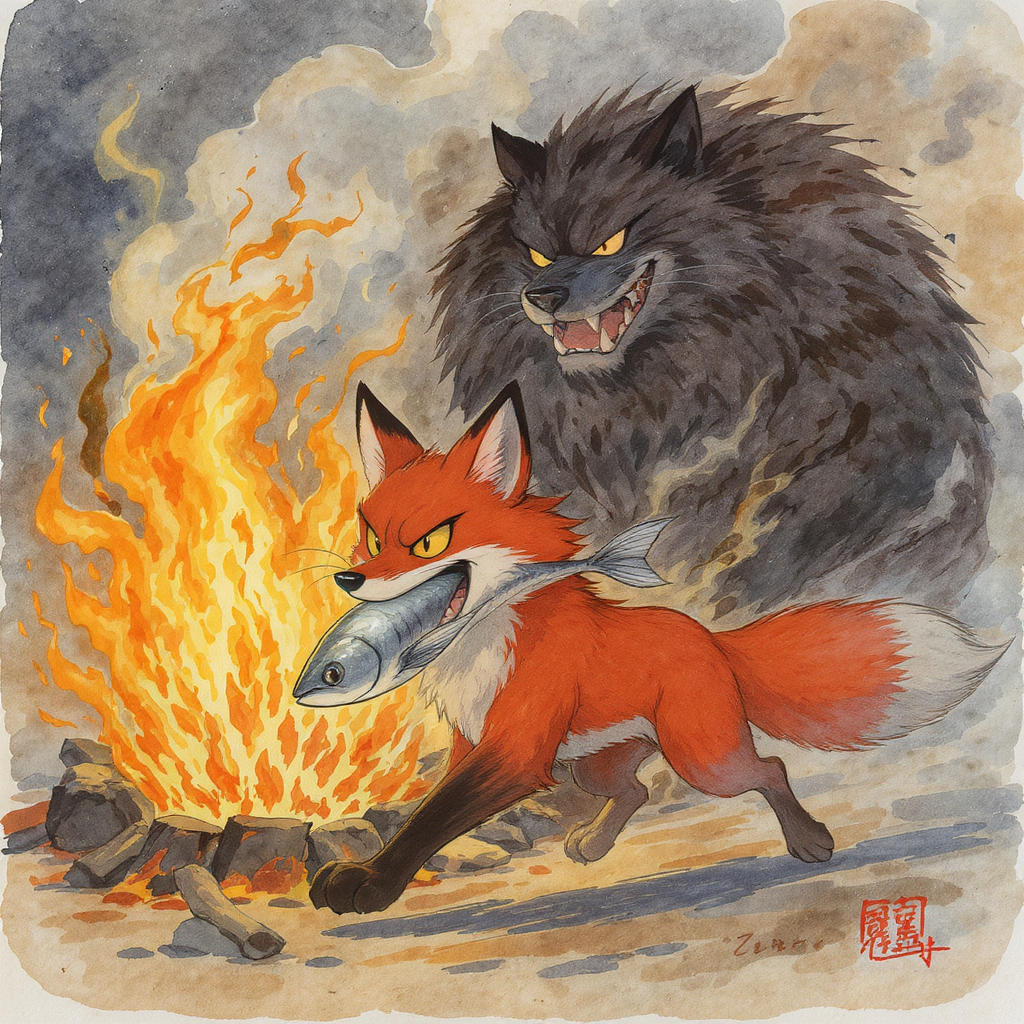
The Fox and the Lapp Once upon a time a fox lay peeping out of his hole, watching the road that ran by at a little distance, and hoping to see something that might amuse him, for he was feeling very dull and rather cross. For a long while he watched in vain; everything seemed asleep, and not even a bird stirred overhead. The fox grew crosser than ever, and he was just turning away in disgust from his place when he heard the sound of feet coming over the snow. He crouched eagerly down at the edge of the road and said to himself: “I wonder what would happen if I were to pretend to be dead! This is a man driving a reindeer sledge, I know the tinkling of the harness. And at any rate I shall have an adventure, and that is always something!” So he stretched himself out by the side of the road, carefully choosing a spot where the driver could not help seeing him, yet where the reindeer would not tread on him; and all fell out just as he had expected. The sledge-driver pulled up sharply, as his eyes lighted on the beautiful animal lying stiffly beside him, and jumping out he threw the fox into the bottom of the sledge, where the goods he was carrying were bound tightly together by ropes. The fox did not move a muscle though his bones were sore from the fall, and the driver got back to his seat again and drove on merrily. But before they had gone very far, the fox, who was near the edge, contrived to slip over, and when the Laplander saw him stretched out on the snow he pulled up his reindeer and put the fox into one of the other sledges that was fastened behind, for it was market-day at the nearest town, and the man had much to sell. They drove on a little further, when some noise in the forest made the man turn his head, just in time to see the fox fall with a heavy thump on to the frozen snow. “That beast is bewitched!” he said to himself, and then he threw the fox into the last sledge of all, which had a cargo of fishes. This was exactly what the cunning creature wanted, and he wriggled gently to the front and bit the cord which tied the sledge to the one before it so that it remained standing in the middle of the road. Now there were so many sledges that the Lapp did not notice for a long while that one was missing; indeed, he would have entered the town without knowing if snow had not suddenly begun to fall. Then he got down to secure more firmly the cloths that kept his goods dry, and going to the end of the long row, discovered that the sledge containing the fish and the fox was missing. He quickly unharnessed one of his reindeer and rode back along the way he had come, to find the sledge standing safe in the middle of the road; but as the fox had bitten off the cord close to the noose there was no means of moving it away. The fox meanwhile was enjoying himself mightily. As soon as he had loosened the sledge, he had taken his favourite fish from among the piles neatly arranged for sale, and had trotted off to the forest with it in his mouth. By-and-by he met a bear, who stopped and said: “Where did you find that fish, Mr. Fox?” “Oh, not far off,” answered he; “I just stuck my tail in the stream close by the place where the elves dwell, and the fish hung on to it of itself.” “Dear me,” snarled the bear, who was hungry and not in a good temper, “if the fish hung on to your tail, I suppose he will hang on to mine.” “Yes, certainly, grandfather,” replied the fox, “if you have patience to suffer what I suffered.” “Of course I can,” replied the bear, “what nonsense you talk! Show me the way.” So the fox led him to the bank of a stream, which, being in a warm place, had only lightly frozen in places, and was at this moment glittering in the spring sunshine. “The elves bathe here,” he said, “and if you put in your tail the fish will catch hold of it. But it is no use being in a hurry, or you will spoil everything.” Then he trotted off, but only went out of sight of the bear, who stood still on the bank with his tail deep in the water. Soon the sun set and it grew very cold and the ice formed rapidly, and the bear’s tail was fixed as tight as if a vice had held it; and when the fox saw that everything had happened just as he had planned it, he called out loudly: “Be quick, good people, and come with your bows and spears. A bear has been fishing in your brook!” And in a moment the whole place was full of little creatures each one with a tiny bow and a spear hardly big enough for a baby; but both arrows and spears could sting, as the bear knew very well, and in his fright he gave such a tug to his tail that it broke short off, and he rolled away into the forest as fast as his legs could carry him. At this sight the fox held his sides for laughing, and then scampered away in another direction. By-and-by he came to a fir tree, and crept into a hole under the root. After that he did something very strange. Taking one of his hind feet between his two front paws, he said softly: “What would you do, my foot, if someone was to betray me?” “I would run so quickly that he should not catch you.” “What would you do, mine ear, if someone was to betray me?” “I would listen so hard that I should hear all his plans.” “What would you do, my nose, if someone was to betray me?” “I would smell so sharply that I should know from afar that he was coming.” “What would you do, my tail, if someone was to betray me?” “I would steer you so straight a course that you would soon be beyond his reach. Let us be off; I feel as if danger was near.” But the fox was comfortable where he was, and did not hurry himself to take his tail’s advice. And before very long he found he was too late, for the bear had come round by another path, and guessing where his enemy was began to scratch at the roots of the tree. The fox made himself as small as he could, but a scrap of his tail peeped out, and the bear seized it and held it tight. Then the fox dug his claws into the ground, but he was not strong enough to pull against the bear, and slowly he was dragged forth and his body flung over the bear’s neck. In this manner they set out down the road, the fox’s tail being always in the bear’s mouth. After they had gone some way, they passed a tree-stump, on which a bright coloured woodpecker was tapping. “Ah! those were better times when I used to paint all the birds such gay colours,” sighed the fox. “What are you saying, old fellow?” asked the bear. “I? Oh, I was saying nothing,” answered the fox drearily. “Just carry me to your cave and eat me up as quick as you can.” The bear was silent, and thought of his supper; and the two continued their journey till they reached another tree with a woodpecker tapping on it. “Ah! those were better times when I used to paint all the birds such gay colours,” said the fox again to himself. “Couldn’t you paint me too?” asked the bear suddenly. But the fox shook his head; for he was always acting, even if no one was there to see him do it. “You bear pain so badly,” he replied, in a thoughtful voice, “and you are impatient besides, and could never put up with all that is necessary. Why, you would first have to dig a pit, and then twist ropes of willow, and drive in posts and fill the hole with pitch, and, last of all, set it on fire. Oh, no; you would never be able to do all that.” “It does not matter a straw how hard the work is,” answered the bear eagerly, “I will do it every bit.” And as he spoke he began tearing up the earth so fast that soon a deep pit was ready, deep enough to hold him. “That is all right,” said the fox at last, “I see I was mistaken in you. Now sit here, and I will bind you.” So the bear sat down on the edge of the pit, and the fox sprang on his back, which he crossed with the willow ropes, and then set fire to the pitch. It burnt up in an instant, and caught the bands of willow and the bear’s rough hair; but he did not stir, for he thought that the fox was rubbing the bright colours into his skin, and that he would soon be as beautiful as a whole meadow of flowers. But when the fire grew hotter still he moved uneasily from one foot to the other, saying, imploringly: “It is getting rather warm, old man.” But all the answer he got was: “I thought you would never be able to suffer pain like those little birds.” The bear did not like being told that he was not as brave as a bird, so he set his teeth and resolved to endure anything sooner than speak again; but by this time the last willow band had burned through, and with a push the fox sent his victim tumbling into the grass, and ran off to hide himself in the forest. After a while he stole cautiously and found, as he expected, nothing left but a few charred bones. These he picked up and put in a bag, which he slung over his back. By-and-by he met a Lapp driving his team of reindeer along the road, and as he drew near, the fox rattled the bones gaily. “That sounds like silver or gold,” thought the man to himself. And he said politely to the fox: “Good-day, friend! What have you got in your bag that makes such a strange sound?” “All the wealth my father left me,” answered the fox. “Do you feel inclined to bargain?” “Well, I don’t mind,” replied the Lapp, who was a prudent man, and did not wish the fox to think him too eager; “but show me first what money you have got.” “Ah, but I can’t do that,” answered the fox, “my bag is sealed up. But if you will give me those three reindeer, you shall take it as it is, with all its contents.” The Lapp did not quite like it, but the fox spoke with such an air that his doubts melted away. He nodded, and stretched out his hand; the fox put the bag into it, and unharnassed the reindeer he had chosen. “Oh, I forgot!” he exclaimed, turning round, as he was about to drive them in the opposite direction, “you must be sure not to open the bag until you have gone at least five miles, right on the other side of those hills out there. If you do, you will find that all the gold and silver has changed into a parcel of charred bones.” Then he whipped up his reindeer, and was soon out of sight. For some time the Lapp was satisfied with hearing the bones rattle, and thinking to himself what a good bargain he had made, and of all the things he would buy with the money. But, after a bit, this amusement ceased to content him, and besides, what was the use of planning when you did not know for certain how rich you were? Perhaps there might be a great deal of silver and only a little gold in the bag; or a great deal of gold, and only a little silver. Who could tell? He would not, of course, take the money out to count it, for that might bring him bad luck. But there could be no harm in just one peep! So he slowly broke the seal, and untied the strings, and, behold, a heap of burnt bones lay before him! In a minute he knew he had been tricked, and flinging the bag to the ground in a rage, he ran after the fox as fast as his snow-shoes would carry him. Now the fox had guessed exactly what would happen, and was on the look out. Directly he saw the little speck coming towards him, he wished that the man’s snow-shoes might break, and that very instant the Lapp’s shoes snapped in two. The Lapp did now know that this was the fox’s work, but he had to stop and fetch one of his other reindeer, which he mounted, and set off again in pursuit of his enemy. The fox soon heard him coming, and this time he wished that the reindeer might fall and break its leg. And so it did; and the man felt it was a hopeless chase, and that he was no match for the fox. So the fox drove on in peace till he reached the cave where all his stores were kept, and then he began to wonder whom he could get to help him kill his reindeer, for though he could steal reindeer he was too small to kill them. “After all, it will be quite easy,” thought he, and he bade a squirrel, who was watching him on a tree close by, take a message to all the robber beasts of the forest, and in less than half an hour a great crashing of branches was heard, and bears, wolves, snakes, mice, frogs, and other creatures came pressing up to the cave. When they heard why they had been summoned, they declared themselves ready each one to do his part. The bear took his crossbow from his neck and shot the reindeer in the chin; and, from that day to this, every reindeer has a mark in that same spot, which is always known as the bear’s arrow. The wolf shot him in the thigh, and the sign of his arrow still remains; and so with the mouse and the viper and all the rest, even the frog; and at the last the reindeer all died. And the fox did nothing, but looked on. “I really must go down to the brook and wash myself,” said he (though he was perfectly clean), and he went under the bank and hid himself behind a stone. From there he set up the most frightful shrieks, so that the animals fled away in all directions. Only the mouse and the ermine remained where they were, for they thought that they were much too small to be noticed. The fox continued his shrieks till he felt sure that the animals must have got to a safe distance; then he crawled out of his hiding-place and went to the bodies of the reindeer, which he now had all to himself. He gathered a bundle of sticks for a fire, and was just preparing to cook a steak, when his enemy, the Lapp, came up, panting with haste and excitement. “What are you doing there?” cried he; “why did you palm off those bones on me? And why, when you had got the reindeer, did you kill them?” “Dear brother,” answered the fox with a sob, “do not blame me for this misfortune. It is my comrades who have slain them in spite of my prayers.” The man made no reply, for the white fur of the ermine, who was crouching with the mouse behind some stones, had just caught his eye. He hastily seized the iron hook which hung over the fire and flung it at the little creature; but the ermine was too quick for him, and the hook only touched the top of its tail, and that has remained black to this day. As for the mouse, the Lapp threw a half-burnt stick after him, and though it was not enough to hurt him, his beautiful white skin was smeared all over with it, and all the washing in the world would not make him clean again. And the man would have been wiser if he had let the ermine and the mouse alone, for when he turned round again he found he was alone. Directly the fox noticed that his enemy’s attention had wandered from himself he watched his chance, and stole softly away till he had reached a clump of thick bushes, when he ran as fast as he could, till he reached a river, where a man was mending his boat. “Oh, I wish, I wish, I had a boat to mend too!” he cried, sitting up on his hind-legs and looking into the man’s face. “Stop your silly chatter!” answered the man crossly, “or I will give you a bath in the river.” “Oh, I wish, I do wish, I had a boat to mend,” cried the fox again, as if he had not heard. And the man grew angry and seized him by the tail, and threw him far out in the stream close to the edge of an island; which was just what the fox wanted. He easily scrambled up, and sitting on the top, he called: “Hasten, hasten, O fishes, and carry me to the other side!” And the fishes left the stones where they had been sleeping, and the pools where they had been feeding, and hurried to see who could get to the island first. “I have won,” shouted the pike. “Jump on my back, dear fox, and you will find yourself in a trice on the opposite shore.” “No, thank you,” answered the fox, “your back is much too weak for me. I should break it.” “Try mine,” said the eel, who had wriggled to the front. “No, thank you,” replied the fox again, “I should slip over your head and be drowned.” “You won’t slip on MY back,” said the perch, coming forward. “No; but you are really TOO rough,” returned the fox. “Well, you can have no fault to find with ME,” put in the trout. “Good gracious! are YOU here?” exclaimed the fox. “But I’m afraid to trust myself to you either.” At this moment a fine salmon swam slowly up. “Ah, yes, you are the person I want,” said the fox; “but come near, so that I may get on your back, without wetting my feet.” So the salmon swam close under the island, and when he was touching it the fox seized him in his claws and drew him out of the water, and put him on a spit, while he kindled a fire to cook him by. When everything was ready, and the water in the pot was getting hot, he popped him in, and waited till he thought the salmon was nearly boiled. But as he stooped down the water gave a sudden fizzle, and splashed into the fox’s eyes, blinding him. He started backwards with a cry of pain, and sat still for some minutes, rocking himself to and fro. When he was a little better he rose and walked down a road till he met a grouse, who stopped and asked what was the matter. “Have you a pair of eyes anywhere about you?” asked the fox politely. “No, I am afraid I haven’t,” answered the grouse, and passed on. A little while after the fox heard the buzzing of an early bee, whom a gleam of sun had tempted out. “Do you happen to have an extra pair of eyes anywhere?” asked the fox. “I am sorry to say I have only those I am using,” replied the bee. And the fox went on till he nearly fell over an asp who was gliding across the road. “I should be SO glad if you would tell me where I could get a pair of eyes,” said the fox. “I suppose you don’t happen to have any you could lend me?” “Well, if you only want them for a short time, perhaps I could manage,” answered the asp; “but I can’t do without them for long.” “Oh, it is only for a very short time that I need them,” said the fox; “I have a pair of my own just behind that hill, and when I find them I will bring yours back to you. Perhaps you will keep these till them.” So he took the eyes out of his own head and popped them into the head of the asp, and put the asp’s eyes in their place. As he was running off he cried over his shoulder: “As long as the world lasts the asps’ eyes will go down in the heads of foxes from generation to generation.” And so it has been; and if you look at the eyes of an asp you will see that they are all burnt; and though thousands and thousands of years have gone by since the fox was going about playing tricks upon everybody he met, the asp still bears the traces of the day when the sly creature cooked the salmon. [Lapplandische Mahrchen.]
Moral of the Story
Cunning and wit can overcome brute strength and size, but sometimes even the cleverest can suffer consequences.
Characters

Fox ★ protagonist
Beautiful fur, cunning eyes, bushy tail
Attire: Natural fur
Cunning, mischievous, selfish

Lapp ⚔ antagonist
Strong, hardy
Attire: Traditional Lapp clothing: tunic, leggings, reindeer-skin boots, belt
Gullible, easily angered, opportunistic

Bear ◆ supporting
Large, brown fur, short tail (after the incident)
Attire: Natural fur
Gullible, greedy, easily angered

Ermine ○ minor
Small, white fur with a black-tipped tail
Attire: Natural fur
Cautious

Mouse ○ minor
Small, white fur smeared with soot
Attire: Natural fur
Cautious

Salmon ○ minor
Large, silvery fish
Attire: Natural scales
Trusting

Asp ○ minor
Snake with burnt-looking eyes
Attire: Natural scales
Gullible
Locations

Fox's Hole by the Road
A hole near a road, overlooking the snowy landscape. The road is not far away.
Mood: dull, cross, expectant
The fox decides to trick the Lapp.

Frozen Stream Bank
A stream with lightly frozen patches, glittering in the spring sunshine. Elves are said to bathe here.
Mood: deceptive, cold
The fox tricks the bear into freezing his tail.

River Island
A small island in a river, close to the edge. A man is mending his boat nearby.
Mood: treacherous, opportunistic
The fox tricks the fish and tries to cook the salmon.
Story DNA
Moral
Cunning and wit can overcome brute strength and size, but sometimes even the cleverest can suffer consequences.
Plot Summary
A clever fox, bored and mischievous, repeatedly tricks a Lapp, first stealing fish from his sledge by feigning death, then leading a gullible bear to lose its tail while 'fishing' in ice. The fox later outwits the vengeful bear, tricking it into a fiery death. After further escapes from the Lapp and orchestrating the killing of reindeer by other animals, the fox is blinded by a cooking accident. He then tricks an asp into exchanging eyes, explaining the origin of the asp's 'burnt' eyes and the fox's keen sight, cementing his reputation as a master trickster.
Themes
Emotional Arc
amusement to mild discomfort to continued amusement
Writing Style
Narrative Elements
Cultural Context
The story reflects the traditional lifestyle and environment of the Sami people, where animals like reindeer are central to survival and interactions with wildlife are common. The trickster figure is a common archetype in many folk traditions.
Plot Beats (14)
- A bored fox pretends to be dead to trick a passing Lapp with a reindeer sledge.
- The Lapp picks up the 'dead' fox, who then repeatedly escapes from different sledges, eventually detaching the fish-laden sledge and stealing fish.
- The fox meets a hungry bear and tricks it into 'fishing' by putting its tail in freezing water, causing the bear to lose its tail when it tries to pull free from the ice.
- The fox is later captured by the vengeful bear, who carries him by the tail.
- The fox tricks the bear into believing he can paint birds with bright colors, convincing the bear to dig a pit, fill it with pitch, and set it on fire, leading to the bear's demise.
- The fox tricks the Lapp into believing a bag of burnt bones is treasure, causing the Lapp to abandon his pursuit.
- The fox uses wishes to disable the Lapp's snowshoes and reindeer, ensuring his escape.
- The fox summons other forest animals to help him kill stolen reindeer, then scares them away with fake shrieks to claim the meat for himself.
- The Lapp returns, confronts the fox, and in anger, causes the ermine's tail to turn black and the mouse's fur to be stained.
- The fox escapes the Lapp again by tricking a man mending a boat into throwing him onto an island.
- On the island, the fox tricks a salmon into carrying him across the river, then catches and prepares to cook the salmon.
- The cooking salmon's water splashes into the fox's eyes, blinding him.
- The fox encounters a grouse, a bee, and an asp, asking for eyes.
- The fox tricks the asp into exchanging eyes, claiming he will return them, thus explaining why asps have burnt-looking eyes and foxes have keen sight.


