The Knights of the Fish
by Andrew Lang

The Two Brave Brothers
Once upon a time, a kind cobbler went fishing. He worked very hard. But they had little food. He hoped to catch a fish.
He stood by the river. Splash! He pulled his line. He caught a shiny fish. The fish looked at him. It spoke in a small voice. "Take me home. Cook me. Give two pieces to your wife. Bury two pieces in the garden."
The cobbler was surprised. But he listened. He cooked the fish. He gave two pieces to his wife. That night, he buried two pieces.
A happy thing happened. Two baby boys were born. In the garden, two tall plants grew. They had shiny shields on top.
Years passed. The boys became young men. They were brave brothers. They looked the same. One day, they wanted fun. They walked to a crossroads. They hugged. "We will meet here again," they promised. Then they walked other ways.
The First Brother walked east. He came to a sad city. People were crying. "What is wrong?" he asked. A man said, "A big dragon comes today. Our princess needs help. She waits by the tree."
The First Brother ran fast. He found the princess. She was scared. "Run away!" she cried. "The dragon is coming!"
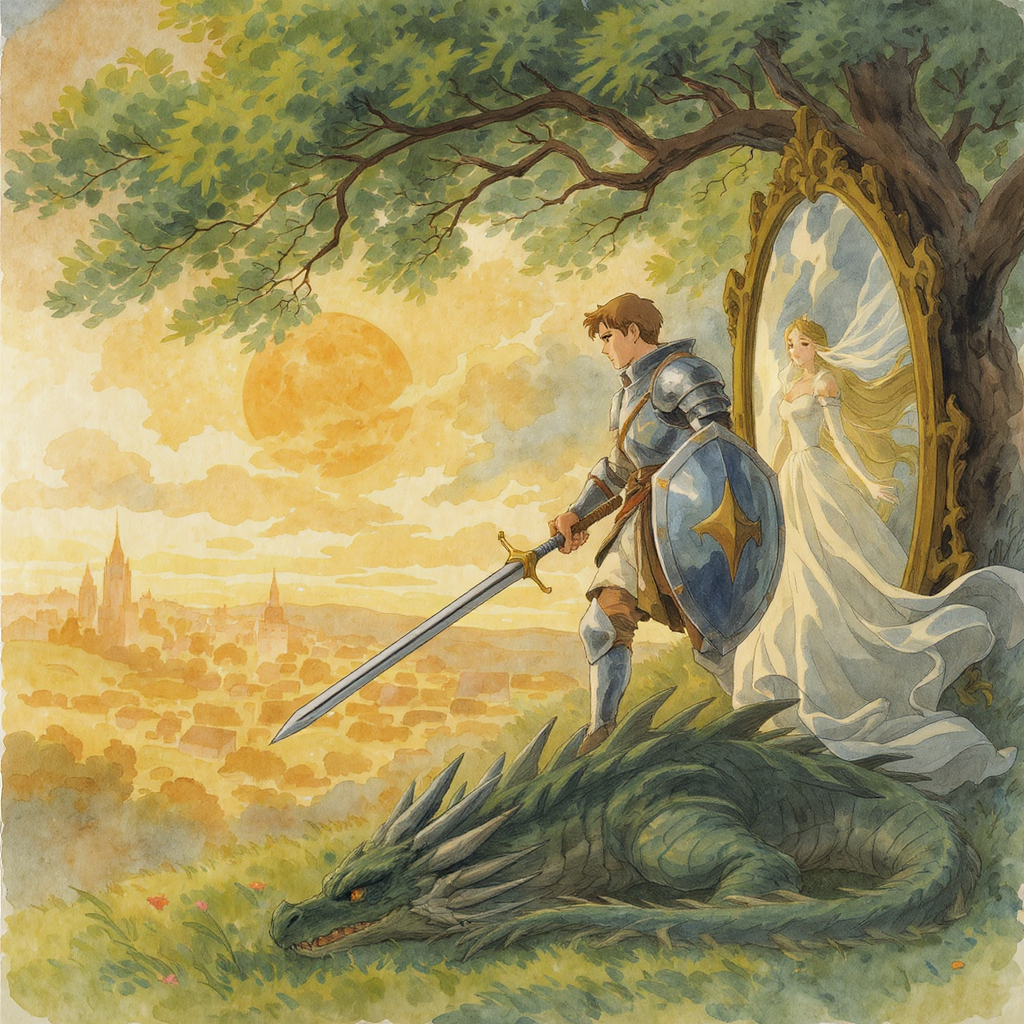
The brother had a clever idea. He got a big mirror. He put it by the tree. He covered it with the princess's veil. "Hide behind the mirror," he said. "When the dragon comes, pull off the veil."
The dragon flew down. Roar! It saw the princess. The princess pulled the veil. The dragon saw itself in the mirror! It saw a big, scary dragon. Roar! It got very angry. It flew at the mirror. Crash! The mirror broke. The dragon saw many pieces of itself. It got scared! It flew away and never came back.
The princess was happy. She and the First Brother became best friends. They had a big party.
Later, the First Brother heard of a magic castle. He wanted to see it. "Be safe," said the princess. But he went to the castle.
An old witch lived there. She had a long nose. "Come in," she whispered. The castle was full of strange things. The witch showed him a dark staircase. "Follow me," she said.
But it was a trick! The brother stepped on a hidden door. Whoosh! He fell down, down into a deep sleep.
Now, the Second Brother walked back to the city. All thought he was his brother! The princess was so happy to see him. "You are back!" she said. The Second Brother knew. His brother was in trouble. "I must go to the castle," he said.
He went to the castle. The witch saw him. She thought he was a ghost! "You!" she cried. The Second Brother was not scared. "Where is my brother?" he asked.
The witch would not tell. The Second Brother was clever. He used a magic word he knew. The witch fell into a deep sleep.
Then he woke the witch up. "Tell me the secret," he said. The witch whispered, "Say 'Wake up, friends' to wake them."
The Second Brother found his sleeping brother. "Wake up, friends!" he said. His brother woke up! They found other sleeping people too. They woke them all up.
The witch ran away. The magic castle vanished with a poof!
The brothers were together again. They went back to the city. All celebrated. The First Brother was with his friend the princess. The Second Brother was happy too.
The brothers learned that being brave and helping each other can solve any problem. And they lived happily ever after.
Original Story
The Knights of the Fish Once upon a time there lived an old cobbler who worked hard at his trade from morning till night, and scarcely gave himself a moment to eat. But, industrious as he was, he could hardly buy bread and cheese for himself and his wife, and they grew thinner and thinner daily. For a long while whey pretended to each other that they had no appetite, and that a few blackberries from the hedges were a great deal nicer than a good strong bowl of soup. But at length there came a day when the cobbler could bear it no longer, and he threw away his last, and borrowing a rod from a neighbour he went out to fish. Now the cobbler was as patient about fishing as he had been about cobbling. From dawn to dark he stood on the banks of the little stream, without hooking anything better than an eel, or a few old shoes, that even he, clever though he was, felt were not worth mending. At length his patience began to give way, and as he undressed one night he said to himself: “Well, I will give it one more chance; and if I don’t catch a fish to-morrow, I will go and hang myself.” He had not cast his line for ten minutes the next morning before he drew from the river the most beautiful fish he had ever seen in his life. But he nearly fell into the water from surprise, when the fish began to speak to him, in a small, squeaky voice: “Take me back to your hut and cook me; then cut me up, and sprinkle me over with pepper and salt. Give two of the pieces to your wife, and bury two more in the garden.” The cobbler did not know what to make of these strange words; but he was wiser than many people, and when he did not understand, he thought it was well to obey. His children wanted to eat all the fish themselves, and begged their father to tell them what to do with the pieces he had put aside; but the cobbler only laughed, and told them it was no business of theirs. And when they were safe in bed he stole out and buried the two pieces in the garden. By and by two babies, exactly alike, lay in a cradle, and in the garden were two tall plants, with two brilliant shields on the top. Years passed away, and the babies were almost men. They were tired of living quietly at home, being mistaken for each other by everybody they saw, and determined to set off in different directions, to seek adventures. So, one fine morning, the two brothers left the hut, and walked together to the place where the great road divided. There they embraced and parted, promising that if anything remarkable had happened to either, he would return to the cross roads and wait till his brother came. The youth who took the path that ran eastwards arrived presently at a large city, where he found everybody standing at the doors, wringing their hands and weeping bitterly. “What is the matter?” asked he, pausing and looking round. And a man replied, in a faltering voice, that each year a beautiful girl was chosen by lot to be offered up to a dreadful fiery dragon, who had a mother even worse than himself, and this year the lot had fallen on their peerless princess. “But where IS the princess?” said the young man once more, and again the man answered him: “She is standing under a tree, a mile away, waiting for the dragon.” This time the Knight of the Fish did not stop to hear more, but ran off as fast as he could, and found the princess bathed in tears, and trembling from head to foot. She turned as she heard the sound of his sword, and removed her handkerchief from his eyes. “Fly,” she cried; “fly while you have yet time, before that monster sees you.” She said it, and she mean it; yet, when he had turned his back, she felt more forsaken than before. But in reality it was not more than a few minutes before he came back, galloping furiously on a horse he had borrowed, and carrying a huge mirror across its neck. “I am in time, then,” he cried, dismounting very carefully, and placing the mirror against the trunk of a tree. “Give me your veil,” he said hastily to the princess. And when she had unwound it from her head he covered the mirror with it. “The moment the dragon comes near you, you must tear off the veil,” cried he; “and be sure you hide behind the mirror. Have no fear; I shall be at hand.” He and his horse had scarcely found shelter amongst some rocks, when the flap of the dragon’s wings could be plainly heard. He tossed his head with delight at the sight of her, and approached slowly to the place where she stood, a little in front of the mirror. Then, still looking the monster steadily in the face, she passed one hand behind her back and snatched off the veil, stepping swiftly behind the tree as she did so. The princess had not known, when she obeyed the orders of the Knight of the Fish, what she expected to happen. Would the dragon with snaky locks be turned to stone, she wondered, like the dragon in an old story her nurse had told her; or would some fiery spark dart from the heart of the mirror, and strike him dead? Neither of these things occurred, but, instead, the dragon stopped short with surprise and rage when he saw a monster before him as big and strong as himself. He shook his mane with rage and fury; the enemy in front did exactly the same. He lashed his tail, and rolled his red eyes, and the dragon opposite was no whit behind him. Opening his mouth to its very widest, he gave an awful roar; but the other dragon only roared back. This was too much, and with another roar which made the princess shake in her shoes, he flung himself upon his foe. In an instant the mirror lay at his feet broken into a thousand pieces, but as every piece reflected part of himself, the dragon thought that he too had been smashed into atoms. It was the moment for which the Knight of the Fish had watched and waited, and before the dragon could find out that he was not hurt at all, the young man’s lance was down his throat, and he was rolling, dead, on the grass. Oh! what shouts of joy rang through the great city, when the youth came riding back with the princess sitting behind him, and dragging the horrible monster by a cord. Everybody cried out that the king must give the victor the hand of the princess; and so he did, and no one had ever seen such balls and feasts and sports before. And when they were all over the young couple went to the palace prepared for them, which was so large that it was three miles round. The first wet day after their marriage the bridegroom begged the bride to show him all the rooms in the palace, and it was so big and took so long that the sun was shining brightly again before they stepped on to the roof to see the view. “What castle is that out there,” asked the knight; “it seems to be made of black marble?” “It is called the castle of Albatroz,” answered the princess. “It is enchanted, and no one that has tried to enter it has ever come back.” Her husband said nothing, and began to talk of something else; but the next morning he ordered his horse, took his spear, called his bloodhound, and set off for the castle. It needed a brave man to approach it, for it made your hair stand on end merely to look at it; it was as dark as the night of a storm, and as silent as the grave. But the Knight of the Fish knew no fear, and had never turned his back on an enemy; so he drew out his horn, and blew a blast. The sound awoke all the sleeping echoes in the castle, and was repeated now loudly, now softly; now near, and now far. But nobody stirred for all that. “Is there anyone inside?” cried the young man in his loudest voice; “anyone who will give a knight hospitality? Neither governor, nor squire, not even a page?” “Not even a page!” answered the echoes. But the young man did not heed them, and only struck a furious blow at the gate. Then a small grating opened, and there appeared the tip of a huge nose, which belonged to the ugliest old woman that ever was seen. “What do you want?” said she. “To enter,” he answered shortly. “Can I rest here this night? Yes or No?” “No, No, No!” repeated the echoes. Between the fierce sun and his anger at being kept waiting, the Knight of the Fish had grown so hot that he lifted his visor, and when the old woman saw how handsome he was, she began fumbling with the lock of the gate. “Come in, come in,” said she, “so fine a gentleman will do us no harm.” “Harm!” repeated the echoes, but again the young man paid no heed. “Let us go in, ancient dame,” but she interrupted him. “You must call me the Lady Berberisca,” she answered, sharply; “and this is my castle, to which I bid you welcome. You shall live here with me and be my husband.” But at these words the knight let his spear fall, so surprised was he. “I marry YOU? why you must be a hundred at least!” cried he. “You are mad! All I desire is to inspect the castle and then go.” As he spoke he heard the voices give a mocking laugh; but the old woman took no notice, and only bade the knight follow her. Old though she was, it seemed impossible to tire her. There was no room, however small, she did not lead him into, and each room was full of curious things he had never seen before. At length they came to a stone staircase, which was so dark that you could not see your hand if you held it up before your face. “I have kept my most precious treasure till the last,” said the old woman; “but let me go first, for the stairs are steep, and you might easily break your leg.” So on she went, now and then calling back to the young man in the darkness. But he did not know that she had slipped aside into a recess, till suddenly he put his foot on a trap door which gave way under him, and he fell down, down, as many good knights had done before him, and his voice joined the echoes of theirs. “So you would not marry me!” chuckled the old witch. “Ha! ha! Ha! ha!” Meanwhile his brother had wandered far and wide, and at last he wandered back to the same great city where the other young knight had met with so many adventures. He noticed, with amazement, that as he walked through the streets the guards drew themselves up in line, and saluted him, and the drummers played the royal march; but he was still more bewildered when several servants in livery ran up to him and told him that the princess was sure something terrible had befallen him, and had made herself ill with weeping. At last it occurred to him that once more he had been taken for his brother. “I had better say nothing,” thought he; “perhaps I shall be able to help him after all.” So he suffered himself to be borne in triumph to the palace, where the princess threw herself into his arms. “And so you did go to the castle?” she asked. “Yes, of course I did,” answered he. “And what did you see there?” “I am forbidden to tell you anything about it, until I have returned there once more,” replied he. “Must you really go back to that dreadful place?” she asked wistfully. “You are the only man who has ever come back from it.” “I must,” was all he answered. And the princess, who was a wise woman, only said: “Well, go to bed now, for I am sure you must be very tired.” But the knight shook his head. “I have sworn never to lie in a bed as long as my work in the castle remains standing.” And the princess again sighed, and was silent. Early next day the young man started for the castle, feeling sure that some terrible thing must have happened to his brother. At the blast of his horn the long nose of the old woman appeared at the grating, but the moment she caught sight of his face, she nearly fainted from fright, as she thought it was the ghost of the youth whose bones were lying in the dungeon of the castle. “Lady of all the ages,” cried the new comer, “did you not give hospitality to a young knight but a short time ago?” “A short time ago!” wailed the voices. “And how have you ill-treated him?” he went on. “Ill-treated him!” answered the voices. The woman did not stop to hear more; she turned to fly; but the knight’s sword entered her body. “Where is my brother, cruel hag?” asked he sternly. “I will tell you,” said she; “but as I feel that I am going to die I shall keep that piece of news to myself, till you have brought me to life again.” The young man laughed scornfully. “How do you propose that I should work that miracle?” “Oh, it is quite easy. Go into the garden and gather the flowers of the everlasting plant and some of dragon’s blood. Crush them together and boil them in a large tub of water, and then put me into it.” The knight did as the old witch bade him, and, sure enough, she came out quite whole, but uglier than ever. She then told the young man what had become of his brother, and he went down into the dungeon, and brought up his body and the bodies of the other victims who lay there, and when they were all washed in the magic water their strength was restored to them. And, besides these, he found in another cavern the bodies of the girls who had been sacrificed to the dragon, and brought them back to life also. As to the old witch, in the end she died of rage at seeing her prey escape her; and at the moment she drew her last breath the castle of Albatroz fell into ruins with a great noise. [From Cuentos, Oraciones, Adivinas recogidos por Fernan Caballaro.] *** END OF THE PROJECT GUTENBERG EBOOK THE BROWN FAIRY BOOK *** Updated editions will replace the previous one—the old editions will be renamed. Creating the works from print editions not protected by U.S. copyright law means that no one owns a United States copyright in these works, so the Foundation (and you!) can copy and distribute it in the United States without permission and without paying copyright royalties. Special rules, set forth in the General Terms of Use part of this license, apply to copying and distributing Project Gutenberg™ electronic works to protect the PROJECT GUTENBERG™ concept and trademark. Project Gutenberg is a registered trademark, and may not be used if you charge for an eBook, except by following the terms of the trademark license, inc
Moral of the Story
Loyalty and courage can overcome even the most formidable challenges, and sometimes, the most unexpected beginnings lead to greatness.
Characters

Cobbler ★ protagonist
Thin, worn from hard work and lack of food
Attire: Simple, patched clothing typical of a poor tradesman
Industrious, patient, obedient

Cobbler's Wife ◆ supporting
Thin, worn from hard work and lack of food
Attire: Simple, patched clothing typical of a poor peasant woman
Supportive, long-suffering

The Fish ◆ supporting
Most beautiful fish he had ever seen
Mysterious, commanding

Knight of the Fish (East) ★ protagonist
Strong, athletic
Attire: Traveling clothes, later fine armor
Brave, resourceful, clever

Knight of the Fish (West) ★ protagonist
Strong, athletic
Attire: Traveling clothes, later fine armor
Determined, compassionate

Princess ◆ supporting
Beautiful, delicate
Attire: Fine gown, veil
Kind, fearful, grateful

The Dragon ⚔ antagonist
Fiery, scaly, huge
Fierce, easily tricked, vain

Lady Berberisca ⚔ antagonist
Old, ugly
Attire: Rich but old-fashioned garments
Cruel, cunning, power-hungry
Locations

Cobbler's Hut
A humble dwelling where the cobbler and his wife live in poverty, growing thinner daily.
Mood: Desolate, impoverished, filled with quiet desperation
The cobbler decides to fish due to extreme hunger; the magical fish instructs him.

Riverbank
Banks of a small stream, where the cobbler fishes from dawn to dark.
Mood: Patient, then increasingly desperate
The cobbler catches the magical fish.

Tree where the Princess waits
A tree a mile outside a large city, where the princess awaits the dragon.
Mood: Fearful, desperate, sorrowful
The Knight of the Fish uses the mirror to defeat the dragon.

Castle Albatroz
An ancient castle with many rooms full of curious things, a dark stone staircase, and a dungeon.
Mood: Eerie, deceptive, dangerous, echoing
The Knight is trapped, then his brother rescues him and the other victims; the castle collapses.

Garden
A garden where the cobbler buries pieces of the magical fish, later sprouting two tall plants with shields.
Mood: Magical, mysterious, fertile
The twins are born; the witch is revived and ultimately dies.
Story DNA
Moral
Loyalty and courage can overcome even the most formidable challenges, and sometimes, the most unexpected beginnings lead to greatness.
Plot Summary
A desperate cobbler catches a magical talking fish that instructs him to cook it, give two pieces to his wife, and bury two in the garden. This leads to the birth of twin boys and the growth of two shielded plants. Years later, the indistinguishable brothers embark on separate adventures. The first brother defeats a dragon to save a princess but is later trapped by a witch in an enchanted castle. The second brother, mistaken for his twin, discovers his brother's plight, confronts the witch, and uses her own magic to revive his brother and other victims, causing the castle to crumble and reuniting the twins.
Themes
Emotional Arc
suffering to triumph
Writing Style
Narrative Elements
Cultural Context
Fernan Caballero was a 19th-century Spanish author who collected and adapted traditional Spanish folk tales, often with a romanticized and moralistic tone. This story reflects common European fairy tale motifs.
Plot Beats (15)
- A poor cobbler, desperate for food, goes fishing after vowing to hang himself if he fails.
- He catches a talking fish that instructs him to cook it, give two pieces to his wife, and bury two in the garden.
- The cobbler follows the instructions, leading to the birth of twin boys and the growth of two plants with shields in the garden.
- Years later, the twin brothers, indistinguishable, decide to seek adventure and part ways at a crossroads, promising to return if anything significant occurs.
- The first brother arrives at a city where a princess is to be sacrificed to a dragon; he uses a mirror to trick the dragon into attacking its own reflection, then kills it.
- He marries the princess and later, curious about the enchanted Castle of Albatroz, sets out to explore it despite warnings.
- He encounters an ugly old woman (Lady Berberisca) at the castle, who tries to marry him; he refuses, and she traps him in a dungeon via a trap door.
- The second brother arrives at the same city, is mistaken for his brother, and is brought to the palace where the princess is distraught over her husband's disappearance.
- The second brother, realizing the situation, pretends to be his brother and sets off for the Castle of Albatroz.
- He confronts the old witch, who initially mistakes him for a ghost, and wounds her with his sword.
- The witch, near death, reveals the method to revive herself and others: a concoction of everlasting plant and dragon's blood.
- The second brother revives the witch, who then tells him where his brother and other victims are imprisoned.
- He revives his brother and all the other victims in the dungeon and a cavern using the magic water.
- The witch dies of rage, and the Castle of Albatroz collapses.
- The brothers are reunited, and the first brother returns to his princess.


