The Mermaid and the Boy
by Andrew Lang

The Prince and the Mermaid
Once, a king made a promise to a mermaid.
His ship was stuck on a rock. The sea was very rough. A mermaid came to him. "I can help you," she said. "Give me your first child." The king felt sad. But he made the promise. The ship was free.
The king went home. He had a baby son! He was very happy. He forgot his promise. The boy grew big and strong. He was brave and kind. One day, the king remembered. He told the queen. They were very worried.
They wanted to keep their son safe. "Go on a long journey," the father said. "Stay safe and learn." The prince was brave. He put on a green coat. He took a bag of food. He said goodbye to his parents.
The prince walked all day. He felt a little lonely. He met a hungry lion. "Please, I need food," the lion said. The prince gave him bread. The lion was happy. "Thank you," he said. "You are kind. Take this piece of my ear. Wish to be a lion for help." The prince took it.
Later, the prince met a hungry bear. He gave the bear food. The bear was happy. "Thank you," it said. "You are kind. Take this piece of my ear. Wish to be a bear for help."
Then, he met a hungry eagle. He gave the eagle food. The eagle was happy. "Thank you," it said. "You are kind. Take this feather. Wish to be an eagle for help."
The prince came to a new kingdom. The king there had a problem. "My magic sword is lost," he said. "It is very special. Whoever finds it can marry my daughter."
The princess was kind and clever. She showed the prince her room. The sword was there! It was hidden. The prince used his magic. He became a small bee. He got the sword. The princess was happy. She broke her gold ring. She gave him half. "This is a promise," she said. "We are friends."
But the mermaid saw him. She took him to the sea. A bad Red Knight saw the sword. He took it to the king. "I found it!" he lied. The king believed him. The Red Knight wanted to marry the princess.
The princess was sad. She played music by the sea. The mermaid told the prince. "Listen! That is your friend." The prince asked to go up. The mermaid took him higher. He heard the music. He became a bee. He flew to the princess. He was safe in her pocket!
At the wedding, the princess was clever. "This man says he can do magic," she said. She pointed to the prince. "Can the Red Knight turn into a lion?" The Red Knight tried. He could not. He tried to be a bear. He could not. He tried to be a bee. He could not.
"Now you try," the princess said to the prince. The prince became a big lion! Then he became a bear. Then he became a bee. Everyone saw the truth.
The king was happy. The Red Knight was sent away. The prince and princess got married. They were very happy.
Promises are important. Being brave and clever can help you.
Original Story
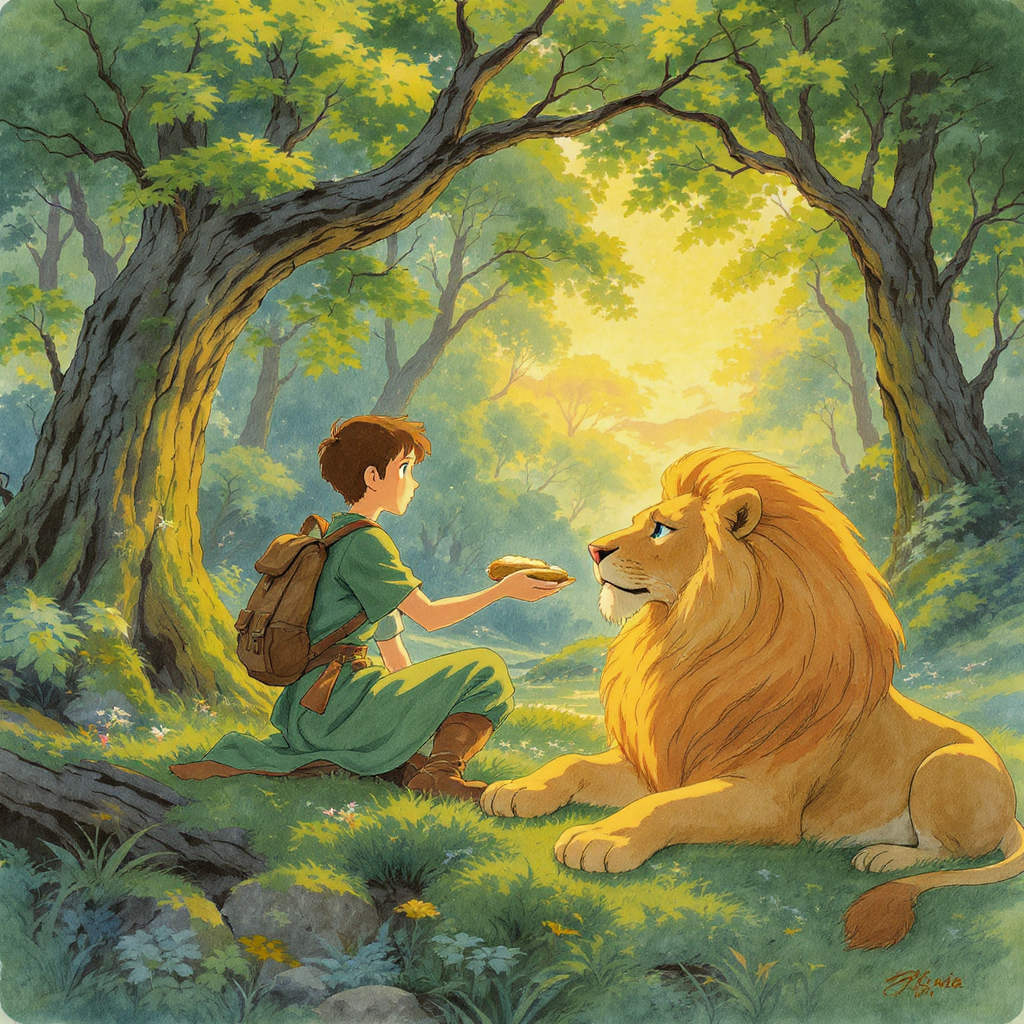
The Mermaid and the Boy Long, long ago, there lived a king who ruled over a country by the sea. When he had been married about a year, some of his subjects, inhabiting a distant group of islands, revolted against his laws, and it became needful for him to leave his wife and go in person to settle their disputes. The queen feared that some ill would come of it, and implored him to stay at home, but he told her that nobody could do his work for him, and the next morning the sails were spread, and the king started on his voyage. The vessel had not gone very far when she ran upon a rock, and stuck so fast in a cleft that the strength of the whole crew could not get her off again. To make matters worse, the wind was rising too, and it was quite plain that in a few hours the ship would be dashed to pieces and everybody would be drowned, when suddenly the form of a mermaid was seen dancing on the waves which threatened every moment to overwhelm them. “There is only one way to free yourselves,” she said to the king, bobbing up and down in the water as she spoke, “and that is to give me your solemn word that you will deliver to me the first child that is born to you.” The king hesitated at this proposal. He hoped that some day he might have children in his home, and the thought that he must yield up the heir to his crown was very bitter to him; but just then a huge wave broke with great force on the ship’s side, and his men fell on their knees and entreated him to save them. So he promised, and this time a wave lifted the vessel clean off the rocks, and she was in the open sea once more. The affairs of the islands took longer to settle than the king had expected, and some months passed away before he returned to his palace. In his absence a son had been born to him, and so great was his joy that he quite forgot the mermaid and the price he had paid for the safety of his ship. But as the years went on, and the baby grew into a fine big boy, the remembrance of it came back, and one day he told the queen the whole story. From that moment the happiness of both their lives was ruined. Every night they went to bed wondering if they should find his room empty in the morning, and every day they kept him by their sides, expecting him to be snatched away before their very eyes. At last the king felt that this state of things could not continue, and he said to his wife: “After all, the most foolish thing in the world one can do is to keep the boy here in exactly the place in which the mermaid will seek him. Let us give him food and send him on his travels, and perhaps, if the mermaid ever blocs come to seek him, she may be content with some other child.” And the queen agreed that his plan seemed the wisest. So the boy was called, and his father told him the story of the voyage, as he had told his mother before him. The prince listened eagerly, and was delighted to think that he was to go away all by himself to see the world, and was not in the least frightened; for though he was now sixteen, he had scarcely been allowed to walk alone beyond the palace gardens. He began busily to make his preparations, and took off his smart velvet coat, putting on instead one of green cloth, while he refused a beautiful bag which the queen offered him to hold his food, and slung a leather knapsack over his shoulders instead, just as he had seen other travellers do. Then he bade farewell to his parents and went his way. All through the day he walked, watching with interest the strange birds and animals that darted across his path in the forest or peeped at him from behind a bush. But as evening drew on he became tired, and looked about as he walked for some place where he could sleep. At length he reached a soft mossy bank under a tree, and was just about to stretch himself out on it, when a fearful roar made him start and tremble all over. In another moment something passed swiftly through the air and a lion stood before him. “What are you doing here?” asked the lion, his eyes glaring fiercely at the boy. “I am flying from the mermaid,” the prince answered, in a quaking voice. “Give me some food then,” said the lion, “it is past my supper time, and I am very hungry.” The boy was so thankful that the lion did not want to eat him, that he gladly picked up his knapsack which lay on the ground, and held out some bread and a flask of wine. “I feel better now,” said the lion when he had done, “so now I shall go to sleep on this nice soft moss, and if you like you can lie down beside me.” So the boy and the lion slept soundly side by side, till the sun rose. “I must be off now,” remarked the lion, shaking the boy as he spoke; “but cut off the tip of my ear, and keep it carefully, and if you are in any danger just wish yourself a lion and you will become one on the spot. One good turn deserves another, you know.” The prince thanked him for his kindness, and did as he was bid, and the two then bade each other farewell. “I wonder how it feels to be a lion,” thought the boy, after he had gone a little way; and he took out the tip of the ear from the breast of his jacket and wished with all his might. In an instant his head had swollen to several times its usual size, and his neck seemed very hot and heavy; and, somehow, his hands became paws, and his skin grew hairy and yellow. But what pleased him most was his long tail with a tuft at the end, which he lashed and switched proudly. “I like being a lion very much,” he said to himself, and trotted gaily along the road. After a while, however, he got tired of walking in this unaccustomed way—it made his back ache and his front paws felt sore. So he wished himself a boy again, and in the twinkling of an eye his tail disappeared and his head shrank, and the long thick mane became short and curly. Then he looked out for a sleeping place, and found some dry ferns, which he gathered and heaped up. But before he had time to close his eyes there was a great noise in the trees near by, as if a big heavy body was crashing through them. The boy rose and turned his head, and saw a huge black bear coming towards him. “What are you doing here?” cried the bear. “I am running away from the mermaid,” answered the boy; but the bear took no interest in the mermaid, and only said: “I am hungry; give me something to eat.” The knapsack was lying on the ground among the fern, but the prince picked it up, and, unfastening the strap, took out his second flask of wine and another loaf of bread. “We will have supper together,” he remarked politely; but the bear, who had never been taught manners, made no reply, and ate as fast as he could. When he had quite finished, he got up and stretched himself. “You have got a comfortable-looking bed there,” he observed. “I really think that, bad sleeper as I am, I might have a good night on it. I can manage to squeeze you in,” he added; “you don’t take up a great deal of room.” The boy was rather indignant at the bear’s cool way of talking; but as he was too tired to gather more fern, they lay down side by side, and never stirred till sunrise next morning. “I must go now,” said the bear, pulling the sleepy prince on to his feet; “but first you shall cut off the tip of my ear, and when you are in any danger just wish yourself a bear and you will become one. One good turn deserves another, you know.” And the boy did as he was bid, and he and the bear bade each other farewell. “I wonder how it feels to be a bear,” thought he to himself when he had walked a little way; and he took out the tip from the breast of his coat and wished hard that he might become a bear. The next moment his body stretched out and thick black fur covered him all over. As before, his hands were changed into paws, but when he tried to switch his tail he found to his disgust that it would not go any distance. “Why it is hardly worth calling a tail!” said he. For the rest of the day he remained a bear and continued his journey, but as evening came on the bear-skin, which had been so useful when plunging through brambles in the forest, felt rather heavy, and he wished himself a boy again. He was too much exhausted to take the trouble of cutting any fern or seeking for moss, but just threw himself down under a tree, when exactly above his head he heard a great buzzing as a bumble-bee alighted on a honeysuckle branch. “What are you doing here?” asked the bee in a cross voice; “at your age you ought to be safe at home.” “I am running away from the mermaid,” replied the boy; but the bee, like the lion and the bear, was one of those people who never listen to the answers to their questions, and only said: “I am hungry. Give me something to eat.” The boy took his last loaf and flask out of his knapsack and laid them on the ground, and they had supper together. “Well, now I am going to sleep,” observed the bee when the last crumb was gone, “but as you are not very big I can make room for you beside me,” and he curled up his wings, and tucked in his legs, and he and the prince both slept soundly till morning. Then the bee got up and carefully brushed every scrap of dust off his velvet coat and buzzed loudly in the boy’s ear to waken him. “Take a single hair from one of my wings,” said he, “and if you are in danger just wish yourself a bee and you will become one. One good turn deserves another, so farewell, and thank you for your supper.” And the bee departed after the boy had pulled out the hair and wrapped it carefully in a leaf. “It must feel quite different to be a bee from what it does to be a lion or bear,” thought the boy to himself when he had walked for an hour or two. “I dare say I should get on a great deal faster,” so he pulled out his hair and wished himself a bee. In a moment the strangest thing happened to him. All his limbs seemed to draw together, and his body to become very short and round; his head grew quite tiny, and instead of his white skin he was covered with the richest, softest velvet. Better than all, he had two lovely gauze wings which carried him the whole day without getting tired. Late in the afternoon the boy fancied he saw a vast heap of stones a long way off, and he flew straight towards it. But when he reached the gates he saw that it was really a great town, so he wished himself back in his own shape and entered the city. He found the palace doors wide open and went boldly into a sort of hall which was full of people, and where men and maids were gossiping together. He joined their talk and soon learned from them that the king had only one daughter who had such a hatred to men that she would never suffer one to enter her presence. Her father was in despair, and had had pictures painted of the handsomest princes of all the courts in the world, in the hope that she might fall in love with one of them; but it was no use; the princess would not even allow the pictures to be brought into her room. “It is late,” remarked one of the women at last; “I must go to my mistress.” And, turning to one of the lackeys, she bade him find a bed for the youth. “It is not necessary,” answered the prince, “this bench is good enough for me. I am used to nothing better.” And when the hall was empty he lay down for a few minutes. But as soon as everything was quiet in the palace he took out the hair and wished himself a bee, and in this shape he flew upstairs, past the guards, and through the keyhole into the princess’s chamber. Then he turned himself into a man again. At this dreadful sight the princess, who was broad awake, began to scream loudly. “A man! a man!” cried she; but when the guards rushed in there was only a bumble-bee buzzing about the room. They looked under the bed, and behind the curtains, and into the cupboards, then came to the conclusion that the princess had had a bad dream, and bowed themselves out. The door had scarcely closed on them than the bee disappeared, and a handsome youth stood in his place. “I knew a man was hidden somewhere,” cried the princess, and screamed more loudly than before. Her shrieks brought back the guards, but though they looked in all kinds of impossible places no man was to be seen, and so they told the princess. “He was here a moment ago—I saw him with my own eyes,” and the guards dared not contradict her, though they shook their heads and whispered to each other that the princess had gone mad on this subject, and saw a man in every table and chair. And they made up their minds that—let her scream as loudly as she might—they would take no notice. Now the princess saw clearly what they were thinking, and that in future her guards would give her no help, and would perhaps, besides, tell some stories about her to the king, who would shut her up in a lonely tower and prevent her walking in the gardens among her birds and flowers. So when, for the third time, she beheld the prince standing before her, she did not scream but sat up in bed gazing at him in silent terror. “Do not be afraid,” he said, “I shall not hurt you”; and he began to praise her gardens, of which he had heard the servants speak, and the birds and flowers which she loved, till the princess’s anger softened, and she answered him with gentle words. Indeed, they soon became so friendly that she vowed she would marry no one else, and confided to him that in three days her father would be off to the wars, leaving his sword in her room. If any man could find it and bring it to him he would receive her hand as a reward. At this point a cock crew, and the youth jumped up hastily saying: “Of course I shall ride with the king to the war, and if I do not return, take your violin every evening to the seashore and play on it, so that the very sea-kobolds who live at the bottom of the ocean may hear it and come to you.” Just as the princess had foretold, in three days the king set out for the war with a large following, and among them was the young prince, who had presented himself at court as a young noble in search of adventures. They had left the city many miles behind them, when the king suddenly discovered that he had forgotten his sword, and though all his attendants instantly offered theirs, he declared that he could fight with none but his own. “The first man who brings it to me from my daughter’s room,” cried he, “shall not only have her to wife, but after my death shall reign in my stead.” At this the Red Knight, the young prince, and several more turned their horses to ride as fast as the wind back to the palace. But suddenly a better plan entered the prince’s head, and, letting the others pass him, he took his precious parcel from his breast and wished himself a lion. Then on he bounded, uttering such dreadful roars that the horses were frightened and grew unmanageable, and he easily outstripped them, and soon reached the gates of the palace. Here he hastily changed himself into a bee, and flew straight into the princess’s room, where he became a man again. She showed him where the sword hung concealed behind a curtain, and he took it down, saying as he did so: “Be sure not to forget what you have promised to do.” The princess made no reply, but smiled sweetly, and slipping a golden ring from her finger she broke it in two and held half out silently to the prince, while the other half she put in her own pocket. He kissed it, and ran down the stairs bearing the sword with him. Some way off he met the Red Knight and the rest, and the Red Knight at first tried to take the sword from him by force. But as the youth proved too strong for him, he gave it up, and resolved to wait for a better opportunity. This soon came, for the day was hot and the prince was thirsty. Perceiving a little stream that ran into the sea, he turned aside, and, unbuckling the sword, flung himself on the ground for a long drink. Unluckily, the mermaid happened at that moment to be floating on the water not very far off, and knew he was the boy who had been given her before he was born. So she floated gently in to where he was lying, she seized him by the arm, and the waves closed over them both. Hardly had they disappeared, when the Red Knight stole cautiously up, and could hardly believe his eyes when he saw the king’s sword on the bank. He wondered what had become of the youth, who an hour before had guarded his treasure so fiercely; but, after all, that was no affair of his! So, fastening the sword to his belt, he carried it to the king. The war was soon over, and the king returned to his people, who welcomed him with shouts of joy. But when the princess from her window saw that her betrothed was not among the attendants riding behind her father, her heart sank, for she knew that some evil must have befallen him, and she feared the Red Knight. She had long ago learned how clever and how wicked he was, and something whispered to her that it was he who would gain the credit of having carried back the sword, and would claim her as his bride, though he had never even entered her chamber. And she could do nothing; for although the king loved her, he never let her stand in the way of his plans. The poor princess was only too right, and everything came to pass exactly as she had foreseen it. The king told her that the Red Knight had won her fairly, and that the wedding would take place next day, and there would be a great feast after it. In those days feasts were much longer and more splendid than they are now; and it was growing dark when the princess, tired out with all she had gone through, stole up to her own room for a little quiet. But the moon was shining so brightly over the sea that it seemed to draw her towards it, and taking her violin under her arm, she crept down to the shore. “Listen! listen! said the mermaid to the prince, who was lying stretched on a bed of seaweeds at the bottom of the sea. “Listen! that is your old love playing, for mermaids know everything that happens upon earth.” “I hear nothing,” answered the youth, who did not look happy. “Take me up higher, where the sounds can reach me.” So the mermaid took him on her shoulders and bore him up midway to the surface. “Can you hear now?” she asked. “No,” answered the prince, “I hear nothing but the water rushing; I must go higher still.” Then the mermaid carried him to the very top. “You must surely be able to hear now?” said she. “Nothing but the water,” repeated the youth. So she took him right to the land. “At any rate you can hear now?” she said again. “The water is still rushing in my ears,” answered he; “but wait a little, that will soon pass off.” And as he spoke he put his hand into his breast, and seizing the hair wished himself a bee, and flew straight into the pocket of the princess. The mermaid looked in vain for him, and coated all night upon the sea; but he never came back, and never more did he gladden her eyes. But the princess felt that something strange was about her, though she knew not what, and returned quickly to the palace, where the young man at once resumed his own shape. Oh, what joy filled her heart at the sight of him! But there was no time to be lost, and she led him right into the hall, where the king and his nobles were still sitting at the feast. “Here is a man who boasts that he can do wonderful tricks,” said she, “better even than the Red Knight’s! That cannot be true, of course, but it might be well to give this impostor a lesson. He pretends, for instance, that he can turn himself into a lion; but that I do not believe. I know that you have studied the art of magic,” she went on, turning to the Red Knight, “so suppose you just show him how it is done, and bring shame upon him.” Now the Red Knight had never opened a book of magic in his life; but he was accustomed to think that he could do everything better than other people without any teaching at all. So he turned and twisted himself about, and bellowed and made faces; but he did not become a lion for all that. “Well, perhaps it is very difficult to change into a lion. Make yourself a bear,” said the princess. But the Red Knight found it no easier to become a bear than a lion. “Try a bee,” suggested she. “I have always read that anyone who can do magic at all can do that.” And the old knight buzzed and hummed, but he remained a man and not a bee. “Now it is your turn,” said the princess to the youth. “Let us see if you can change yourself into a lion.” And in a moment such a fierce creature stood before them, that all the guests rushed out of the hall, treading each other underfoot in their fright. The lion sprang at the Red Knight, and would have torn him in pieces had not the princess held him back, and bidden him to change himself into a man again. And in a second a man took the place of the lion. “Now become a bear,” said she; and a bear advanced panting and stretching out his arms to the Red Knight, who shrank behind the princess. By this time some of the guests had regained their courage, and returned as far as the door, thinking that if it was safe for the princess perhaps it was safe for them. The king, who was braver than they, and felt it needful to set them a good example besides, had never left his seat, and when at a new command of the princess the bear once more turned into a man, he was silent from astonishment, and a suspicion of the truth began to dawn on him. “Was it he who fetched the sword?” asked the king. “Yes, it was,” answered the princess; and she told him the whole story, and how she had broken her gold ring and given him half of it. And the prince took out his half of the ring, and the princess took out hers, and they fitted exactly. Next day the Red Knight was hanged, as he richly deserved, and there was a new marriage feast for the prince and princess. [Lapplandische Mahrchen.]
Moral of the Story
Promises, especially those made under duress, can have far-reaching consequences, but resourcefulness and true love can overcome even the most daunting of fates.
Characters

King ◆ supporting
No specific details given
Attire: Royal attire, including robes, crown, and possibly armor
Duty-bound, easily swayed by immediate pressure, ultimately values his son's life

Mermaid ⚔ antagonist
Classic mermaid form: human upper body, fish tail
Attire: Seaweed adornments, shell jewelry
Persistent, demanding, possessive

Prince ★ protagonist
Grows from a baby to a 'fine big boy'
Attire: Initially velvet coat (replaced with green cloth), leather knapsack
Brave, curious, resourceful

Lion ◆ supporting
Large, powerful lion
Initially threatening, but ultimately kind and helpful

Princess ◆ supporting
No specific details given
Attire: Royal gowns, jewelry
Clever, observant, loyal

Red Knight ⚔ antagonist
No specific details given
Attire: Red knightly armor, sword
Deceitful, arrogant, incompetent
Locations

Shipwreck Rocks
A rocky coastline with a ship stuck fast in a cleft between rocks. Waves are rising, threatening to destroy the ship.
Mood: Perilous, desperate, chaotic
The king makes a deal with the mermaid to save his ship and crew.

Forest Path
A path winding through a forest, with strange birds and animals darting across. A soft, mossy bank under a tree.
Mood: Intriguing, but increasingly lonely and potentially dangerous as evening approaches
The prince encounters the lion and shares his food.

Seabed
A bed of seaweed at the bottom of the sea.
Mood: Eerie, melancholic, watery
The mermaid holds the prince captive, but he longs to hear his love.

Royal Feast Hall
A grand hall with a long table where the king and his nobles are feasting. Lit by torches or candles, filled with guests.
Mood: Festive, tense, expectant
The prince reveals his true identity and exposes the Red Knight's treachery.
Story DNA
Moral
Promises, especially those made under duress, can have far-reaching consequences, but resourcefulness and true love can overcome even the most daunting of fates.
Plot Summary
A king, to save his ship, promises his firstborn to a mermaid. Years later, his son, the prince, is sent away to escape this fate. On his journey, he befriends a lion, bear, and eagle, gaining the power to transform into them. He uses these powers to retrieve a king's sword, winning the love of a princess, but is then captured by the mermaid. The princess, playing her violin, lures the mermaid to the surface, allowing the prince to escape. He returns to expose a treacherous knight and, through a magical display of his animal forms, proves his identity, marries the princess, and lives happily ever after.
Themes
Emotional Arc
fear to liberation, separation to reunion, danger to triumph
Writing Style
Narrative Elements
Cultural Context
The story is presented as a 'Lapplandische Mahrchen,' suggesting a German collection of tales, possibly with influences from Northern European folklore, where mermaids and animal helpers are common motifs.
Plot Beats (15)
- A king's ship is wrecked; a mermaid offers to save it in exchange for his firstborn child.
- The king agrees, is saved, and returns home to find a son has been born, forgetting his promise for years.
- Haunted by the promise, the king and queen send their sixteen-year-old son, the prince, away to escape the mermaid.
- The prince encounters a hungry lion, feeds it, and receives a magical ear-tip to transform into a lion.
- The prince encounters a hungry bear, feeds it, and receives a magical ear-tip to transform into a bear.
- The prince encounters a hungry eagle, feeds it, and receives a magical feather to transform into an eagle.
- The prince arrives at a foreign court, where the king offers his daughter and kingdom to whoever retrieves his forgotten sword.
- The prince, using his animal transformations, retrieves the sword from the princess's room, and they exchange halves of a golden ring as a promise.
- The mermaid seizes the prince as he drinks from a stream, pulling him to the bottom of the sea, while the Red Knight steals the sword.
- The Red Knight claims credit for retrieving the sword and demands the princess's hand in marriage.
- The princess, heartbroken, plays her violin by the sea, which the mermaid uses to taunt the imprisoned prince.
- The prince tricks the mermaid into bringing him to the surface, then transforms into a bee and escapes into the princess's pocket.
- The princess reveals the prince at the wedding feast and challenges the Red Knight to perform animal transformations.
- The Red Knight fails; the prince successfully transforms into a lion, bear, and bee, proving his identity and the Red Knight's deceit.
- The king recognizes the truth, the Red Knight is punished, and the prince and princess marry.


