The Prince and the Three Fates
by Andrew Lang

The Prince Who Beat Fate
A baby prince was born long ago. Three fairies said he would meet three special beasts. They might cause trouble.
King Father was worried. He built a big, safe castle on a tall hill. Prince Leo grew up there. He was happy and strong.
One day, Prince Leo saw a fluffy dog. "I want a dog!" he said. King Father said yes. The dog's name was Buddy. They played each day.
Prince Leo grew up. "I want to see the world," he said. "I will be safe." King Father said yes. Prince Leo and Buddy went on a trip.
They came to a new kingdom. A princess lived there. Her name was Princess Emma. A tall wall was around her home. "Climb the wall to meet me," she said.
Prince Leo was smart. He climbed the wall! He met Princess Emma. They were happy. They got married.
One day, a big snake appeared. "I will cause trouble!" it hissed. Princess Emma was brave. She made a loud noise. The snake got scared and went away.
Later, Mr. Croc came. "Hello!" he said. "Make a sand pit hold water. Then I will go." It was a hard puzzle.
Prince Leo was sad. "I cannot do it," he said.
"I have an idea!" said Princess Emma. "I know a magic plant. It can help."
Princess Emma went on a long walk. She climbed a high hill. She found the green, four-leaf plant. She brought it back.
Prince Leo dug a pit in the sand. He filled it with water. Princess Emma put the plant in the water. The water stayed! Mr. Croc smiled. "Good job!" he said. He went away.
Prince Leo was happy. He stood by the river. Buddy was chasing a duck. "Woof! Woof!" barked Buddy.
Buddy ran fast. He bumped into Prince Leo. Prince Leo fell into the water with a splash! The water was shallow.
"Oh no!" cried Princess Emma. She used her rope. She pulled Prince Leo out. Buddy swam to them. All were safe.
Prince Leo hugged Princess Emma. "You are so strong," he said. "With love and help, we can beat any problem!"
Teamwork makes them strong. Prince Leo, Princess Emma, and Buddy smiled as one. And they were happy always.
Original Story
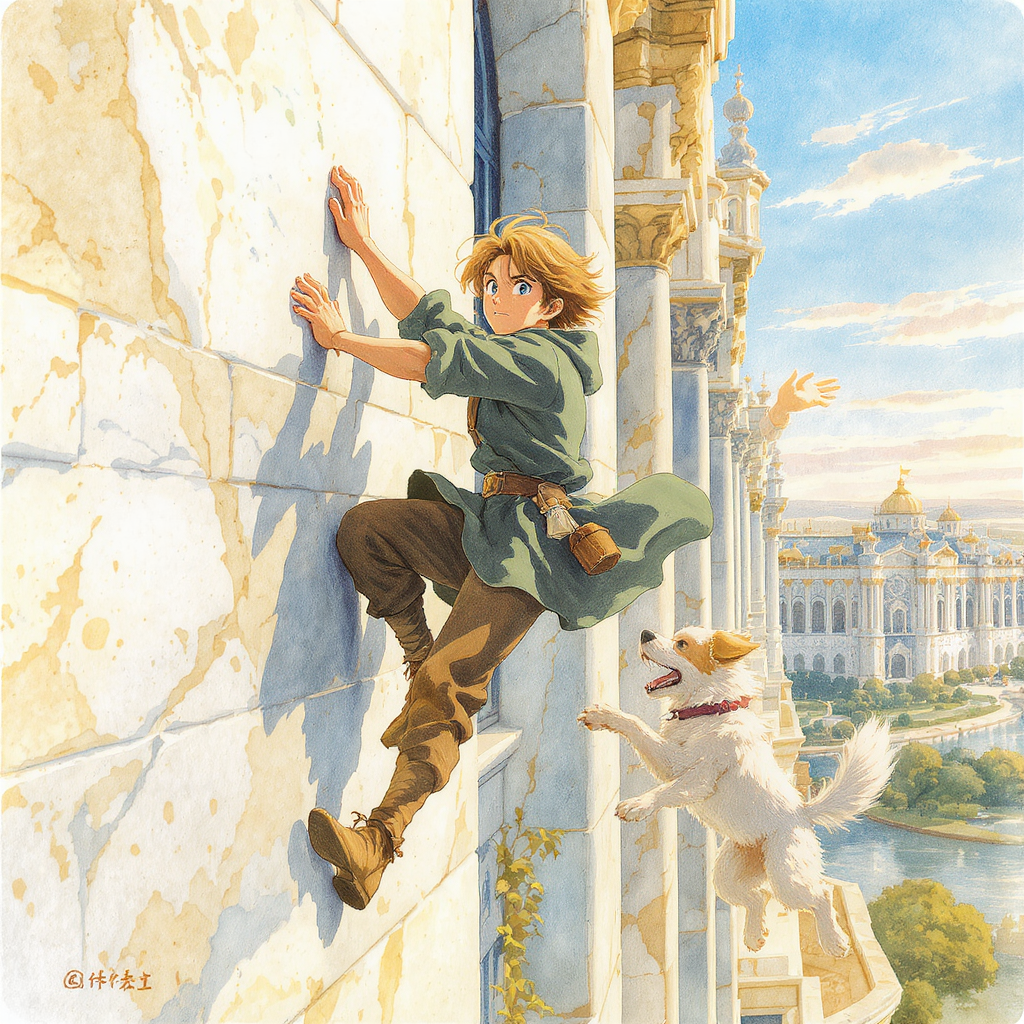
The Prince and the Three Fates Once upon a time a little boy was born to a king who ruled over a great country through which ran a wide river. The king was nearly beside himself with joy, for he had always longed for a son to inherit his crown, and he sent messages to beg all the most powerful fairies to come and see this wonderful baby. In an hour or two, so many were gathered round the cradle, that the child seemed in danger of being smothered; but the king, who was watching the fairies eagerly, was disturbed to see them looking grave. “Is there anything the matter?” he asked anxiously. The fairies looked at him, and all shook their heads at once. “He is a beautiful boy, and it is a great pity; but what IS to happen WILL happen,” said they. “It is written in the books of fate that he must die, either by a crocodile, or a serpent, or by a dog. If we could save him we would; but that is beyond our power.” And so saying they vanished. For a time the king stood where he was, horror-stricken at what he had heard; but, being of a hopeful nature, he began at once to invent plans to save the prince from the dreadful doom that awaited him. He instantly sent for his master builder, and bade him construct a strong castle on the top of a mountain, which should be fitted with the most precious things from the king’s own palace, and every kind of toy a child could wish to play with. And, besides, he gave the strictest orders that a guard should walk round the castle night and day. For four or five years the baby lived in the castle alone with his nurses, taking his airings on the broad terraces, which were surrounded by walls, with a moat beneath them, and only a drawbridge to connect them with the outer world. One day, when the prince was old enough to run quite fast by himself, he looked from the terrace across the moat, and saw a little soft fluffy ball of a dog jumping and playing on the other side. Now, of course, all dogs had been kept from him for fear that the fairies’ prophecy should come true, and he had never even beheld one before. So he turned to the page who was walking behind him, and said: “What is that funny little thing which is running so fast over there?” “That is a dog, prince,” answered the page. “Well, bring me one like it, and we will see which can run the faster.” And he watched the dog till it had disappeared round the corner. The page was much puzzled to know what to do. He had strict orders to refuse the prince nothing; yet he remembered the prophecy, and felt that this was a serious matter. At last he thought he had better tell the king the whole story, and let him decide the question. “Oh, get him a dog if he wants one,” said the king, “he will only cry his heart out if he does not have it.” So a puppy was found, exactly like the other; they might have been twins, and perhaps they were. Years went by, and the boy and the dog played together till the boy grew tall and strong. The time came at last when he sent a message to his father, saying: “Why do you keep me shut up here, doing nothing? I know all about the prophecy that was made at my birth, but I would far rather be killed at once than live an idle, useless life here. So give me arms, and let me go, I pray you; me and my dog too.” And again the king listened to his wishes, and he and his dog were carried in a ship to the other side of the river, which was so broad here it might almost have been the sea. A black horse was waiting for him, tied to a tree, and he mounted and rode away wherever his fancy took him, the dog always at his heels. Never was any prince so happy as he, and he rode and rode till at length he came to a king’s palace. The king who lived in it did not care about looking after his country, and seeing that his people lived cheerful and contented lives. He spent his whole time in making riddles, and inventing plans which he had much better have let alone. At the period when the young prince reached the kingdom he had just completed a wonderful house for his only child, a daughter. It had seventy windows, each seventy feet from the ground, and he had sent the royal herald round the borders of the neighbouring kingdoms to proclaim that whoever could climb up the walls to the window of the princess should win her for his wife. The fame of the princess’s beauty had spread far and wide, and there was no lack of princes who wished to try their fortune. Very funny the palace must have looked each morning, with the dabs of different colour on the white marble as the princes were climbing up the walls. But though some managed to get further than others, nobody was anywhere near the top. They had already been spending several days in this manner when the young prince arrived, and as he was pleasant to look upon, and civil to talk to, they welcomed him to the house, which had been given to them, and saw that his bath was properly perfumed after his long journey. “Where do you come from?” they said at last. “And whose son are you?” But the young prince had reasons for keeping his own secret, and he answered: “My father was master of the horse to the king of my country, and after my mother died he married another wife. At first all went well, but as soon as she had babies of her own she hated me, and I fled, lest she should do me harm.” The hearts of the other young men were touched as soon as they heard this story, and they did everything they could think of to make him forget his past sorrows. “What are you doing here?” said the youth, one day. “We spend our whole time climbing up the walls of the palace, trying to reach the windows of the princess,” answered the young men; “but, as yet, no one has reached within ten feet of them.” “Oh, let me try too,” cried the prince; “but to-morrow I will wait and see what you do before I begin. So the next day he stood where he could watch the young men go up, and he noted the places on the wall that seemed most difficult, and made up his mind that when his turn came he would go up some other way. Day after day he was to be seen watching the wooers, till, one morning, he felt that he knew the plan of the walls by heart, and took his place by the side of the others. Thanks to what he had learned from the failure of the rest, he managed to grasp one little rough projection after another, till at last, to the envy of his friends, he stood on the sill of the princess’s window. Looking up from below, they saw a white hand stretched forth to draw him in. Then one of the young men ran straight to the king’s palace, and said: “The wall has been climbed, and the prize is won!” “By whom?” cried the king, starting up from his throne; “which of the princes may I claim as my son-in-law?” “The youth who succeeded in climbing to the princess’s window is not a prince at all,” answered the young man. “He is the son of the master of the horse to the great king who dwells across the river, and he fled from his own country to escape from the hatred of his stepmother.” At this news the king was very angry, for it had never entered his head that anyone BUT a prince would seek to woo his daughter. “Let him go back to the land whence he came,” he shouted in wrath; “does he expect me to give my daughter to an exile?” And he began to smash the drinking vessels in his fury; indeed, he quite frightened the young man, who ran hastily home to his friends, and told the youth what the king had said. Now the princess, who was leaning from her window, heard his words and bade the messenger go back to the king her father and tell him that she had sworn a vow never to eat or drink again if the youth was taken from her. The king was more angry than ever when he received this message, and ordered his guards to go at once to the palace and put the successful wooer to death; but the princess threw herself between him and his murderers. “Lay a finger on him, and I shall be dead before sunset,” said she; and as they saw that she meant it, they left the palace, and carried the tale to her father. By this time the king’s anger was dying away, and he began to consider what his people would think of him if he broke the promise he had publicly given. So he ordered the princess to be brought before him, and the young man also, and when they entered the throne room he was so pleased with the noble air of the victor that his wrath quite melted away, and he ran to him and embraced him. “Tell me who you are?” he asked, when he had recovered himself a little, “for I will never believe that you have not royal blood in your veins.” But the prince still had his reasons for being silent, and only told the same story. However, the king had taken such a fancy to the youth that he said no more, and the marriage took place the following day, and great herds of cattle and a large estate were given to the young couple. After a little while the prince said to his wife: “My life is in the hands of three creatures—a crocodile, a serpent, and a dog.” “Ah, how rash you are!” cried the princess, throwing her arms round his neck. “If you know that, how can you have that horrid beast about you? I will give orders to have him killed at once.” But the prince would not listen to her. “Kill my dear little dog, who had been my playfellow since he was a puppy?” exclaimed he. “Oh, never would I allow that.” And all that the princess could get from him was that he would always wear a sword, and have somebody with him when he left the palace. When the prince and princess had been married a few months, the prince heard that his stepmother was dead, and his father was old and ill, and longing to have his eldest son by his side again. The young man could not remain deaf to such a message, and he took a tender farewell of his wife, and set out on his journey home. It was a long way, and he was forced to rest often on the road, and so it happened that, one night, when he was sleeping in a city on the banks of the great river, a huge crocodile came silently up and made its way along a passage to the prince’s room. Fortunately one of his guards woke up as it was trying to steal past them, and shut the crocodile up in a large hall, where a giant watched over it, never leaving the spot except during the night, when the crocodile slept. And this went on for more than a month. Now, when the prince found that he was not likely to leave his father’s kingdom again, he sent for his wife, and bade the messenger tell her that he would await her coming in the town on the banks of the great river. This was the reason why he delayed his journey so long, and narrowly escaped being eaten by the crocodile. During the weeks that followed the prince amused himself as best he could, though he counted the minutes to the arrival of the princess, and when she did come, he at once prepared to start for the court. That very night, however, while he was asleep, the princess noticed something strange in one of the corners of the room. It was a dark patch, and seemed, as she looked, to grow longer and longer, and to be moving slowly towards the cushions on which the prince was lying. She shrank in terror, but, slight as was the noise, the thing heard it, and raised its head to listen. Then she saw it was the long flat head of a serpent, and the recollection of the prophecy rushed into her mind. Without waking her husband, she glided out of bed, and taking up a heavy bowl of milk which stood on a table, laid it on the floor in the path of the serpent—for she knew that no serpent in the world can resist milk. She held her breath as the snake drew near, and watched it throw up its head again as if it was smelling something nice, while its forky tongue darted out greedily. At length its eyes fell upon the milk, and in an instant it was lapping it so fast that it was a wonder the creature did not choke, for it never took its head from the bowl as long as a drop was left in it. After that it dropped on the ground and slept heavily. This was what the princess had been waiting for, and catching up her husband’s sword, she severed the snake’s head from its body. The morning after this adventure the prince and princess set out for the king’s palace, but found when they reached it, that he was already dead. They gave him a magnificent burial, and then the prince had to examine the new laws which had been made in his absence, and do a great deal of business besides, till he grew quite ill from fatigue, and was obliged to go away to one of his palaces on the banks of the river, in order to rest. Here he soon got better, and began to hunt, and to shoot wild duck with his bow; and wherever he went, his dog, now grown very old, went with him. One morning the prince and his dog were out as usual, and in chasing their game they drew near the bank of the river. The prince was running at full speed after his dog when he almost fell over something that looked like a log of wood, which was lying in his path. To his surprise a voice spoke to him, and he saw that the thing which he had taken for a branch was really a crocodile. “You cannot escape from me,” it was saying, when he had gathered his senses again. “I am your fate, and wherever you go, and whatever you do, you will always find me before you. There is only one means of shaking off my power. If you can dig a pit in the dry sand which will remain full of water, my spell will be broken. If not death will come to you speedily. I give you this one chance. Now go.” The young man walked sadly away, and when he reached the palace he shut himself into his room, and for the rest of the day refused to see anyone, not even his wife. At sunset, however, as no sound could be heard through the door, the princess grew quite frightened, and made such a noise that the prince was forced to draw back the bolt and let her come in. “How pale you look,” she cried, “has anything hurt you? Tell me, I pray you, what is the matter, for perhaps I can help!” So the prince told her the whole story, and of the impossible task given him by the crocodile. “How can a sand hole remain full of water?” asked he. “Of course, it will all run through. The crocodile called it a ‘chance’; but he might as well have dragged me into the river at once. He said truly that I cannot escape him.” “Oh, if that is all,” cried the princess, “I can set you free myself, for my fairy godmother taught me to know the use of plants and in the desert not far from here there grows a little four-leaved herb which will keep the water in the pit for a whole year. I will go in search of it at dawn, and you can begin to dig the hole as soon as you like. To comfort her husband, the princess had spoken lightly and gaily; but she knew very well she had no light task before her. Still, she was full of courage and energy, and determined that, one way or another, her husband should be saved. It was still starlight when she left the palace on a snow-white donkey, and rode away from the river straight to the west. For some time she could see nothing before her but a flat waste of sand, which became hotter and hotter as the sun rose higher and higher. Then a dreadful thirst seized her and the donkey, but there was no stream to quench it, and if there had been she would hardly have had time to stop, for she still had far to go, and must be back before evening, or else the crocodile might declare that the prince had not fulfilled his conditions. So she spoke cheering words to her donkey, who brayed in reply, and the two pushed steadily on. Oh! how glad they both were when they caught sight of a tall rock in the distance. They forgot that they were thirsty, and that the sun was hot; and the ground seemed to fly under their feet, till the donkey stopped of its own accord in the cool shadow. But though the donkey might rest the princess could not, for the plant, as she knew, grew on the very top of the rock, and a wide chasm ran round the foot of it. Luckily she had brought a rope with her, and making a noose at one end, she flung it across with all her might. The first time it slid back slowly into the ditch, and she had to draw it up, and throw it again, but at length the noose caught on something, the princess could not see what, and had to trust her whole weight to this little bridge, which might snap and let her fall deep down among the rocks. And in that case her death was as certain as that of the prince. But nothing so dreadful happened. The princess got safely to the other side, and then became the worst part of her task. As fast as she put her foot on a ledge of the rock the stone broke away from under her, and left her in the same place as before. Meanwhile the hours were passing, and it was nearly noon. The heart of the poor princess was filled with despair, but she would not give up the struggle. She looked round till she saw a small stone above her which seemed rather stronger than the rest, and by only poising her foot lightly on those that lay between, she managed by a great effort to reach it. In this way, with torn and bleeding hands, she gained the top; but here such a violent wind was blowing that she was almost blinded with dust, and was obliged to throw herself on the ground, and feel about after the precious herb. For a few terrible moments she thought that the rock was bare, and that her journey had been to no purpose. Feel where she would, there was nothing but grit and stones, when, suddenly, her fingers touched something soft in a crevice. It was a plant, that was clear; but was it the right one? See she could not, for the wind was blowing more fiercely than ever, so she lay where she was and counted the leaves. One, two, three—yes! yes! there were four! And plucking a leaf she held it safe in her hand while she turned, almost stunned by the wind, to go down the rock. When once she was safely over the side all became still in a moment, and she slid down the rock so fast that it was only a wonder that she did not land in the chasm. However, by good luck, she stopped quite close to her rope bridge and was soon across it. The donkey brayed joyfully at the sight of her, and set off home at his best speed, never seeming to know that the earth under his feet was nearly as hot as the sun above him. On the bank of the great river he halted, and the princess rushed up to where the prince was standing by the pit he had digged in the dry sand, with a huge water pot beside it. A little way off the crocodile lay blinking in the sun, with his sharp teeth and whity-yellow jaws wide open. At a signal from the princess the prince poured the water in the hole, and the moment it reached the brim the princess flung in the four-leaved plant. Would the charm work, or would the water trickle away slowly through the sand, and the prince fall a victim to that horrible monster? For half an hour they stood with their eyes rooted to the spot, but the hole remained as full as at the beginning, with the little green leaf floating on the top. Then the prince turned with a shout of triumph, and the crocodile sulkily plunged into the river. The prince had escape for ever the second of his three fates! He stood there looking after the crocodile, and rejoicing that he was free, when he was startled by a wild duck which flew past them, seeking shelter among the rushes that bordered the edge of the stream. In another instant his dog dashed by in hot pursuit, and knocked heavily against his master’s legs. The prince staggered, lost his balance and fell backwards into the river, where the mud and the rushes caught him and held him fast. He shrieked for help to his wife, who came running; and luckily brought her rope with her. The poor old dog was drowned, but the prince was pulled to shore. “My wife,” he said, “has been stronger than my fate.” [Adapted from Les Contes Populaires de l’Egypte Ancienne.]
Moral of the Story
Even the most dire prophecies can be overcome through courage, ingenuity, and the unwavering support of loved ones.
Characters

The Prince ★ protagonist
Handsome, grows tall and strong
Attire: Fine clothes as a child, later arms and armor, princely attire
Curious, brave, determined

The King ◆ supporting
Not described, but assumed to be regal
Attire: Royal robes, crown, scepter
Anxious, loving, ultimately yielding

The Princess ◆ supporting
Beautiful, resourceful
Attire: Royal gowns, practical attire for her desert journey
Courageous, intelligent, devoted

The Dog ◆ supporting
Small, soft, fluffy
Loyal, playful

The Three Fates ⚔ antagonist
Not described, but implied to be ethereal and powerful
Attire: Robes of fate
Stern, unyielding, prophetic

The Crocodile ⚔ antagonist
Large, with sharp teeth and whity-yellow jaws
Treacherous, demanding
Locations

Castle on a Mountain
A strong castle on the top of a mountain, fitted with precious things and toys. Broad terraces surrounded by walls with a moat beneath them, connected to the outer world by a drawbridge.
Mood: safe, isolated, luxurious
The prince spends his early childhood here, protected from the prophecy.

King's Palace (Riddle Palace)
A palace with seventy windows, each seventy feet from the ground. White marble walls.
Mood: competitive, challenging, whimsical
The prince attempts to win the princess by climbing the palace walls.

Desert Rock
A tall rock in a flat waste of sand. A wide chasm runs around the foot of it. The plant grows on the very top of the rock.
Mood: desolate, dangerous, desperate
The princess retrieves the herb to save the prince from the crocodile.

Riverbank Sand Pit
The bank of a great river, with a pit dug in the dry sand. Rushes border the edge of the stream.
Mood: tense, hopeful, dangerous
The prince fills the pit with water and the princess throws in the herb, tricking the crocodile.
Story DNA
Moral
Even the most dire prophecies can be overcome through courage, ingenuity, and the unwavering support of loved ones.
Plot Summary
A newborn prince is cursed by fairies to die by a crocodile, a serpent, or a dog. His father isolates him, but the prince eventually leaves, wins a princess, and together they face the prophesied dangers. The princess bravely defeats a giant serpent and then undertakes a perilous quest to find a magical herb, saving the prince from an impossible task set by a crocodile. Finally, the prince's old dog accidentally causes him to fall into a river, fulfilling the last prophecy, but the princess rescues him, proving that their love and ingenuity can overcome even fate.
Themes
Emotional Arc
fear to triumph
Writing Style
Narrative Elements
Cultural Context
This story is an adaptation from 'Les Contes Populaires de l’Egypte Ancienne,' suggesting ancient Egyptian roots for the core narrative elements, particularly the concept of inescapable fate and the specific threats (crocodile, serpent).
Plot Beats (15)
- A king's newborn son is prophesied by fairies to die by a crocodile, a serpent, or a dog.
- The king builds a secluded mountain castle to protect his son from the prophecy.
- The young prince sees a dog and insists on having one, which the king allows.
- As a young man, the prince, tired of isolation, convinces his father to let him leave with his dog.
- The prince travels to another kingdom and, using his wits, climbs an impossible wall to win a princess.
- The princess's father, initially angry that the suitor is not a prince, is convinced by his daughter to accept the marriage.
- The prince and princess encounter a giant serpent, one of the prophesied fates, which the princess bravely kills.
- The prince and princess return to his kingdom, where he becomes king after his father's death.
- The crocodile, the second prophesied fate, confronts the prince and gives him an impossible task: to make a sand pit hold water.
- The prince is despairing, but the princess reveals her knowledge of a magical four-leaved herb that can make the pit hold water.
- The princess embarks on a perilous journey across the desert and up a treacherous rock to find the herb.
- The princess successfully retrieves the herb and returns to the prince, who then fulfills the crocodile's task, causing the crocodile to retreat.
- The prince's old dog, chasing a wild duck, accidentally knocks the prince into the river, fulfilling the final prophecy.
- The princess, using her rope, rescues the prince from the river, while the dog drowns.
- The prince declares his wife stronger than his fate, having overcome all three prophecies through her help.


