The Sacred Milk of Koumongoe
by Andrew Lang

Thakane and the Magic Tree
Once upon a time, a girl lived. Her name was Thakane. She lived in a hot land. She had a brother named Koane.
One morning, Koane was thirsty. "Thakane," he said. "I want milk." He pointed to a tree. "The magic tree," he said. The tree was called Koumo. Its milk was sweet.
"Oh, Koane," said Thakane. "Father said no."
"The cattle need grass," said Koane. "I will not take them out."
Thakane wanted to help. She took a small bowl. She tapped the tree gently. Milk flowed into the bowl.
"Here is your milk," she said.
"It is not enough," said Koane. "Get more."
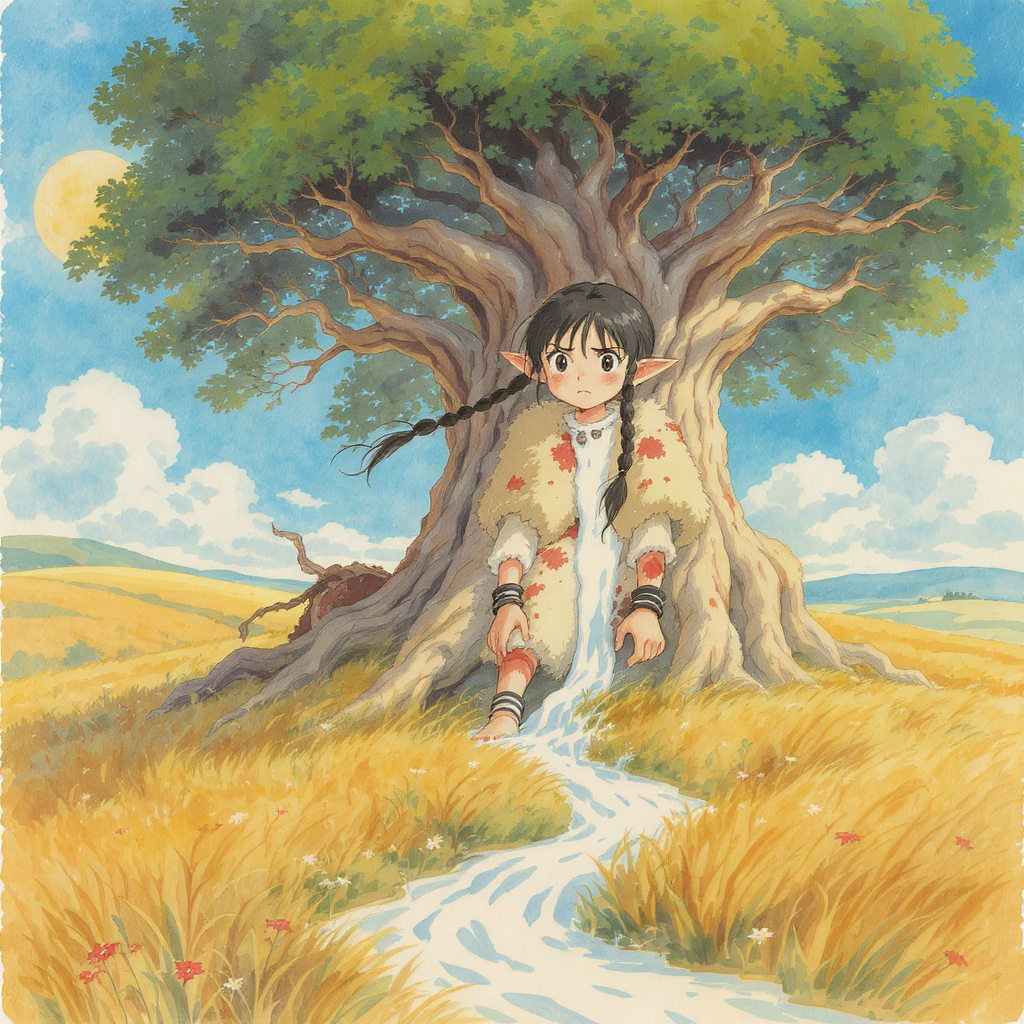
Thakane tapped the tree again. Milk poured out fast. It filled the hut.
"Help me!" cried Thakane. "The milk is too much!"
Koane tried to help. But the milk flowed outside. It went down the hill.
Father and Mother saw the milk. "What happened?" they asked. They hurried home.
"Koane wanted milk," said Thakane. "I tapped the tree."
Father was upset. "You touched our tree," he said. "We must go on a trip. You will learn a lesson."
Father put warm skins on Thakane. They walked down the road. Thakane felt sad. The sun was hot.
A rabbit saw them. "Why are you sad?" it asked Thakane.
Thakane sang a song. "I gave milk to Koane. I helped the cattle. I was kind."
"You are kind," said the rabbit.
They walked more. They met some elands. "Why are you sad?" they asked.
Thakane sang her song again. "I gave milk to Koane. I helped the cattle. I was kind."
"You are kind," said the elands.
They walked on. They met a boy. His name was Masilo. "Why are you here?" he asked.
"I am learning a lesson," said Thakane.
Masilo was kind. "Stay with us," he said. Father left calmly.
Thakane and Masilo became friends. They had a baby girl. Her name was Dilah.
In their land, babies went to the lake woman for safety. But Thakane loved Dilah. She wanted to keep her.
She took Dilah to the lake. A kind Lake Woman lived there. "Keep her safe," said Thakane.
"I will," said the Lake Woman.
Thakane visited Dilah often. Dilah grew big and strong.
One day, a friend saw Thakane at the lake. He told Masilo.
Masilo was happy. He followed Thakane to the lake. He saw Dilah.
"Our daughter!" he said. "She is safe!"
"Please bring her home," Masilo asked Thakane. "I will keep her safe."
Thakane asked the Lake Woman. "Can Dilah come home?"
"Yes," said the Lake Woman. "Give me some cattle for her."
Masilo brought many cattle. Thakane sang her song. "Bring me Dilah, my kind daughter."
Dilah came from the water. She smiled. The cattle went to the Lake Woman's magic home.
Thakane, Masilo, and Dilah were together. They smiled. The lake sparkled. All was well.
Being kind and brave helps all. Love keeps family safe.
Original Story
The Sacred Milk of Koumongoé Far way, in a very hot country, there once lived a man and woman who had two children, a son named Koane and a daughter called Thakane. Early in the morning and late in the evenings the parents worked hard in the fields, resting, when the sun was high, under the shade of some tree. While they were absent the little girl kept house alone, for her brother always got up before the dawn, when the air was fresh and cool, and drove out the cattle to the sweetest patches of grass he could find. One day, when Koane had slept later than usual, his father and mother went to their work before him, and there was only Thakane to be seen busy making the bread for supper. “Thakane,” he said, “I am thirsty. Give me a drink from the tree Koumongoé, which has the best milk in the world.” “Oh, Koane,” cried his sister, “you know that we are forbidden to touch that tree. What would father say when he came home? For he would be sure to know.” “Nonsense,” replied Koane, “there is so much milk in Koumongoé that he will never miss a little. If you won’t give it to me, I sha’n’t take the cattle out. They will just have to stay all day in the hut, and you know that they will starve.” And he turned from her in a rage, and sat down in the corner. After a while Thakane said to him: “It is getting hot, had you better drive out the cattle now?” But Koane only answered sulkily: “I told you I am not going to drive them out at all. If I have to do without milk, they shall do without grass.” Thakane did not know what to do. She was afraid to disobey her parents, who would most likely beat her, yet the beasts would be sure to suffer if they were kept in, and she would perhaps be beaten for that too. So at last she took an axe and a tiny earthen bowl, she cut a very small hole in the side of Koumongoé, and out gushed enough milk to fill the bowl. “Here is the milk you wanted,” said she, going up to Koane, who was still sulking in his corner. “What is the use of that?” grumbled Koane; “why, there is not enough to drown a fly. Go and get me three times as much!” Trembling with fright, Thakane returned to the tree, and struck it a sharp blow with the axe. In an instant there poured forth such a stream of milk that it ran like a river into the hut. “Koane! Koane!” cried she, “come and help me to plug up the hole. There will be no milk left for our father and mother.” But Koane could not stop it any more than Thakane, and soon the milk was flowing through the hut downhill towards their parents in the fields below. The man saw a white stream a long way off, and guessed what had happened. “Wife, wife,” he called loudly to the woman, who was working at a little distance: “Do you see Koumongoé running fast down the hill? That is some mischief of the children’s, I am sure. I must go home and find out what is the matter.” And they both threw down their hoes and hurried to the side of Koumongoé. Kneeling on the grass, the man and his wife made a cup of their hands and drank the milk from it. And no sooner had they done this, than Koumongoé flowed back again up the hill, and entered the hut. “Thakane,” said the parents, severely, when they reached home panting from the heat of the sun, “what have you been doing? Why did Koumongoé come to us in the fields instead of staying in the garden?” “It was Koane’s fault,” answered Thakane. “He would not take the cattle to feed until he drank some of the milk from Koumongoé. So, as I did not know what else to do, I gave it to him.” The father listened to Thakane’s words, but made no answer. Instead, he went outside and brought in two sheepskins, which he stained red and sent for a blacksmith to forge some iron rings. The rings were then passed over Thakane’s arms and legs and neck, and the skins fastened on her before and behind. When all was ready, the man sent for his servants and said: “I am going to get rid of Thakane.” “Get rid of your only daughter?” they answered, in surprise. “But why?” “Because she has eaten what she ought not to have eaten. She has touched the sacred tree which belongs to her mother and me alone.” And, turning his back, he called to Thakane to follow him, and they went down the road which led to the dwelling of an ogre. They were passing along some fields where the corn was ripening, when a rabbit suddenly sprang out at their feet, and standing on its hind legs, it sang: Why do you give to the ogre Your child, so fair, so fair? “You had better ask her,” replied the man, “she is old enough to give you an answer.” Then, in her turn, Thakane sang: I gave Koumongoé to Koane, Koumongoé to the keeper of beasts; For without Koumongoé they could not go to the meadows: Without Koumongoé they would starve in the hut; That was why I gave him the Koumongoé of my father. And when the rabbit heard that, he cried: “Wretched man! it is you whom the ogre should eat, and not your beautiful daughter.” But the father paid no heed to what the rabbit said, and only walked on the faster, bidding Thakane to keep close behind him. By-and-by they met with a troop of great deer, called elands, and they stopped when they saw Thakane and sang: Why do you give to the ogre Your child, so fair, so fair? “You had better ask her, replied the man, “she is old enough to give you an answer.” Then, in her turn, Thakane sang: I gave Koumongoé to Koane, Koumongoé to the keeper of beasts; For without Koumongoé they could not go to the meadows: Without Koumongoé they would starve in the hut; That was why I gave him the Koumongoé of my father. And the elands all cried: “Wretched man! it is you whom the ogre should eat, and not your beautiful daughter.” By this time it was nearly dark, and the father said they could travel no further that night, and must go to sleep where they were. Thakane was thankful indeed when she heard this, for she was very tired, and found the two skins fastened round her almost too heavy to carry. So, in spite of her dread of the ogre, she slept till dawn, when her father woke her, and told her roughly that he was ready to continue their journey. Crossing the plain, the girl and her father passed a herd of gazelles feeding. They lifted their heads, wondering who was out so early, and when they caught sight of Thakane, they sang: Why do you give to the ogre Your child, so fair, so fair? “You had better ask her, replied the man, “she is old enough to answer for herself.” Then, in her turn, Thakane sang: I gave Koumongoé to Koane, Koumongoé to the keeper of beasts; For without Koumongoé they could not go to the meadows: Without Koumongoé they would starve in the hut; That was why I gave him the Koumongoé of my father. And the gazelles all cried: “Wretched man! it is you whom the ogre should eat, and not your beautiful daughter.” At last they arrived at the village where the ogre lived, and they went straight to his hut. He was nowhere to be seen, but in his place was his son Masilo, who was not an ogre at all, but a very polite young man. He ordered his servants to bring a pile of skins for Thakane to sit on, but told her father he must sit on the ground. Then, catching sight of the girl’s face, which she had kept down, he was struck by its beauty, and put the same question that the rabbit, and the elands, and the gazelles had done. Thakane answered him as before, and he instantly commanded that she should be taken to the hut of his mother, and placed under her care, while the man should be led to his father. Directly the ogre saw him he bade the servant throw him into the great pot which always stood ready on the fire, and in five minutes he was done to a turn. After that the servant returned to Masilo and related all that had happened. Now Masilo had fallen in loved with Thakane the moment he saw her. At first he did not know what to make of this strange feeling, for all his life he had hated women, and had refused several brides whom his parents had chosen for him. However, they were so anxious that he should marry, that they willingly accepted Thakane as their daughter-in-law, though she did bring any marriage portion with her. After some time a baby was born to her, and Thakane thought it was the most beautiful baby that ever was seen. But when her mother-in-law saw it was a girl, she wrung her hands and wept, saying: “O miserable mother! Miserable child! Alas for you! why were you not a boy!” Thakane, in great surprise, asked the meaning of her distress; and the old woman told her that it was the custom in that country that all the girls who were born should be given to the ogre to eat. Then Thakane clasped the baby tightly in her arms, and cried: “But it is not the customer in MY country! There, when children die, they are buried in the earth. No one shall take my baby from me.” That night, when everyone in the hut was asleep, Thakane rose, and carrying her baby on her back, went down to a place where the river spread itself out into a large lake, with tall willows all round the bank. Here, hidden from everyone, she sat down on a stone and began to think what she should do to save her child. Suddenly she heard a rustling among the willows, and an old woman appeared before her. “What are you crying for, my dear?” said she. And Thakane answered: “I was crying for my baby—I cannot hide her for ever, and if the ogre sees her, he will eat her; and I would rather she was drowned than that.” “What you say is true,” replied the old woman. “Give me your child, and let me take care of it. And if you will fix a day to meet me here I will bring the baby.” Then Thakane dried her eyes, and gladly accepted the old woman’s offer. When she got home she told her husband she had thrown it in the river, and as he had watched her go in that direction he never thought of doubting what she said. On the appointed day, Thakane slipped out when everybody was busy, and ran down the path that led to the lake. As soon as she got there, she crouched down among the willows, and sang softly: Bring to me Dilah, Dilah the rejected one, Dilah, whom her father Masilo cast out! And in a moment the old woman appeared holding the baby in her arms. Dilah had become so big and strong, that Thakane’s heart was filled with joy and gratitude, and she stayed as long as she dared, playing with her baby. At last she felt she must return to the village, lest she should be missed, and the child was handed back to the old woman, who vanished with her into the lake. Children grow up very quickly when they live under water, and in less time than anyone could suppose, Dilah had changed from a baby to a woman. Her mother came to visit her whenever she was able, and one day, when they were sitting talking together, they were spied out by a man who had come to cut willows to weave into baskets. He was so surprised to see how like the face of the girl was to Masilo, that he left his work and returned to the village. “Masilo,” he said, as he entered the hut, “I have just beheld your wife near the river with a girl who must be your daughter, she is so like you. We have been deceived, for we all thought she was dead.” When he heard this, Masilo tried to look shocked because his wife had broken the law; but in his heart he was very glad. “But what shall we do now?” asked he. “Make sure for yourself that I am speaking the truth by hiding among the bushes the first time Thakane says she is going to bathe in the river, and waiting till the girl appears.” For some days Thakane stayed quietly at home, and her husband began to think that the man had been mistaken; but at last she said to her husband: “I am going to bathe in the river.” “Well, you can go,” answered he. But he ran down quickly by another path, and got there first, and hid himself in the bushes. An instant later, Thakane arrived, and standing on the bank, she sang: Bring to me Dilah, Dilah the rejected one, Dilah, whom her father Masilo cast out! Then the old woman came out of the water, holding the girl, now tall and slender, by the hand. And as Masilo looked, he saw that she was indeed his daughter, and he wept for joy that she was not lying dead in the bottom of the lake. The old woman, however, seemed uneasy, and said to Thakane: “I feel as if someone was watching us. I will not leave the girl to-day, but will take her back with me”; and sinking beneath the surface, she drew the girl after her. After they had gone, Thakane returned to the village, which Masilo had managed to reach before her. All the rest of the day he sat in a corner weeping, and his mother who came in asked: “Why are you weeping so bitterly, my son?” “My head aches,” he answered; “it aches very badly.” And his mother passed on, and left him alone. In the evening he said to his wife: “I have seen my daughter, in the place where you told me you had drowned her. Instead, she lives at the bottom of the lake, and has now grown into a young woman.” “I don’t know what you are talking about,” replied Thakane. “I buried my child under the sand on the beach.” Then Masilo implored her to give the child back to him; but she would not listen, and only answered: “If I were to give her back you would only obey the laws of your country and take her to your father, the ogre, and she would be eaten.” But Masilo promised that he would never let his father see her, and that now she was a woman no one would try to hurt her; so Thakane’s heart melted, and she went down to the lake to consult the old woman. “What am I to do?” she asked, when, after clapping her hands, the old woman appeared before her. “Yesterday Masilo beheld Dilah, and ever since he has entreated me to give him back his daughter.” “If I let her go he must pay me a thousand head of cattle in exchange,” replied the old woman. And Thakane carried her answer back to Masilo. “Why, I would gladly give her two thousand!” cried he, “for she has saved my daughter.” And he bade messengers hasten to all the neighbouring villages, and tell his people to send him at once all the cattle he possessed. When they were all assembled he chose a thousand of the finest bulls and cows, and drove them down to the river, followed by a great crowd wondering what would happen. Then Thakane stepped forward in front of the cattle and sang: Bring to me Dilah, Dilah the rejected one, Dilah, whom her father Masilo cast out! And Dilah came from the waters holding out her hands to Masilo and Thakane, and in her place the cattle sank into the lake, and were driven by the old woman to the great city filled with people, which lies at the bottom. [Contes Populaires des Bassoutos.]
Moral of the Story
Disobeying unjust laws or traditions, especially out of compassion, can lead to unexpected and positive outcomes, and true parental love transcends societal norms.
Characters

Koane ⚔ antagonist
Not described, presumed typical for the setting
Attire: Simple clothing appropriate for a cattle herder in a hot climate
Selfish, demanding

Thakane ★ protagonist
Described as fair and beautiful
Attire: Simple clothing appropriate for a young girl in a hot climate, later red sheepskins and iron rings
Obedient, compassionate

Father (Masilo) ◆ supporting
Not described, presumed typical for the setting
Attire: Simple clothing appropriate for a farmer in a hot climate
Stern, regretful

Mother ◆ supporting
Not described, presumed typical for the setting
Attire: Simple clothing appropriate for a farmer in a hot climate
Stern

Rabbit ◆ supporting
Ordinary rabbit
Attire: Not applicable
Wise, judgmental

Elands ◆ supporting
Great deer
Attire: Not applicable
Wise, judgmental

Old Woman ◆ supporting
Not described, presumed typical for an old woman
Attire: Not described, presumed simple
Helpful, magical

Dilah ◆ supporting
Tall and slender
Attire: Not described
Not described
Locations

Fields under the hot sun
Fields where the parents work, with shade trees for resting when the sun is high.
Mood: hardworking, exposed
The parents first see the stream of milk and realize something is wrong.

The Hut
A simple dwelling where the children stay while their parents work.
Mood: domestic, vulnerable
Thakane disobeys her parents and cuts the Koumongoé tree, flooding the hut with milk.

Koumongoé Tree
A sacred tree with magical milk.
Mood: forbidden, magical
Koane demands milk from it, leading to Thakane's transgression.

Lake with Willows
A large lake fed by a river, surrounded by tall willows.
Mood: secretive, magical, protective
Thakane meets the old woman and hides her baby, later reuniting with her daughter Dilah.
Story DNA
Moral
Disobeying unjust laws or traditions, especially out of compassion, can lead to unexpected and positive outcomes, and true parental love transcends societal norms.
Plot Summary
Thakane, out of compassion for her brother's cattle, taps the forbidden sacred tree, Koumongoé, causing it to overflow. Her enraged father, believing she has desecrated the tree, attempts to sacrifice her to an ogre. Along the way, animals question his injustice, and Thakane is ultimately saved by the ogre's kind son, Masilo, whom she marries. When their daughter, Dilah, is born, Thakane discovers a tradition of sacrificing female babies and hides Dilah with a magical old woman in a lake. Years later, Masilo discovers Dilah, and after much pleading, Thakane, with the old woman's help, negotiates Dilah's return in exchange for a thousand cattle, which are then magically absorbed into the lake.
Themes
Emotional Arc
suffering to triumph
Writing Style
Narrative Elements
Cultural Context
The story is presented as a 'Contes Populaires des Bassoutos,' indicating its origin as a folk tale from the Basotho people. The concept of ogres and specific cultural practices like cattle as wealth, and the tragic fate of female infants, reflect elements found in various African folklore traditions.
Plot Beats (13)
- Koane demands milk from the forbidden sacred tree, Koumongoé, threatening to let the cattle starve.
- Thakane, out of fear for the cattle, taps Koumongoé, which then gushes uncontrollably, revealing her disobedience to her parents.
- The parents discover the overflowing milk and, upon returning home, the father decides to punish Thakane for touching the sacred tree.
- The father dresses Thakane in sheepskins and iron rings and leads her to an ogre's dwelling for sacrifice.
- Along the way, various animals question the father's actions, and Thakane explains her compassionate reasons for touching Koumongoé through song.
- At the ogre's village, the ogre's son, Masilo, takes a liking to Thakane and has his father eat her father instead.
- Thakane marries Masilo, but later gives birth to a daughter, Dilah, and learns of the custom to feed female babies to the ogre.
- Thakane hides Dilah with a magical old woman who lives in a lake, visiting her secretly over the years.
- A villager discovers Thakane visiting a grown Dilah, and reports it to Masilo.
- Masilo, pretending to be angry but secretly glad, follows Thakane to the lake and sees Dilah, confirming the villager's story.
- Masilo implores Thakane to bring Dilah back, promising to protect her from the ogre.
- Thakane consults the old woman, who agrees to release Dilah in exchange for a thousand cattle.
- Masilo gathers the cattle, and at the lake, Thakane sings for Dilah, who emerges, while the cattle sink into the lake, joining the old woman's underwater city.


