The Sister of the Sun
by Andrew Lang

The Boy and the Golden Feather
A boy and a prince played in a field. They used bows and arrows. A golden feather stuck in an arrow. Both said, "Mine!" They went to the King.
The King loved his son. He smiled at the Prince. "The feather is for you," he said. The Boy was not happy. "It is mine!" he said. The King became angry. His face turned red. "Find the golden hen," he said. "If you do not find it, you must leave for good."
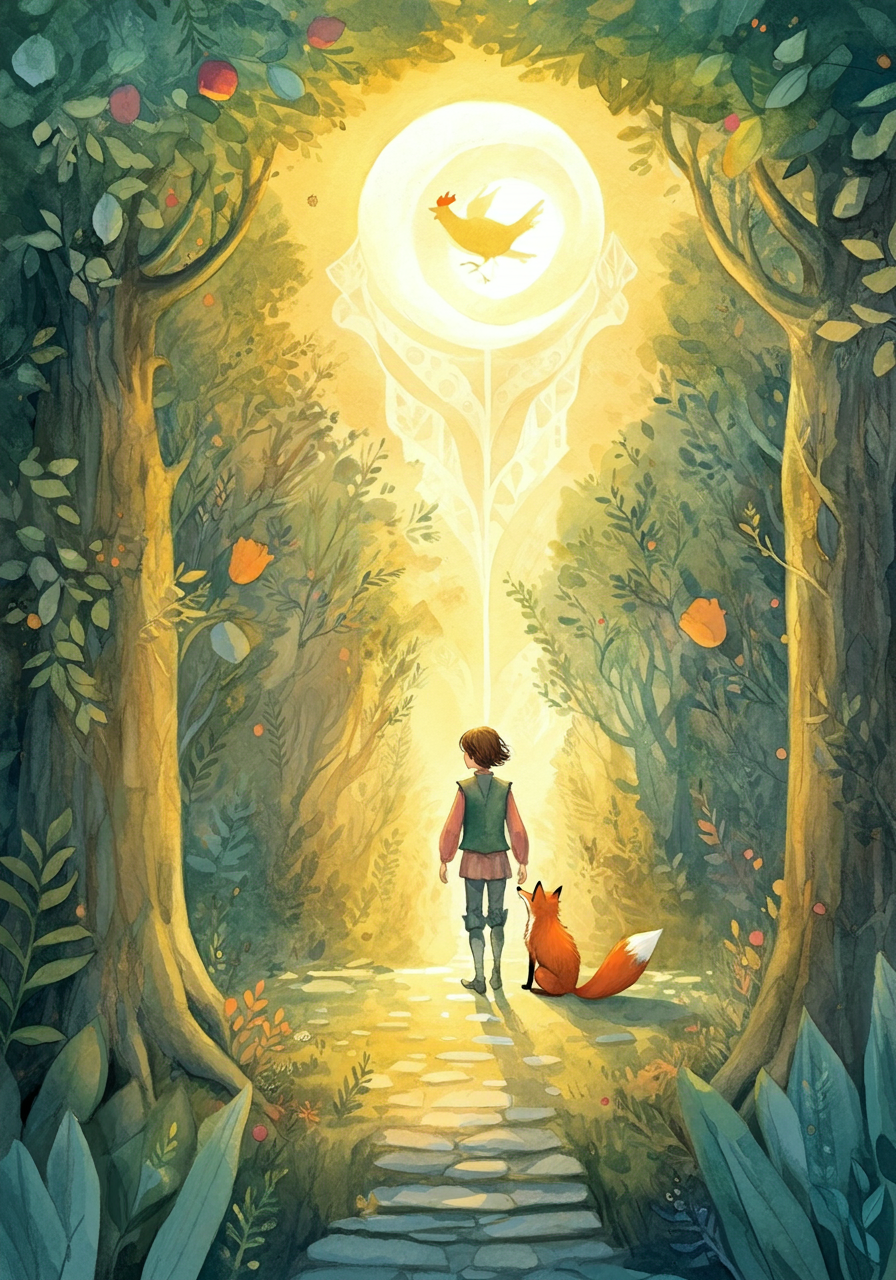
The Boy was very sad. He walked and walked. He met a Fox. The Fox was friendly. "Where are you going?" asked the Fox. "I must find the golden hen," said the Boy. "I can help," said the Fox. "The Sun Sister has three golden hens. We will go to her castle."
They walked as friends. They came to the Sun Sister's castle. "I will go in," said the Boy. "Be safe," said the Fox. "Only take the hen with the missing feather."
The Boy saw three hens. One hen had a missing feather. He caught the hen. He held it tight. He saw pretty things inside the castle. He looked and looked. The hen flew away. He lost the hen.
The Sun Sister saw him. She was kind. "Help me," she said. "A big creature has my sister. Save her, and you can have the hen." The Boy said, "I will help."
The Fox helped the Boy. They tricked the big creature. They saved the sister. But the Boy was not safe. He lost the sister again. He missed the ship. He was alone.
The Boy was very sad. He met an Old Woman. She was kind. "Take this letter to my sister," she said. "If you are tired, rustle the paper." The Boy took the letter.
He walked and walked. He was very tired. He rustled the paper. He felt better. The Old Woman knew the Sun Sister.
"The Sun Sister is sad," said the Old Woman. "Go to her castle. Stick a pin in her hand. Suck the blood. She will wake up." The Boy said, "Thank you."
He walked on. He saw two men fighting. They fought over a magic cloth. "Let me see it," said the Boy. He put the cloth on. He vanished! He took the cloth.
He saw two more men. They fought over a magic blanket. "Let me see it," said the Boy. He took the blanket. He was hidden.
He saw two more men. They fought over a magic stick. "This stick helps and wakes up people," they said. "Let me see it," said the Boy. He took the stick.
He saw two more men. They fought over magic shoes. "These shoes take you any place," they said. "Let me see them," said the Boy. He put on the shoes. "Take me to the Sun Sister's castle!" he said.
He was at the castle. The Sun Sister was very sad. He stuck a pin in her hand. He sucked the blood. She woke up. She was happy to see him.
"Your father had trouble," she said. "His soldiers are very tired." The Boy took his magic stick. He touched the tired soldiers. They woke up. All were happy.
The Sun Sister smiled. "You learned to think first," she said. "Thinking before acting helps us succeed." The Boy and the Sun Sister got married. They were very happy.
Original Story
The Sister of the Sun A long time ago there lived a young prince whose favourite playfellow was the son of the gardener who lived in the grounds of the palace. The king would have preferred his choosing a friend from the pages who were brought up at court; but the prince would have nothing to say to them, and as he was a spoilt child, and allowed his way in all things, and the gardener’s boy was quiet and well-behaved, he was suffered to be in the palace, morning, noon, and night. The game the children loved the best was a match at archery, for the king had given them two bows exactly alike, and they would spend whole days in trying to see which could shoot the highest. This is always very dangerous, and it was a great wonder they did not put their eyes out; but somehow or other they managed to escape. One morning, when the prince had done his lessons, he ran out to call his friend, and they both hurried off to the lawn which was their usual playground. They took their bows out of the little hut where their toys were kept, and began to see which could shoot the highest. At last they happened to let fly their arrows both together, and when they fell to earth again the tail feather of a golden hen was found sticking in one. Now the question began to arise whose was the lucky arrow, for they were both alike, and look as closely as you would you could see no difference between them. The prince declared that the arrow was his, and the gardener’s boy was quite sure it was HIS—and on this occasion he was perfectly right; but, as they could not decide the matter, they went straight to the king. When the king had heard the story, he decided that the feather belonged to his son; but the other boy would not listen to this and claimed the feather for himself. At length the king’s patience gave way, and he said angrily: “Very well; if you are so sure that the feather is yours, yours it shall be; only you will have to seek till you find a golden hen with a feather missing from her tail. And if you fail to find her your head will be the forfeit.” The boy had need of all his courage to listen silently to the king’s words. He had no idea where the golden hen might be, or even, if he discovered that, how he was to get to her. But there was nothing for it but to do the king’s bidding, and he felt that the sooner he left the palace the better. So he went home and put some food into a bag, and then set forth, hoping that some accident might show him which path to take. After walking for several hours he met a fox, who seemed inclined to be friendly, and the boy was so glad to have anyone to talk to that he sat down and entered into conversation. “Where are you going?” asked the fox. “I have got to find a golden hen who has lost a feather out of her tail,” answered the boy; “but I don’t know where she lives or how I shall catch her!” “Oh, I can show you the way!” said the fox, who was really very good-natured. “Far towards the east, in that direction, lives a beautiful maiden who is called ‘The Sister of the Sun.’ She has three golden hens in her house. Perhaps the feather belongs to one of them.” The boy was delighted at this news, and they walked on all day together, the fox in front, and the boy behind. When evening came they lay down to sleep, and put the knapsack under their heads for a pillow. Suddenly, about midnight, the fox gave a low whine, and drew nearer to his bedfellow. “Cousin,” he whispered very low, “there is someone coming who will take the knapsack away from me. Look over there!” And the boy, peeping through the bushes, saw a man. “Oh, I don’t think he will rob us!” said the boy; and when the man drew near, he told them his story, which so much interested the stranger that he asked leave to travel with them, as he might be of some use. So when the sun rose they set out again, the fox in front as before, the man and boy following. After some hours they reached the castle of the Sister of the Sun, who kept the golden hens among her treasures. They halted before the gate and took counsel as to which of them should go in and see the lady herself. “I think it would be best for me to enter and steal the hens,” said the fox; but this did not please the boy at all. “No, it is my business, so it is right that I should go,” answered he. “You will find it a very difficult matter to get hold of the hens,” replied the fox. “Oh, nothing is likely to happen to me,” returned the boy. “Well, go then,” said the fox, “but be careful not to make any mistake. Steal only the hen which has the feather missing from her tail, and leave the others alone.” The man listened, but did not interfere, and the boy entered the court of the palace. He soon spied the three hens strutting proudly about, though they were really anxiously wondering if there were not some grains lying on the ground that they might be glad to eat. And as the last one passed by him, he saw she had one feather missing from her tail. At this sight the youth darted forward and seized the hen by the neck so that she could not struggle. Then, tucking her comfortably under his arm, he made straight for the gate. Unluckily, just as he was about to go through it he looked back and caught a glimpse of wonderful splendours from an open door of the palace. “After all, there is no hurry,” he said to himself; “I may as well see something now I AM here,” and turned back, forgetting all about the hen, which escaped from under his arm, and ran to join her sisters. He was so much fascinated by the sight of all the beautiful things which peeped through the door that he scarcely noticed that he had lost the prize he had won; and he did not remember there was such a thing as a hen in the world when he beheld the Sister of the Sun sleeping on a bed before him. For some time he stood staring; then he came to himself with a start, and feeling that he had no business there, softly stole away, and was fortunate enough to recapture the hen, which he took with him to the gate. On the threshold he stopped again. “Why should I not look at the Sister of the Sun?” he thought to himself; “she is asleep, and will never know.” And he turned back for the second time and entered the chamber, while the hen wriggled herself free as before. When he had gazed his fill he went out into the courtyard and picked up his hen who was seeking for corn. As he drew near the gate he paused. “Why did I not give her a kiss?” he said to himself; “I shall never kiss any woman so beautiful.” And he wrung his hands with regret, so that the hen fell to the ground and ran away. “But I can do it still!” he cried with delight, and he rushed back to the chamber and kissed the sleeping maiden on the forehead. But, alas! when he came out again he found that the hen had grown so shy that she would not let him come near her. And, worse than that, her sisters began to cluck so loud that the Sister of the Sun was awakened by the noise. She jumped up in haste from her bed, and going to the door she said to the boy: “You shall never, never, have my hen till you bring me back my sister who was carried off by a giant to his castle, which is a long way off.” Slowly and sadly the youth left the palace and told his story to his friends, who were waiting outside the gate, how he had actually held the hen three times in his arms and had lost her. “I knew that we should not get off so easily,” said the fox, shaking his head; “but there is no more time to waste. Let us set off at once in search of the sister. Luckily, I know the way.” They walked on for many days, till at length the fox, who, as usual, was going first, stopped suddenly. “The giant’s castle is not far now,” he said, “but when we reach it you two must remain outside while I go and fetch the princess. Directly I bring her out you must both catch hold of her tight, and get away as fast as you can; while I return to the castle and talk to the giants—for there are many of them—so that they may not notice the escape of the princess.” A few minutes later they arrived at the castle, and the fox, who had often been there before, slipped in without difficulty. There were several giants, both young and old, in the hall, and they were all dancing round the princess. As soon as they saw the fox they cried out: “Come and dance too, old fox; it is a long time since we have seen you.” So the fox stood up, and did his steps with the best of them; but after a while he stopped and said: “I know a charming new dance that I should like to show you; but it can only be done by two people. If the princess will honour me for a few minutes, you will soon see how it is done.” “Ah, that is delightful; we want something new,” answered they, and placed the princess between the outstretched arms of the fox. In one instant he had knocked over the great stand of lights that lighted the hall, and in the darkness had borne the princess to the gate. His comrades seized hold of her, as they had been bidden, and the fox was back again in the hall before anyone had missed him. He found the giants busy trying to kindle a fire and get some light; but after a bit someone cried out: “Where is the princess?” “Here, in my arms,” replied the fox. “Don’t be afraid; she is quite safe.” And he waited until he thought that his comrades had gained a good start, and put at least five or six mountains between themselves and the giants. Then he sprang through the door, calling, as he went: “The maiden is here; take her if you can!” At these words the giants understood that their prize had escaped, and they ran after the fox as fast as their great legs could carry them, thinking that they should soon come up with the fox, who they supposed had the princess on his back. The fox, on his side, was far too clever to choose the same path that his friends had taken, but would in and out of the forest, till at last even HE was tired out, and fell fast asleep under a tree. Indeed, he was so exhausted with his day’s work that he never heard the approach of the giants, and their hands were already stretched out to seize his tail when his eyes opened, and with a tremendous bound he was once more beyond their reach. All the rest of the night the fox ran and ran; but when bright red spread over the east, he stopped and waited till the giants were close upon him. Then he turned, and said quietly: “Look, there is the Sister of the Sun!” The giants raised their eyes all at once, and were instantly turned into pillars of stone. The fox then made each pillar a low bow, and set off to join his friends. He knew a great many short cuts across the hills, so it was not long before he came up with them, and all four travelled night and day till they reached the castle of the Sister of the Sun. What joy and feasting there was throughout the palace at the sight of the princess whom they had mourned as dead! and they could not make enough of the boy who had gone through such dangers in order to rescue her. The golden hen was given to him at once, and, more than that, the Sister of the Sun told him that, in a little time, when he was a few years older, she would herself pay a visit to his home and become his wife. The boy could hardly believe his ears when he heard what was in store for him, for his was the most beautiful princess in all the world; and however thick the darkness might be, it fled away at once from the light of a star on her forehead. So the boy set forth on his journey home, with his friends for company; his heart full of gladness when he thought of the promise of the princess. But, one by one, his comrades dropped off at the places where they had first met him, and he was quite alone when he reached his native town and the gates of the palace. With the golden hen under his arm he presented himself before the king, and told his adventures, and how he was going to have for a wife a princess so wonderful and unlike all other princesses, that the star on her forehead could turn night into day. The king listened silently, and when the boy had done, he said quietly: “If I find that your story is not true I will have you thrown into a cask of pitch.” “It is true—every word of it,” answered the boy; and went on to tell that the day and even the hour were fixed when his bride was to come and seek him. But as the time drew near, and nothing was heard of the princess, the youth became anxious and uneasy, especially when it came to his ears that the great cask was being filled with pitch, and that sticks were laid underneath to make a fire to boil it with. All day long the boy stood at the window, looking over the sea by which the princess must travel; but there were no signs of her, not even the tiniest white sail. And, as he stood, soldiers came and laid hands on him, and led him up to the cask, where a big fire was blazing, and the horrid black pitch boiling and bubbling over the sides. He looked and shuddered, but there was no escape; so he shut his eyes to avoid seeing. The word was given for him to mount the steps which led to the top of the cask, when, suddenly, some men were seen running with all their might, crying as they went that a large ship with its sails spread was making straight for the city. No one knew what the ship was, or whence it came; but the king declared that he would not have the boy burned before its arrival, there would always be time enough for that. At length the vessel was safe in port, and a whisper went through the watching crowd that on board was the Sister of the Sun, who had come to marry the young peasant as she had promised. In a few moments more she had landed, and desired to be shown the way to the cottage which her bridegroom had so often described to her; and whither he had been led back by the king’s order at the first sign of the ship. “Don’t you know me?” asked the Sister of the Sun, bending over him where he lay, almost driven out of his senses with terror. “No, no; I don’t know you,” answered the youth, without raising his eyes. “Kiss me,” said the Sister of the Sun; and the youth obeyed her, but still without looking up. “Don’t you know me NOW?” asked she. “No, I don’t know you—I don’t know you,” he replied, with the manner of a man whom fear had driven mad. At this the Sister of the Sun grew rather frightened, and beginning at the beginning, she told him the story of his meeting with her, and how she had come a long way in order to marry him. And just as she had finished in walked the king, to see if what the boy had said was really true. But hardly had he opened the door of the cottage when he was almost blinded by the light that filled it; and he remembered what he had been told about the star on the forehead of the princess. He staggered back as if he had been struck, then a curious feeling took hold of him, which he had never felt before, and falling on his knees before the Sister of the Sun, he implored her to give up all thought of the peasant boy, and to share his throne. But she laughed, and said she had a finer throne of her own, if she wanted to sit on it, and that she was free to please herself, and would have no husband but the boy whom she would never have seen except for the king himself. “I shall marry him to-morrow,” ended she; and ordered the preparations to be set on foot at once. When the next day came, however, the bridegroom’s father informed the princess that, by the law of the land, the marriage must take place in the presence of the king; but he hoped his majesty would not long delay his arrival. An hour or two passed, and everyone was waiting and watching, when at last the sound of trumpets was heard and a grand procession was seen marching up the street. A chair covered with velvet had been made ready for the king, and he took his seat upon it, and, looking round upon the assembled company, he said: “I have no wish to forbid this marriage; but, before I can allow it to be celebrated, the bridegroom must prove himself worthy of such a bride by fulfilling three tasks. And the first is that in a single day he must cut down every tree in an entire forest. The youth stood aghast as the king’s words. He had never cut down a tree in his life, and had not the least idea how to begin. And as for a whole forest—! But the princess saw what was passing in his mind, and whispered to him: “Don’t be afraid. In my ship you will find an axe, which you must carry off to the forest. When you have cut down one tree with it just say: ‘So let the forest fall,’ and in an instant all the trees will be on the ground. But pick up three chips of the tree you felled, and put them in your pocket.” And the young man did exactly as he was bid, and soon returned with the three chips safe in his coat. The following morning the princess declared that she had been thinking about the matter, and that, as she was not a subject of the king, she saw no reason why she should be bound by his laws; and she meant to be married that very day. But the bridegroom’s father told her that it was all very well for her to talk like that, but it was quite different for his son, who would pay with his head for any disobedience to the king’s commands. However, in consideration of what the youth had done the day before, he hoped his majesty’s heart might be softened, especially as he had sent a message that they might expect him at once. With this the bridal pair had to be content, and be as patient as they could till the king’s arrival. He did not keep them long, but they saw by his face that nothing good awaited them. “The marriage cannot take place,” he said shortly, “till the youth has joined to their roots all the trees he cut down yesterday.” This sounded much more difficult than what he had done before, and he turned in despair to the Sister of the Sun. “It is all right,” she whispered encouragingly. “Take this water and sprinkle it on one of the fallen trees, and say to it: ‘So let all the trees of the forest stand upright,’ and in a moment they will be erect again.” And the young man did what he was told, and left the forest looking exactly as it had done before. Now, surely, thought the princess, there was no longer any need to put off the wedding; and she gave orders that all should be ready for the following day. But again the old man interfered, and declared that without the king’s permission no marriage could take place. For the third time his majesty was sent for, and for the third time he proclaimed that he could not give his consent until the bridegroom should have slain a serpent which dwelt in a broad river that flowed at the back of the castle. Everyone knew stories of this terrible serpent, though no one had actually seen it; but from time to time a child strayed from home and never came back, and then mothers would forbid the other children to go near the river, which had juicy fruits and lovely flowers growing along its banks. So no wonder the youth trembled and turned pale when he heard what lay before him. “You will succeed in this also,” whispered the Sister of the Sun, pressing his hand, “for in my ship is a magic sword which will cut through everything. Go down to the river and unfasten a boat which lies moored there, and throw the chips into the water. When the serpent rears up its body you will cut off its three heads with one blow of your sword. Then take the tip of each tongue and go with it to-morrow morning into the king’s kitchen. If the king himself should enter, just say to him: ‘Here are three gifts I offer you in return for the services you demanded of me!’ and throw the tips of the serpent’s tongues at him, and hasten to the ship as fast as your legs will carry you. But be sure you take great care never to look behind you.” The young man did exactly what the princess had told him. The three chips which he flung into the river became a boat, and, as he steered across the stream, the serpent put up its head and hissed loudly. The youth had his sword ready, and in another second the three heads were bobbing on the water. Guiding his boat till he was beside them, he stooped down and snipped off the ends of the tongues, and then rowed back to the other bank. Next morning he carried them into the royal kitchen, and when the king entered, as was his custom, to see what he was going to have for dinner, the bridegroom flung them in his face, saying: “Here is a gift for you in return for the services you asked of me.” And, opening the kitchen door, he fled to the ship. Unluckily he missed the way, and in his excitement ran backwards and forwards, without knowing whither he was going. At last, in despair, he looked round, and saw to his amazement that both the city and palace had vanished completely. Then he turned his eyes in the other direction, and, far, far away, he caught sight of the ship with her sails spread, and a fair wind behind her. This dreadful spectacle seemed to take away his senses, and all day long he wandered about, without knowing where he was going, till, in the evening, he noticed some smoke from a little hut of turf near by. He went straight up to it and cried: “O mother, let me come in for pity’s sake!” The old woman who lived in the hut beckoned to him to enter, and hardly was he inside when he cried again: “O mother, can you tell me anything of the Sister of the Sun?” But the woman only shook her head. “No, I know nothing of her,” said she. The young man turned to leave the hut, but the old woman stopped him, and, giving him a letter, begged him to carry it to her next eldest sister, saying: “If you should get tired on the way, take out the letter and rustle the paper.” This advice surprised the young man a good deal, as he did not see how it could help him; but he did not answer, and went down the road without knowing where he was going. At length he grew so tired he could walk no more; then he remembered what the old woman had said. After he had rustled the leaves only once all fatigue disappeared, and he strode over the grass till he came to another little turf hut. “Let me in, I pray you, dear mother,” cried he. And the door opened in front of him. “Your sister has sent you this letter,” he said, and added quickly: “O mother! can you tell me anything of the Sister of the Sun?” “No, I know nothing of her,” answered she. But as he turned hopelessly away, she stopped him. “If you happen to pass my eldest sister’s house, will you give her this letter?” said she. “And if you should get tired on the road, just take it out of your pocket and rustle the paper.” So the young man put the letter in his pocket, and walked all day over the hills till he reached a little turf hut, exactly like the other two. “Let me in, I pray you, dear mother,” cried he. And as he entered he added: “Here is a letter from your sister and—can you tell me anything of the Sister of the Sun?” “Yes, I can,” answered the old woman. “She lives in the castle on the Banka. Her father lost a battle only a few days ago because you had stolen his sword from him, and the Sister of the Sun herself is almost dead of grief. But, when you see her, stick a pin into the palm of her hand, and suck the drops of blood that flow. Then she will grow calmer, and will know you again. Only, beware; for before you reach the castle on the Banka fearful things will happen.” He thanked the old woman with tears of gladness for the good news she had given him, and continued his journey. But he had not gone very far when, at a turn of the road, he met with two brothers, who were quarrelling over a piece of cloth. “My good men, what are you fighting about?” said he. “That cloth does not look worth much!” “Oh, it is ragged enough,” answered they, “but it was left us by our father, and if any man wraps it round him no one can see him; and we each want it for our own.” “Let me put it round me for a moment,” said the youth, “and then I will tell you whose it ought to be!” The brothers were pleased with this idea, and gave him the stuff; but the moment he had thrown it over his shoulder he disappeared as completely as if he had never been there at all. Meanwhile the young man walked briskly along, till he came up with two other men, who were disputing over a table-cloth. “What is the matter?” asked he, stopping in front of them. “If this cloth is spread on a table,” answered they, “the table is instantly covered with the most delicious food; and we each want to have it.” “Let me try the table-cloth,” said the youth, “and I will tell you whose it ought to be.” The two men were quite pleased with this idea, and handed him the cloth. He then hastily threw the first piece of stuff round his shoulders and vanished from sight, leaving the two men grieving over their own folly. The young man had not walked far before he saw two more men standing by the road-side, both grasping the same stout staff, and sometimes one seemed on the point of getting it, and sometimes the other. “What are you quarrelling about? You could cut a dozen sticks from the wood each just as good as that!” said the young man. And as he spoke the fighters both stopped and looked at him. “Ah! you may think so,” said one, “but a blow from one end of this stick will kill a man, while a touch from the other end will bring him back to life. You won’t easily find another stick like that!” “No; that is true,” answered the young man. “Let me just look at it, and I will tell you whose it ought to be.” The men were pleased with the idea, and handed him the staff. “It is very curious, certainly,” said he; “but which end is it that restores people to life? After all, anyone can be killed by a blow from a stick if it is only hard enough!” But when he was shown the end he threw the stuff over his shoulders and vanished. At last he saw another set of men, who were struggling for the possession of a pair of shoes. “Why can’t you leave that pair of old shoes alone?” said he. “Why, you could not walk a yard in them!” “Yes, they are old enough,” answered they; “but whoever puts them on and wishes himself at a particular place, gets there without going.” “That sounds very clever,” said the youth. “Let me try them, and then I shall be able to tell you whose they ought to be.” The idea pleased the men, and they handed him the shoes; but the moment they were on his feet he cried: “I wish to be in the castle on the Banka!” And before he knew it, he was there, and found the Sister of the Sun dying of grief. He knelt down by her side, and pulling a pin he stuck it into the palm of her hand, so that a drop of blood gushed out. This he sucked, as he had been told to do by the old woman, and immediately the princess came to herself, and flung her arms round his neck. Then she told him all her story, and what had happened since the ship had sailed away without him. “But the worst misfortune of all,” she added, “was a battle which my father lost because you had vanished with his magic sword; and out of his whole army hardly one man was left.” “Show me the battle-field,” said he. And she took him to a wild heath, where the dead were lying as they fell, waiting for burial. One by one he touched them with the end of his staff, till at length they all stood before him. Throughout the kingdom there was nothing but joy; and THIS time the wedding was REALLY celebrated. And the bridal pair lived happily in the castle on the Banka till they died. [Lapplandische Mahrchen.]
Moral of the Story
Impulsivity can lead to significant setbacks, but perseverance, combined with wisdom and magical assistance, can overcome even the most daunting challenges.
Characters

Prince ○ minor
Not described
Attire: Royal attire, tunics, possibly velvet or silk
Spoiled, demanding

Gardener's Boy ★ protagonist
Not described
Attire: Simple tunic and trousers, leather boots
Courageous, determined

King ⚔ antagonist
Not described
Attire: Royal robes, crown
Impatient, autocratic

Fox ◆ supporting
Red fur, bushy tail
Helpful, clever

Sister of the Sun ◆ supporting
Beautiful
Attire: Princess gown, possibly sun-themed
Grief-stricken, kind

Old Woman 1 ◆ supporting
Not described
Attire: Simple peasant dress
Helpful, mysterious

Old Woman 2 ◆ supporting
Not described
Attire: Simple peasant dress
Helpful, mysterious

Old Woman 3 ◆ supporting
Not described
Attire: Simple peasant dress
Helpful, mysterious
Locations

Palace Lawn
A grassy area used for archery practice, with a small hut for storing toys.
Mood: Playful, competitive, carefree
The prince and gardener's boy find the golden hen feather, leading to the quest.

Sister of the Sun's Castle Courtyard
The outer area of the castle where the golden hens strut about.
Mood: Magical, opulent, slightly dangerous
The boy attempts to capture the hen but gets distracted by the castle's interior.

Turf Hut of the Old Woman
A small, humble dwelling made of turf, found along the road.
Mood: Mysterious, helpful, ancient
The boy receives crucial information and instructions about how to save the Sister of the Sun.

Battlefield Heath
A wild, desolate heath covered with the bodies of fallen soldiers.
Mood: Desolate, tragic, lifeless
The boy uses the magic staff to resurrect the fallen army.

Castle on the Banka
The castle where the Sister of the Sun resides, filled with grief.
Mood: Grief-stricken, magical, hopeful
The boy heals the Sister of the Sun and restores her to health.
Story DNA
Moral
Impulsivity can lead to significant setbacks, but perseverance, combined with wisdom and magical assistance, can overcome even the most daunting challenges.
Plot Summary
A gardener's son is banished by a king to find a golden hen after a dispute with the prince. Aided by a fox, he journeys to the Sister of the Sun's castle, but his impulsiveness causes him to lose the hen and be tasked with rescuing the Sister's sister from a giant. After successfully rescuing the princess but again losing her due to his haste, he wanders, acquiring four powerful magical items from quarreling men. He then uses these items to return to the Sister of the Sun, revive her from grief, and restore her father's army, ultimately marrying her and living happily ever after.
Themes
Emotional Arc
suffering to triumph
Writing Style
Narrative Elements
Cultural Context
Andrew Lang collected this tale, likely from a collection of Lappland (Sami) fairy tales, indicating its origins in Northern European indigenous folklore. The themes of magical aid and quests are common in many cultures.
Plot Beats (14)
- Prince and gardener's son dispute ownership of a golden feather found after an archery contest.
- King, biased towards his son, orders the gardener's son to find the golden hen or be executed.
- The boy leaves, meets a fox who guides him to the Sister of the Sun's castle, where the golden hens are kept.
- The boy, despite the fox's warning, repeatedly loses the golden hen due to his curiosity and impulsiveness, eventually waking the Sister of the Sun.
- The Sister of the Sun demands he rescue her sister from a giant before she will give him the hen.
- With the fox's help, the boy rescues the princess from the giant, but again, his impulsiveness causes him to lose the princess and miss the ship.
- Lost and despairing, he encounters three old women, each giving him a letter to her elder sister, and the last reveals the Sister of the Sun's location and how to revive her.
- He encounters two brothers fighting over an invisibility cloak, tricks them, and acquires it.
- He encounters two men fighting over a magic tablecloth, tricks them, and acquires it.
- He encounters two men fighting over a staff that kills and revives, tricks them, and acquires it.
- He encounters two men fighting over wishing shoes, tricks them, and acquires them.
- Using the wishing shoes, he arrives at the Sister of the Sun's castle, revives her as instructed, and learns of her father's defeat.
- He uses his magic staff to revive the dead soldiers on the battlefield.
- The kingdom rejoices, and the boy marries the Sister of the Sun, living happily ever after.


