Which was the Foolishest?
by Andrew Lang

The Two Silly Husbands
Two wives had a silly argument.
“My husband is sillier!” said Wife One. “No, my husband is sillier!” said Wife Two.
“My husband is very silly,” said Wife One. “He puts his hat on his feet!” “He tries to cook soup with a shoe!” “He sings to the potatoes in the garden!”
“My husband is sillier,” said Wife Two. “He feeds the chickens socks!” “He buys ducks that do not quack!” “He brushes his teeth with a broom!”
“Let’s play a game,” said Wife One. “We will see who is sillier.”
Wife One sat at her wheel. She spun nothing at all. “Look at this fine blanket!” she said. “It is soft and warm and blue.” Her husband, Husband One, looked. “Oh, I see it now!” he said. “It is very, very fine.” He reached out to touch it.
Wife One cut the air. She sewed the air with a needle. “Try on your new blanket!” she said. Husband One stood still. She put the nothing around his shoulders. “It does not feel warm,” he said. “It is so fine,” said Wife One. “It is magic, so you cannot feel it.”
Wife Two looked at her husband. “Oh no!” she cried. “You look very tired, Husband Two!” Husband Two felt fine. But he said, “I am tired.” He went to bed.
“You are still tired,” said Wife Two. Husband Two stayed in bed. He did not sleep at all. He just looked at the ceiling.
“I have a big box,” said Wife Two. “It is for a sleeping game.” Husband Two got in the box. He wore his pajamas. Friends carried the box to the garden. They walked very slowly and carefully.
Then Husband One ran to the garden. He wore his pajamas. But he thought he wore his fine blanket. He twirled around and around. Everyone laughed and laughed.
“What is funny?” said Husband Two. He peeked out of his box. “I would laugh too,” he said. “But I am playing a sleeping game!”
The friends opened the box. Wife One and Wife Two explained the game. Everyone laughed some more. It was hard to say who was sillier. But they all had a good laugh.
Wife One and Wife Two smiled. “Let’s be friends,” they said. Remember, it’s not nice to trick people. But sometimes funny things happen.
Original Story
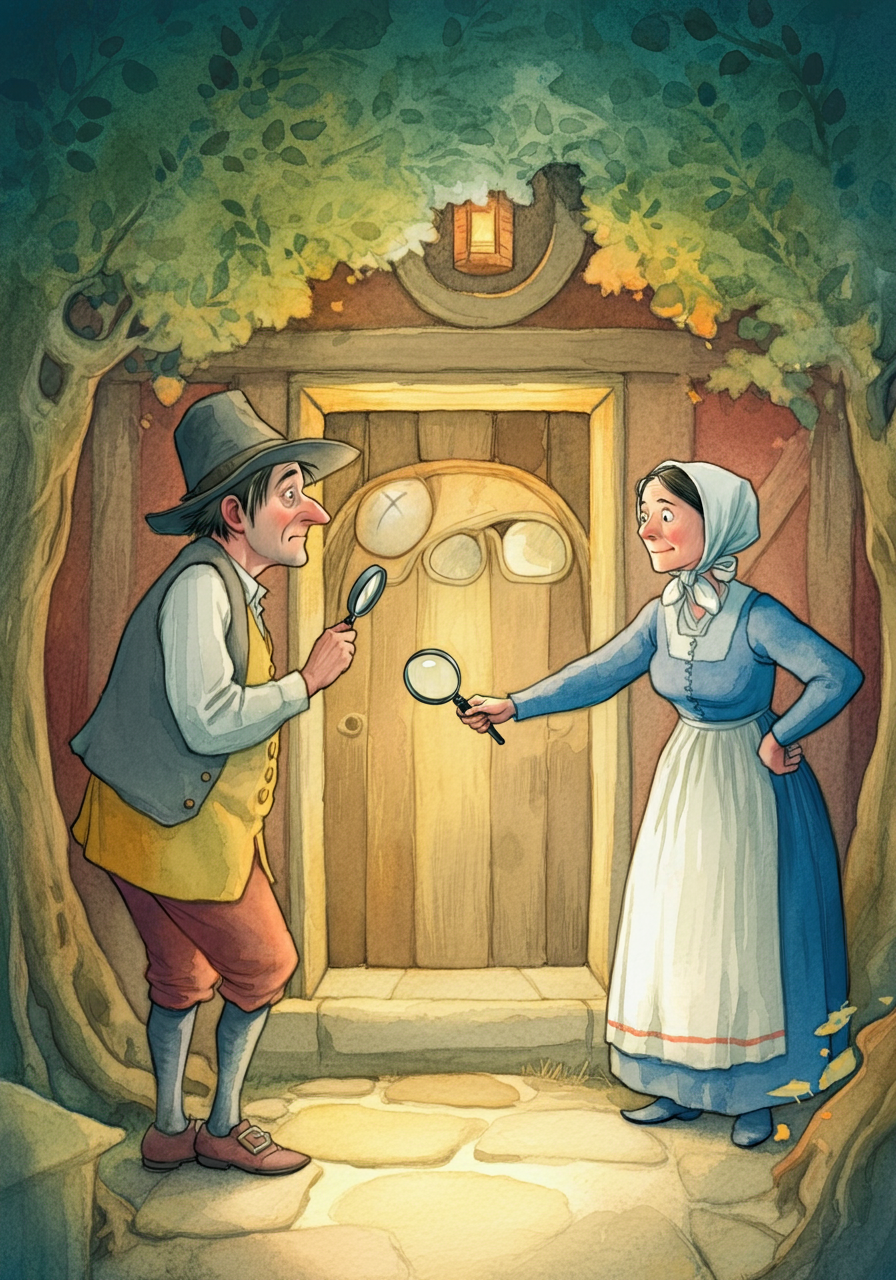
Which was the Foolishest? In a little village that stood on a wide plain, where you could see the sun from the moment he rose to the moment he set, there lived two couples side by side. The men, who worked under the same master, were quite good friends, but the wives were always quarrelling, and the subject they quarrelled most about was—which of the two had the stupidest husband. Unlike most women—who think that anything that belongs to them must be better than what belongs to anyone else—each thought her husband the more foolish of the two. “You should just see what he does!” one said to her neighbour. “He puts on the baby’s frock upside down, and, one day, I found him trying to feed her with boiling soup, and her mouth was scalded for days after. Then he picks up stones in the road and sows them instead of potatoes, and one day he wanted to go into the garden from the top window, because he declared it was a shorter way than through the door.” “That is bad enough, of course,” answered the other; “but it is really NOTHING to what I have to endure every day from MY husband. If, when I am busy, I ask him to go and feed the poultry, he is certain to give them some poisonous stuff instead of their proper food, and when I visit the yard next I find them all dead. Once he even took my best bonnet, when I had gone away to my sick mother, and when I came back I found he had given it to the hen to lay her eggs in. And you know yourself that, only last week, when I sent him to buy a cask of butter, he returned driving a hundred and fifty ducks which someone had induced him to take, and not one of them would lay.” “Yes, I am afraid he IS trying,” replied the first; “but let us put them to the proof, and see which of them is the most foolish.” So, about the time that she expected her husband home from work, she got out her spinning-wheel, and sat busily turning it, taking care not even to look up from her work when the man came in. For some minutes he stood with his mouth open watching her, and as she still remained silent, he said at last: “Have you gone mad, wife, that you sit spinning without anything on the wheel?” “YOU may think that there is nothing on it,” answered she, “but I can assure you that there is a large skein of wool, so fine that nobody can see it, which will be woven into a coat for you.” “Dear me!” he replied, “what a clever wife I have got! If you had not told me I should never have known that there was any wool on the wheel at all. But now I really do seem to see something.” The woman smiled and was silent, and after spinning busily for an hour more, she got up from her stoop, and began to weave as fast as she could. At last she got up, and said to her husband: “I am too tired to finish it to-night, so I shall go to bed, and to-morrow I shall only have the cutting and stitching to do.” So the next morning she got up early, and after she had cleaned her house, and fed her chickens, and put everything in its place again, she bent over the kitchen table, and the sound of her big scissors might be heard snip! snap! as far as the garden. Her husband could not see anything to snip at; but then he was so stupid that was not surprising! After the cutting came the sewing. The woman patted and pinned and fixed and joined, and then, turning to the man, she said: “Now it is ready for you to try on.” And she made him take off his coat, and stand up in front of her, and once more she patted an pinned and fixed and joined, and was very careful in smoothing out every wrinkle. “It does not feel very warm,” observed the man at last, when he had borne all this patiently for a long time. “That is because it is so fine,” answered she; “you do not want it to be as thick as the rough clothes you wear every day.” He DID, but was ashamed to say so, and only answered: “Well, I am sure it must be beautiful since you say so, and I shall be smarter than anyone in the whole village. ‘What a splendid coat!’ they will exclaim when they see me. But it is not everybody who has a wife as clever as mine.” Meanwhile the other wife was not idle. As soon as her husband entered she looked at him with such a look of terror that the poor man was quite frightened. “Why do you stare at me so? Is there anything the matter?” asked he. “Oh! go to bed at once,” she cried; “you must be very ill indeed to look like that!” The man was rather surprised at first, as he felt particularly well that evening; but the moment his wife spoke he became quite certain that he had something dreadful the matter with him, and grew quite pale. “I dare say it would be the best place for me,” he answered, trembling; and he suffered his wife to take him upstairs, and to help him off with his clothes. “If you sleep well during the might there MAY be a chance for you,” said she, shaking her head, as she tucked him up warmly; “but if not—” And of course the poor man never closed an eye till the sun rose. “How do you feel this morning?” asked the woman, coming in on tip-toe when her house-work was finished. “Oh, bad; very bad indeed,” answered he; “I have not slept for a moment. Can you think of nothing to make me better?” “I will try everything that is possible,” said the wife, who did not in the least wish her husband to die, but was determined to show that he was more foolish that the other man. “I will get some dried herbs and make you a drink, but I am very much afraid that it is too late. Why did you not tell me before?” “I thought perhaps the pain would go off in a day or two; and, besides, I did not want to make you unhappy,” answered the man, who was by this time quite sure he had been suffering tortures, and had borne them like a hero. “Of course, if I had had any idea how ill I really was, I should have spoken at once.” “Well, well, I will see what can be done,” said the wife, “but talking is not good for you. Lie still, and keep yourself warm.” All that day the man lay in bed, and whenever his wife entered the room and asked him, with a shake of the head, how he felt, he always replied that he was getting worse. At last, in the evening, she burst into tears, and when he inquired what was the matter, she sobbed out: “Oh, my poor, poor husband, are you really dead? I must go to-morrow and order your coffin.” Now, when the man heard this, a cold shiver ran through his body, and all at once he knew that he was as well as he had ever been in his life. “Oh, no, no!” he cried, “I feel quite recovered! Indeed, I think I shall go out to work.” “You will do no such thing,” replied his wife. “Just keep quite quiet, for before the sun rises you will be a dead man.” The man was very frightened at her words, and lay absolutely still while the undertaker came and measured him for his coffin; and his wife gave orders to the gravedigger about his grave. That evening the coffin was sent home, and in the morning at nine o’clock the woman put him on a long flannel garment, and called to the undertaker’s men to fasten down the lid and carry him to the grave, where all their friends were waiting them. Just as the body was being placed in the ground the other woman’s husband came running up, dressed, as far as anyone could see, in no clothes at all. Everybody burst into shouts of laughter at the sight of him, and the men laid down the coffin and laughed too, till their sides nearly split. The dead man was so astonished at this behaviour, that he peeped out of a little window in the side of the coffin, and cried out: “I should laugh as loudly as any of you, if I were not a dead man.” When they heard the voice coming from the coffin the other people suddenly stopped laughing, and stood as if they had been turned into stone. Then they rushed with one accord to the coffin, and lifted the lid so that the man could step out amongst them. “Were you really not dead after all?” asked they. “And if not, why did you let yourself be buried?” At this the wives both confessed that they had each wished to prove that her husband was stupider than the other. But the villagers declared that they could not decide which was the most foolish—the man who allowed himself to be persuaded that he was wearing fine clothes when he was dressed in nothing, or the man who let himself be buried when he was alive and well. So the women quarrelled just as much as they did before, and no one ever knew whose husband was the most foolish. [Adapted from the Neuislandische Volksmärchen.]
Moral of the Story
It is difficult to determine true foolishness when people are easily swayed by others' perceptions, even to their own detriment.
Characters

First Wife ◆ supporting
No specific details given.
Attire: Simple, functional clothing suitable for housework and spinning; likely a long skirt, blouse, and apron.
Quarrelsome, competitive

First Husband ◆ supporting
No specific details given.
Attire: Everyday work clothes, likely a tunic or shirt, breeches, and a simple coat.
Gullible, easily persuaded

Second Wife ◆ supporting
No specific details given.
Attire: Simple, functional clothing suitable for housework; likely a long skirt, blouse, and apron.
Quarrelsome, manipulative

Second Husband ◆ supporting
No specific details given.
Attire: Nightshirt, then a long flannel garment for burial.
Suggestible, fearful
Locations

Village Plain
A wide, flat plain where the sun is visible from sunrise to sunset.
Mood: Open, exposed, ordinary
The setting for the entire story and the home of the two families.

First Wife's Home
A simple home with a spinning wheel, kitchen table, and garden visible from the window.
Mood: Domestic, industrious, deceptive
The first wife tricks her husband into believing he is wearing an invisible coat.

Second Wife's Bedroom
A bedroom where the husband is convinced he is deathly ill.
Mood: Anxious, fearful, manipulative
The second wife convinces her husband he is dying and arranges for his mock funeral.

Graveyard
A graveyard where the second husband's coffin is brought for burial.
Mood: Morbid, absurd, revelatory
The climax of the story where the second husband emerges from the coffin, revealing the foolishness of both men.
Story DNA
Moral
It is difficult to determine true foolishness when people are easily swayed by others' perceptions, even to their own detriment.
Plot Summary
Two neighboring wives, constantly bickering over whose husband is stupider, decide to test them. One wife convinces her husband he is wearing a magnificent, invisible coat, which he proudly accepts. The other wife convinces her husband he is gravely ill and dying, leading him to passively accept his own burial preparations. At the grave, the 'dead' man is about to be buried when the 'invisible-coated' man runs up naked, causing laughter. Both wives confess their schemes, but the villagers cannot decide which husband was truly the most foolish, leaving the wives' quarrel unresolved.
Themes
Emotional Arc
amusement to perplexity
Writing Style
Narrative Elements
Cultural Context
Folk tales often reflect common societal observations about human nature and relationships, particularly in close-knit communities.
Plot Beats (15)
- Two wives in a village constantly argue about whose husband is the most foolish.
- Each wife recounts absurd examples of her husband's stupidity to the other.
- They agree to devise tests to prove which husband is truly the most foolish.
- Wife 1 pretends to spin an invisible skein of wool for a coat, and her husband believes it, even claiming to see it.
- Wife 1 then pretends to cut and sew the invisible coat, and her husband patiently 'tries it on', believing it to be a fine garment.
- Wife 2, upon her husband's return, convinces him he is gravely ill, despite his feeling perfectly fine.
- Wife 2's husband, convinced by her words, goes to bed and believes he is dying, suffering through the night.
- The next day, Wife 2 continues to convince her husband he is worsening, and he accepts his fate.
- Wife 2 announces her husband's 'death' and orders a coffin and grave, which the husband passively accepts.
- The undertaker measures the 'dead' man, and the coffin is delivered.
- Wife 2's husband is dressed in a shroud and placed in the coffin, which is then carried to the grave.
- As the coffin is being lowered, Wife 1's husband runs up, naked but believing he is wearing a splendid coat, causing everyone to burst into laughter.
- The 'dead' man, astonished by the laughter, peeks out of his coffin and declares he would laugh too if he weren't dead.
- The villagers, shocked, open the coffin, and both wives confess their schemes.
- The villagers are unable to decide which husband was more foolish, and the wives continue their quarrel.


