Clever Maria
by Andrew Lang

Clever Maria and the King
Once, there was a clever girl, Maria. She was very clever and kind. She lived with her father and two sisters. Her father gave them three basil pots. The pots were small and pretty. “Let no one in,” he said. Then he went on a journey.
The next day, the King came to visit. Maria played a hiding game. She hid behind a big tree. She went to a neighbor’s house to sleep. Her basil pot grew big and green. Her sisters’ pots died. Maria was happy her pot grew.
Maria’s First Sister wanted some fruit. She saw medlars in the King’s garden. The medlars looked red and sweet. Maria climbed down a rope to get them. She moved very quietly. She sneaked past the garden man. Then she climbed back up. She gave the fruit to her sister.
Her Second Sister wanted a fruit. Maria went into the garden again. The garden had many plants. She saw the King from far away. She hid behind a bush very quickly. The King could not find her. She took the fruit back home.
Maria’s sisters married the King’s friends. The King felt very sad. He missed clever Maria. He thought about her every day.
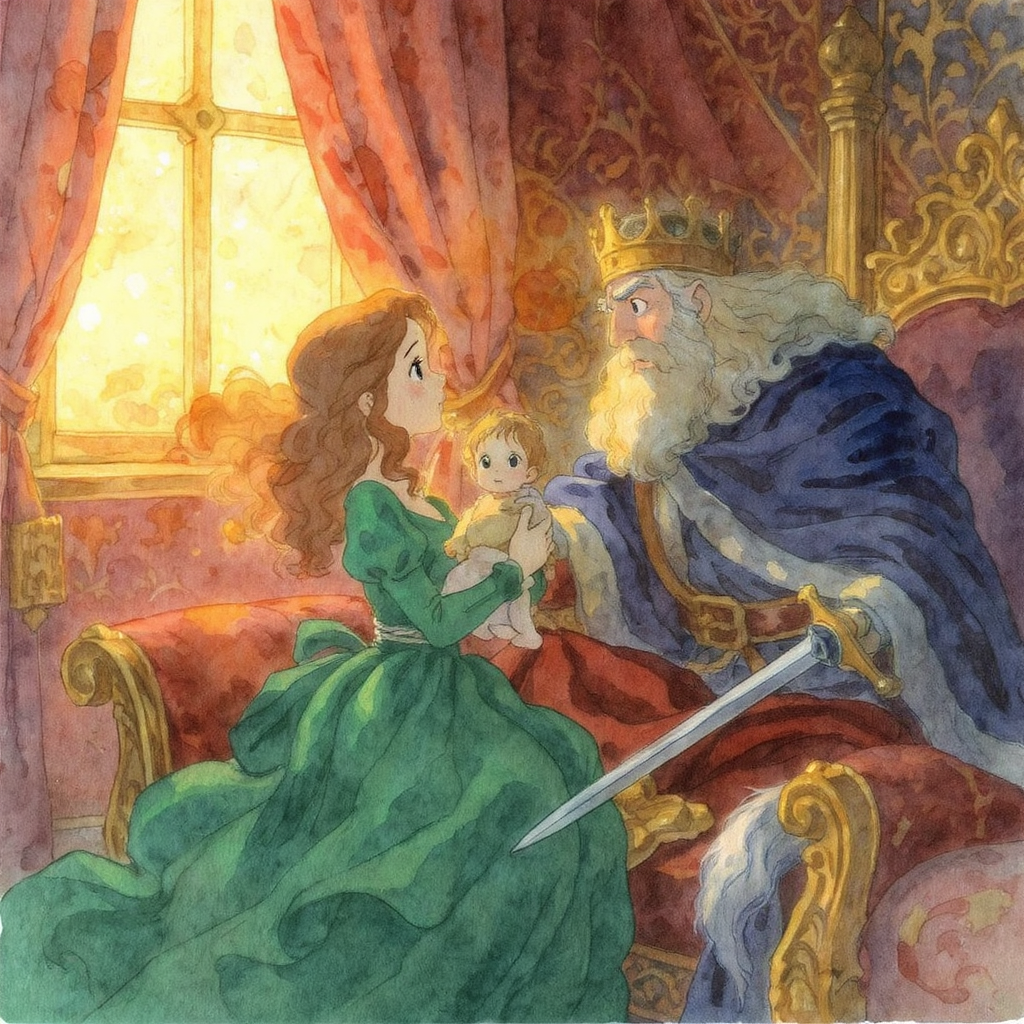
Maria took her sisters’ babies to play. She put them in a pretty basket. The basket was soft and safe. She gave them to the King as gifts. The King was surprised. He smiled at the babies.
Maria’s father came home. The King asked for a stone coat. Or he wanted Maria. Father did not know what to do. He looked worried.
Maria had a clever idea. She told her father to measure the King. She said, “Ask for his size.” But the King still wanted Maria. He said, “Bring Maria to me.”
Maria made a doll that looked like her. The doll was small and cute. She put a string on its head. She hid under the King’s bed. She waited quietly.
The King talked to the doll. He asked about her playful tricks. He said, “Did you take the fruit?” Maria pulled the string. The doll nodded for yes. The King asked more questions.
The King got angry. He broke the doll by mistake. He felt very sad. He started to cry. He said, “I am sorry.”
The real Maria came out. She gave the King a hug. The King said he was sorry. They became best friends. They laughed together.
Clever Maria and the King are happy. They smile and hold hands. They play games every day. They are happy forever.
Original Story
Clever Maria There was once a merchant who lived close to the royal palace, and had three daughters. They were all pretty, but Maria, the youngest, was the prettiest of the three. One day the king sent for the merchant, who was a widower, to give him directions about a journey he wished the good man to take. The merchant would rather not have gone, as he did not like leaving his daughters at home, but he could not refuse to obey the king’s commands, and with a heavy heart he returned home to say farewell to them. Before he left, he took three pots of basil, and gave one to each girl, saying, “I am going a journey, but I leave these pots. You must let nobody into the house. When I come back, they will tell me what has happened.” “Nothing will have happened,” said the girls. The father went away, and the following day the king, accompanied by two friends, paid a visit to the three girls, who were sitting at supper. When they saw who was there, Maria said, “Let us go and get a bottle of wine from the cellar. I will carry the key, my eldest sister can take the light, while the other brings the bottle.” But the king replied, “Oh, do not trouble; we are not thirsty.” “Very well, we will not go,” answered the two elder girls; but Maria merely said, “I shall go, anyhow.” She left the room, and went to the hall where she put out the light, and putting down the key and the bottle, ran to the house of a neighbour, and knocked at the door. “Who is there so late?” asked the old woman, thrusting her head out of the window. “Oh, let me in,” answered Maria. “I have quarrelled with my eldest sister, and as I do not want to fight any more, I have come to beg you to allow me to sleep with you.” So the old woman opened the door and Maria slept in her house. The king was very angry at her for playing truant, but when she returned home the next day, she found the plants of her sisters withered away, because they had disobeyed their father. Now the window in the room of the eldest overlooked the gardens of the king, and when she saw how fine and ripe the medlars were on the trees, she longed to eat some, and begged Maria to scramble down by a rope and pick her a few, and she would draw her up again. Maria, who was good-natured, swung herself into the garden by the rope, and got the medlars, and was just making the rope fast under her arms so as to be hauled up, when her sister cried: “Oh, there are such delicious lemons a little farther on. You might bring me one or two.” Maria turned round to pluck them, and found herself face to face with the gardener, who caught hold of her, exclaiming, “What are you doing here, you little thief?” “Don’t call me names,” she said, “or you will get the worst of it,” giving him as she spoke such a violent push that he fell panting into the lemon bushes. Then she seized the cord and clambered up to the window. The next day the second sister had a fancy for bananas and begged so hard, that, though Maria had declared she would never do such a thing again, at last she consented, and went down the rope into the king’s garden. This time she met the king, who said to her, “Ah, here you are again, cunning one! Now you shall pay for your misdeeds.” And he began to cross-question her about what she had done. Maria denied nothing, and when she had finished, the king said again, “Follow me to the house, and there you shall pay the penalty.” As he spoke, he started for the house, looking back from time to time to make sure that Maria had not run away. All of a sudden, when he glanced round, he found she had vanished completely, without leaving a trace of where she had gone. Search was made all through the town, and there was not a hole or corner which was not ransacked, but there was no sign of her anywhere. This so enraged the king that he became quite ill, and for many months his life was despaired of. Meanwhile the two elder sisters had married the two friends of the king, and were the mothers of little daughters. Now one day Maria stole secretly to the house where her elder sister lived, and snatching up the children put them into a beautiful basket she had with her, covered with flowers inside and out, so that no one would ever guess it held two babies. Then she dressed herself as a boy, and placing the basket on her head, she walked slowly past the palace, crying as she went: “Who will carry these flowers to the king, who lies sick of love?” And the king in his bed heard what she said, and ordered one of his attendants to go out and buy the basket. It was brought to his bedside, and as he raised the lid cries were heard, and peeping in he saw two little children. He was furious at this new trick which he felt had been played on him by Maria, and was still looking at them, wondering how he should pay her out, when he was told that the merchant, Maria’s father, had finished the business on which he had been sent and returned home. Then the king remembered how Maria had refused to receive his visit, and how she had stolen his fruit, and he determined to be revenged on her. So he sent a message by one of his pages that the merchant was to come to see him the next day, and bring with him a coat made of stone, or else he would be punished. Now the poor man had been very sad since he got home the evening before, for though his daughters had promised that nothing should happen while he was away, he had found the two elder ones married without asking his leave. And now there was this fresh misfortune, for how was he to make a coat of stone? He wrung his hands and declared that the king would be the ruin of him, when Maria suddenly entered. “Do not grieve about the coat of stone, dear father; but take this bit of chalk, and go to the palace and say you have come to measure the king.” The old man did not see the use of this, but Maria had so often helped him before that he had confidence in her, so he put the chalk in his pocket and went to the palace. “That is no good,” said the king, when the merchant had told him what he had come for. “Well, I can’t make the coat you want,” replied he. “Then if you would save your head, hand over to me your daughter Maria.” The merchant did not reply, but went sorrowfully back to his house, where Maria sat waiting for him. “Oh, my dear child, why was I born? The king says that, instead of the coat, I must deliver you up to him.” “Do not be unhappy, dear father, but get a doll made, exactly like me, with a string attached to its head, which I can pull for ‘Yes’ and ‘No.’” So the old man went out at once to see about it. The king remained patiently in his palace, feeling sure that this time Maria could not escape him; and he said to his pages, “If a gentleman should come here with his daughter and ask to be allowed to speak with me, put the young lady in my room and see she does not leave it.” When the door was shut on Maria, who had concealed the doll under her cloak, she hid herself under the couch, keeping fast hold of the string which was fastened to its head. “Senhora Maria, I hope you are well,” said the king when he entered the room. The doll nodded. “Now we will reckon up accounts,” continued he, and he began at the beginning, and ended up with the flower-basket, and at each fresh misdeed Maria pulled the string, so that the doll’s head nodded assent. “Who-so mocks at me merits death,” declared the king when he had ended, and drawing his sword, cut off the doll’s head. It fell towards him, and as he felt the touch of a kiss, he exclaimed, “Ah, Maria, Maria, so sweet in death, so hard to me in life! The man who could kill you deserves to die!” And he was about to turn his sword on himself, when the true Maria sprung out from under the bed, and flung herself into his arms. And the next day they were married and lived happily for many years. [From the Portuguese.]
Moral of the Story
Cleverness and wit can overcome even the most powerful adversaries, and true affection can emerge from initial conflict.
Characters

Maria ★ protagonist
Prettiest of the three sisters
Attire: Simple dresses appropriate for a merchant's daughter in a historical Portuguese setting
Clever, resourceful, good-natured

The King ⚔ antagonist
Not specified, but implied to be of noble bearing
Attire: Royal attire, including robes, crown, and sword
Vengeful, easily tricked, ultimately forgiving

The Merchant ◆ supporting
Not specified, but implied to be of middle age
Attire: Merchant's clothing, simple but respectable
Anxious, easily manipulated, loving father

Eldest Sister ○ minor
Pretty, but not as pretty as Maria
Attire: Simple dresses appropriate for a merchant's daughter in a historical Portuguese setting
Envious, lazy

Second Sister ○ minor
Pretty, but not as pretty as Maria
Attire: Simple dresses appropriate for a merchant's daughter in a historical Portuguese setting
Envious, lazy
Locations

Merchant's House
Home to the merchant and his three daughters, containing pots of basil and a cellar for wine.
Mood: Initially peaceful, later anxious and secretive.
The father gives the basil pots to his daughters, and Maria tricks the king during his visit.

King's Gardens
A lush garden filled with medlar trees, lemon trees, and banana trees.
Mood: tempting, forbidden
Maria sneaks into the garden twice, encountering the gardener and then the king.

Royal Palace
The king's residence, including his bedchamber where he lies sick and later confronts the doll.
Mood: formal, tense, then relieved
The king receives the flower basket with the babies, and later confronts the doll that resembles Maria.
Story DNA
Moral
Cleverness and wit can overcome even the most powerful adversaries, and true affection can emerge from initial conflict.
Plot Summary
Clever Maria, the youngest of three sisters, repeatedly outwits a king who initially seeks revenge for her defiance. After evading his visits and stealing from his garden, she even tricks him into buying her sisters' babies. When the king demands her from her father, Maria creates a doll in her likeness to deceive him. The king, believing he has killed Maria, is overcome with remorse, at which point the real Maria reveals herself, leading to their marriage and a happy ending.
Themes
Emotional Arc
conflict to resolution and love
Writing Style
Narrative Elements
Cultural Context
Fairy tales often reflect societal structures where kings hold absolute power and commoners must use wit to navigate challenges.
Plot Beats (13)
- A merchant leaves his three daughters, including clever Maria, with basil pots as a test of their obedience while he's away.
- The king visits the daughters; Maria cleverly avoids him by feigning a quarrel and staying with a neighbor, her basil pot thrives.
- Maria's elder sister tricks her into stealing medlars from the king's garden, where Maria pushes the gardener.
- Maria's second sister tricks her into stealing bananas; Maria encounters the king but vanishes before he can punish her.
- Maria's sisters marry the king's friends while Maria is in hiding; the king falls ill from his unrequited anger/love for Maria.
- Maria, disguised as a boy, steals her sisters' babies and sells them to the sick king as 'flowers'.
- The merchant returns, finding his elder daughters married without his consent, and is then commanded by the king to bring a 'coat of stone' or Maria.
- Maria instructs her father to demand to measure the king for the coat, which the king rejects, demanding Maria instead.
- Maria creates a doll in her likeness with a string for 'yes' and 'no' and hides herself when brought to the king's room.
- The king recounts Maria's 'misdeeds' to the doll, which 'assents' to each charge.
- The king, declaring death for those who mock him, decapitates the doll, then feels a kiss and is filled with remorse, preparing to kill himself.
- The real Maria emerges from hiding, stops the king, and they reconcile.
- Maria and the king marry and live happily ever after.


