Eisenkopf
by Andrew Lang

Peter and the Iron-Headed Man
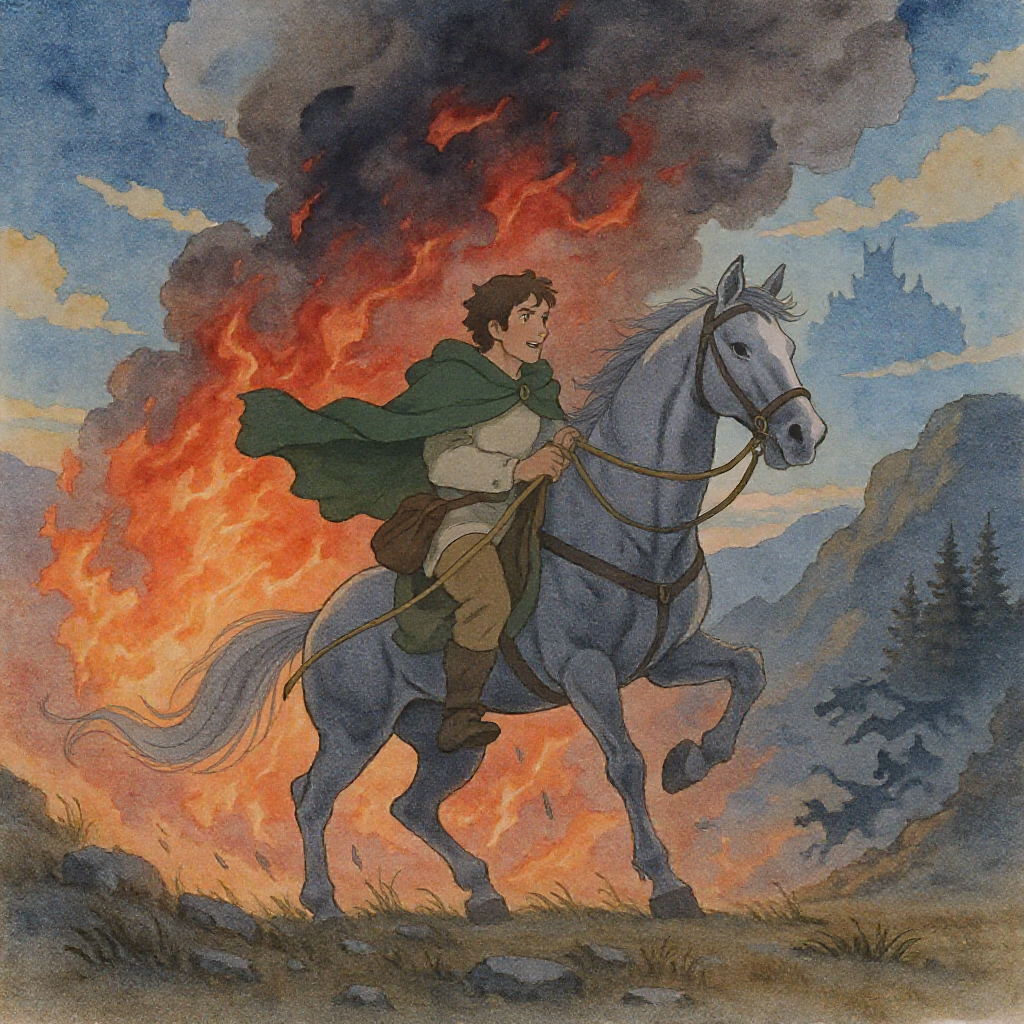
Once, there was a boy named Peter. He lived with his father. His father said, "Peter, you should marry." "I promised Eisenkopf not to," said Peter. "Promises can be broken," said his father. So Peter married a girl. They had a wedding party. All were happy. Then Eisenkopf came to the window. "Peter, you broke your promise," he said. Peter was scared. He ran to the stable. He jumped on a grey horse. The horse ran very fast. Eisenkopf followed him.
Peter rode for a long time. He came to a small house. An old woman lived there. "Hello, mother," said Peter. "Hello, my son," she said. "Rest here. My dog will bark when Eisenkopf is near." Peter ate some food. The dog barked. "Go now!" said the old woman. She gave him a magic napkin and cake. Peter put them in his bag. He rode away.
Peter rode to a second house. A second old woman lived there. She gave him food. Her dog barked. "Go now!" she said. She gave him a magic napkin and cake. Peter put them in his bag.
Peter rode to a third house. A third old woman lived there. She gave him food. Her dog barked. "Go now!" she said. She gave him a magic napkin and cake. "You have three napkins and three cakes," she said. "Ride straight for seven days. You will see a big fire. Hit the fire three times with the napkins. It will open. Then throw the three cakes behind you."
Peter rode for seven days. He saw a big magic fire. He hit it three times with the napkins. The fire opened. Peter rode through. He threw the cakes behind him. Three big dogs appeared. Their names were World's-weight, Strong, and Quick-ear. The dogs were happy to see Peter. The fire closed. Eisenkopf could not follow. He had to wait.
Peter found a small white house. A girl and an old woman lived there. "Can I stay?" asked Peter. "Yes," said the old woman. Peter helped with the work. He became friends with the blonde girl.
One day, the old woman went out. The girl was interested. She took Peter's magic napkins. She went to the fire. She hit it three times. The fire opened. Eisenkopf came through. He followed the girl home. The girl ran inside. Eisenkopf came in too.
Peter came home. He found his napkins. He saw the girl. She was tired but okay. Peter's dog, World's-weight, barked at Eisenkopf. Eisenkopf went away.
The next day, Peter went to the forest. Eisenkopf found him. Peter climbed a tall tree. "Peter, you broke your promise," said Eisenkopf. "Let me call for help," said Peter. Peter called, "Strong, World's-weight, Quick-ear, help me!" The dogs heard him. They ran to the tree. "At him!" said Peter. The dogs chased Eisenkopf far away. He did not come back.
Peter said goodbye to the woman and girl. The girl gave him a pretty ring. It was a gift of friendship. Peter rode home. His wife was not there. She had gone away. Peter was sad for a while.
One night, Peter had a dream. He moved the ring to his other hand. When he woke up, he did it. The blonde girl appeared! She came to live with Peter. They played each day. Peter learned to keep his promises. And with his friends, he was happy.
Original Story
Eisenkopf. The next day some of the cattle were driven to market and sold, and with the money the old man was able to buy some of the fields and gardens round his house, and in a few months had grown the richest and most prosperous man in the whole village. Everything seemed to turn to gold in his hands, till one day, when he and his son were sitting in the orchard watching their herds of cattle grazing in the meadows, he suddenly said: “Peter, my boy, it is time that you were thinking of marrying.” “But, my dear father, I told you I can never marry, because of the promise I gave to Eisenkopf.” “Oh, one promises here and promises there, but no one ever thinks of keeping such promises. If Eisenkopf does not like your marrying, he will have to put up with it all the same! Besides, there stands in the stable a grey horse which is saddled night and day; and if Eisenkopf should show his face, you have only got to jump on the horse’s back and ride away, and nobody on earth can catch you. When all is safe you will come back again, and we shall live as happily as two fish in the sea.” And so it all happened. The young man found a pretty, brown-skinned girl who was willing to have him for a husband, and the whole village came to the wedding feast. The music was at its gayest, and the dance at its merriest, when Eisenkopf looked in at the window. “Oh, ho, my brother! what is going on here? It has the air of being a wedding feast. Yet I fancied—was I mistaken?—that you had given me a promise that you never would marry.” But Peter had not waited for the end of this speech. Scarcely had he seen Eisenkopf than he darted like the wind to the stable and flung himself on the horse’s back. In another moment he was away over the mountain, with Eisenkopf running fast behind him. On they went through thick forests where the sun never shone, over rivers so wide that it took a whole day to sail across them, up hills whose sides were all of glass; on they went through seven times seven countries till Peter reined in his horse before the house of an old woman. “Good day, mother,” said he, jumping down and opening the door. “Good day, my son,” answered she, “and what are you doing here, at the world’s end?” “I am flying for my life, mother, flying to the world which is beyond all worlds; for Eisenkopf is at my heels.” “Come in and rest then, and have some food, for I have a little dog who will begin to howl when Eisenkopf is still seven miles off.” So Peter went in and warmed himself and ate and drank, till suddenly the dog began to howl. “Quick, my son, quick, you must go,” cried the old woman. And the lightning itself was not quicker than Peter. “Stop a moment,” cried the old woman again, just as he was mounting his horse, “take this napkin and this cake, and put them in your bag where you can get hold of them easily.” Peter took them and put them into his bag, and waving his thanks for her kindness, he was off like the wind. Round and round he rode, through seven times seven countries, through forests still thicker, and rivers still wider, and mountains still more slippery than the others he had passed, till at length he reached a house where dwelt another old woman. “Good day, mother,” said he. “Good day, my son! What are you seeking here at the world’s end?” “I am flying for my life, mother, flying to the world that is beyond all worlds, for Eisenkopf is at my heels.” “Come in, my son, and have some food. I have a little dog who will begin to howl when Eisenkopf is still seven miles off; so lie on this bed and rest yourself in peace.” Then she went to the kitchen and baked a number of cakes, more than Peter could have eaten in a whole month. He had not finished a quarter of them, when the dog began to howl. “Now, my son, you must go,” cried the old woman “but first put these cakes and this napkin in your bag, where you can easily get at them.” So Peter thanked her and was off like the wind. On he rode, through seven times seven countries, till he came to the house of a third old woman, who welcomed him as the others had done. But when the dog howled, and Peter sprang up to go, she said, as she gave him the same gifts for his journey: “You have now three cakes and three napkins, for I know that my sisters have each given you one. Listen to me, and do what I tell you. Ride seven days and nights straight before you, and on the eighth morning you will see a great fire. Strike it three times with the three napkins and it will part in two. Then ride into the opening, and when you are in the middle of the opening, throw the three cakes behind your back with your left hand.” Peter thanked her for her counsel, and was careful to do exactly all the old woman had told him. On the eighth morning he reached a fire so large that he could see nothing else on either side, but when he struck it with the napkins it parted, and stood on each hand like a wall. As he rode through the opening he threw the cakes behind him. From each cake there sprang a huge dog, and he gave them the names of World’s-weight, Ironstrong, and Quick-ear. They bayed with joy at the sight of him, and as Peter turned to pat them, he beheld Eisenkopf at the edge of the fire, but the opening had closed up behind Peter, and he could not get through. “Stop, you promise-breaker,” shrieked he; “you have slipped through my hands once, but wait till I catch you again!” Then he lay down by the fire and watched to see what would happen. When Peter knew that he had nothing more to fear from Eisenkopf, he rode on slowly till he came to a small white house. Here he entered and found himself in a room where a gray-haired woman was spinning and a beautiful girl was sitting in the window combing her golden hair. “What brings you here, my son?” asked the old woman. “I am seeking for a place, mother,” answered Peter. “Stay with me, then, for I need a servant,” said the old woman. “With pleasure, mother,” replied he. After that Peter’s life was a very happy one. He sowed and ploughed all day, except now and then when he took his dogs and went to hunt. And whatever game he brought back the maiden with the golden hair knew how to dress it. One day the old woman had gone to the town to buy some flour, and Peter and the maiden were left alone in the house. They fell into talk, and she asked him where his home was, and how he had managed to come through the fire. Peter then told her the whole story, and of his striking the flames with the three napkins as he had been told to do. The maiden listened attentively and wondered in herself whether what he said was true. So after Peter had gone out to the fields, she crept up to his room and stole the napkins and then set off as fast as she could to the fire by a path she knew of over the hill. At the third blow she gave the flames divided, and Eisenkopf, who had been watching and hoping for a chance of this kind, ran down the opening and stood before her. At this sight the maiden was almost frightened to death, but with a great effort she recovered herself and ran home as fast as her legs would carry her, closely pursued by Eisenkopf. Panting for breath she rushed into the house and fell fainting on the floor; but Eisenkopf entered behind her, and hid himself in the kitchen under the hearth. Not long after, Peter came in and picked up the three napkins which the maiden had dropped on the threshold. He wondered how they got there, for he knew he had left them in his room; but what was his horror when he saw the form of the fainting girl lying where she had dropped, as still and white as if she had been dead. He lifted her up and carried her to her bed, where she soon revived, but she did not tell Peter about Eisenkopf, who had been almost crushed to death under the hearth-stone by the body of World’s-weight. The next morning Peter locked up his dogs and went out into the forest alone. Eisenkopf, however, had seen him go, and followed so closely at his heels that Peter had barely time to clamber up a tall tree, where Eisenkopf could not reach him. “Come down at once, you gallows bird,” he cried. “Have you forgotten your promise that you never would marry?” “Oh, I know it is all up with me,” answered Peter, “but let me call out three times.” “You can call a hundred times if you like,” returned Eisenkopf, “for now I have got you in my power, and you shall pay for what you have done.” “Iron-strong, World’s-weight, Quick-ear, fly to my help!” cried Peter; and Quick-ear heard, and said to his brothers: “Listen, our master is calling us.” “You are dreaming, fool,” answered World’s-weight; “why he has not finished his breakfast.” And he gave Quick-ear a slap with his paw, for he was young and needed to be taught sense. “Iron-strong, World’s-weight, Quick-ear, fly to my help!” cried Peter again. This time World’s-weight heard also, and he said, “Ah, now our master is really calling.” “How silly you are!” answered Iron-strong; “you know that at this hour he is always eating.” And he gave World’s-weight a cuff, because he was old enough to know better. Peter sat trembling on the tree dreading lest his dogs had never heard, or else that, having heard, they had refused to come. It was his last chance, so making a mighty effort he shrieked once more: “Iron-strong, World’s-weight, Quick-ear, fly to my help, or I am a dead man!” And Iron-strong heard, and said: “Yes, he is certainly calling, we must go at once.” And in an instant he had burst open the door, and all three were bounding away in the direction of the voice. When they reached the foot of the tree Peter just said: “At him!” And in a few minutes there was nothing left of Eisenkopf. As soon as his enemy was dead Peter got down and returned to the house, where he bade farewell to the old woman and her daughter, who gave him a beautiful ring, all set with diamonds. It was really a magic ring, but neither Peter nor the maiden knew that. Peter’s heart was heavy as he set out for home. He had ceased to love the wife whom he had left at his wedding feast, and his heart had gone out to the golden-haired girl. However, it was no use thinking of that, so he rode forward steadily. The fire had to be passed through before he had gone very far, and when he came to it, Peter shook the napkins three times in the flames and a passage opened for trim. But then a curious thing happened; the three dogs, who had followed at his heels all the way, now became three cakes again, which Peter put into his bag with the napkins. After that he stopped at the houses of the three old women, and gave each one back her napkin and her cake. “Where is my wife?” asked Peter, when he reached home. “Oh, my dear son, why did you ever leave us? After you had vanished, no one knew where, your poor wife grew more and more wretched, and would neither eat nor drink. Little by little she faded away, and a month ago we laid her in her grave, to hide her sorrows under the earth.” At this news Peter began to weep, for he had loved his wife before he went away and had seen the golden-haired maiden. He went sorrowfully about his work for the space of half a year, when, one night, he dreamed that he moved the diamond ring given him by the maiden from his right hand and put it on the wedding finger of the left. The dream was so real that he awoke at once and changed the ring from one hand to the other. And as he did so guess what he saw? Why, the golden-haired girl standing before him. And he sprang up and kissed her, and said: “Now you are mine for ever and ever, and when we die we will both be buried in one grave.” And so they were. [From Ungarische Mährchen.]
Moral of the Story
Promises, especially those made to supernatural beings, carry significant weight and their breaking can lead to unforeseen and dangerous consequences, but true love can overcome even the most dire circumstances.
Characters

Peter ★ protagonist
Not explicitly described, but implied to be strong and capable due to his farming and riding skills.
Attire: Peasant clothing suitable for farming and riding: tunic, breeches, boots, perhaps a simple hat.
Impulsive, easily swayed, ultimately remorseful.

Eisenkopf ⚔ antagonist
Implied to be monstrous and frightening, but not explicitly described.
Attire: Not described, but likely imposing and dark.
Relentless, vengeful, bound by promises.

The Father ◆ supporting
An old man who becomes wealthy.
Attire: Simple, practical clothing appropriate for a farmer.
Materialistic, manipulative, dismissive of promises.

First Old Woman ◆ supporting
Not described, but implied to be wise and magical.
Attire: Simple, old-fashioned clothing.
Helpful, wise, protective.

Second Old Woman ◆ supporting
Not described, but implied to be wise and magical.
Attire: Simple, old-fashioned clothing.
Helpful, wise, protective.

Third Old Woman ◆ supporting
Not described, but implied to be wise and magical.
Attire: Simple, old-fashioned clothing.
Helpful, wise, protective.

Golden-Haired Maiden ◆ supporting
Beautiful.
Attire: Simple dress suitable for a servant.
Curious, resourceful, ultimately loving.

World's-weight ◆ supporting
Huge, powerful dog.
Loyal, strong, protective.
Locations

Orchard and Meadows
Fields and gardens round the old man's house, with herds of cattle grazing in the meadows.
Mood: Prosperous, peaceful
The father suggests Peter should marry, breaking his promise to Eisenkopf.

Wedding Feast
A village hall filled with music and dancing.
Mood: Festive, joyous, tense
Eisenkopf appears at the window, interrupting the wedding.

House of the Third Old Woman
A house at the world's end, similar to the other old women's houses.
Mood: Safe, magical, helpful
Peter receives the crucial advice and items (napkins and cakes) to overcome the fire.

Great Fire
A fire so large that it fills the horizon.
Mood: Dangerous, magical, transformative
Peter uses the napkins and cakes to create the dogs and escape Eisenkopf.

Small White House
A room with a gray-haired woman spinning and a beautiful girl combing her golden hair by the window.
Mood: Peaceful, domestic, romantic
Peter finds love with the golden-haired girl, and Eisenkopf is finally defeated.
Story DNA
Moral
Promises, especially those made to supernatural beings, carry significant weight and their breaking can lead to unforeseen and dangerous consequences, but true love can overcome even the most dire circumstances.
Plot Summary
Peter, having promised a mysterious Eisenkopf never to marry, breaks his vow at his father's insistence. Eisenkopf appears at his wedding, forcing Peter to flee on a magical horse. Guided by three old women and their magical gifts, Peter creates three powerful dogs to escape Eisenkopf through a magical fire. He finds refuge and falls in love with a golden-haired maiden, but her curiosity inadvertently allows Eisenkopf to pursue them again. After a final confrontation where Peter's dogs destroy Eisenkopf, Peter returns home to find his first wife dead. A magical ring from the maiden then transforms her into his true wife, and they live happily ever after.
Themes
Emotional Arc
fear and flight to peace and true love
Writing Style
Narrative Elements
Cultural Context
Andrew Lang collected this tale from 'Ungarische Mährchen' (Hungarian Fairy Tales), indicating its origin in Hungarian folklore, which often features magical elements and moral lessons.
Plot Beats (15)
- Peter's father, now wealthy, urges Peter to marry despite his promise to Eisenkopf.
- Peter marries; Eisenkopf appears at the wedding, reminding Peter of his broken promise.
- Peter flees on a magical horse, pursued by Eisenkopf.
- Peter encounters three old women in succession, each providing shelter, food, and magical items (napkins and cakes) and instructions for his journey.
- Peter reaches a magical fire, uses the napkins to part it, and throws the cakes behind him, creating three powerful dogs.
- Eisenkopf is trapped by the closing fire, unable to reach Peter.
- Peter finds refuge in a small white house with an old woman and her beautiful, golden-haired daughter, with whom he falls in love.
- The golden-haired maiden, curious about Peter's story, steals his magical napkins and uses them to open the fire, allowing Eisenkopf to escape and pursue her.
- Eisenkopf hides in the kitchen after pursuing the maiden, who faints.
- Peter returns, finds the maiden, and his dog World's-weight accidentally crushes Eisenkopf, who is hiding.
- Eisenkopf, having survived, traps Peter in a tree, taunting him about his broken promise.
- Peter calls his dogs for help; after two failed attempts, they finally hear and rush to his aid, destroying Eisenkopf.
- Peter bids farewell to the old woman and maiden, receiving a diamond ring from the maiden.
- Peter returns home, where he learns his first wife has died of sorrow.
- Peter dreams of moving the diamond ring to his wedding finger, and upon waking, the golden-haired maiden appears, becoming his true wife.


