Lovely Ilonka
by Andrew Lang

The Three Bulrushes
Once upon a time, a prince wanted to marry. His father the king said, "No. You must do a brave thing first." The prince was sad. He went to find three special plants.
He asked an old woman for help. She called her birds. The birds did not know. He asked an old woman for help. She called her birds. The birds did not know. He asked another old woman for help. She called her birds. One bird knew the way!
The bird showed him a big, high wall. The prince jumped over the wall. He found the three plants. He took them and went home.
He opened the first plant. A lovely girl came out. "Give me water," she said. There was no water. She flew away. He opened the second plant. A lovely girl came out. "Give me water," she said. There was no water. She flew away.
He was very careful with the third plant. He waited by a well. He opened it. A girl, Ilonka, came out. "Give me water," she said. He gave her water. She did not fly away. "I am your love," she said. "I am your love," he said. They promised to marry.
The prince left Ilonka with some helpers. He went to get a coach. One helper was bad. He pushed Ilonka into the well. He put his Bad Daughter in her place. The Bad Daughter wore Ilonka's pretty dress.
The prince came back. He saw the wrong girl. He was sad. But he married her. He became the king.
Ilonka was a duck in the well. A man found her. She became a girl again. She worked in the king's house. She had a magic spinning wheel. It spun by itself.
The wrong queen wanted the magic wheel. "I will give it to you," said Ilonka. "Let me sleep in the king's room." The queen agreed. She gave the king a sleeping drink at night. Ilonka came to the king. "My love, it is me, Ilonka," she said. The king did not wake up. He could not hear her. She tried again the next night. The king slept again.
Some good helpers told the king the truth. "Do not drink the queen's drink," they said. That night, the king pretended to sleep. Ilonka came in. "My love, it is me, Ilonka," she said. The king woke up! He was so happy. Ilonka told him her whole story.
The king sent the bad helpers away. He married Ilonka. They were very happy. Good wins over bad. True love is strong.
Original Story
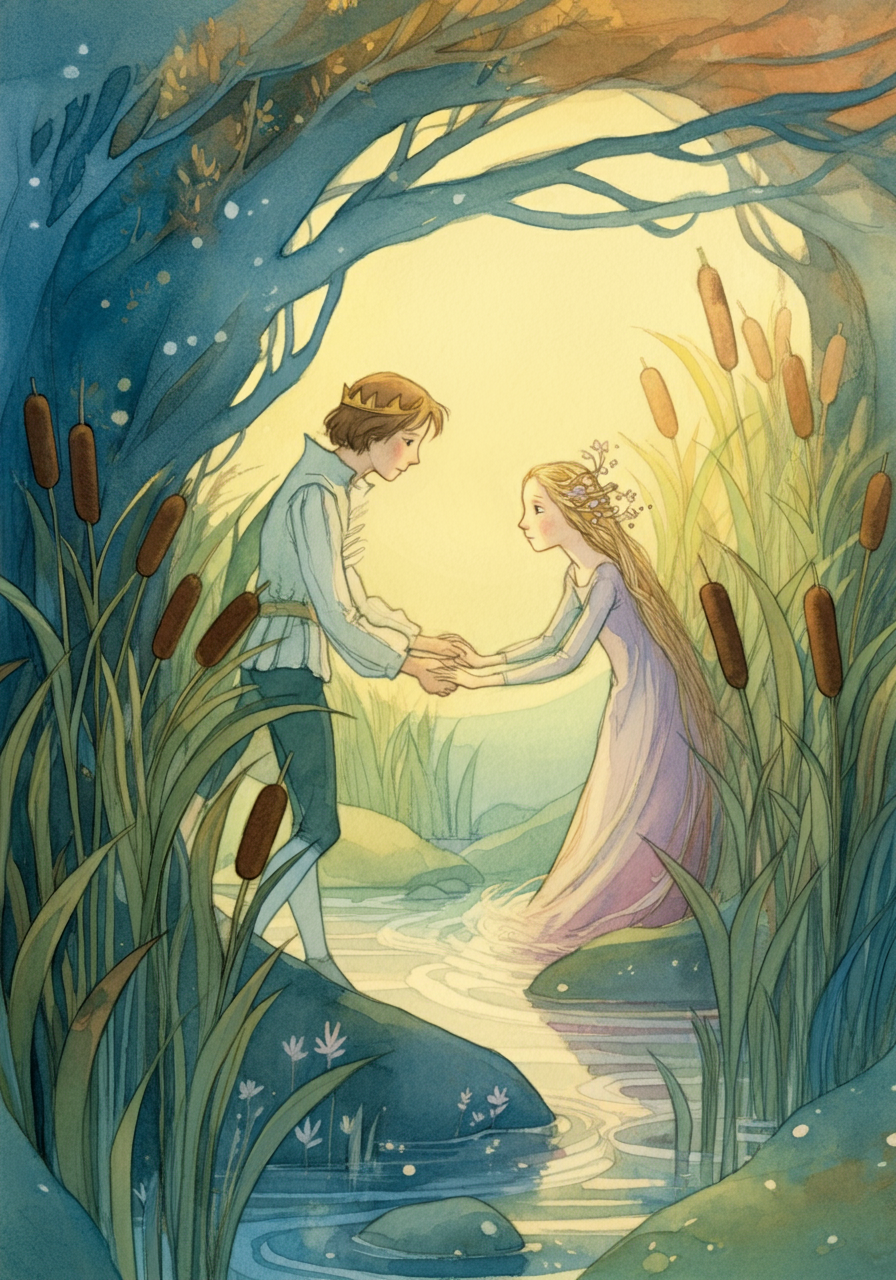
Lovely Ilonka There was once a king’s son who told his father that he wished to marry. “No, no!” said the king; “you must not be in such a hurry. Wait till you have done some great deed. My father did not let me marry till I had won the golden sword you see me wear.” The prince was much disappointed, but he never dreamed of disobeying his father, and he began to think with all his might what he could do. It was no use staying at home, so one day he wandered out into the world to try his luck, and as he walked along he came to a little hut in which he found an old woman crouching over the fire. “Good evening, mother. I see you have lived long in this world; do you know anything about the three bulrushes?” “Yes, indeed, I’ve lived long and been much about in the world, but I have never seen or heard anything of what you ask. Still, if you will wait till to-morrow I may be able to tell you something.” Well, he waited till the morning, and quite early the old woman appeared and took out a little pipe and blew in it, and in a moment all the crows in the world were flying about her. Not one was missing. Then she asked if they knew anything about the three bulrushes, but not one of them did. The prince went on his way, and a little further on he found another hut in which lived an old man. On being questioned the old man said he knew nothing, but begged the prince to stay overnight, and the next morning the old man called all the ravens together, but they too had nothing to tell. The prince bade him farewell and set out. He wandered so far that he crossed seven kingdoms, and at last, one evening, he came to a little house in which was an old woman. “Good evening, dear mother,” said he politely. “Good evening to you, my dear son,” answered the old woman. “It is lucky for you that you spoke to me or you would have met with a horrible death. But may I ask where are you going?” “I am seeking the three bulrushes. Do you know anything about them?” “I don’t know anything myself, but wait till to-morrow. Perhaps I can tell you then.” So the next morning she blew on her pipe, and lo! and behold every magpie in the world flew up. That is to say, all the magpies except one who had broken a leg and a wing. The old woman sent after it at once, and when she questioned the magpies the crippled one was the only one who knew where the three bulrushes were. Then the prince started off with the lame magpie. They went on and on till they reached a great stone wall, many, many feet high. “Now, prince,” said the magpie, “the three bulrushes are behind that wall.” The prince wasted no time. He set his horse at the wall and leaped over it. Then he looked about for the three bulrushes, pulled them up and set off with them on his way home. As he rode along one of the bulrushes happened to knock against something. It split open and, only think! out sprang a lovely girl, who said: “My heart’s love, you are mine and I am yours; do give me a glass of water.” But how could the prince give it her when there was no water at hand? So the lovely maiden flew away. He split the second bulrush as an experiment and just the same thing happened. How careful he was of the third bulrush! He waited till he came to a well, and there he split it open, and out sprang a maiden seven times lovelier than either of the others, and she too said: “My heart’s love, I am yours and you are mine; do give me a glass of water.” This time the water was ready and the girl did not fly away, but she and the prince promised to love each other always. Then they set out for home. They soon reached the prince’s country, and as he wished to bring his promised bride back in a fine coach he went on to the town to fetch one. In the field where the well was, the king’s swineherds and cowherds were feeding their droves, and the prince left Ilonka (for that was her name) in their care. Unluckily the chief swineherd had an ugly old daughter, and whilst the prince was away he dressed her up in fine clothes, and threw Ilonka into the well. The prince returned before long, bringing with him his father and mother and a great train of courtiers to escort Ilonka home. But how they all stared when they saw the swineherd’s ugly daughter! However, there was nothing for it but to take her home; and, two days later, the prince married her, and his father gave up the crown to him. But he had no peace! He knew very well he had been cheated, though he could not think how. Once he desired to have some water brought him from the well into which Ilonka had been thrown. The coachman went for it and, in the bucket he pulled up, a pretty little duck was swimming. He looked wonderingly at it, and all of a sudden it disappeared and he found a dirty looking girl standing near him. The girl returned with him and managed to get a place as housemaid in the palace. Of course she was very busy all day long, but whenever she had a little spare time she sat down to spin. Her distaff turned of itself and her spindle span by itself and the flax wound itself off; and however much she might use there was always plenty left. When the queen—or, rather, the swineherd’s daughter—heard of this, she very much wished to have the distaff, but the girl flatly refused to give it to her. However, at last she consented on condition that she might sleep one night in the king’s room. The queen was very angry, and scolded her well; but as she longed to have the distaff she consented, though she gave the king a sleeping draught at supper. Then the girl went to the king’s room looking seven times lovelier than ever. She bent over the sleeper and said: “My heart’s love, I am yours and you are mine. Speak to me but once; I am your Ilonka.” But the king was so sound asleep he neither heard nor spoke, and Ilonka left the room, sadly thinking he was ashamed to own her. Soon after the queen again sent to say that she wanted to buy the spindle. The girl agreed to let her have it on the same conditions as before; but this time, also, the queen took care to give the king a sleeping draught. And once more Ilonka went to the king’s room and spoke to him; whisper as sweetly as she might she could get no answer. Now some of the king’s servants had taken note of the matter, and warned their master not to eat and drink anything that the queen offered him, as for two nights running she had given him a sleeping draught. The queen had no idea that her doings had been discovered; and when, a few days later, she wanted the flax, and had to pay the same price for it, she felt no fears at all. At supper that night the queen offered the king all sorts of nice things to eat and drink, but he declared he was not hungry, and went early to bed. The queen repented bitterly her promise to the girl, but it was too late to recall it; for Ilonka had already entered the king’s room, where he lay anxiously waiting for something, he knew not what. All of a sudden he saw a lovely maiden who bent over him and said: “My dearest love, I am yours and you are mine. Speak to me, for I am your Ilonka.” At these words the king’s heart bounded within him. He sprang up and embraced and kissed her, and she told him all her adventures since the moment he had left her. And when he heard all that Ilonka had suffered, and how he had been deceived, he vowed he would be revenged; so he gave orders that the swineherd, his wife and daughter should all be hanged; and so they were. The next day the king was married, with great rejoicings, to the fair Ilonka; and if they are not yet dead—why, they are still living. [From Ungarische Mährchen.]
Moral of the Story
True love and virtue will eventually triumph over deceit and wickedness.
Characters

Prince ★ protagonist
Not described, but assumed to be handsome and strong.
Attire: Princely attire, including fine fabrics, possibly a tunic, hose, and boots. Later, royal robes.
Determined, easily deceived, ultimately just.

Lovely Ilonka ★ protagonist
Described as 'lovely' and 'seven times lovelier' than the other maidens.
Attire: Initially appears from the bulrush in simple attire, later as a housemaid in plain clothes, and finally in royal wedding garments.
Patient, loving, persistent.

King ◆ supporting
Not described, but assumed to be regal and imposing.
Attire: Royal robes and crown, signifying his authority.
Wise, traditional, trusting.

Swineherd's Ugly Daughter ⚔ antagonist
Described as 'ugly'.
Attire: Initially plain peasant clothes, then fine clothes stolen from Ilonka.
Deceitful, greedy, opportunistic.

Old Woman (Magpie) ◆ supporting
Wrinkled face, hunched posture.
Attire: Simple, rustic clothing suitable for an old woman living in a hut.
Helpful, knowledgeable, resourceful.
Locations

Old Woman's Hut
A small, humble dwelling with an old woman crouching over a fire.
Mood: isolated, humble, possibly magical
The prince seeks information about the three bulrushes and learns how to summon the magpies.

Stone Wall
A great stone wall, many feet high, concealing the three bulrushes.
Mood: mysterious, barrier
The prince leaps over the wall to find the three bulrushes.

Well in a Field
A well located in a field where the king's swineherds and cowherds are feeding their droves.
Mood: pastoral, fateful
Ilonka emerges from the third bulrush; Ilonka is thrown into the well by the swineherd's daughter.

Royal Palace
The grand residence of the king and later the prince, where the prince marries the swineherd's daughter.
Mood: deceptive, tense, eventually triumphant
The prince is tricked into marrying the swineherd's daughter; Ilonka works as a housemaid and attempts to reveal her identity; the king discovers the truth and punishes the villains.
Story DNA
Moral
True love and virtue will eventually triumph over deceit and wickedness.
Plot Summary
A prince, tasked with a great deed before marriage, seeks the mythical three bulrushes. He finds them, and from the third, the beautiful Ilonka emerges, whom he promises to marry. However, while he fetches a coach, a wicked swineherd replaces Ilonka with his ugly daughter, throwing Ilonka into a well where she transforms into a duck, then a housemaid. Through magical spinning tools, Ilonka repeatedly tries to reveal her identity to the king, who is drugged by the false queen. Eventually, warned by servants, the king stays awake, hears Ilonka's story, and restores her to her rightful place, punishing the deceivers.
Themes
Emotional Arc
suffering to triumph
Writing Style
Narrative Elements
Cultural Context
Andrew Lang collected this tale from 'Ungarische Mährchen' (Hungarian Fairy Tales), reflecting Central European folkloric traditions.
Plot Beats (15)
- A prince is told by his father he must perform a great deed before marrying.
- The prince leaves home to find the 'three bulrushes'.
- He consults three old women, each with a different bird (crows, ravens, magpies), to learn the location of the bulrushes.
- A crippled magpie guides him to a high wall, behind which he finds the bulrushes.
- He opens the first two bulrushes, releasing maidens who fly away due to lack of water.
- He opens the third bulrush by a well, releasing Ilonka, whom he promises to marry.
- The prince leaves Ilonka with swineherds to fetch a coach and his family.
- The chief swineherd throws Ilonka into the well and replaces her with his ugly daughter.
- The prince, his family, and courtiers are dismayed by the ugly bride but proceed with the marriage; the prince becomes king.
- Ilonka, transformed into a duck in the well, is found by a coachman and becomes a housemaid in the palace.
- Ilonka possesses magical spinning tools that attract the false queen's attention.
- Ilonka agrees to sell her tools if she can sleep in the king's room, but the false queen drugs the king.
- Ilonka attempts to speak to the king twice, but he is asleep and doesn't hear her pleas.
- Servants warn the king about the sleeping draughts, and he pretends to sleep, allowing Ilonka to reveal herself and her story.
- The king executes the swineherd family, marries Ilonka, and they live happily ever after.


