The Crab and the Monkey
by Andrew Lang

The Crab and the Monkey
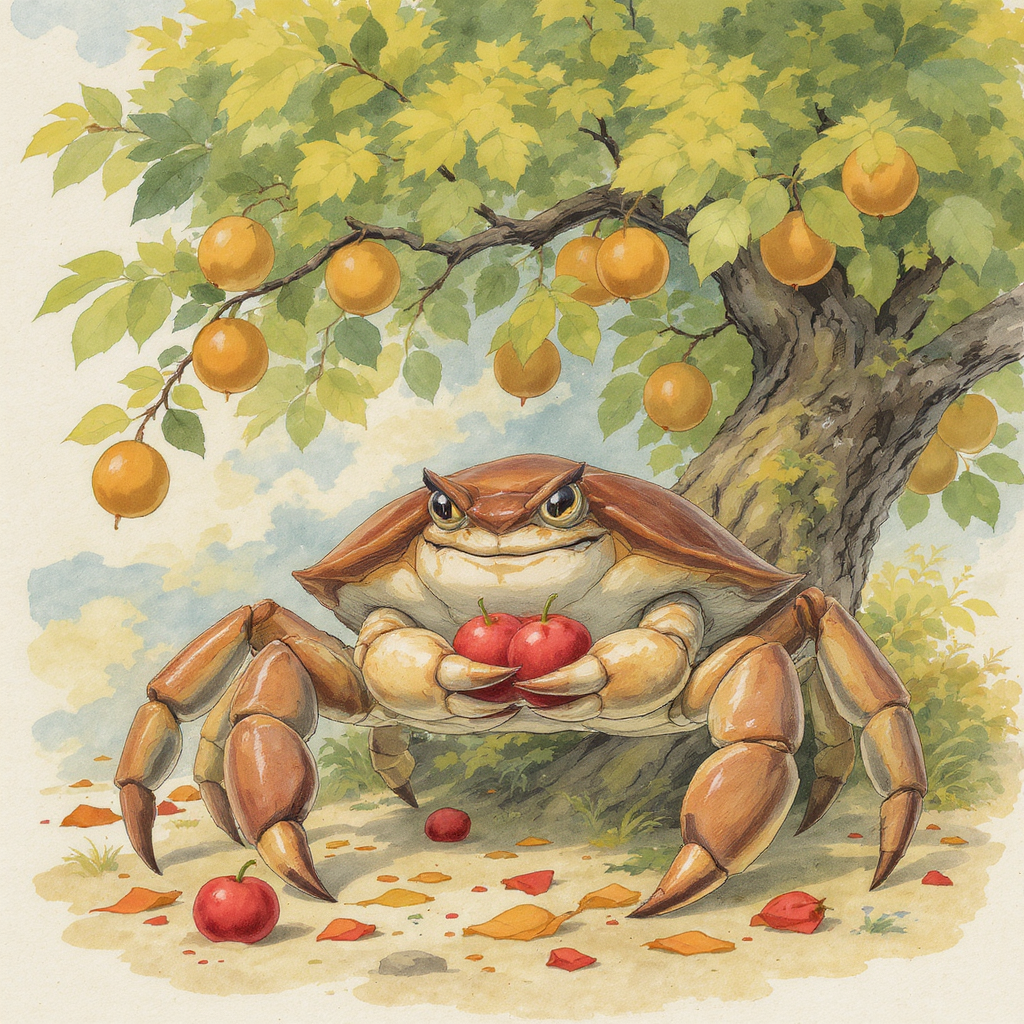
A crab worked hard in a clean hole.
One day, she found rice on the ground. The rice was white and very tasty. She felt very happy about her find. She decided to save it for later.
A sneaky monkey saw the rice nearby. He wanted it for himself. He promised a seed for the rice. The crab gave it to him.
The crab gently planted the seed in her garden. Soon, it grew into a big tree. The tree had many sweet, orange fruits. The fruits looked tasty.
The monkey returned when the fruits were ripe. He saw the tasty fruit. "Please, may I have some?" he asked nicely. "I will share with you," he lied.
The crab agreed gladly. The monkey quickly climbed the tree. He ate the best fruits first. He only threw down bad fruit for the crab.
The crab felt very sad and upset. She then had a clever idea. "Can you do a flip?" she asked. The monkey tried to do one. All the good fruit fell out of his pockets.
The crab gathered all the good fruit. The monkey became very angry. He shouted and took the fruit, making her cry.
The crab's friends found her crying. They were a wasp, mortar, and egg. They were very upset. "We will help you," they said kindly.
They planned to teach the monkey a lesson. The heavy mortar sat above the door. The egg lay still on the floor. The wasp waited near a water bucket. The crab hid nearby under a leaf.
The monkey came to the door later. "I am sorry," he said, but he did not mean it. He went inside the hole. He saw the egg on the floor. He put it on the warm fire to cook. Then, the egg rolled and made a pop, shocking him.
He quickly ran to the water to cool down. The wasp buzzed loudly near his ear, making him dizzy. He ran for the door in fear. The heavy mortar fell with a loud thud, blocking his way. The scared monkey ran away quickly into the forest.
The crab came out of hiding. She was safe and very happy. She lived happily under her tree with her friends. They shared the sweet fruits.
Being mean is not good, and friends can help make things right.
Original Story
The Crab And The Monkey There was once a crab who lived in a hole on the shady side of a mountain. She was a very good housewife, and so careful and industrious that there was no creature in the whole country whose hole was so neat and clean as hers, and she took great pride in it. One day she saw lying near the mouth of her hole a handful of cooked rice which some pilgrim must have let fall when he was stopping to eat his dinner. Delighted at this discovery, she hastened to the spot, and was carrying the rice back to her hole when a monkey, who lived in some trees near by, came down to see what the crab was doing. His eyes shone at the sight of the rice, for it was his favourite food, and like the sly fellow he was, he proposed a bargain to the crab. She was to give him half the rice in exchange for the kernel of a sweet red kaki fruit which he had just eaten. He half expected that the crab would laugh in his face at this impudent proposal, but instead of doing so she only looked at him for a moment with her head on one side and then said that she would agree to the exchange. So the monkey went off with his rice, and the crab returned to her hole with the kernel. For some time the crab saw no more of the monkey, who had gone to pay a visit on the sunny side of the mountain; but one morning he happened to pass by her hole, and found her sitting under the shadow of a beautiful kaki tree. “Good day,” he said politely, “you have some very fine fruit there! I am very hungry, could you spare me one or two?” “Oh, certainly,” replied the crab, “but you must forgive me if I cannot get them for you myself. I am no tree-climber.” “Pray do not apologise,” answered the monkey. “Now that I have your permission I can get them myself quite easily.” And the crab consented to let him go up, merely saying that he must throw her down half the fruit. In another moment he was swinging himself from branch to branch, eating all the ripest kakis and filling his pockets with the rest, and the poor crab saw to her disgust that the few he threw down to her were either not ripe at all or else quite rotten. “You are a shocking rogue,” she called in a rage; but the monkey took no notice, and went on eating as fast as he could. The crab understood that it was no use her scolding, so she resolved to try what cunning would do. “Sir Monkey,” she said, “you are certainly a very good climber, but now that you have eaten so much, I am quite sure you would never be able to turn one of your somersaults.” The monkey prided himself on turning better somersaults than any of his family, so he instantly went head over heels three times on the bough on which he was sitting, and all the beautiful kakis that he had in his pockets rolled to the ground. Quick as lightning the crab picked them up and carried a quantity of them into her house, but when she came up for another the monkey sprang on her, and treated her so badly that he left her for dead. When he had beaten her till his arm ached he went his way. It was a lucky thing for the poor crab that she had some friends to come to her help or she certainly would have died then and there. The wasp flew to her, and took her back to bed and looked after her, and then he consulted with a rice-mortar and an egg which had fallen out of a nest near by, and they agreed that when the monkey returned, as he was sure to do, to steal the rest of the fruit, that they would punish him severely for the manner in which he had behaved to the crab. So the mortar climbed up to the beam over the front door, and the egg lay quite still on the ground, while the wasp set down the water-bucket in a corner. Then the crab dug itself a deep hole in the ground, so that not even the tip of her claws might be seen. Soon after everything was ready the monkey jumped down from his tree, and creeping to the door began a long hypocritical speech, asking pardon for all he had done. He waited for an answer of some sort, but none came. He listened, but all was still; then he peeped, and saw no one; then he went in. He peered about for the crab, but in vain; however, his eyes fell on the egg, which he snatched up and set on the fire. But in a moment the egg had burst into a thousand pieces, and its sharp shell struck him in the face and scratched him horribly. Smarting with pain he ran to the bucket and stooped down to throw some water over his head. As he stretched out his hand up started the wasp and stung him on the nose. The monkey shrieked and ran to the door, but as he passed through down fell the mortar and struck him dead. “After that the crab lived happily for many years, and at length died in peace under her own kaki tree. [From _Japanische Mährchen_.]
Moral of the Story
Cruelty and greed will eventually be met with cunning and collective justice.
Characters

Crab ★ protagonist
Industrious, lives in a neat hole
Industrious, cunning, vengeful

Monkey ⚔ antagonist
Sly, agile
Sly, greedy, boastful

Wasp ◆ supporting
Flying insect with a stinger
Helpful, loyal

Rice-Mortar ◆ supporting
Heavy wooden mortar
Silent, deadly

Egg ◆ supporting
Fragile egg
Deceptive, explosive
Locations

Crab's Hole
A neat and clean hole on the shady side of a mountain.
Mood: peaceful, industrious
The crab discovers the rice and makes a deal with the monkey.

Kaki Tree
A beautiful kaki tree growing near the crab's hole, laden with sweet red fruit.
Mood: deceptive, tempting
The monkey tricks the crab and steals the kakis.

Crab's Home Interior
The interior of the crab's hole, containing a hearth.
Mood: dangerous, vengeful
The wasp, rice-mortar, and egg set a trap for the monkey.
Story DNA
Moral
Cruelty and greed will eventually be met with cunning and collective justice.
Plot Summary
A diligent crab trades rice for a kaki seed from a sly monkey, growing a beautiful tree. The monkey later abuses the crab's generosity, eating all the good fruit and brutally beating her. The injured crab's friends—a wasp, a rice-mortar, and an egg—conspire to avenge her. They set a trap in the crab's hole, leading to the monkey's painful and fatal encounter with each of them, ensuring justice for the crab.
Themes
Emotional Arc
suffering to triumph
Writing Style
Narrative Elements
Cultural Context
This story, 'Saru Kani Gassen' (The Monkey-Crab Battle), is a well-known Japanese folktale, often depicting the triumph of the weak and clever over the strong and cruel.
Plot Beats (14)
- A diligent crab finds a handful of cooked rice near her hole.
- A sly monkey tricks the crab into exchanging half the rice for a kaki fruit kernel.
- The crab plants the kernel, and it grows into a beautiful kaki tree.
- The monkey returns, sees the tree, and asks the crab for fruit, promising to share.
- The monkey climbs the tree, eats the best fruit, and throws down only rotten ones to the crab.
- The crab, angered, tricks the monkey into performing somersaults, causing him to drop all the good fruit.
- The crab gathers the dropped fruit, but the monkey springs on her and beats her severely, leaving her for dead.
- The crab's friends (a wasp, a rice-mortar, and an egg) find her injured and vow revenge.
- The friends set a trap in the crab's hole: the mortar above the door, the egg on the ground, the wasp by a water bucket, and the crab hidden.
- The monkey returns, feigns apology, and enters the crab's hole.
- The monkey picks up the egg, which bursts when he puts it on the fire, scratching his face.
- The monkey runs to the water bucket, where the wasp stings him on the nose.
- The monkey shrieks and runs for the door, where the mortar falls and kills him.
- The crab emerges from her hiding place, and lives happily ever after under her kaki tree.


