The Gold-bearded Man
by Andrew Lang

The Kind Prince and the Gold-Bearded Man
Once, a prince had a kind heart. His father, the King, went on a long trip. "I will be away," said the King. "Please be kind to our son." The Queen promised she would be kind.
But the Queen did not keep her promise. She married a new man. He became the new king. He was not kind to the prince. He gave the prince old clothes. He gave the prince little food. The new king was mean to all. He locked a man with a gold beard in a room. He told all, "Do not go near the milk brook!"
The prince had to watch the Gold-Bearded Man. "If he escapes, you will be in big trouble," said the new king. The prince was scared. But he looked at the Gold-Bearded Man. The man looked sad. The prince felt sorry for him. He opened the door of the room. "Go! Be free!" said the prince. The Gold-Bearded Man smiled. "Thank you, kind prince," he said. Then he vanished in a sparkle of light. The prince knew he had to run away. He went on a journey to find help.
The prince had a shiny silver bow. He used it to show his skill. He also used it to help others. On his journey, the prince met a bird. The bird was stuck in some thorns. The prince used an arrow from his silver bow. He gently cut the thorns. The bird was free! "Tweet! Thank you!" said the bird. "I will help you one day." Next, he met a fox. The fox was very thirsty. The prince gave the fox some water. "Yip! Thank you!" said the fox. "I will help you one day." Then he met a wolf. The wolf had a thorn in his paw. The prince helped the wolf. "Howl! Thank you!" said the wolf. "I will help you one day." The prince was kind to all the beasts.
After some time, the new king went away. The kingdom was sad. People needed help. The prince went back home. He wanted to help his mother and the people.
Then, a great thing happened! The Gold-Bearded Man appeared. He was not just any man. He was a magic king! Sparkles filled the air. The prince felt new. He was now a handsome young man. He wore a fine blue tunic. He wore a shiny silver crown. "You are kind," said the Gold-Bearded Man. "Now you will be the new king." The prince was very happy.
The new young king wanted a friend. He knew a princess. He had helped her once before. He would go and find her. He started his journey.
The journey had some problems. There was a wide, wide river. The bird came to help. "I will show you the shallow path!" tweeted the bird. Then there was a dark, dark forest. The fox came to help. "I know the way out!" barked the fox. The young king used the help of his friends.
He reached the princess's home. Her father, the old king, had some games. The first game was to find a shiny ring. It was hidden in the garden. The young king looked and looked. The wolf came to help. He sniffed and found the ring! "Here it is!" howled the wolf. The second game was to find the princess. She was with her friends. They all wore the same dress. The young king did not know. The bird flew down. It landed on the princess's shoulder. "Tweet! This is her!" sang the bird. The young king passed all the games.
The young king and the princess were very happy. They had a big, happy wedding. All smiled. The new king said he was sorry. "I will be kind now," he said. The Gold-Bearded Man waved goodbye. He went back to his own home. The young king and the princess ruled the kingdom. They were always kind. Being kind to others makes good things happen. That is the best magic of all.
Original Story
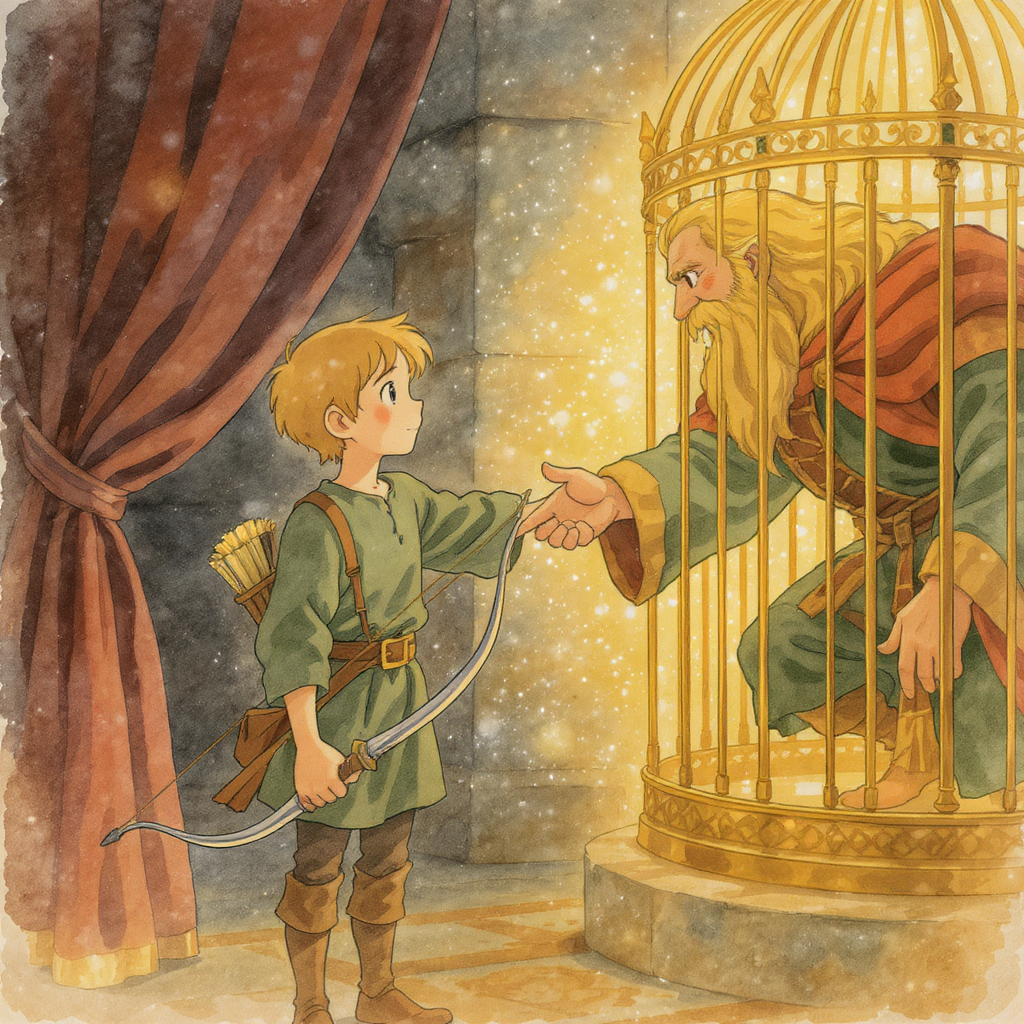
The Gold-Bearded Man Once upon a time there lived a great king who had a wife and one son whom he loved very much. The boy was still young when, one day, the king said to his wife: “I feel that the hour of my death draws near, and I want you to promise that you will never take another husband but will give up your life to the care of our son.” The queen burst into tears at these words, and sobbed out that she would never, never marry again, and that her son’s welfare should be her first thought as long as she lived. Her promise comforted the troubled heart of the king, and a few days after he died, at peace with himself and with the world. But no sooner was the breath out of his body, than the queen said to herself, “To promise is one thing, and to keep is quite another.” And hardly was the last spadeful of earth flung over the coffin than she married a noble from a neighbouring country, and got him made king instead of the young prince. Her new husband was a cruel, wicked man, who treated his stepson very badly, and gave him scarcely anything to eat, and only rags to wear; and he would certainly have killed the boy but for fear of the people. Now by the palace grounds there ran a brook, but instead of being a water-brook it was a milk-brook, and both rich and poor flocked to it daily and drew as much milk as they chose. The first thing the new king did when he was seated on the throne, was to forbid anyone to go near the brook, on pain of being seized by the watchmen. And this was purely spite, for there was plenty of milk for everybody. For some days no one dared venture near the banks of the stream, but at length some of the watchmen noticed that early in the mornings, just at dawn, a man with a gold beard came down to the brook with a pail, which he filled up to the brim with milk, and then vanished like smoke before they could get near enough to see who he was. So they went and told the king what they had seen. At first the king would not believe their story, but as they persisted it was quite true, he said that he would go and watch the stream that night himself. With the earliest streaks of dawn the gold-bearded man appeared, and filled his pail as before. Then in an instant he had vanished, as if the earth had swallowed him up. The king stood staring with eyes and mouth open at the place where the man had disappeared. He had never seen him before, that was certain; but what mattered much more was how to catch him, and what should be done with him when he was caught? He would have a cage built as a prison for him, and everyone would talk of it, for in other countries thieves were put in prison, and it was long indeed since any king had used a cage. It was all very well to plan, and even to station a watchman behind every bush, but it was of no use, for the man was never caught. They would creep up to him softly on the grass, as he was stooping to fill his pail, and just as they stretched out their hands to seize him, he vanished before their eyes. Time after time this happened, till the king grew mad with rage, and offered a large reward to anyone who could tell him how to capture his enemy. The first person that came with a scheme was an old soldier who promised the king that if he would only put some bread and bacon and a flask of wine on the bank of the stream, the gold-bearded man would be sure to eat and drink, and they could shake some powder into the wine, which would send him to sleep at once. After that there was nothing to do but to shut him in the cage. This idea pleased the king, and he ordered bread and bacon and a flask of drugged wine to be placed on the bank of the stream, and the watchers to be redoubled. Then, full of hope, he awaited the result. Everything turned out just as the soldier had said. Early next morning the gold-bearded man came down to the brook, ate, drank, and fell sound asleep, so that the watchers easily bound him, and carried him off to the palace. In a moment the king had him fast in the golden cage, and showed him, with ferocious joy, to the strangers who were visiting his court. The poor captive, when he awoke from his drunken sleep, tried to talk to them, but no one would listen to him, so he shut himself up altogether, and the people who came to stare took him for a dumb man of the woods. He wept and moaned to himself all day, and would hardly touch food, though, in dread that he should die and escape his tormentors, the king ordered his head cook to send him dishes from the royal table. The gold-bearded man had been in captivity about a month, when the king was forced to make war upon a neighbouring country, and left the palace, to take command of his army. But before he went he called his stepson to him and said: “Listen, boy, to what I tell you. While I am away I trust the care of my prisoner to you. See that he has plenty to eat and drink, but be careful that he does not escape, or even walk about the room. If I return and find him gone, you will pay for it by a terrible death.” The young prince was thankful that his stepfather was going to the war, and secretly hoped he might never come back. Directly he had ridden off the boy went to the room where the cage was kept, and never left it night and day. He even played his games beside it. One day he was shooting at a mark with a silver bow; one of his arrows fell into the golden cage. “Please give me my arrow,” said the prince, running up to him; but the gold-bearded man answered: “No, I shall not give it to you unless you let me out of my cage.” “I may not let you out,” replied the boy, “for if I do my stepfather says that I shall have to die a horrible death when he returns from the war. My arrow can be of no use to you, so give it to me.” The man handed the arrow through the bars, but when he had done so he begged harder than ever that the prince would open the door and set him free. Indeed, he prayed so earnestly that the prince’s heart was touched, for he was a tender-hearted boy who pitied the sorrows of other people. So he shot back the bolt, and the gold-bearded man stepped out into the world. “I will repay you a thousand fold for that good deed.” said the man, and then he vanished. The prince began to think what he should say to the king when he came back; then he wondered whether it would be wise to wait for his stepfather’s return and run the risk of the dreadful death which had been promised him. “No,” he said to himself, “I am afraid to stay. Perhaps the world will be kinder to me than he has been.” Unseen he stole out when twilight fell, and for many days he wandered over mountains and through forests and valleys without knowing where he was going or what he should do. He had only the berries for food, when, one morning, he saw a wood-pigeon sitting on a bough. In an instant he had fitted an arrow to his bow, and was taking aim at the bird, thinking what a good meal he would make off him, when his weapon fell to the ground at the sound of the pigeon’s voice: “Do not shoot, I implore you, noble prince! I have two little sons at home, and they will die of hunger if I am not there to bring them food.” And the young prince had pity, and unstrung his bow. “Oh, prince, I will repay your deed of mercy, said the grateful wood-pigeon. “Poor thing! how can you repay me?” asked the prince. “You have forgotten,” answered the wood-pigeon, “the proverb that runs, ‘mountain and mountain can never meet, but one living creature can always come across another.’” The boy laughed at this speech and went his way. By-and-by he reached the edge of a lake, and flying towards some rushes which grew near the shore he beheld a wild duck. Now, in the days that the king, his father, was alive, and he had everything to eat he could possibly wish for, the prince always had wild duck for his birthday dinner, so he quickly fitted an arrow to his bow and took a careful aim. “Do not shoot, I pray you, noble prince!” cried the wild duck; “I have two little sons at home; they will die of hunger if I am not there to bring them food.” And the prince had pity, and let fall his arrow and unstrung his bow. “Oh, prince! I will repay your deed of mercy,” exclaimed the grateful wild duck. “You poor thing! how can you repay me?” asked the prince. “You have forgotten,” answered the wild duck, “the proverb that runs, ‘mountain and mountain can never meet, but one living creature can always come across another.’” The boy laughed at this speech and went his way. He had not wandered far from the shores of the lake, when he noticed a stork standing on one leg, and again he raised his bow and prepared to take aim. “Do not shoot, I pray you, noble prince,” cried the stork; “I have two little sons at home; they will die of hunger if I am not there to bring them food.” Again the prince was filled with pity, and this time also he did not shoot. “Oh, prince, I will repay your deed of mercy,” cried the stork. “You poor stork! how can you repay me?” asked the prince. “You have forgotten,” answered the stork, “the proverb that runs, ‘mountain and mountain can never meet, but one living creature can always come across another.’” The boy laughed at hearing these words again, and walked slowly on. He had not gone far, when he fell in with two discharged soldiers. “Where are you going, little brother?” asked one. “I am seeking work,” answered the prince. “So are we,” replied the soldier. “We can all go together.” The boy was glad of company and they went on, and on, and on, through seven kingdoms, without finding anything they were able to do. At length they reached a palace, and there was the king standing on the steps. “You seem to be looking for something,” said he. “It is work we want,” they all answered. So the king told the soldiers that they might become his coachmen; but he made the boy his companion, and gave him rooms near his own. The soldiers were dreadfully angry when they heard this, for of course they did not know that the boy was really a prince; and they soon began to lay their heads together to plot his ruin. Then they went to the king. “Your Majesty,” they said, “we think it our duty to tell you that your new companion has boasted to us that if he were only your steward he would not lose a single grain of corn out of the storehouses. Now, if your Majesty would give orders that a sack of wheat should be mixed with one of barley, and would send for the youth, and command him to separate the grains one from another, in two hours’ time, you would soon see what his talk was worth.” The king, who was weak, listened to what these wicked men had told him, and desired the prince to have the contents of the sack piled into two heaps by the time that he returned from his council. “If you succeed,” he added, “you shall be my steward, but if you fail, I will put you to death on the spot.” The unfortunate prince declared that he had never made any such boast as was reported; but it was all in vain. The king did not believe him, and turning him into an empty room, bade his servants carry in the huge sack filled with wheat and barley, and scatter them in a heap on the floor. The prince hardly knew where to begin, and indeed if he had had a thousand people to help him, and a week to do it in, he could never have finished his task. So he flung himself on the ground in despair, and covered his face with his hands. While he lay thus, a wood-pigeon flew in through the window. “Why are you weeping, noble prince?” asked the wood-pigeon. “How can I help weeping at the task set me by the king. For he says, if I fail to do it, I shall die a horrible death.” “Oh, there is really nothing to cry about,” answered the wood-pigeon soothingly. “I am the king of the wood-pigeons, whose life you spared when you were hungry. And now I will repay my debt, as I promised.” So saying he flew out of the window, leaving the prince with some hope in his heart. In a few minutes he returned, followed by a cloud of wood-pigeons, so dense that it seemed to fill the room. Their king showed them what they had to do, and they set to work so hard that the grain was sorted into two heaps long before the council was over. When the king came back he could not believe his eyes; but search as he might through the two heaps, he could not find any barley among the wheat, or any wheat amongst the barley. So he praised the prince for his industry and cleverness, and made him his steward at once. This made the two soldiers more envious still, and they began to hatch another plot. “Your Majesty,” they said to the king, one day, as he was standing on the steps of the palace, “that fellow has been boasting again, that if he had the care of your treasures not so much as a gold pin should ever be lost. Put this vain fellow to the proof, we pray you, and throw the ring from the princess’s finger into the brook, and bid him find it. We shall soon see what his talk is worth.” And the foolish king listened to them, and ordered the prince to be brought before him. “My son,” he said, “I have heard that you have declared that if I made you keeper of my treasures you would never lose so much as a gold pin. Now, in order to prove the truth of your words, I am going to throw the ring from the princess’s finger into the brook, and if you do not find it before I come back from council, you will have to die a horrible death.” It was no use denying that he had said anything of the kind. The king did not believe him; in fact he paid no attention at all, and hurried off, leaving the poor boy speechless with despair in the corner. However, he soon remembered that though it was very unlikely that he should find the ring in the brook, it was impossible that he should find it by staying in the palace. For some time the prince wandered up and down peering into the bottom of the stream, but though the water was very clear, nothing could he see of the ring. At length he gave it up in despair, and throwing himself down at the foot of the tree, he wept bitterly. “What is the matter, dear prince?” said a voice just above him, and raising his head, he saw the wild duck. “The king of this country declares I must die a horrible death if I cannot find the princess’s ring which he has thrown into the brook,” answered the prince. “Oh, you must not vex yourself about that, for I can help you,” replied the bird. “I am the king of the wild ducks, whose life you spared, and now it is my turn to save yours.” Then he flew away, and in a few minutes a great flock of wild ducks were swimming all up and down the stream looking with all their might, and long before the king came back from his council there it was, safe on the grass beside the prince. At this sight the king was yet more astonished at the cleverness of his steward, and at once promoted him to be the keeper of his jewels. Now you would have thought that by this time the king would have been satisfied with the prince, and would have left him alone; but people’s natures are very hard to change, and when the two envious soldiers came to him with a new falsehood, he was as ready to listen to them as before. “Gracious Majesty,” said they, “the youth whom you have made keeper of your jewels has declared to us that a child shall be born in the palace this night, which will be able to speak every language in the world and to play every instrument of music. Is he then become a prophet, or a magician, that he should know things which have not yet come to pass?” At these words the king became more angry than ever. He had tried to learn magic himself, but somehow or other his spells would never work, and he was furious to hear that the prince claimed a power that he did not possess. Stammering with rage, he ordered the youth to be brought before him, and vowed that unless this miracle was accomplished he would have the prince dragged at a horse’s tail until he was dead. In spite of what the soldiers had said, the boy knew no more magic than the king did, and his task seemed more hopeless than before. He lay weeping in the chamber which he was forbidden to leave, when suddenly he heard a sharp tapping at the window, and, looking up, he beheld a stork. “What makes you so sad, prince?” asked he. “Someone has told the king that I have prophesied that a child shall be born this night in the palace, who can speak all the languages in the world and play every musical instrument. I am no magician to bring these things to pass, but he says that if it does not happen he will have me dragged through the city at a horse’s tail till I die.” “Do not trouble yourself,” answered the stork. “I will manage to find such a child, for I am the king of the storks whose life you spared, and now I can repay you for it.” The stork flew away and soon returned carrying in his beak a baby wrapped in swaddling clothes, and laid it down near a lute. In an instant the baby stretched out its little hands and began to play a tune so beautiful that even the prince forgot his sorrows as he listened. Then he was given a flute and a zither, but he was just as well able to draw music from them; and the prince, whose courage was gradually rising, spoke to him in all the languages he knew. The baby answered him in all, and no one could have told which was his native tongue! The next morning the king went straight to the prince’s room, and saw with his own eyes the wonders that baby could do. “If your magic can produce such a baby,” he said, “you must be greater than any wizard that ever lived, and shall have my daughter in marriage.” And, being a king, and therefore accustomed to have everything the moment he wanted it, he commanded the ceremony to be performed without delay, and a splendid feast to be made for the bride and bridegroom. When it was over, he said to the prince: “Now that you are really my son, tell me by what arts you were able to fulfil the tasks I set you?” “My noble father-in-law,” answered the prince, “I am ignorant of all spells and arts. But somehow I have always managed to escape the death which has threatened me.” And he told the king how he had been forced to run away from his stepfather, and how he had spared the three birds, and had joined the two soldiers, who had from envy done their utmost to ruin him. The king was rejoiced in his heart that his daughter had married a prince, and not a common man, and he chased the two soldiers away with whips, and told them that if they ever dared to show their faces across the borders of his kingdom, they should die the same death he had prepared for the prince. [From Ungarische Mährchen] Tritill, Litill, And The Birds Once upon a time there lived a princess who was so beautiful and so good that everybody loved her. Her father could hardly bear her out of his sight, and he almost died of grief when, one day, she disappeared, and though the whole kingdom was searched through and through, she could not be found in any corner of it. In despair, the king ordered a proclamation to be made that whoever could bring her back to the palace should have her for his wife. This made the young men start afresh on the search, but they were no more successful than before, and returned sorrowfully to their homes. Now there dwelt, not far from the palace, an old man who had three sons. The two eldest were allowed by their parents to do just as they liked, but the youngest was always obliged to give way to his brothers. When they were all grown up, the eldest told his father that he was tired of leading such a quiet life, and that he meant to go away and see the world. The old people were very unhappy at the thought that they must part with him, but they said nothing, and began to collect all that he would want for his travels, and were careful to add a pair of new boots. When everything was ready, he bade them farewell, and started merrily on his way. For some miles his road lay through a wood, and when he left it he suddenly came out on a bare hillside. Here he sat down to rest, and pulling out his wallet prepared to eat his dinner. He had only eaten a few mouthfuls when an old man badly dressed passed by, and seeing the food, asked if the young man could not spare him a little. “Not I, indeed!” answered he; “why I have scarcely enough for myself. If you want food you must earn it.” And the beggar went on. After the young man had finished his dinner he rose and walked on for several hours, till he reached a second hill, where he threw himself down on the grass, and took some bread and milk from his wallet. While he was eating and drinking, there came by an old man, yet more wretched than the first, and begged for a few mouthfuls. But instead of food he only got hard words, and limped sadly away. Towards evening the young man reached an open space in the wood, and by this time he thought he would like some supper. The birds saw the food, and flew round his head in numbers hoping for some crumbs, but he threw stones at them, and frightened them off. Then he began to wonder where he should sleep. Not in the open space he was in, for that was bare and cold, and though he had walked a long way that day, and was tired, he dragged himself up, and went on seeking for a shelter. At length he saw a deep sort of hole or cave under a great rock, and as it seemed quite empty, he went in, and lay down in a corner. About midnight he was awakened by a noise, and peeping out he beheld a terrible ogress approaching. He implored her not to hurt him, but to let him stay there for the rest of the night, to which she consented, on condition that he should spend the next day in doing any task which she might choose to set him. To this the young man willingly agreed, and turned over and went to sleep again. In the morning, the ogress bade him sweep the dust out of the cave, and to have it clean before her return in the evening, otherwise it would be the worse for him. Then she left the cave. The young man took the spade, and began to clean the floor of the cave, but try as he would to move it the dirt still stuck to its place. He soon gave up the task, and sat sulkily in the corner, wondering what punishment the ogress would find for him, and why she had set him to do such an impossible thing. He had not long to wait, after the ogress came home, before he knew what his punishment was to be! She just gave one look at the floor of the cave, then dealt him a blow on the head which cracked his skull, and there was an end of him. Meanwhile his next brother grew tired of staying at home, and let his parents have no rest till they had consented that he also should be given some food and some new boots, and go out to see the world. On his road, he also met the two old beggars, who prayed for a little of his bread and milk, but this young man had never been taught to help other people, and had made it a rule through his life to keep all he had to himself. So he turned a deaf ear and finished his dinner. By-and-by he, too, came to the cave, and was bidden by the ogress to clean the floor, but he was no more successful than his brother, and his fate was the same. Anyone would have thought that when the old people had only one son left that at least they would have been kind to him, even if they did not love him. But for some reason they could hardly bear the sight of him, though he tried much harder to make them comfortable than his brothers had ever done. So when he asked their leave to go out into the world they gave it at once, and seemed quite glad to be rid of him. They felt it was quite generous of them to provide him with a pair of new boots and some bread and milk for his journey. Besides the pleasure of seeing the world, the youth was very anxious to discover what had become of his brothers, and he determined to trace, as far as he could, the way that they must have gone. He followed the road that led from his father’s cottage to the hill, where he sat down to rest, saying to himself: “I am sure my brothers must have stopped here, and I will do the same.” He was hungry as well as tired, and took out some of the food his parents had given him. He was just going to begin to eat when the old man appeared, and asked if he could not spare him a little. The young man at once broke off some of the bread, begging the old man to sit down beside him, and treating him as if he was an old friend. At last the stranger rose, and said to him: “If ever you are in trouble call me, and I will help you. My name is Tritill.” Then he vanished, and the young man could not tell where he had gone. However, he felt he had now rested long enough, and that he had better be going his way. At the next hill he met with the second old man, and to him also he gave food and drink. And when this old man had finished he said, like the first: “If you ever want help in the smallest thing call to me. My name is Litill.” The young man walked on till he reached the open space in the wood, where he stopped for dinner. In a moment all the birds in the world seemed flying round his head, and he crumbled some of his bread for them and watched them as they darted down to pick it up. When they had cleared off every crumb the largest bird with the gayest plumage said to him: “If you are in trouble and need help say, ‘My birds, come to me!’ and we will come.” Then they flew away. Towards evening the young man reached the cave where his brothers had met their deaths, and, like them, he thought it would be a good place to sleep in. Looking round, he saw some pieces of the dead men’s clothes and of their bones. The sight made him shiver, but he would not move away, and resolved to await the return of the ogress, for such he knew she must be. Very soon she came striding in, and he asked politely if she would give him a night’s lodging. She answered as before, that he might stay on condition that he should do any work that she might set him to next morning. So the bargain being concluded, the young man curled himself up in his corner and went to sleep. The dirt lay thicker than ever on the floor of the cave when the young man took the spade and began his work. He could not clear it any more than his brothers had done, and at last the spade itself stuck in the earth so that he could not pull it out. The youth stared at it in despair, then the old beggar’s words flashed into his mind, and he cried: “Tritill, Tritill, come and help me!” And Tritill stood beside him and asked what he wanted. The youth told him all his story, and when he had finished, the old man said: “Spade and shovel do your duty,” and they danced about the cave till, in a short time, there was not a speck of dust left on the floor. As soon as it was quite clean Tritill went his way. With a light heart the young man awaited the return of the ogress. When she came in she looked carefully round, and then said to him: “You did not do that quite alone. However, as the floor is clean I will leave your head on.” The following morning the ogress told the young man that he must take all the feathers out of her pillows and spread them to dry in the sun. But if one feather was missing when she came back at night his head should pay for it.” The young man fetched the pillows, and shook out all the feathers, and oh! what quantities of them there were! He was thinking to himself, as he spread them out carefully, how lucky it was that the sun was so bright and that there was no wind, when suddenly a breeze sprang up, and in a moment the feathers were dancing high in the air. At first the youth tried to collect them again, but he soon found that it was no use, and he cried in despair: “Tritill, Litill, and all my birds, come and help me!” He had hardly said the words when there they all were; and when the birds had brought all the feathers back again, Tritill, and Litill, and he, put them away in the pillows, as the ogress had bidden him. But one little feather they kept out, and told the young man that if the ogress missed it he was to thrust it up her nose. Then they all vanished,
Moral of the Story
Kindness and compassion, even to the seemingly insignificant, will be repaid manifold, while cruelty and selfishness lead to ruin.
Characters

The King ◆ supporting
Not described, but regal
Attire: Royal robes and crown
Loving, concerned

The Queen ⚔ antagonist
Not described, but regal
Attire: Royal gowns and jewelry
Selfish, deceitful

The Prince ★ protagonist
Thin, poorly dressed
Attire: Rags
Kind, hopeful

The New King ⚔ antagonist
Cruel-looking
Attire: Royal attire, armor
Cruel, wicked

The Gold-Bearded Man ◆ supporting
Mysterious
Attire: Not described, but likely simple
Quiet, sorrowful

The Old Soldier ◆ supporting
Wily
Attire: Old military uniform
Cunning, opportunistic

Tritill ◆ supporting
Not described
Attire: Not described
Helpful, magical

Litill ◆ supporting
Not described
Attire: Not described
Helpful, magical

The Ogress ⚔ antagonist
Large, strong, dirty
Attire: Ragged clothing
Cruel, demanding
Locations

Palace Grounds Milk-Brook
A brook that flows with milk instead of water, located near the palace grounds.
Mood: initially bountiful, then forbidden and secretive
The Gold-Bearded Man appears to collect milk, leading to the king's obsession and attempts to capture him.

Golden Cage in the Palace
A golden cage used as a prison within the palace.
Mood: oppressive, sorrowful
The Gold-Bearded Man is imprisoned, and the young prince interacts with him, eventually leading to his release.

Ogress's Cave
A cave where the ogress lives, initially dirty and filled with bones and remains of previous victims.
Mood: dangerous, menacing
The youngest brother stays the night and is tasked with impossible chores, which he completes with magical help.

Hillside
A hill where the youngest brother rests and shares his food with an old beggar.
Mood: peaceful, generous
The youngest brother shows kindness and receives the gift of magical aid from Tritill.
Story DNA
Moral
Kindness and compassion, even to the seemingly insignificant, will be repaid manifold, while cruelty and selfishness lead to ruin.
Plot Summary
A dying king's queen breaks her promise, remarrying a cruel man who abuses her son and imprisons a mysterious gold-bearded man. The compassionate prince releases the prisoner and flees, encountering and aiding various animals who promise their help. After his stepfather's defeat, the prince returns, is transformed into a handsome king by the gold-bearded man, and embarks on a quest to marry a princess he once saved. With the aid of his magical benefactors, he overcomes challenges, marries the princess, and rules justly, while his cruel stepfather faces retribution.
Themes
Emotional Arc
suffering to triumph
Writing Style
Narrative Elements
Cultural Context
This tale, collected by Andrew Lang, is a variant of a widespread European folktale type (ATU 550, 'The Quest for the Golden Bird' or 'The Bird, the Horse, and the Princess'). It reflects common themes of good vs. evil, the reward of virtue, and the power of magic in pre-industrial societies.
Plot Beats (12)
- A dying king makes his queen promise to care for their son and not remarry.
- The queen immediately remarries a cruel man who abuses the prince and imprisons a mysterious gold-bearded man.
- The prince, left in charge of the prisoner, pities the gold-bearded man and releases him, then flees the kingdom.
- The prince shows kindness to a wood-pigeon, a wild duck, and a wolf, who all promise future aid.
- The prince's stepfather is defeated in war, and the prince returns to find his mother and the kingdom in chaos.
- The gold-bearded man, revealed as a powerful king, appears and transforms the prince into a handsome man, making him the new king.
- The prince, now king, sets out to find his true love, a princess he had previously rescued from a dragon.
- The prince uses the help of the animals he befriended to overcome obstacles and reach the princess's kingdom.
- The prince, disguised, must pass tests set by the princess's father, including finding a lost ring and identifying the princess among her maids.
- With the help of the gold-bearded man and the animals, the prince succeeds in all tasks.
- The prince and princess are married, and the cruel stepfather is punished.
- The gold-bearded man, his curse broken, returns to his own kingdom, leaving the prince and princess to rule happily.


