The Magic Kettle
by Andrew Lang

The Magic Kettle
Once, an old man lived in a small house. He loved his house very much.
One day, he found an old, rusty kettle. It was in the corner of his room. He did not know how it got there.
He cleaned the kettle. It looked very nice. He put it on the fire.
A magic thing happened. The kettle got warm. It changed! The handle became a head. The spout became a tail. Four paws grew out. It was a funny animal. It jumped off the fire. It jumped with joy around the room.
The old man was surprised. He caught the animal gently. He put it in a wooden box.
A man named Jimmu came to visit. The old man wanted to sell the kettle. He opened the box. There was no animal inside. Only the old kettle was there. Jimmu bought the kettle. He took it home.
That night, Jimmu heard a noise. He looked. The kettle changed into the animal again! The animal played and danced. In the morning, it was a kettle again.
Jimmu told his friend. His friend had a good idea. "Show the animal to people," he said. "But you must ask the animal first. Ask if it wants to help."
Jimmu asked the animal. The animal said yes. Jimmu made a little show tent. He told people to come and see.
Many people came. Jimmu put the kettle on a stand. It changed into the animal. The animal danced fun dances. All were very happy.
Jimmu got lots of money from the show. He was rich. But he felt he should share. The old man had found the kettle first.
Jimmu went back to the old man. He gave the kettle back. He put some gold inside it. "Thank you for being honest," said the old man. "You are kind," he said.
The magic kettle brought them both good luck. They lived happy for a long time. Being honest and kind brings good things and friends.
Original Story
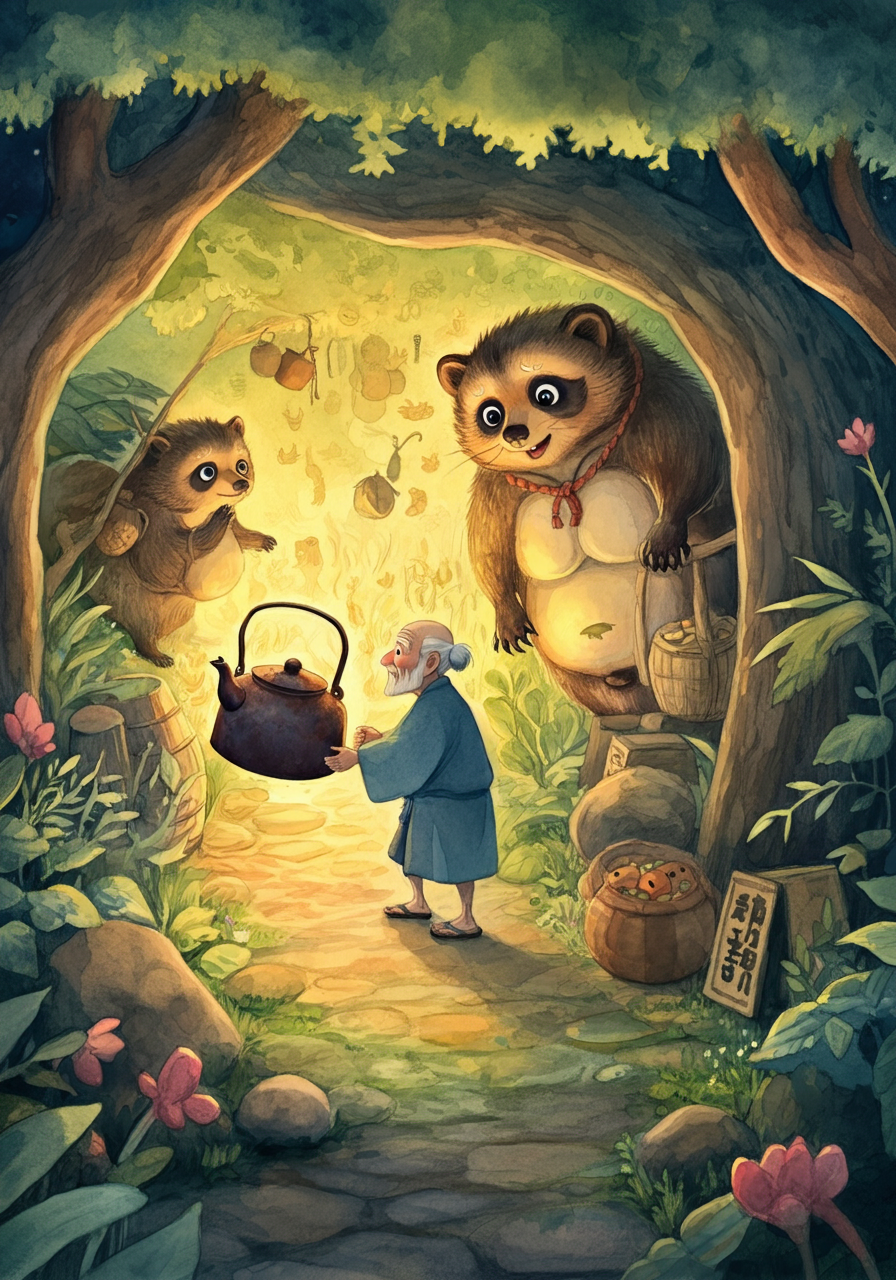
The Magic Kettle Right in the middle of Japan, high up among the mountains, an old man lived in his little house. He was very proud of it, and never tired of admiring the whiteness of his straw mats, and the pretty papered walls, which in warm weather always slid back, so that the smell of the trees and flowers might come in. One day he was standing looking at the mountain opposite, when he heard a kind of rumbling noise in the room behind him. He turned round, and in the corner he beheld a rusty old iron kettle, which could not have seen the light of day for many years. How the kettle got there the old man did not know, but he took it up and looked it over carefully, and when he found that it was quite whole he cleaned the dust off it and carried it into his kitchen. “That was a piece of luck,” he said, smiling to himself; “a good kettle costs money, and it is as well to have a second one at hand in case of need; mine is getting worn out, and the water is already beginning to come through its bottom.” Then he took the other kettle off the fire, filled the new one with water, and put it in its place. No sooner was the water in the kettle getting warm than a strange thing happened, and the man, who was standing by, thought he must be dreaming. First the handle of the kettle gradually changed its shape and became a head, and the spout grew into a tail, while out of the body sprang four paws, and in a few minutes the man found himself watching, not a kettle, but a tanuki! The creature jumped off the fire, and bounded about the room like a kitten, running up the walls and over the ceiling, till the old man was in an agony lest his pretty room should be spoilt. He cried to a neighbour for help, and between them they managed to catch the tanuki, and shut him up safely in a wooden chest. Then, quite exhausted, they sat down on the mats, and consulted together what they should do with this troublesome beast. At length they decided to sell him, and bade a child who was passing send them a certain tradesman called Jimmu. When Jimmu arrived, the old man told him that he had something which he wished to get rid of, and lifted the lid of the wooden chest, where he had shut up the tanuki. But, to his surprise, no tanuki was there, nothing but the kettle he had found in the corner. It was certainly very odd, but the man remembered what had taken place on the fire, and did not want to keep the kettle any more, so after a little bargaining about the price, Jimmu went away carrying the kettle with him. Now Jimmu had not gone very far before he felt that the kettle was getting heavier and heavier, and by the time he reached home he was so tired that he was thankful to put it down in the corner of his room, and then forgot all about it. In the middle of the night, however, he was awakened by a loud noise in the corner where the kettle stood, and raised himself up in bed to see what it was. But nothing was there except the kettle, which seemed quiet enough. He thought that he must have been dreaming, and fell asleep again, only to be roused a second time by the same disturbance. He jumped up and went to the corner, and by the light of the lamp that he always kept burning he saw that the kettle had become a tanuki, which was running round after his tail. After he grew weary of that, he ran on the balcony, where he turned several somersaults, from pure gladness of heart. The tradesman was much troubled as to what to do with the animal, and it was only towards morning that he managed to get any sleep; but when he opened his eyes again there was no tanuki, only the old kettle he had left there the night before. As soon as he had tidied his house, Jimmu set off to tell his story to a friend next door. The man listened quietly, and did not appear so surprised as Jimmu expected, for he recollected having heard, in his youth, something about a wonder-working kettle. “Go and travel with it, and show it off,” said he, “and you will become a rich man; but be careful first to ask the tanuki’s leave, and also to perform some magic ceremonies to prevent him from running away at the sight of the people.” Jimmu thanked his friend for his counsel, which he followed exactly. The tanuki’s consent was obtained, a booth was built, and a notice was hung up outside it inviting the people to come and witness the most wonderful transformation that ever was seen. They came in crowds, and the kettle was passed from hand to hand, and they were allowed to examine it all over, and even to look inside. Then Jimmu took it back, and setting it on the platform, commanded it to become a tanuki. In an instant the handle began to change into a head, and the spout into a tail, while the four paws appeared at the sides. “Dance,” said Jimmu, and the tanuki did his steps, and moved first on one side and then on the other, till the people could not stand still any longer, and began to dance too. Gracefully he led the fan dance, and glided without a pause into the shadow dance and the umbrella dance, and it seemed as if he might go on dancing for ever. And so very likely he would, if Jimmu had not declared he had danced enough, and that the booth must now be closed. Day after day the booth was so full it was hardly possible to enter it, and what the neighbour foretold had come to pass, and Jimmu was a rich man. Yet he did not feel happy. He was an honest man, and he thought that he owed some of his wealth to the man from whom he had bought the kettle. So, one morning, he put a hundred gold pieces into it, and hanging the kettle once more on his arm, he returned to the seller of it. “I have no right to keep it any longer,” he added when he had ended his tale, “so I have brought it back to you, and inside you will find a hundred gold pieces as the price of its hire.” The man thanked Jimmu, and said that few people would have been as honest as he. And the kettle brought them both luck, and everything went well with them till they died, which they did when they were very old, respected by everyone. [Adapted from Japanische Mährchen] *** END OF THE PROJECT GUTENBERG EBOOK THE CRIMSON FAIRY BOOK *** Updated editions will replace the previous one—the old editions will be renamed. Creating the works from print editions not protected by U.S. copyright law means that no one owns a United States copyright in these works, so the Foundation (and you!) can copy and distribute it in the United States without permission and without paying copyright royalties. Special rules, set forth in the General Terms of Use part of this license, apply to copying and distributing Project Gutenberg™ electronic works to protect the PROJECT GUTENBERG™ concept and trademark. Project Gutenberg is a registered trademark, and may not be used if you charge for an eBook, except by following the terms of the trademark licen
Moral of the Story
Honesty and kindness can lead to lasting prosperity and respect.
Characters

Old Man ★ protagonist
Not explicitly described, but likely frail due to age.
Attire: Traditional Japanese clothing for an elderly man of modest means, such as a simple kimono and perhaps a haori jacket.
Proud, appreciative, honest

Magic Kettle/Tanuki ◆ supporting
Rusty iron kettle that transforms into a tanuki with head, tail, and paws.
Attire: None (as a kettle); as a tanuki, natural fur.
Playful, energetic, cooperative (eventually)

Jimmu ◆ supporting
Not explicitly described, but implied to be of average build.
Attire: Tradesman's attire of the period, likely a practical kimono and perhaps a simple overcoat.
Honest, enterprising, initially bewildered

Jimmu's Friend ○ minor
Not described.
Attire: Not described.
Helpful, knowledgeable, calm
Locations

Old Man's Little House
A small dwelling high in the mountains, featuring white straw mats and pretty papered walls that slide back in warm weather.
Mood: Proud, peaceful, and appreciative of nature.
The old man discovers the magic kettle.

Old Man's Kitchen
A kitchen with a hearth where the old man usually boils water.
Mood: Ordinary, domestic.
The kettle transforms into a tanuki for the first time.

Jimmu's Room
A room where Jimmu puts the kettle in the corner.
Mood: Startled, confused.
The kettle transforms into a tanuki at night, running around and performing somersaults.

Jimmu's Booth
A temporary structure with a platform inside, where the kettle transforms into a tanuki and dances for the public.
Mood: Festive, crowded, and magical.
The tanuki performs various dances, attracting large crowds and making Jimmu rich.
Story DNA
Moral
Honesty and kindness can lead to lasting prosperity and respect.
Plot Summary
An old man finds a rusty kettle that transforms into a lively tanuki when heated. Frightened, he sells it to a tradesman named Jimmu. The kettle transforms again for Jimmu, who, advised by a friend, decides to put on public performances with the shapeshifting tanuki. They become rich, but Jimmu, out of honesty, returns the kettle and a portion of his earnings to the old man. Both men live long, prosperous, and respected lives, benefiting from the magic kettle's fortune.
Themes
Emotional Arc
discovery to wonder to prosperity
Writing Style
Narrative Elements
Cultural Context
Tanuki are a common figure in Japanese folklore, known for their shapeshifting abilities and often associated with good fortune. The story reflects traditional Japanese values of honesty and community.
Plot Beats (13)
- An old man in a mountain house in Japan finds a rusty old kettle.
- He cleans it and puts it on the fire to boil water.
- The kettle transforms into a lively tanuki, jumping around the room.
- The old man and a neighbor catch the tanuki and lock it in a chest.
- When a tradesman named Jimmu comes to buy it, the tanuki has reverted to a kettle.
- Jimmu buys the kettle, but it transforms into a tanuki again in his home that night.
- Jimmu consults a friend who advises him to perform with the tanuki for profit, after gaining its consent.
- Jimmu builds a booth, obtains the tanuki's consent, and advertises a wondrous transformation.
- Crowds gather to watch the kettle transform into a tanuki and perform various dances.
- Jimmu becomes very rich from the performances.
- Feeling he owes the old man, Jimmu returns the kettle with a hundred gold pieces inside.
- The old man thanks Jimmu for his honesty.
- Both Jimmu and the old man live long, prosperous, and respected lives, thanks to the magic kettle.


