The Rogue and the Herdsman
by Andrew Lang

Clever Tom and the Herdsman
Once, there was a boy named Tom. He did not like hard work. He liked to play all day. His father was worried about Tom. One day, his father said, “Go, Tom. You must learn to work. Find a job and be clever.” Tom took some food for his trip. He said goodbye to his father. He walked and walked for a long time. He found a big house on a hill. He knocked on the door carefully.
A man opened it with a smile. “I am Mr. Herdsman,” he said. “You can sleep here tonight.” “Thank you,” said Tom happily. The next morning, Mr. Herdsman said, “Today, you work. Watch my pigs in the woods.” “I can do that,” said Tom bravely. He took the pigs to the woods. But the pigs ran away quickly! Tom was surprised and scared.
Tom went to his father’s house fast. “Hello, Father,” said Tom quietly. “Look at these pigs I have.” “Whose pigs are these?” asked his father. “They are Mr. Herdsman’s,” said Tom. “Help me make them disappear, please.” His father helped him with a nod. They hid all the pigs together. Tom took the pig tails carefully. He put them in the mud softly.
He went back to Mr. Herdsman slowly. “Oh no!” said Tom with big eyes. “The pigs went into the mud!” Mr. Herdsman looked at the mud. He saw the tails in the mud. “Oh my!” he said surprised. “That is very strange indeed.” He pulled a tail gently. It did not move at all. “You told the truth,” he said kindly.
The next day, Mr. Herdsman said, “Watch my sheep.” “I will,” said Tom with confidence. He took the sheep to a green field. But the sheep ran away fast! Tom went to his father’s house again. “Help me,” he said softly. They hid all the sheep together. Tom took a bell from a ram’s collar. He put it on a high rock.
He went back to Mr. Herdsman quickly. “Oh no!” said Tom with a sad face. “The sheep flew away into the sky!” Mr. Herdsman looked up high. He saw the bell on the rock. “Oh my!” he said amazed. “That is very strange for sure.” He heard the bell ring clearly. “You told the truth,” he said happily.
The next day, Mr. Herdsman said, “Watch my cows.” “I will,” said Tom with a smile. He took the cows to a big field. But the cows ran away suddenly! Tom went to his father’s house fast. “Help me,” he said quietly. They hid all the cows together. Tom made a small fire carefully. It made some smoke rise up.
He went back to Mr. Herdsman slowly. “Oh no!” said Tom pointing. “The cows are gone forever! See the smoke in the air.” Mr. Herdsman looked at the smoke. He saw the smoke floating. “Oh my!” he said confused. “That is very strange indeed.” “You told the truth,” he said softly.
Mr. Herdsman was very amazed by Tom. He gave Tom a new job happily. “Make some tools for me,” he said. Tom could not make tools at all. He visited his parents for advice. Then he came back with an idea.
Tom had a clever idea in his mind. He went to Mr. Herdsman with excitement. He held a stick like a sword playfully. “Can I marry your daughter?” he asked politely. Mr. Herdsman smiled at Tom warmly. “Yes!” he said with joy. “You are very clever, Tom.” Tom married the daughter in a fun wedding. They were very happy together.
Later, Tom told Mr. Herdsman his tricks. “I hid the animals,” he said laughing. Mr. Herdsman laughed with Tom loudly. “That is very funny!” he said.
The King heard the story from someone. He called Tom to the palace. “You are very clever,” said the King. “Using your brain is great! You can be my helper now.” Tom was very happy with this. And Tom lived cleverly ever after.
Original Story
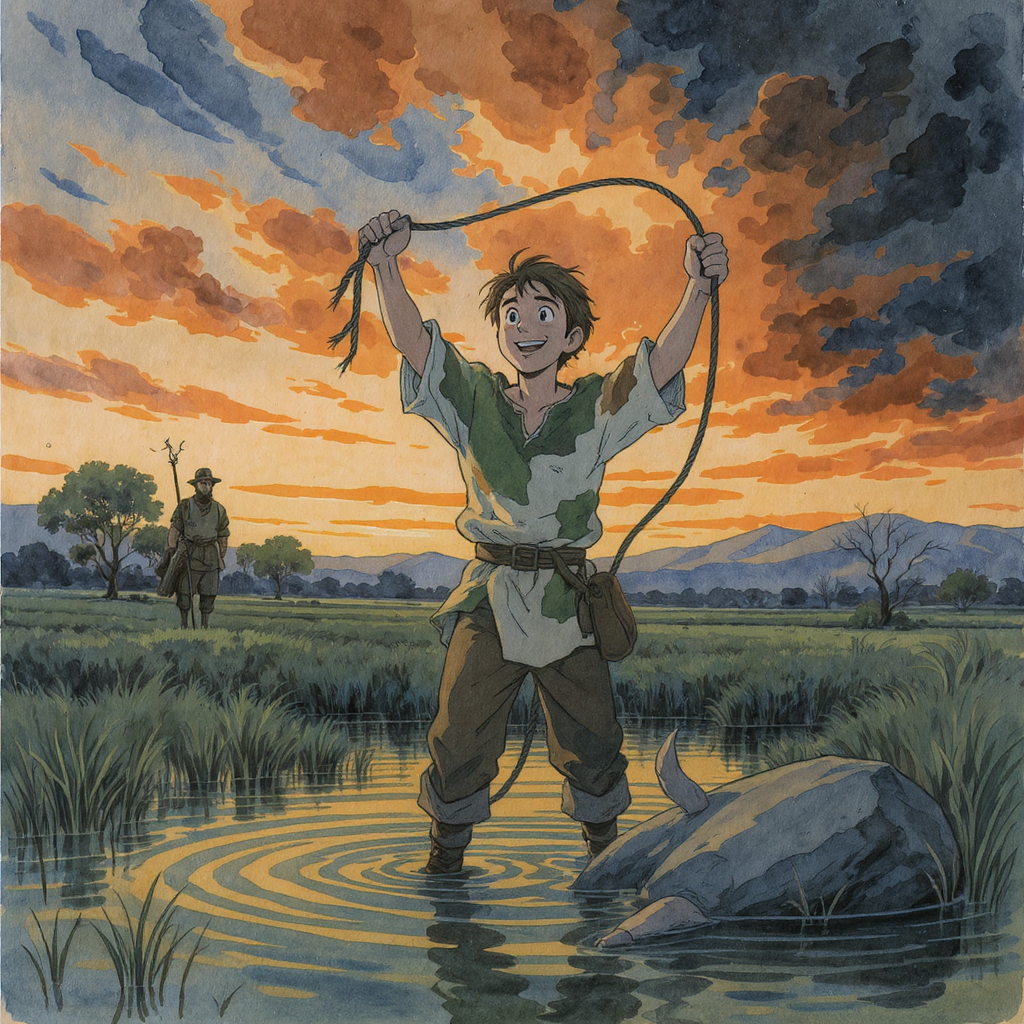
The Rogue And The Herdsman In a tiny cottage near the king’s palace there once lived an old man, his wife, and his son, a very lazy fellow, who would never do a stroke of work. He could not be got even to look after their one cow, but left her to look after herself, while he lay on a bank and went to sleep in the sun. For a long time his father bore with him, hoping that as he grew older he might gain more sense; but at last the old man’s patience was worn out, and he told his son that he should not stay at house in idleness, and must go out into the world to seek his fortune. The young man saw that there was no help for it, and he set out with a wallet full of food over his shoulder. At length he came to a large house, at the door of which he knocked. “What do you want?” asked the old man who opened it. And the youth told him how his father had turned him out of his house because he was so lazy and stupid, and he needed shelter for the night. “That you shall have,” replied the man; “but to-morrow I shall give you some work to do, for you must know that I am the chief herdsman of the king.” The youth made no answer to this. He felt, if he was to be made to work after all, that he might as well have stayed where he was. But as he did not see any other way of getting a bed, he went slowly in. The herdsman’s two daughters and their mother were sitting at supper, and invited him to join them. Nothing more was said about work, and when the meal was over they all went to bed. In the morning, when the young man was dressed, the herdsman called to him and said: “Now listen, and I will tell you what you have to do.” “What is it?” asked the youth, sulkily. “Nothing less than to look after two hundred pigs,” was the reply. “Oh, I am used to that,” answered the youth. “Yes; but this time you will have to do it properly,” said the herdsman; and he took the youth to the place where the pigs were feeding, and told him to drive them to the woods on the side of the mountain. This the young man did, but as soon as they reached the outskirts of the mountain they grew quite wild, and would have run away altogether, had they not luckily gone towards a narrow ravine, from which the youth easily drove them home to his father’s cottage. “Where do all these pigs come from, and how did you get them?” asked the old man in surprise, when his son knocked at the door of the hut he had left only the day before. “They belong to the king’s chief herdsman,” answered his son. “He gave them to me to look after, but I knew I could not do it, so I drove them straight to you. Now make the best of your good fortune, and kill them and hang them up at once.” “What are you talking about?” cried the father, pale with horror. “We should certainly both be put to death if I did any such thing.” “No, no; do as I tell you, and I will get out of it somehow,” replied the young man. And in the end he had his way. The pigs were killed, and laid side by side in a row. Then he cut off the tails and tied them together with a piece of cord, and swinging the bundle over his back, he returned to the place where they should have been feeding. Here there was a small swamp, which was just what he wanted, and finding a large stone, he fastened the rope to it, and sank it in the swamp, after which he arranged the tails carefully one by one, so that only their points were seen sticking out of the water. When everything was in order, he hastened home to his master with such a sorrowful face that the herdsman saw at once that something dreadful had happened. “Where are the pigs?” asked he. “Oh, don’t speak of them!” answered the young man; “I really can hardly tell you. The moment they got into the field they became quite mad, and each ran in a different direction. I ran too, hither and thither, but as fast as I caught one, another was off, till I was in despair. At last, however, I collected them all and was about to drive them back, when suddenly they rushed down the hill into the swamp, where they vanished completely, leaving only the points of their tails, which you can see for yourself.” “You have made up that story very well,” replied the herdsman. “No, it is the real truth; come with me and I’ll prove it.” And they went together to the spot, and there sure enough were the points of the tails sticking up out of the water. The herdsman laid hold of the nearest, and pulled at it with all his might, but it was no use, for the stone and the rope held them all fast. He called to the young man to help him, but the two did not succeed any better than the one had done. “Yes, your story was true after all; it is a wonderful thing,” said the herdsman. “But I see it is no fault of yours, and I must put up with my loss as well as I can. Now let us return home, for it is time for supper. Next morning the herdsman said to the young man: “I have got some other work for you to do. To-day you must take a hundred sheep to graze; but be careful that no harm befalls them.” “I will do my best,” replied the youth. And he opened the gate of the fold, where the sheep had been all night, and drove them out into the meadow. But in a short time they grew as wild as the pigs had done, and scattered in all directions. The young man could not collect them, try as he would, and he thought to himself that this was the punishment for his laziness in refusing to look after his father’s one cow. At last, however, the sheep seemed tired of running about, and then the youth managed to gather them together, and drove them, as before, straight to his father’s house. “Whose sheep are these, and what are they doing here?” asked the old man in wonder, and his son told him. But when the tale was ended the father shook his head. “Give up these bad ways and take them back to your master,” said he. “No, no,” answered the youth; “I am not so stupid as that! We will kill them and have them for dinner.” “You will lose your life if you do,” replied the father. “Oh, I am not sure of that!” said the son, “and, anyway, I will have my will for once.” And he killed all the sheep and laid them on the grass. But he cut off the head of the ram which always led the flock and had bells round its horns. This he took back to the place where they should have been feeding, for here he had noticed a high rock, with a patch of green grass in the middle and two or three thick bushes growing on the edge. Up this rock he climbed with great difficulty, and fastened the ram’s head to the bushes with a cord, leaving only the tips of the horns with the bells visible. As there was a soft breeze blowing, the bushes to which the head was tied moved gently, and the bells rang. When all was done to his liking he hastened quickly back to his master. “Where are the sheep?” asked the herdsman as the young man ran panting up the steps. “Oh! don’t speak of them,” answered he. “It is only by a miracle that I am here myself.” “Tell me at once what has happened,” said the herdsman sternly. The youth began to sob, and stammered out: “I—I hardly know how to tell you! They—they—they were so—so troublesome—that I could not manage them at all. They—ran about in—in all directions, and I—I—ran after them and nearly died of fatigue. Then I heard a—a noise, which I—I thought was the wind. But—but—it was the sheep, which, be—before my very eyes, were carried straight up—up into the air. I stood watching them as if I was turned to stone, but there kept ringing in my ears the sound of the bells on the ram which led them.” “That is nothing but a lie from beginning to end,” said the herdsman. “No, it is as true as that there is a sun in heaven,” answered the young man. “Then give me a proof of it,” cried his master. “Well, come with me,” said the youth. By this time it was evening and the dusk was falling. The young man brought the herdsman to the foot of the great rock, but it was so dark you could hardly see. Still the sound of sheep bells rang softly from above, and the herdsman knew them to be those he had hung on the horns of his ram. “Do you hear?” asked the youth. “Yes, I hear; you have spoken the truth, and I cannot blame you for what has happened. I must bear the loss as best as I can.” He turned and went home, followed by the young man, who felt highly pleased with his own cleverness. “I should not be surprised if the tasks I set you were too difficult, and that you were tired of them,” said the herdsman next morning; “but to-day I have something quite easy for you to do. You must look after forty oxen, and be sure you are very careful, for one of them has gold-tipped horns and hoofs, and the king reckons it among his greatest treasures.” The young man drove out the oxen into the meadow, and no sooner had they got there than, like the sheep and the pigs, they began to scamper in all directions, the precious bull being the wildest of all. As the youth stood watching them, not knowing what to do next, it came into his head that his father’s cow was put out to grass at no great distance; and he forthwith made such a noise that he quite frightened the oxen, who were easily persuaded to take the path he wished. When they heard the cow lowing they galloped all the faster, and soon they all arrived at his father’s house. The old man was standing before the door of his hut when the great herd of animals dashed round a corner of the road, with his son and his own cow at their head. “Whose cattle are these, and why are they here?” he asked; and his son told him the story. “Take them back to your master as soon as you can,” said the old man; but the son only laughed, and said: “No, no; they are a present to you! They will make you fat!” For a long while the old man refused to have anything to do with such a wicked scheme; but his son talked him over in the end, and they killed the oxen as they had killed the sheep and the pigs. Last of all they came to the king’s cherished ox. The son had a rope ready to cast round its horns, and throw it to the ground, but the ox was stronger than the rope, and soon tore it in pieces. Then it dashed away to the wood, the youth following; over hedges and ditches they both went, till they reached the rocky pass which bordered the herdsman’s land. Here the ox, thinking itself safe, stopped to rest, and thus gave the young man a chance to come up with it. Not knowing how to catch it, he collected all the wood he could find and made a circle of fire round the ox, who by this time had fallen asleep, and did not wake till the fire had caught its head, and it was too late for it to escape. Then the young man, who had been watching, ran home to his master. “You have been away a long while,” said the herdsman. “Where are the cattle?” The young man gasped, and seemed as if he was unable to speak. At last he answered: “It is always the same story! The oxen are—gone—gone!” “G-g-gone?” cried the herdsman. “Scoundrel, you lie!” “I am telling you the exact truth,” answered the young man. “Directly we came to the meadow they grew so wild that I could not keep them together. Then the big ox broke away, and the others followed till they all disappeared down a deep hole into the earth. It seemed to me that I heard sounds of bellowing, and I thought I recognised the voice of the golden horned ox; but when I got to the place from which the sounds had come, I could neither see nor hear anything in the hole itself, though there were traces of a fire all round it.” “Wretch!” cried the herdsman, when he had heard this story, “even if you did not lie before, you are lying now.” “No, master, I am speaking the truth. Come and see for yourself.” “If I find you have deceived me, you are a dead man, said the herdsman; and they went out together. “What do you call that?” asked the youth. And the herdsman looked and saw the traces of a fire, which seemed to have sprung up from under the earth. “Wonder upon wonder,” he exclaimed, “so you really did speak the truth after all! Well, I cannot reproach you, though I shall have to pay heavily to my royal master for the value of that ox. But come, let us go home! I will never set you to herd cattle again, henceforward I will give you something easier to do.” “I have thought of exactly the thing for you,” said the herdsman as they walked along, “and it is so simple that you cannot make a mistake. Just make me ten scythes, one for every man, for I want the grass mown in one of my meadows to-morrow.” At these words the youth’s heart sank, for he had never been trained either as a smith or a joiner. However, he dared not say no, but smiled and nodded. Slowly and sadly he went to bed, but he could not sleep, for wondering how the scythes were to be made. All the skill and cunning he had shown before was of no use to him now, and after thinking about the scythes for many hours, there seemed only one way open to him. So, listening to make sure that all was still, he stole away to his parents, and told them the whole story. When they had heard everything, they hid him where no one could find him. Time passed away, and the young man stayed at home doing all his parents bade him, and showing himself very different from what he had been before he went out to see the world; but one day he said to his father that he should like to marry, and have a house of his own. “When I served the king’s chief herdsman,” added he, “I saw his daughter, and I am resolved to try if I cannot win her for my wife.” “It will cost you your life, if you do,” answered the father, shaking his head. “Well, I will do my best,” replied his son; “but first give me the sword which hangs over your bed!” The old man did not understand what good the sword would do, however he took it down, and the young man went his way. Late in the evening he arrived at the house of the herdsman, and knocked at the door, which was opened by a little boy. “I want to speak to your master,” said he. “So it is you?” cried the herdsman, when he had received the message. “Well, you can sleep here to-night if you wish.” “I have come for something else besides a bed,” replied the young man, drawing his sword, “and if you do not promise to give me your youngest daughter as my wife I will stab you through the heart.” What could the poor man do but promise? And he fetched his youngest daughter, who seemed quite pleased at the proposed match, and gave the youth her hand. Then the young man went home to his parents, and bade them get ready to welcome his bride. And when the wedding was over he told his father-in-law, the herdsman, what he had done with the sheep, and pigs, and cattle. By-and-by the story came to the king’s ears, and he thought that a man who was so clever was just the man to govern the country; so he made him his minister, and after the king himself there was no one so great as he. [From Islandische Mährchen.] Eisenkopf Once upon a time there lived an old man who had only one son, whom he loved dearly; but they were very poor, and often had scarcely enough to eat. Then the old man fell ill, and things grew worse than ever, so he called his son and said to him: “My dear boy, I have no longer any food to give you, and you must go into the world and get it for yourself. It does not matter what work you do, but remember if you do it well and are faithful to your master, you will always have your reward.” So Peter put a piece of black bread in his knapsack, and strapping it on his back, took a stout stick in his hand, and set out to seek his fortune. For a long while he travelled on and on, and nobody seemed to want him; but one day he met an old man, and being a polite youth, he took off his hat and said: “Good morning,” in a pleasant voice. “Good morning,” answered the old man; “and where are you going?” “I am wandering through the country trying to get work,” replied Peter. “Then stay with me, for I can give you plenty,” said the old man, and Peter stayed. His work did not seem hard, for he had only two horses and a cow to see after, and though he had been hired for a year, the year consisted of but three days, so that it was not long before he received his wages. In payment the old man gave him a nut, and offered to keep him for another year; but Peter was home-sick; and, besides, he would rather have been paid ever so small a piece of money than a nut; for, thought he, nuts grow on every tree, and I can gather as many as I like. However, he did not say this to the old man, who had been kind to him, but just bade him farewell. The nearer Peter drew to his father’s house the more ashamed he felt at having brought back such poor wages. What could one nut do for him? Why, it would not buy even a slice of bacon. It was no use taking it home, he might as well eat it. So he sat down on a stone and cracked it with his teeth, and then took it out of his mouth to break off the shell. But who could ever guess what came out of that nut? Why, horses and oxen and sheep stepped out in such numbers that they seemed as if they would stretch to the world’s end! The sight gave Peter such a shock that he wrung his hands in dismay. What was he to do with all these creatures, where was he to put them? He stood and gazed in terror, and at this moment Eisenkopf came by. “What is the matter, young man?” asked he. “Oh, my friend, there is plenty the matter,” answered Peter. “I have gained a nut as my wages, and when I cracked it this crowd of beasts came out, and I don’t know what to do with them all!” “Listen to me, my son,” said Eisenkopf. “If you will promise never to marry I will drive them all back into the nut again.” In his trouble Peter would have promised far harder things than this, so he gladly gave the promise Eisenkopf asked for; and at a whistle from the stranger the animals all began crowding into the nut again, nearly tumbling over each other in their haste. When the last foot had got inside, the two halves of the shell shut close. Then Peter put it in his pocket and went on to the house. No sooner had he reached it than he cracked his nut for the second time, and out came the horses, sheep, and oxen again. Indeed Peter thought that there were even more of them than before. The old man could not believe his eyes when he saw the multitudes of horses, oxen and sheep standing before his door. “How did you come by all these?” he gasped, as soon as he could speak; and the son told him the whole story, and of the promise he had given
Moral of the Story
Cunning and quick wit can sometimes achieve more than honest labor, and can even lead to unexpected success.
Characters

The Rogue ★ protagonist
Lazy, but clever and resourceful
Attire: Simple peasant clothing, perhaps a tunic and trousers, with a wallet for carrying food
Lazy, cunning, resourceful

The Herdsman ◆ supporting
Stern, easily fooled
Attire: Practical clothing suitable for a herdsman, such as a tunic, sturdy boots, and a wide belt
Gullible, easily angered

The Father ◆ supporting
Worried, initially disapproving but eventually supportive
Attire: Simple, worn peasant clothing, reflecting his poverty
Anxious, cautious

The King ○ minor
Wise, discerning
Attire: Royal attire, including a crown, robes, and possibly a sword
Astute, values cleverness

Eisenkopf ⚔ antagonist
Mysterious, powerful
Attire: Unspecified
Deceptive
Locations

Tiny Cottage
Small, humble dwelling where the old man, his wife, and lazy son live near the king's palace.
Mood: poor, cramped
The son is kicked out to seek his fortune.

Herdsman's House
A large house where the king's chief herdsman lives with his wife and two daughters.
Mood: hospitable
The rogue gets a place to sleep.

Woods on the side of the mountain
A wooded area on a mountain slope, accessible via a narrow ravine.
Mood: wild
The pigs run wild.

Small Swamp
A swampy area where the rogue sinks the pig tails.
Mood: deceptive
The rogue tricks the herdsman into thinking the pigs drowned.
Story DNA
Moral
Cunning and quick wit can sometimes achieve more than honest labor, and can even lead to unexpected success.
Plot Summary
A lazy young man, cast out by his father, finds work as a herdsman for the king's chief herdsman. To avoid actual labor, he repeatedly tricks his master by faking the disappearance of pigs, sheep, and cattle, convincing the herdsman of bizarre accidents. When given a task requiring skill he lacks, he flees, then returns to coerce the herdsman into letting him marry his daughter. After the marriage, his clever deceptions are revealed to the king, who, impressed by his wit, appoints him as a minister.
Themes
Emotional Arc
laziness to cunning to triumph
Writing Style
Narrative Elements
Cultural Context
Fairy tales often reflect societal values where cleverness, even if deceptive, could be admired, especially if it led to a favorable outcome for the protagonist.
Plot Beats (15)
- A lazy young man is sent away by his father to find work.
- He finds shelter with the king's chief herdsman, who assigns him to herd 200 pigs.
- The young man drives the pigs to his father, who reluctantly helps him kill them.
- He fakes the pigs' disappearance by sinking their tails in a swamp, convincing the herdsman they drowned.
- The herdsman assigns him to herd 100 sheep.
- The young man drives the sheep to his father, who again helps him kill them.
- He fakes the sheep's disappearance by hanging a ram's head with bells on a high rock, convincing the herdsman they flew into the air.
- The herdsman assigns him to herd cattle, including a golden-horned ox.
- The young man drives the cattle to his father, kills them, and fakes their disappearance into a deep hole, using fire traces as evidence.
- The herdsman, though amazed, is convinced by the 'evidence' and gives up on herding tasks, assigning him to make ten scythes.
- Unable to perform this skilled labor, the young man flees to his parents, then returns to the herdsman's house.
- He threatens the herdsman with a sword, demanding to marry his youngest daughter.
- The herdsman, terrified, agrees, and the young man marries the daughter.
- After the wedding, the young man reveals his deceptions to his father-in-law.
- The king hears of the young man's cleverness and appoints him as his minister.


