The Six Hungry Beasts
by Andrew Lang

The Clever Fox and His White Tail
Once, a clever fox lived in the forest. He met a bear and a hungry wolf. They played a chasing game. It was a fun game. The smallest one had to run fast! Run, run, run! The squirrel ran up a tree. Up, up, up! The hare hopped deep into the woods. Hop, hop, hop! The marten ran fast into a burrow. Dig, dig, dig! Fox was next. He was not small. But Fox had a plan. Fox always had a plan. "Let us be friends," said Fox. "We can hunt together. We can share food." Bear and Wolf agreed. They were friends now. Good friends. They played together every day.
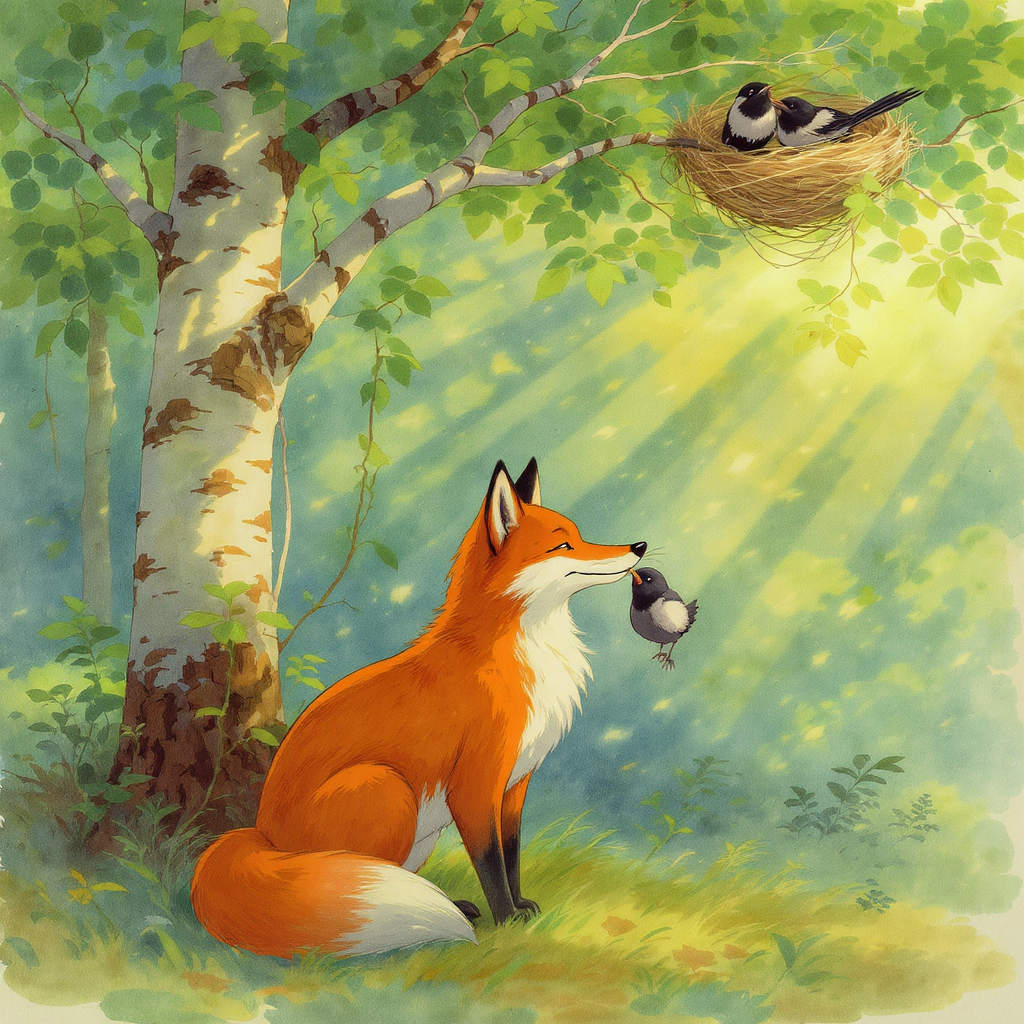
One day, Fox saw a magpie. The magpie had sweet, red berries. Yummy berries. Fox wanted the berries. He wanted them a lot. "I will cut this tree," said Fox. "I need it for a new sledge." "Oh no!" cried the magpie. "Please, no!" "Please do not cut my tree! My berries are here! My home is here!" "Give me some berries," said Fox. "Then I will not cut the tree." The sad magpie gave Fox some berries. Just a few. Fox was happy. He ate them all. Every single one. Fox licked his lips. Yum!
A few days later, Fox came back. He wanted more berries. More yummy berries. But the magpie was not sad now. The magpie was brave. Very brave. "You have no axe," said the magpie. "You cannot cut my tree!" "Who told you that?" asked Fox. "The wise crow told me," said the magpie. "He knows." Fox was angry at the crow. So angry. Fox planned to trick the crow.
Fox had a new plan. A clever plan. He lay very still on the path. Still as a stone. He closed his eyes. He did not move. Not a bit. The crow flew down. He wanted to see. Curious crow. Fox jumped up! He caught the crow's wing. Gotcha! "Ah, brother crow!" said Fox. "I will eat you now! Yum, yum!" "Wait!" said the clever crow. "Wait a moment!" "Throw me up high first. Then everyone will see how clever you are." Fox liked that idea. He liked it a lot. He threw the crow up high. Up, up! But the crow flew away! Fly away! "Ha ha!" laughed the crow. "Silly fox!" "You can catch, but you cannot keep!" Fox was very angry. He was also hungry. So hungry. Fox looked for food everywhere.
Later, Fox met his friend Bear. Bear looked very sad. Very, very sad. "What is wrong?" asked Fox. "I lost my pot of honey," said Bear. "I am so sad. I need help. Please help." Wolf tried to help. He howled. "Ow-oo!" howled Wolf. Loud and long. It was too loud. Bear was not happy. Not at all. Hare tried to help. She sang. "La-la-la!" sang Hare. Soft and sweet. It was too quiet. Bear was not happy. Still sad. Then Fox spoke. "I can help," he said. "I will find your honey. I am very clever." Bear was happy. "Yes! Help me!" he said. "Please!" Bear loved his honey very much.
Fox had another plan. Another clever plan. "Your cave is too dark," said Fox. "Put the honey pot in the sunny shed. Then I can see better to help." Bear moved the heavy pot. Heavy, heavy pot. He went to make some tea. Tea time. Fox was alone with the honey. All alone. He ate and ate. He ate it all! Every drop! Bear came back. He saw the empty pot. "Fox! You ate my honey!" roared Bear. Loud roar. Bear was very, very angry. Super angry. He ran after Fox. He had a big spoon. Big spoon. Fox ran fast. He was very scared. So scared. Bear threw the spoon. It had white flour on it. White flour. The spoon hit Fox's tail tip. Right on the tip. Now Fox's tail has a white tip forever. Forever and ever. Fox never forgot that day.
Fox ran away into the forest. Far away. He was clever. But he was alone. All alone. He had no friends. He had a white tail. White tip. He ran and ran. He was still clever. Very clever.
Original Story
The Six Hungry Beasts Once upon a time there lived a man who dwelt with his wife in a little hut, far away from any neighbours. But they did not mind being alone, and would have been quite happy, if it had not been for a marten, who came every night to their poultry yard, and carried off one of their fowls. The man laid all sorts of traps to catch the thief, but instead of capturing the foe, it happened that one day he got caught himself, and falling down, struck his head against a stone, and was killed. Not long after the marten came by on the look out for his supper. Seeing the dead man lying there, he said to himself: “That is a prize, this time I have done well”; and dragging the body with great difficulty to the sledge which was waiting for him, drove off with his booty. He had not driven far when he met a squirrel, who bowed and said: “Good-morning, godfather! what have you got behind you?” The marten laughed and answered: “Did you ever hear anything so strange? The old man that you see here set traps about his hen-house, thinking to catch me but he fell into his own trap, and broke his own neck. He is very heavy; I wish you would help me to draw the sledge.” The squirrel did as he was asked, and the sledge moved slowly along. By-and-by a hare came running across a field, but stopped to see what wonderful thing was coming. “What have you got there?” she asked, and the marten told his story and begged the hare to help them pull. The hare pulled her hardest, and after a while they were joined by a fox, and then by a wolf, and at length a bear was added to the company, and he was of more use than all the other five beasts put together. Besides, when the whole six had supped off the man he was not so heavy to draw. The worst of it was that they soon began to get hungry again, and the wolf, who was the hungriest of all, said to the rest: “What shall we eat now, my friends, as there is no more man?” “I suppose we shall have to eat the smallest of us,” replied the bear, and the marten turned round to seize the squirrel who was much smaller than any of the rest. But the squirrel ran up a tree like lightning, and the marten remembering, just in time, that he was the next in size, slipped quick as thought into a hole in the rocks. “What shall we eat now?” asked the wolf again, when he had recovered from his surprise. “We must eat the smallest of us,” repeated the bear, stretching out a paw towards the hare; but the hare was not a hare for nothing, and before the paw had touched her, she had darted deep into the wood. Now that the squirrel, the marten, and the hare had all gone, the fox was the smallest of the three who were left, and the wolf and the bear explained that they were very sorry, but they would have to eat him. Michael, the fox, did not run away as the others had done, but smiled in a friendly manner, and remarked: “Things taste so stale in a valley; one’s appetite is so much better up on a mountain.” The wolf and the bear agreed, and they turned out of the hollow where they had been walking, and chose a path that led up the mountain side. The fox trotted cheerfully by his two big companions, but on the way he managed to whisper to the wolf: “Tell me, Peter, when I am eaten, what will you have for your next dinner?” This simple question seemed to put out the wolf very much. What would they have for their next dinner, and, what was more important still, who would there be to eat it? They had made a rule always to dine off the smallest of the party, and when the fox was gone, why of course, he was smaller than the bear. These thoughts flashed quickly through his head, and he said hastily: “Dear brothers, would it not be better for us to live together as comrades, and everyone to hunt for the common dinner? Is not my plan a good one?” “It is the best thing I have ever heard,” answered the fox; and as they were two to one the bear had to be content, though in his heart he would much have preferred a good dinner at once to any friendship. For a few days all went well; there was plenty of game in the forest, and even the wolf had as much to eat as he could wish. One morning the fox as usual was going his rounds when he noticed a tall, slender tree, with a magpie’s nest in one of the top branches. Now the fox was particularly fond of young magpies, and he set about making a plan by which he could have one for dinner. At last he hit upon something which he thought would do, and accordingly he sat down near the tree and began to stare hard at it. “What are you looking at, Michael?” asked the magpie, who was watching him from a bough. “I’m looking at this tree. It has just struck me what a good tree it would be to cut my new snow-shoes out of.” But at this answer the magpie screeched loudly, and exclaimed: “Oh, not this tree, dear brother, I implore you! I have built my nest on it, and my young ones are not yet old enough to fly.” “It will not be easy to find another tree that would make such good snow-shoes,” answered the fox, cocking his head on one side, and gazing at the tree thoughtfully; “but I do not like to be ill-natured, so if you will give me one of your young ones I will seek my snow-shoes elsewhere.” Not knowing what to do the poor magpie had to agree, and flying back, with a heavy heart, he threw one of his young ones out of the nest. The fox seized it in his mouth and ran off in triumph, while the magpie, though deeply grieved for the loss of his little one, found some comfort in the thought that only a bird of extraordinary wisdom would have dreamed of saving the rest by the sacrifice of the one. But what do you think happened? Why, a few days later, Michael the fox might have been seen sitting under the very same tree, and a dreadful pang shot through the heart of the magpie as he peeped at him from a hole in the nest. “What are you looking at?” he asked in a trembling voice. “At this tree. I was just thinking what good snowshoes it would make,” answered the fox in an absent voice, as if he was not thinking of what he was saying. “Oh, my brother, my dear little brother, don’t do that,” cried the magpie, hopping about in his anguish. “You know you promised only a few days ago that you would get your snow-shoes elsewhere.” “So I did; but though I have searched through the whole forest, there is not a single tree that is as good as this. I am very sorry to put you out, but really it is not my fault. The only thing I can do for you is to offer to give up my snow-shoes altogether if you will throw me down one of your young ones in exchange.” And the poor magpie, in spite of his wisdom, was obliged to throw another of his little ones out of the nest; and this time he was not able to console himself with the thought that he had been much cleverer than other people. He sat on the edge of his nest, his head drooping and his feathers all ruffled, looking the picture of misery. Indeed he was so different from the gay, jaunty magpie whom every creature in the forest knew, that a crow who was flying past, stopped to inquire what was the matter. “Where are the two young ones who are not in the nest?” asked he. “I had to give them to the fox,” replied the magpie in a quivering voice; “he has been here twice in the last week, and wanted to cut down my tree for the purpose of making snow-shoes out of it, and the only way I could buy him off was by giving him two of my young ones.” Oh, you fool,” cried the crow, “the fox was only trying to frighten you. He could not have cut down the tree, for he has neither axe nor knife. Dear me, to think that you have sacrificed your young ones for nothing! Dear, dear! how could you be so very foolish!” And the crow flew away, leaving the magpie overcome with shame and sorrow. The next morning the fox came to his usual place in front of the tree, for he was hungry, and a nice young magpie would have suited him very well for dinner. But this time there was no cowering, timid magpie to do his bidding, but a bird with his head erect and a determined voice. “My good fox,” said the magpie putting his head on one side and looking very wise—“my good fox, if you take my advice, you will go home as fast as you can. There is no use your talking about making snow-shoes out of this tree, when you have neither knife nor axe to cut it down with!” “Who has been teaching you wisdom?” asked the fox, forgetting his manners in his surprise at this new turn of affairs. “The crow, who paid me a visit yesterday,” answered the magpie. “The crow was it?” said the fox, “well, the crow had better not meet me for the future, or it may be the worse for him.” As Michael, the cunning beast, had no desire to continue the conversation, he left the forest; but when he came to the high road he laid himself at full length on the ground, stretching himself out, just as if he was dead. Very soon he noticed, out of the corner of his eye, that the crow was flying towards him, and he kept stiller and stiffer than ever, with his tongue hanging out of his mouth. The crow, who wanted her supper very badly, hopped quickly towards him, and was stooping forward to peck at his tongue when the fox gave a snap, and caught him by the wing. The crow knew that it was of no use struggling, so he said: “Ah, brother, if you are really going to eat me, do it, I beg of you, in good style. Throw me first over this precipice, so that my feathers may be strewn here and there, and that all who see them may know that your cunning is greater than mine.” This idea pleased the fox, for he had not yet forgiven the crow for depriving him of the young magpies, so he carried the crow to the edge of the precipice and threw him over, intending to go round by a path he knew and pick him up at the bottom. But no sooner had the fox let the crow go than he soared up into the air, and hovering just out of teach of his enemy’s jaws, he cried with a laugh: “Ah, fox! you know well how to catch, but you cannot keep.” With his tail between his legs, the fox slunk into the forest. He did not know where to look for a dinner, as he guessed that the crow would have flown back before him, and put every one on their guard. The notion of going to bed supperless was very unpleasant to him, and he was wondering what in the world he should do, when he chanced to meet with his old friend the bear. This poor animal had just lost his wife, and was going to get some one to mourn over her, for he felt her loss greatly. He had hardly left his comfortable cave when he had come across the wolf, who inquired where he was going. “I am going to find a mourner,” answered the bear, and told his story. “Oh, let me mourn for you,” cried the wolf. “Do you understand how to howl?” said the bear. “Oh, certainly, godfather, certainly,” replied the wolf; but the bear said he should like to have a specimen of his howling, to make sure that he knew his business. So the wolf broke forth in his song of lament: “Hu, hu, hu, hum, hoh,” he shouted, and he made such a noise that the bear put up his paws to his ears, and begged him to stop. “You have no idea how it is done. Be off with you,” said he angrily. A little further down the road the hare was resting in a ditch, but when she saw the bear, she came out and spoke to him, and inquired why he looked so sad. The bear told her of the loss of his wife, and of his search after a mourner that could lament over her in the proper style. The hare instantly offered her services, but the bear took care to ask her to give him a proof of her talents, before he accepted them. “Pu, pu, pu, pum, poh,” piped the hare; but this time her voice was so small that the bear could hardly hear her. “That is not what I want,” he said, “I will bid you good morning.” It was after this that the fox came up, and he also was struck with the bear’s altered looks, and stopped. “What is the matter with you, godfather?” asked he, “and where are you going?” “I am going to find a mourner for my wife,” answered the bear. “Oh, do choose me,” cried the fox, and the bear looked at him thoughtfully. “Can you howl well?” he said. “Yes, beautifully, just listen,” and the fox lifted up his voice and sang weeping: “Lou, lou, lou! the famous spinner, the baker of good cakes, the prudent housekeeper is torn from her husband! Lou, lou, lou! she is gone! she is gone!” “Now at last I have found some one who knows the art of lamentation,” exclaimed the bear, quite delighted; and he led the fox back to his cave, and bade him begin his lament over the dead wife who was lying stretched out on her bed of grey moss. But this did not suit the fox at all. “One cannot wail properly in this cave,” he said, “it is much too damp. You had better take the body to the storehouse. It will sound much finer there.” So the bear carried his wife’s body to the storehouse, while he himself went back to the cave to cook some pap for the mourner. From time to time he paused and listened for the sound of wailing, but he heard nothing. At last he went to the door of the storehouse, and called to the fox: “Why don’t you howl, godfather? What are you about?” And the fox, who, instead of weeping over the dead bear, had been quietly eating her, answered: “There only remain now her legs and the soles of her feet. Give me five minutes more and they will be gone also!” When the bear heard that he ran back for the kitchen ladle, to give the traitor the beating he deserved. But as he opened the door of the storehouse, Michael was ready for him, and slipping between his legs, dashed straight off into the forest. The bear, seeing that the traitor had escaped, flung the ladle after him, and it just caught the tip of his tail, and that is how there comes to be a spot of white on the tails of all foxes. [From Finnische Mährchen.]
Moral of the Story
Cunning and wit can overcome brute strength, but unchecked greed can lead to isolation and loss.
Characters

The Man ○ minor
Strong enough to set traps
Attire: Simple peasant clothing suitable for working outdoors
Industrious, but unlucky

The Marten ⚔ antagonist
Small and agile
Opportunistic, boastful

The Squirrel ◆ supporting
Small and nimble
Easily frightened, quick-thinking

The Hare ◆ supporting
Fast and alert
Timid, but resourceful

Michael, the Fox ★ protagonist
Sleek and cunning
Clever, manipulative, self-serving

Peter, the Wolf ◆ supporting
Large and hungry
Greedy, easily fooled

The Bear ◆ supporting
Large and strong
Gullible, sentimental

The Crow ◆ supporting
Black feathers
Wily, vengeful
Locations

Little Hut
A small dwelling, isolated from neighbors
Mood: secluded, initially peaceful, later tragic
The man is killed by his own trap while trying to catch the marten.

Forest Road
A path through the woods
Mood: opportunistic, dangerous
The marten meets the squirrel, hare, fox, wolf, and bear, who help him pull the sledge with the dead man.

Tall, Slender Tree
A high tree with a magpie's nest in the top branches
Mood: deceptive, cunning
The fox tricks the magpie into giving up one of its young.

Bear's Cave
A comfortable cave
Mood: grief-stricken, then violated
The fox pretends to mourn the bear's wife but eats her instead.
Story DNA
Moral
Cunning and wit can overcome brute strength, but unchecked greed can lead to isolation and loss.
Plot Summary
A marten accidentally kills a man and enlists other animals to help drag the body away to eat. After their meal, the animals decide to eat the smallest among them, leading to several escapes. The cunning fox, facing being eaten, convinces the wolf and bear to form a 'comradeship.' The fox then repeatedly tricks a magpie into sacrificing its young and later attempts to eat a crow, but the crow outsmarts him. Finally, the isolated fox encounters a grieving bear and tricks him into letting him 'mourn' his dead wife, only to eat her, resulting in the bear chasing him and leaving a white tip on the fox's tail.
Themes
Emotional Arc
desperation to cunning triumph to isolation
Writing Style
Narrative Elements
Cultural Context
Andrew Lang collected this tale, likely from a Finnish source, as part of his 'Colour Fairy Books' series, which aimed to preserve and popularize traditional folklore.
Plot Beats (13)
- A marten kills a man who was trying to trap him.
- The marten enlists a squirrel, hare, fox, wolf, and bear to help drag the man's body away to eat.
- After eating the man, the animals decide to eat the smallest among them, causing the squirrel, marten, and hare to escape.
- The fox, next in line, convinces the wolf and bear to form a hunting 'comradeship' instead of eating each other.
- The fox repeatedly tricks a magpie into giving up its young by pretending he will cut down its tree for snow-shoes.
- A crow reveals the fox's deception to the magpie, who then confronts the fox.
- The fox, angered, pretends to be dead to catch the crow, and succeeds in grabbing its wing.
- The crow tricks the fox into throwing him over a precipice, then flies away, mocking the fox.
- The fox, now isolated and hungry, encounters the bear, who is grieving his dead wife and seeking a mourner.
- The wolf and hare fail to impress the bear with their 'howling' for his dead wife.
- The fox offers to mourn the bear's wife, and the bear, impressed by his 'lament', brings him back to the cave.
- The fox convinces the bear to move the wife's body to a storehouse, then proceeds to eat her while the bear cooks pap.
- The bear discovers the fox eating his wife and chases him, but the fox escapes, getting the tip of his tail caught by a thrown ladle, turning it white.


