KING SHAH BAKHT AND HIS WAZIR AL-RAHWAN.—Vol. XI. p. 127
by Unknown
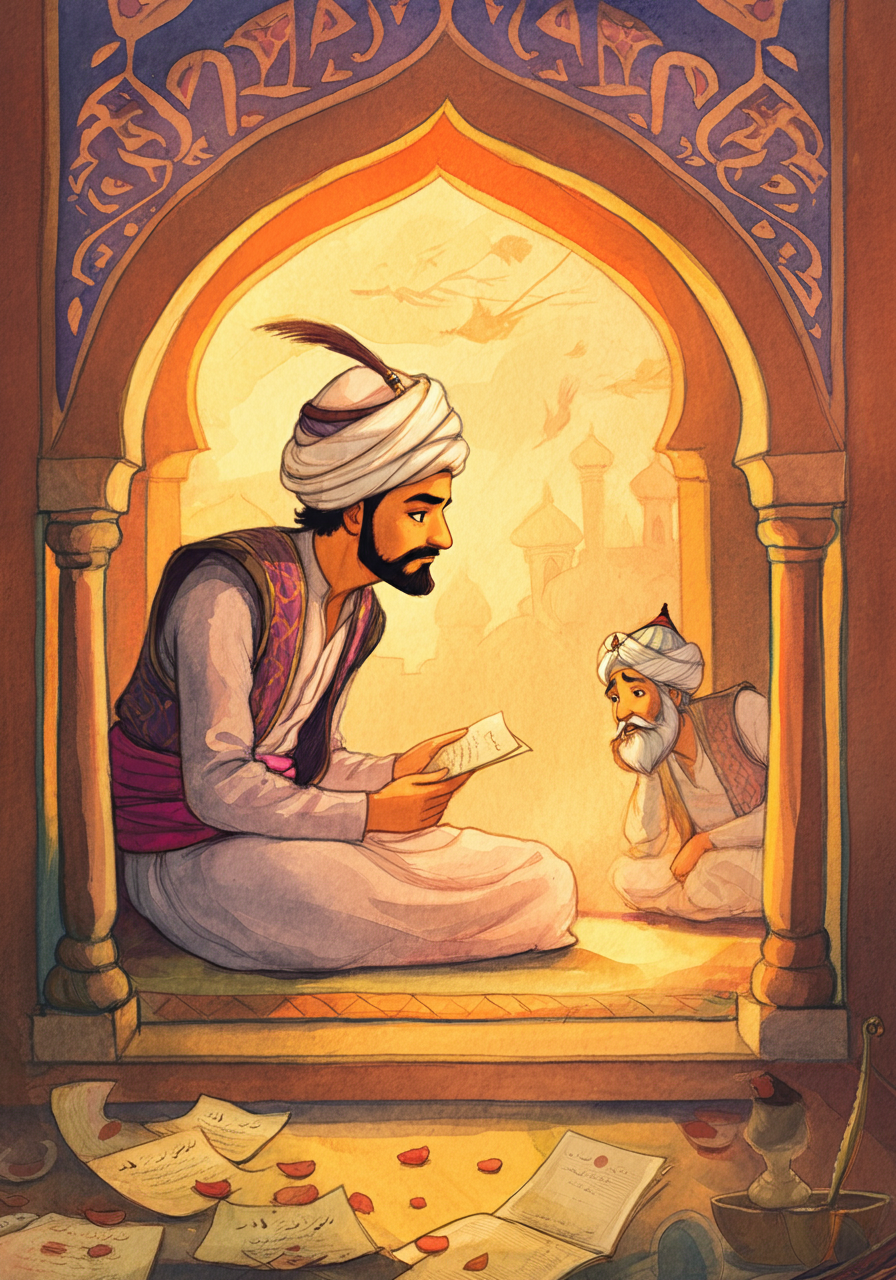
Adapted Version
Once there was King Bakht. He had a good helper. His name was Wazir Rahwan. Wazir Rahwan was a wise man. Some people did not like him. They told King Bakht bad things. These things were not true.
King Bakht got very angry. He did not think well. He believed the bad words. King Bakht was very quick. He made a fast choice. King Bakht said, "Wazir Rahwan must leave! Go!"
Wazir Rahwan felt sad. He did not want to leave. He asked for one more night. King Bakht liked stories. He said, "Yes, you can stay."
Each night, Wazir Rahwan told a story. His stories were very good. They helped King Bakht learn. The stories showed him to think first. They showed him to be fair. They showed him to be kind. King Bakht listened well.
The stories were fun. But they were more than fun. They helped King Bakht know. He thought about being fair. He thought about being kind. The stories made him think.
After each story, Wazir Rahwan smiled. He promised a better story. So Wazir Rahwan stayed. He stayed one more day.
The stories helped Wazir Rahwan. He showed King Bakht the truth. He was a good helper. The bad things people said were not true. King Bakht learned to think well. He learned to be wise. He learned to wait.
King Bakht listened to all. He started to see the truth. He knew Wazir Rahwan's wise words. The stories were very clever. King Bakht learned much.
King Bakht said, "Stay." Rahwan was happy. King Bakht learned a big lesson. He said, "You taught me to think well."
So King Bakht learned to think well. Wazir Rahwan stayed his good helper. They lived well. It is good to think before you act.
Original Story
KING SHAH BAKHT AND HIS WAZIR AL-RAHWAN.—Vol. XI. p. 127.
While the frame-story of this interesting group is similar to that of the Ten Wazírs (vol. i. p. 55), insomuch as in both a king's favourite is sentenced to death in consequence of the false accusations of his enemies, and obtains a respite from day to day by relating stories to the king, there is yet a very important difference: Like those of the renowned Shahrazad, the stories which Al-Rahwan tells have no particular, at least no uniform, "purpose," his sole object being to prolong his life by telling the king an entertaining story, promising, when he has ended his recital, to relate one still "stranger" the next night, if the king will spare his life another day. On the other hand, Bakhtyár, while actuated by the same motive, appeals to the king's reason, by relating stories distinctly designed to exhibit the evils of hasty judgements and precipitate conduct—in fact, to illustrate the maxim,
Each order given by a reigning king, Should after long reflection be expressed; For it may be that endless woe will spring From a command he paused not to digest.
And in this respect they are consistent with the circumstances of the case, like the tales of the Book of Sindibád, from which the frame of the Ten Wazírs was imitated, and in which the Wazírs relate stories showing the depravity and profligacy of women and that no reliance should be placed on their unsupported assertions, and to these the lady opposes equally cogent stories setting forth the wickedness and perfidy of men. Closely resembling the frame-story of the Ten Wazírs, however, is that of a Tamil romance entitled, "Alakeswara Kathá," a copy of which, written on palm leaves, was in the celebrated Mackenzie collection, of which Dr. H. H. Wilson published a descriptive catalogue; it is "a story of the Rájá of Alakepura and his four ministers, who, being falsely accused of violating the sanctity of the inner apartments, vindicate their innocence and disarm the king's wrath by relating a number of stories." Judging by the specimen given by Wilson, the well-known tale of the Lost Camel, it seems probable that the ministers' stories, like those of Bakhtyár, are suited to their own case and illustrate the truth of the adage that "appearances are often deceptive." Whether in the Siamese collection "Nonthuk Pakkaranam" (referred to in vol. i. p. 191) the stories related by the Princess Kankras to the King of Pataliput (Palibothra), to save her father's life, are similarly designed, does not appear from Benfey's notice of the work in his paper in "Orient and Occident," iii. 171 ff. He says that the title of the book, "Nonthuk Pakkaranam," is taken from the name of a wise ox, Nonthuk, that plays the principal part in the longest of the tales, which are all apparently translated from the Sanskrit, in which language the title would be Nandaka Prakaranam, the History of Nandaka.
Most of the tales related by the wazir Al-Rahwan are not only in themselves entertaining, but are of very considerable importance from the story-comparer's point of view, since in this group occur Eastern forms of tales which were known in Italy in the 14th century, and some had spread over Europe even earlier. The reader will have seen from Sir R. F. Burton's notes that not a few of the stories have their parallels or analogues in countries far apart, and it is interesting to find four of them which properly belong to the Eastern texts of the Book of Sindibad, with the frame-story of which that of this group has so close an affinity.
---
Moral of the Story
Hasty judgments and precipitate conduct can lead to endless woe.
Characters

King Shah Bakht ★ protagonist
A man of regal bearing, likely of average height with a sturdy build, reflecting a life of authority and occasional indulgence. His skin tone would be consistent with a ruler from a Middle Eastern kingdom, possibly olive-toned. He carries himself with the weight of his decisions.
Attire: Richly embroidered silk robes (thobe or dishdasha) in deep jewel tones like sapphire blue or emerald green, possibly with gold threadwork depicting geometric patterns or calligraphic designs. A wide, intricately patterned sash (kamarband) cinches his waist. He would wear soft leather slippers and a jeweled turban (imamah) adorned with a prominent gemstone.
Wants: To maintain order and justice in his kingdom, to be entertained, and to make sound decisions, though he often struggles with the latter.
Flaw: Susceptibility to false accusations and a tendency towards hasty judgments without thorough investigation.
He begins as a king prone to rash decisions based on accusations, but through Al-Rahwan's stories, he is implicitly encouraged to reflect more deeply before acting, though the story doesn't explicitly state a full transformation.
Impetuous, easily swayed by accusations, yet open to entertainment and persuasion. He is a ruler who values amusement but can be prone to hasty judgments.

Wazir Al-Rahwan ◆ supporting
A man of slender to average build, with an intelligent and perhaps slightly weary demeanor. His posture would reflect his scholarly nature and the stress of his predicament. Skin tone consistent with a Middle Eastern scholar or courtier.
Attire: Elegant but less ostentatious than the King's. Fine linen or cotton robes (qamis) in muted, respectable colors like cream, deep maroon, or forest green, possibly with subtle embroidery. A simple, well-made turban (imamah) or a skullcap (taqiyah) would cover his head. He might wear a long, flowing outer coat (abaya or jubbah) over his qamis.
Wants: To prolong his life and ultimately clear his name by entertaining the King with captivating stories.
Flaw: His initial vulnerability to false accusations and his reliance on his storytelling to survive, which puts him in a precarious position.
He begins under a death sentence due to false accusations and must use his wit to survive. His arc is one of sustained survival through his unique talent, hoping for eventual vindication.
Intelligent, resourceful, eloquent, and a skilled storyteller. He is quick-witted and determined to survive.
Locations

King Shah Bakht's Royal Audience Chamber
A grand, formal chamber within an Arabian palace, likely adorned with intricate geometric tile mosaics, perhaps with muqarnas vaults overhead. The floor would be polished marble or covered with rich carpets. There would be a raised dais for the king's throne.
Mood: Tense, formal, expectant, as the wazir tells stories to prolong his life.
Al-Rahwan, the wazir, tells his nightly stories to King Shah Bakht to avoid execution, creating a nightly ritual of storytelling and judgment.
Story DNA
Moral
Hasty judgments and precipitate conduct can lead to endless woe.
Plot Summary
King Shah Bakht's favorite wazir, Al-Rahwan, is falsely accused by his enemies and sentenced to death. To prolong his life, Al-Rahwan obtains a daily reprieve by promising to tell the king an entertaining story each night. Unlike mere entertainment, Al-Rahwan's stories are carefully chosen to illustrate the evils of hasty judgments and precipitate conduct, appealing to the king's reason. Through this sustained effort, Al-Rahwan not only saves his own life but also imparts a valuable lesson to the king about the importance of reflection and justice.
Themes
Emotional Arc
suspense to resolution
Writing Style
Narrative Elements
Cultural Context
This story belongs to a tradition of frame narratives, like the Book of Sindibád and One Thousand and One Nights, where stories are told to influence a ruler's decision or prolong a life. It highlights the role of wisdom and rhetoric in ancient courts.
Plot Beats (9)
- King Shah Bakht's favorite wazir, Al-Rahwan, is falsely accused by his enemies.
- The king, without sufficient reflection, sentences Al-Rahwan to death.
- Al-Rahwan requests a reprieve, promising to tell the king an entertaining story each night.
- Each night, Al-Rahwan tells a story specifically designed to illustrate the dangers of hasty judgments and precipitate conduct.
- The wazir's stories are not merely entertaining but serve a didactic purpose, appealing to the king's reason.
- Al-Rahwan consistently promises a 'still stranger' story for the next night to prolong his life.
- Through these stories, Al-Rahwan gradually vindicates himself and demonstrates the importance of careful consideration.
- The king ultimately recognizes the truth and the wisdom in Al-Rahwan's tales.
- Al-Rahwan's life is spared, and the king learns a valuable lesson about justice and leadership.