STORY OF THE FOUL-FAVOURED MAN AND HIS FAIR WIFE
by Unknown

Adapted Version
Once, a young man named Ahmed was sad. His wife was not pretty.
Ahmed went to look for his lost animals. He walked for a long time. He found a tent. An ugly man lived there. The ugly man was Omar. Omar had a very beautiful wife, Layla.
Ahmed wondered why. Why did the ugly man marry a beautiful wife? Omar saw him looking. "I will tell you my story," said Omar.
Omar was young once. He was ugly. His father was not kind. His father treated him badly. "Go away," his father told him.
Omar ran to find help. He met a wise and kind old man. The old man was Elder Hassan. He had a daughter, Layla.
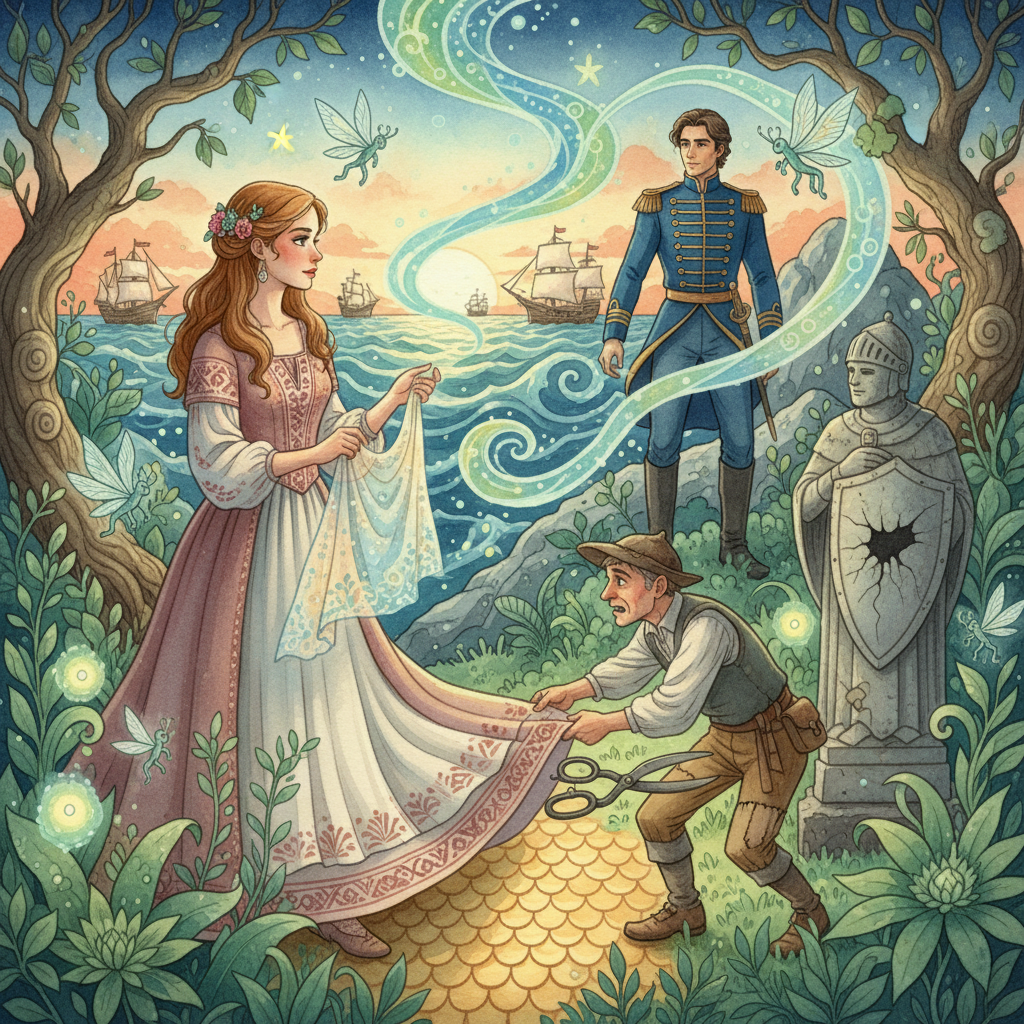
One night, Omar fell into a big hole. It was deep. Layla saw him. She was kind. She wanted to help. She gave him a rope.
Omar held the rope. He pulled. Layla fell in too! They were stuck. A dog was with them. The dog barked loudly for help.
In the morning, her family could not find them. "They ran away," they thought. Her brothers went to look for them.
Soon, Elder Hassan found them. He was happy they were safe. He listened to their whole story.
Elder Hassan told his sons to be kind. "Omar has a good heart," he said. "He did not mean to cause trouble."
Elder Hassan asked Omar to marry Layla. Omar happily said yes.
Omar and Layla got married. They lived happily with her family. Omar became successful because he was kind.
Ahmed was amazed by the story. The next day, he found his animals. He went home. He told his wife the story.
And that is the end of the story. Ahmed learned kindness makes a person truly beautiful.
Original Story
STORY OF THE FOUL-FAVOURED MAN AND HIS FAIR WIFE.
There was once a man of the Arabs who had a number of sons, and amongst them a boy, never was seen a fairer than he of favour nor a more accomplished in loveliness, no, nor a more perfect of wit. When he came to man's estate, his father married him to the daughter of one of his uncles, and she excelled not in beauty, neither was she praiseworthy of attributes; wherefore she pleased not the youth, but he bore with her, for kinship's sake.
One day, he went forth in quest of certain stray camels of his and fared on all his day and night till eventide, when he \[came to an Arab encampment and\] was fain to seek hospitality of one of the inhabitants. So he alighted at one of the tents of the camp and there came forth to him a man of short stature and loathly aspect, who saluted him and lodging him in a corner of the tent, sat entertaining him with talk, the goodliest that might be. When his food was dressed, the Arab's wife brought it to the guest, and he looked at the mistress of the tent and saw a favour than which no goodlier might be. Indeed, her beauty and grace and symmetry amazed him and he abode confounded, looking now at her and now at her husband. When his looking grew long, the man said to him, 'Harkye, O son of the worthy! Occupy thyself with thine own concerns, for by me and this woman hangeth a rare story, that is yet goodlier than that which thou seest of her beauty; and when we have made an end of our food, I will tell it thee.'
So, when they had made an end of eating and drinking, the young man asked his host for the story, and he said, 'Know that in my youth I was even as thou seest me in the matter of loathliness and foul favour; and I had brethren of the comeliest of the folk; wherefore my father preferred them over me and used to show them kindness, to my exclusion, and employ me, in their room \[in menial service\], like as one employeth slaves. One day, a she-camel of his went astray and he said to me, "Go thou forth in quest of her and return not but with her." Quoth I, "Send other than I of thy sons." But he would not consent to this and reviled me and insisted upon me, till the matter came to such a pass with him that he took a whip and fell to beating me. So I arose and taking a riding-camel, mounted her and sallied forth at a venture, purposing to go out into the deserts and return to him no more. I fared on all my night \[and the next day\] and coming at eventide to \[the encampment of\] this my wife's people, alighted down with her father, who was a very old man, and became his guest.
When the night was half spent, I arose \[and went forth the tent\] to do an occasion of mine, and none knew of my case save this woman. The dogs misdoubted of me and followed me and gave not over besetting me, till I fell on my back into a deep pit, wherein was water, and one of the dogs fell in with me. The woman, who was then a girl in the first bloom of youth, full of strength and spirit, was moved to pity on me, for that wherein I was fallen, and coming to me with a rope, said to me, "Lay hold of this rope." So I laid hold of the rope and clung to it and she pulled me up; but, when I was halfway up, I pulled her \[down\] and she fell with me into the pit; and there we abode three days, she and I and the dog.
When her people arose in the morning and saw her not, they sought her in the camp, but, finding her not and missing me also, doubted not but she had fled with me. Now she had four brothers, as they were falcons, and they mounted and dispersed in quest of us. When the day dawned \[on the fourth morning\], the dog began to bark and the other dogs answered him and coming to the mouth of the pit, stood howling to him. My wife's father, hearing the howling of the dogs, came up and standing at the brink of the pit, \[looked in and\] beheld a marvel. Now he was a man of valour and understanding, an elder versed\[FN#62\] in affairs so he fetched a rope and bringing us both forth, questioned us of our case. I told him all that had betided and he abode pondering the affair.
Presently, her brothers returned, whereupon the old man acquainted them with the whole case and said to them, "O my sons, know that your sister purposed not aught but good, and if ye slay this man, ye will earn abiding reproach and ye will wrong him, ay, and wrong yourselves and your sister, to boot; for indeed there appeareth no cause \[of offence\] such as calleth for slaughter, and it may not be denied that this incident is a thing the like whereof may well betide and that he may well have been baffled by the like of this chance." Then he turned to me and questioned me of my lineage; so I set forth to him my genealogy and he said, "A man of equal rank, honourable \[and\] understanding." And he offered me \[his daughter in\] marriage. I consented to him of this and marrying her, took up my abode with him and God the Most High hath opened on me the gates of weal and fortune, so that I am become the most abounding in substance of the folk of the tribe; and He hath stablished me in that which He hath given me of His bounties.'
The young man marvelled at his story and lay the night with him; and when he arose in the morning, he found his strays. So he took them and returning \[to his family.\], acquainted them with what he had seen and that which had betided him. Nor," added the vizier, "is this more marvellous or rarer than the story of the king who lost kingdom and wealth and wife and children and God restored them unto him and requited him with a kingdom more magnificent than that which he had lost and goodlier and rarer and greater of wealth and elevation."
The vizier's story pleased the king and he bade depart to his dwelling.
The Twenty-Sixth Night of the Month.
When came the night, the king summoned his vizier and bade him tell the story of the king who lost kingdom and wife and wealth. "Hearkening and obedience," replied Er Rehwan. "Know, O king, that
Moral of the Story
True worth and good fortune are not determined by outward appearance but by character, integrity, and the will of God.
Characters

The Young Man (Guest) ★ protagonist
Of the fairest favour and most accomplished in loveliness, with perfect wit. He is described as exceptionally handsome, embodying the ideal of youthful male beauty among the Arabs.
Attire: Typical attire for a young Arab man of means, likely consisting of a thobe or similar flowing garment made of fine linen or cotton, possibly with a simple head covering like a keffiyeh or ghutra, suitable for travel in the desert.
Wants: Initially driven by the practical need to find his stray camels; later, by curiosity about the unusual couple and a desire to understand the 'rare story' behind their marriage.
Flaw: Perhaps a superficial appreciation for beauty, as evidenced by his initial displeasure with his own wife and his long gaze at the host's beautiful wife.
He learns that true worth and happiness are not solely tied to physical beauty or initial circumstances, but can be found through character, resilience, and divine favor. He returns home with a new perspective.
Curious, observant, somewhat discontent (with his own wife), respectful (as a guest), and appreciative of beauty and good storytelling.

The Foul-Favoured Man (Host) ◆ supporting
Short stature and loathly aspect, described as 'foul-favoured' and 'loathliness' in his youth and present. His appearance is notably unattractive.
Attire: Simple, practical attire of an Arab tribesman, likely a sturdy, worn thobe made of coarse wool or linen, suitable for desert life and tending to camels. A simple head covering, perhaps a worn keffiyeh.
Wants: To survive and find his own path after being rejected by his father; later, to provide for his family and share his wisdom with others.
Flaw: His physical unattractiveness, which caused him initial hardship and rejection.
Transforms from a rejected, 'foul-favoured' youth into a respected, prosperous, and wise elder, demonstrating that inner worth surpasses outward appearance. He finds love and fortune through his character.
Wise, eloquent, resilient, patient, grateful, and possessing a deep understanding of human nature and divine providence. He is a skilled storyteller.

The Fair Wife (Hostess) ◆ supporting
Possesses a beauty, grace, and symmetry than which no goodlier might be. She is exceptionally beautiful, captivating the Young Man with her appearance.
Attire: Elegant but practical attire for an Arab woman of a prosperous tribe. Likely a flowing, brightly colored dress (thobe) made of fine cotton or silk, perhaps with embroidered details, and a matching head covering (shayla or khimar) that frames her beautiful face. She would wear simple, elegant jewelry.
Wants: Initially driven by compassion to save a man in distress; later, by loyalty and love for her husband, and a desire to build a life with him.
Flaw: Her compassion, which led her into a dangerous situation (falling into the pit).
From a compassionate girl who saves a stranger, she becomes a loyal and loving wife, demonstrating her inner strength and character, and proving her innocence and good intentions.
Compassionate, strong-willed, courageous, loyal, and resourceful. She shows pity and takes decisive action to help a stranger.

The Old Man (Fair Wife's Father) ◆ supporting
A very old man, described as a man of valour and understanding, an elder versed in affairs. His appearance suggests wisdom and experience.
Attire: Dignified and practical attire of a respected Arab elder, likely a well-made, clean thobe of good quality linen or wool, and a traditional head covering like a ghutra or keffiyeh, possibly with a simple agal. He might carry a walking stick.
Wants: To ensure justice for his daughter and guest, and to maintain the honor and well-being of his family and tribe.
Flaw: None explicitly stated, but perhaps the natural vulnerability of old age.
He acts as a catalyst for resolution, using his wisdom to prevent bloodshed and facilitate a marriage, ensuring a positive outcome for all involved.
Wise, just, discerning, calm under pressure, and a skilled mediator. He prioritizes honor and truth over hasty judgment.

The Dog ○ minor
A dog, likely a desert breed such as a Saluki or a similar lean, agile hound, common in Arab encampments. Its specific color or size is not mentioned, but it is strong enough to fall into a pit and bark loudly.
Attire: None.
Wants: To protect its territory (initially); to survive and be rescued (when in the pit).
Flaw: Its instinct to bark at strangers, which led it to fall into the pit.
Plays a crucial role in the rescue by alerting the family to the pit, inadvertently becoming a key element in the story's resolution.
Protective (initially suspicious of the guest), resilient (surviving in the pit), and vocal (barking to alert others).
Locations

Arab Encampment (Host's Tent)
A collection of tents in the desert, specifically focusing on one tent where the foul-favoured man resides. The interior is simple, providing shelter and a place for hospitality.
Mood: Initially welcoming and curious, later revealing a story of hardship and fortune.
The young man seeks hospitality and hears the host's extraordinary story of how he came to marry his beautiful wife.

The Deep Pit
A deep, water-filled pit in the desert, large enough for two people and a dog to fall into and remain for three days. The sides are steep and difficult to climb.
Mood: Desperate, confined, dangerous, but ultimately a place of unexpected connection and survival.
The foul-favoured man falls into the pit, followed by his future wife and a dog, leading to their shared ordeal and the beginning of their bond.

Wife's Father's Encampment
An Arab encampment, similar to the host's, but specifically where the foul-favoured man first sought refuge after being beaten by his father. It is the home of his future wife's family.
Mood: Initially a place of refuge, then anxiety and suspicion, finally resolution and acceptance.
The foul-favoured man arrives, later falls into the pit, and is eventually rescued and offered marriage by the wise elder, his future father-in-law.
Story DNA
Moral
True worth and good fortune are not determined by outward appearance but by character, integrity, and the will of God.
Plot Summary
A handsome young Arab man, unhappy with his plain wife, encounters a foul-favoured man married to a beautiful woman while searching for stray camels. The host recounts his life story: as an ugly youth, he was mistreated by his father and ran away. He fell into a pit, and a kind girl, who also fell in, helped him. Her wise father, finding them, recognized the young man's good character and offered his daughter in marriage. The foul-favoured man accepted, became prosperous, and now lives happily, proving that inner worth and divine favor transcend outward appearance.
Themes
Emotional Arc
discontent to wonder to understanding
Writing Style
Narrative Elements
Cultural Context
Reflects traditional Arab tribal society, where honor, hospitality, and family reputation were paramount. The concept of 'foul-favoured' vs. 'fair' is a common motif in folklore, often used to explore deeper truths about character.
Plot Beats (14)
- A handsome young Arab man is dissatisfied with his plain wife.
- He goes searching for stray camels and finds hospitality with a foul-favoured man and his exceptionally beautiful wife.
- The young man is confused by the couple's contrasting appearances, prompting the host to offer to tell his story.
- The host begins his tale, describing his youth as an ugly, mistreated son, sent away by his father.
- He runs away and seeks shelter with an old man and his daughter.
- He falls into a deep pit, and the old man's daughter, out of pity, tries to pull him out with a rope.
- During the rescue, the daughter also falls into the pit, and they are trapped for three days with a dog.
- The family, finding them missing, assumes they eloped, and the daughter's four brothers set out to find them.
- On the fourth day, the father discovers them in the pit, pulls them out, and hears their full account.
- The father, a man of wisdom, convinces his sons not to harm the young man, recognizing his good intentions and honorable lineage.
- The father offers his daughter in marriage to the foul-favoured man, who accepts.
- The foul-favoured man marries the beautiful woman, settles with her family, and becomes wealthy and respected through God's blessings.
- The young guest marvels at the story, finds his camels the next morning, and returns home to share the tale.
- The vizier concludes by stating this story is less marvelous than another, hinting at a subsequent tale.