ISKANDAR ZU AL-KARNAYN\[FN#460\] AND A CERTAIN TRIBE OF POOR FOLK
by Unknown
![ISKANDAR ZU AL-KARNAYN\[FN#460\] AND A CERTAIN TRIBE OF POOR FOLK](/library-files/english/unknown/the_book_of_the_thousand_nights_and_a_night_volume_05_of_10/iskandar_zu_al_karnayn_fn_460_and_a_certain_tribe_of_poor_folk/images/cover/cover_001.png)
Adapted Version
Once, there was a king. He had gold. He had silver. He had all things! But the King was not happy. He had much. But he felt sad. He traveled to a new land. He saw a small village. People lived there. They had no gold. They had no silver. They had pretty gardens. They ate food from the earth. They had bright flowers. They had fresh water. They smiled much.
The King sent a man. The man asked the Wise Man to come. The Wise Man said, "No, thank you. I am happy here." He loved his home. He loved his life.
The King went to the village. He saw the people. He asked, "Where are your big houses? Where is your gold? You have no silver." He looked all around. He saw no jewels. He saw no fine clothes.
The Wise Man smiled. He said, "We do not need big things. We have warm sunshine. We have good friends. We eat food from our gardens. We are happy here." We have green trees. We have blue sky. We have sweet air.
The Wise Man said, "We grow our food. We share our food. We eat good fruits. We eat good plants. We eat good bread. We eat with all. It is good." We sit on the ground. We laugh and talk. Food tastes very good.
The Wise Man looked at the King. He asked, "What makes a good king? Is it much gold? Or is it being kind?" The King thought. He felt a new thing. He thought of his gold. He thought of his worries. He thought of this happy place.
The King smiled. He said, "You are very wise! Please come with me. I will share my kingdom. I will share all things." Come live in my big house. You can have much gold.
The Wise Man said, "No, thank you. I am happy here. I have friends. I have sunshine. I have my garden. You are busy. You worry much. I am calm. I am happy." I have no big house. I have no much gold. I have no worries here.
The King thanked the Wise Man. He gave him a big hug. He walked away smiling. He learned a big thing today. Few things make you happy. He did not find more gold. He found a better thing. He felt light. He felt free. He felt very good.
Original Story
ISKANDAR ZU AL-KARNAYN\[FN#460\] AND A CERTAIN TRIBE OF POOR FOLK.
It is related that Iskandar Zu al-Karnayn\[FN#461\] once came, in his journeyings, upon a tribe of small folk, who owned naught of the weals of the world and who dug their graves over against the doors of their houses and were wont at all times to visit them and sweep the earth from them and keep them clean and pray at them and worship Almighty Allah at them; and they had no meat save grasses and the growth of the ground. So Iskandar sent a man to summon their King, but he refused to come, saying, "I have no need of him." Thereupon Iskandar went to him and said, "How is it with you and what manner of men are ye?; for I see with you forsooth naught of gold or silver, nor find I with you aught of the weals of the world." Answered the King, "None hath his fill of the weals of the world." Iskandar then asked "Why do you dig your graves before your house-doors?"; and the King answered, "That they may be the prospective of our eye-glances; so we may look on them and ever renew talk and thought of death, neither forget the world to come; and on this wise the love of the world be banished from our hearts and we be not thereby distracted from the service of our Lord, the Almighty." Quoth Iskandar, "Why do ye eat grasses?"; and the other replied, "Because we abhor to make our bellies the tombs of animals and because the pleasure of eating outstrippeth not the gullet." Then putting forth his hand he brought out a skull of a son of Adam and, laying it before Iskandar, said, "O Zu al-Karnayn, Lord of the Two Horns, knowest thou who owned this skull?" Quoth he, "Nay;" and quoth the other, "He who owned this skull was a King of the Kings of the world, who dealt tyrannously with his subjects, specially wronging the weak and wasting his time in heaping up the rubbish of this world, till Allah took his sprite and made the fire his abiding-site; and this is his head." He then put forth his hand and produced another skull and, laying it before Iskandar, said to him, "Knowest thou this?" "No," answered the conqueror; and the other rejoined, "This is the skull of another King, who dealt justly by his lieges and was kindly solicitous for the folk of his realm and his dominions, till Allah took his soul and lodged him in His Garden and made high his degree in Heaven." Then laying his hands on Iskandar's head he said, "Would I knew which of these two art thou." Whereupon Iskandar wept with sore weeping and straining the King to his bosom cried, "If thou be minded to company with me, I will commit to thee as Wazir the government of my affairs and share with thee my kingdom." Cried the other, "Well-away, well-away! I have no mind to this." "And why so?" asked Iskandar, and the King answered, "Because all men are thy foes by reason of the wealth and the worlds thou hast won: while all men are my true friends, because of my contentment and pauperdom, for that I possess nothing, neither covet aught of the goods of life; I have no desire to them nor wish for them, neither reck I aught save contentment." So Iskandar pressed him to his breast and kissed him between the eyes and went his way.\[FN#462\] And among the tales they tell is one concerning
Moral of the Story
True wealth lies not in worldly possessions or power, but in contentment, spiritual devotion, and living a just life.
Characters

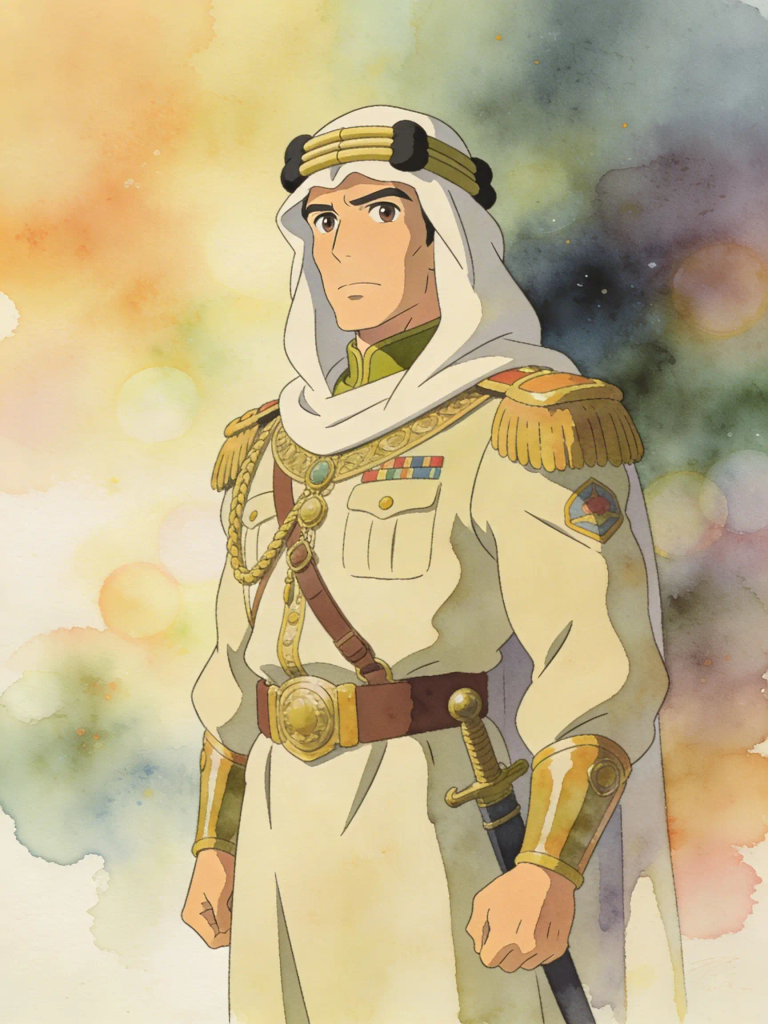
Iskandar Zu al-Karnayn ★ protagonist
A powerful and imposing figure, likely tall and well-built, reflecting his status as a world conqueror. His features would be strong and commanding, perhaps with a sun-darkened complexion from extensive travel.
Attire: Rich, flowing robes of silk and brocade, possibly in deep blues, purples, or reds, adorned with gold embroidery. He would wear a jeweled turban or a crown, and a wide sash at his waist. His attire would reflect the opulence and power of a Middle Eastern monarch of ancient times.
Wants: To understand the world and its people, to expand his knowledge and perhaps his empire, and to find meaning beyond material wealth.
Flaw: Initially driven by worldly conquests and material possessions, which he later questions.
He begins as a powerful conqueror focused on worldly gains but is deeply moved and humbled by the wisdom of the Poor Folk's King, leading him to weep and offer a share of his kingdom, indicating a shift in his values.
Curious, powerful, initially materialistic, capable of introspection, empathetic, and ultimately respectful of wisdom.

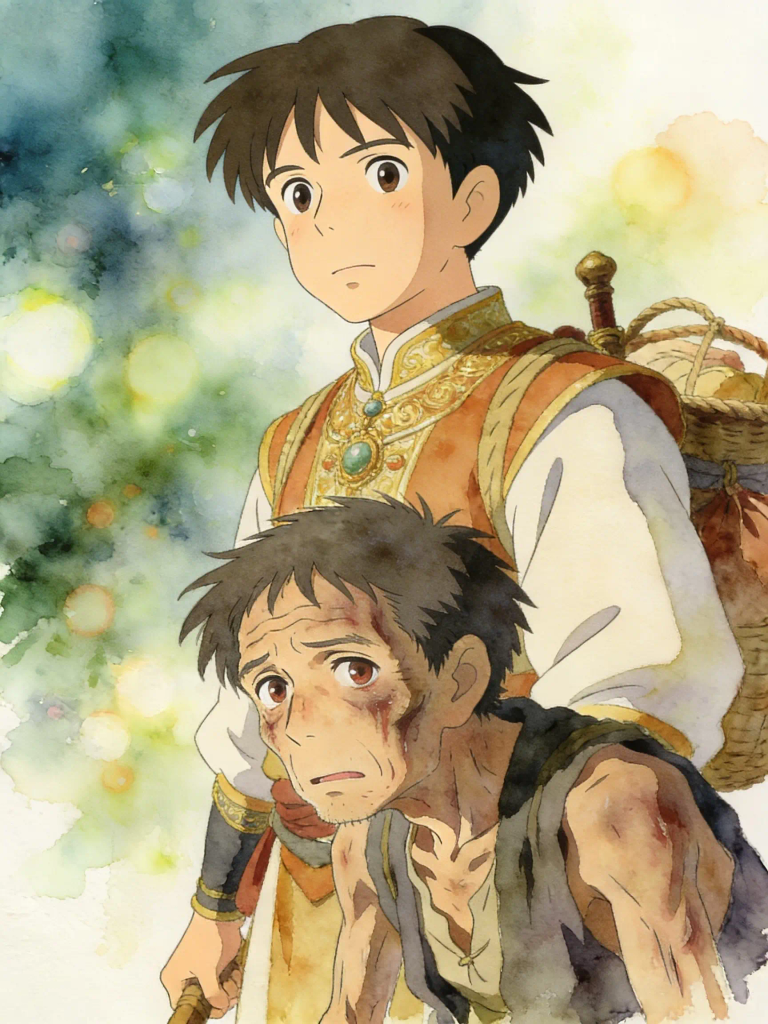
The King of the Poor Folk ◆ supporting
A man of humble appearance, likely lean from a simple diet of grasses. His features would be weathered but serene, reflecting a life of contentment and spiritual focus, rather than physical hardship.
Attire: Simple, undyed linen or coarse wool garments, perhaps a tunic and trousers, in earthy tones like off-white, grey, or light brown. His clothes would be clean but unadorned, reflecting his rejection of worldly possessions.
Wants: To live a life dedicated to Allah, free from worldly distractions, and to prepare for the afterlife.
Flaw: His complete detachment from worldly affairs might make him seem unapproachable or impractical to others.
He remains steadfast in his beliefs and way of life, serving as a catalyst for Iskandar's introspection rather than undergoing a personal change himself.
Wise, content, humble, unmaterialistic, spiritually focused, firm in his beliefs, and insightful.
Locations

Village of the Poor Folk
A humble settlement of small folk, characterized by their simple dwellings and a unique practice of digging graves directly in front of their house doors.
Mood: Serene, contemplative, humble, and deeply spiritual, with an underlying sense of peace and detachment from worldly possessions.
Iskandar encounters the tribe, questions their way of life, and learns profound lessons about contentment and mortality from their King.

King's Dwelling Entrance
The immediate area outside the King's house, where his grave is located, serving as a place for reflection and discussion.
Mood: Philosophical, solemn, yet calm and unburdened by worldly concerns.
Iskandar confronts the King, who uses the skulls to illustrate his wisdom about life, death, and the vanity of worldly power.
Story DNA
Moral
True wealth lies not in worldly possessions or power, but in contentment, spiritual devotion, and living a just life.
Plot Summary
Iskandar Zu al-Karnayn encounters a humble tribe whose King lives simply, eats only grasses, and keeps graves by their homes to remember mortality. When Iskandar questions their lack of worldly possessions, the King explains their philosophy of contentment, rejection of materialism, and constant remembrance of the afterlife. The King illustrates his point by showing two skulls, one of a tyrannical king and one of a just king, highlighting their ultimate fates. Deeply moved, Iskandar weeps and offers the King a position of power, but the King refuses, explaining that his contentment brings him universal friendship, unlike Iskandar's wealth which brings enemies. Humbled, Iskandar departs, having learned a profound lesson.
Themes
Emotional Arc
pride to humility
Writing Style
Narrative Elements
Cultural Context
Iskandar Zu al-Karnayn is the Arabic name for Alexander the Great, who appears in the Quran and various Islamic legends as a just conqueror and prophet-like figure. This story reflects a common theme in Islamic literature of contrasting worldly power with spiritual wisdom and humility.
Plot Beats (11)
- Iskandar Zu al-Karnayn, during his travels, discovers a tribe of small, poor folk who live simply, eat only grasses, and dig their graves by their houses.
- The tribe's King refuses Iskandar's summons, stating he has no need of him.
- Iskandar goes to the King and questions their way of life, noting their lack of gold, silver, or worldly possessions.
- The King explains that no one is truly satisfied with worldly goods and that they dig graves to constantly remember death and the afterlife, thus banishing love of the world.
- The King further explains they eat grasses to avoid making their bellies tombs for animals and because the pleasure of eating is fleeting.
- The King presents a skull, identifying it as a tyrannical king who wronged his subjects and now resides in hell.
- The King presents a second skull, identifying it as a just king who cared for his people and now resides in heaven.
- The King places his hands on Iskandar's head and asks which type of king Iskandar will be, causing Iskandar to weep.
- Iskandar, moved, embraces the King and offers him a position as his Wazir and a share of his kingdom.
- The King refuses, explaining that Iskandar's wealth makes him an enemy to many, while his own contentment and poverty make him a friend to all.
- Iskandar, accepting the wisdom, kisses the King and continues his journey.