The King's Treasure
by Unknown

Adapted Version
Abdul lived in a small, sunny village. He worked hard each day.
Abdul was a kind man. He had a wife, Zeeba. Zeeba liked nice things. They had two children. Yusuf was their boy. Fatima was their girl. They lived in a small house. Abdul worked very hard.
One day, Abdul's master was happy. He gave Abdul ten shiny coins. Abdul was very happy. He ran home to Zeeba. "Look!" he said. "We have money!" Zeeba was happy. The children were happy. Abdul said, "I will go to the city. I will give two coins to a holy spot. I will buy gifts." Zeeba wanted a silk dress. Yusuf wanted a horse and a sword. Fatima wanted a pretty scarf and golden shoes.
Abdul went to the big city. He gave two coins at the holy place. Then he went to the big market. He tried to buy a silk dress. The man said, "It costs many coins." Abdul had only eight coins left. The man laughed at Abdul. Abdul felt very sad. He tried to buy a horse. It cost many coins. He tried to buy a sword. It cost many coins. He tried to buy shoes. They cost many coins. Abdul felt very sad.
Abdul walked home. He was very sad. He saw a poor man. The poor man asked for help. Abdul had eight coins. He gave all his coins to the poor man. The poor man said, "You will get much, much more back!" Abdul went home. Zeeba was cross. His master was cross.
The Master was very angry. He said, "Abdul, you are foolish!" He told Abdul, "You must work extra hard! Go dig for water. Dig in the dry ground. Dig each day." Abdul felt very sad. But he went to dig.
Abdul dug and dug. The sun was hot. He dug for many days. He dug very deep. He found two old pots. Inside were many shiny, bright stones. Abdul picked one up. He tried to bite it. It was very hard. Abdul thought they were just pretty rocks.
Abdul hid most of the stones. He put them under a big rock. He took a few stones. He went to the big market. He found a man. This man sold shiny things. Abdul showed him the stones. The man looked closely. His eyes grew wide. "These are the King's lost stones!" he cried. He called the King's guards. The guards came quickly. They took Abdul. They went to his small house. They took Zeeba and the children. They took all Abdul's kin. They went to the King's big house.
The King had special dreams. A kind voice spoke to him. "Help Abdul!" the voice said. "He is a good man. He found your lost treasure." The King thought of Abdul. He knew Abdul was kind. The King rode to Abdul. Abdul was tied with ropes. The King took off the ropes. "You are a good man," the King said. "I will help you now." The King made Abdul a very big helper. Abdul was given many gifts. Zeeba got a silk dress. Yusuf got a horse and a sword. Fatima got a pretty scarf and golden shoes. Abdul got all he wished for his loved ones.
Abdul was kind. He shared with all. He got much more back. Just like the poor man said. He helped his loved ones. He helped the holy spot. He helped other poor people. Abdul and his loved ones lived with joy. They were kind to all people. They always thought of sharing.
Original Story
The King's Treasure
Accurately relating how a marked advance in material and political prosperity accrued to Abdul Karim, and the part played by a monarch whose philosophy included the immediate advancement of a worthy subject.
LABORING man named Abdul Karim, with his wife, Zeeba—"the beautiful one"—lived in a sheltered valley, surrounded by hills, the sides of which were covered with fine gardens, in which the peach, the grape, the mulberry, and other delicious fruits grew in great profusion.
Although his wife's name was Zeeba, as a matter of fact, she was very plain in appearance. But from having been named Zeeba, she really thought she was beautiful, and thus it came about that, moved by vanity, her two children were named, the boy, Yusuf, or Joseph, who as you know, was sold by his brethren into Egypt and became next to the King; and the girl, Fatima, after Fatima, the favorite daughter of Mahomet, and the wife of the famous Ali.
Now Abdul Karim was only a laborer on the land, receiving no wages, merely being paid in grain and cloth sufficient for the wants of himself and family. Of money he knew nothing except by name.
One day his master was so pleased with his work that he actually gave him ten "krans," equivalent to about a dollar of our money. To Abdul Karim this seemed great wealth, and directly his day's work was done, he ran home to his wife and said: "Look, Zeeba, there's riches for you!" and spread out the money before her. His good wife was delighted, and so were the children.
Then Abdul Karim said: "How shall we spend this great sum? The master has also given me a day's holiday, so if you don't mind, I will go to the famous city of Meshed, which is only twenty miles from here, and after placing two krans on the shrine of the holy Imam, I will then visit the bazaars and buy everything you and the children desire."
"You would better buy me a piece of silk for a new dress," said Zeeba.
"I want a fine horse and a sword," said little Yusuf.
"I would like an Indian handkerchief and a pair of gold slippers," said Fatima.
"They shall be here by to-morrow night," said the father, and taking a big stick, he set off on his journey.
When he had come down from the mountains to the plain below, Abdul Karim saw stretched before him the glorious city, and was lost in wonder at the sight of the splendid domes, where roofs glittered with gold, and the minarets, from the tops of which the priests were calling the people to prayer.
Then coming to the gate of the shrine, he asked an old priest if he might enter. "Yes, my son," was the reply. "Go in and give what thou canst spare to the mosque, and Allah will reward thee."
So Abdul Karim walked through the great court, amidst worshipers from every city in Asia. With open-mouthed astonishment he gazed on the riches of the temple, the jewels, the lovely carpets, the silks, the golden ornaments, and with humility he placed his two pieces of money on the sacred tomb. Then through the noise and bustle of the crowded streets, he went until he found the bazaars.
He found the sellers of fruits in one place, in another those who sold pots and pans, then he came to the jewelers, the bakers, the butchers, each trade having its own part of the bazaar, and so on, until he reached that part where there were only those who sold silks.
He entered one of the shops and asked to see some silks, and after much picking and choosing, fixed upon a superb piece of purple silk with an embroidered border of exquisite design. "I will take this," he said. "What is the price?"
"I shall only ask you two hundred krans, as you are a new customer," said the shopkeeper. "Anybody else but you would have to pay three or four hundred."
"Two hundred krans," repeated Abdul Karim, in astonishment. "Surely you have made a mistake. Do you mean krans like these?" taking one out of his pocket.
"Certainly I do," replied the shopkeeper, "and let me tell you it is very cheap at that price."
Abdul Karim pictured the disappointment of his wife. "Poor Zeeba," he sighed.
"Poor who?" said the silk merchant.
"My wife," said Abdul Karim.
"What have I to do with your wife?" asked the merchant, getting angry because he saw that all his trouble was in vain.
"I will tell you about it," said Abdul Karim. "Because I did my work well, my master gave me ten krans, the first time I ever have had any money. After giving two krans to the shrine, I intended to buy a piece of silk for my wife, a horse and sword for my little boy Yusuf, and an Indian handkerchief and a pair of gold slippers for my little girl Fatima. And here you ask me two hundred krans for one piece of silk. How can I pay you and buy the other things?"
"Here I have been wasting my time and rumpling my beautiful silks for a fool like you," cried the angry merchant. "Get out of my shop! Go home to your stupid Zeeba and your stupid children. Buy them some stale cakes and some black sugar, and don't put your head in my shop again, or it will be worse for you."
Then he took off his slipper, and with many blows drove poor Abdul Karim out into the street. Then Abdul Karim went to the horse market, only to find that the lowest-priced horse would cost two hundred and fifty krans.
The horse dealer mocked him when they found he had only eight krans, and suggested that he buy the sixteenth part of a donkey for his little son. As for a sword, he found that it would cost at least thirty krans; while a pair of golden slippers would run into many hundreds of krans; and for an Indian handkerchief, the price was twelve krans.
As poor Abdul Karim bent his weary way home, he met a beggar crying: "Dear friend, give me something, for to-morrow is Friday"—the Mahommedan Sunday. "He that giveth to the poor, lendeth to the Lord, and of a certainty the Lord will pay him back a hundredfold."
"Of all the men I have met to-day, you are the only one with whom I can deal," said simple Abdul Karim. "Here are eight krans. Use them in the service of God, and don't forget to pay me back a hundredfold."
Wrapping up the eight krans very carefully, the cunning beggar promised some day to return them a hundredfold.
At last Abdul Karim came in sight of his cottage, and little Yusuf, who had been all day on the look-out for him, ran breathlessly to meet him. "Where's my horse and sword, father?" he cried. And Fatima, who had just come up, called out, "And my handkerchief and golden slippers?" And Zeeba asked for her bit of silk.
Poor Abdul Karim looked so confused, that his wife said: "Be quiet, my dears. Your father could not bring them all with him, so he has packed them on Yusuf's horse and left him in charge of a servant, who will be here presently." But when she heard his story, and above all that he had given eight krans to a beggar, she got very angry, and marched off and told the master.
But the master was still more angry, and said: "What! the blockhead gave his eight krans to a beggar? Send him to me." And when Abdul Karim came before him, he said scornfully: "You must fancy yourself a big man, Abdul. I never give more than a copper coin to a beggar, but your Excellency gives them silver. The beggar promised that you should be repaid a hundredfold, did he? And it shall be so, even now." Then as Abdul's face brightened, he laughed and said: "Not in money, but in stripes." And his servants threw Abdul on the ground and gave him one hundred blows on his bare feet.
The next day, Abdul's master sent for him again, and after calling him a fool, said: "I have a nice little job for you, that will bring you to your proper senses. Go into the field and dig for water, day after day until you find it."
So for many days Abdul labored under the scorching sun, until he had dug down to a depth of about thirty feet, and then he came upon a brass vessel, finely chased, full of round white stones, which fairly dazzled his eyes in the fierce sunlight. He put one in his mouth and tried to break it with his teeth, but could not.
Then he said to himself, "The master has planted some rice and it has turned into stones. Perhaps there are some more." And going down a few feet lower, he found another pot filled with sparkling stones of various colors.
Then he remembered that he had seen pretty pieces of glass like these for sale in Meshed, and made up his mind that on the first opportunity he would again visit the city and take the stones with him. Meanwhile, he would hide them, and say nothing.
Abdul did not have to wait long for a holiday, for on finding water a little lower down, his master was so pleased that he gave him a well- deserved rest, and then Abdul set off for Meshed. But before entering the city, he hid most of the treasure at the foot of a tree under a big stone. Then with still a pocket full, he went straight to the shop where he had seen such stones, and spoke to the shopkeeper who was seated at the entrance to his shop, calmly smoking his water-pipe.
"Do you want to buy any more stones like those?" he asked, pointing to some in a brass tray. "Yes, have you got one?" replied the merchant, for Abdul did not look like a man who was likely to have more than one, if any.
"I have a pocket full of them," said Abdul.
"You have a pocket full of pebbles, more likely," said the jeweler. But when Abdul took out a handful and showed him, he was so astonished that he could hardly speak. Trembling in every limb, he bade Abdul wait a minute, and leaving his apprentice in charge, he hastily left the shop. When he returned, the chief of the police was with him.
"I am innocent," cried the jeweler. "There is the man. His pockets are filled with diamonds, rubies, emeralds, and pearls of great price. Without doubt he has found the long-lost treasure of Cyrus."
Then Abdul was searched; the precious stones were found upon him; and when they had brought Zeeba and the children, the whole family were sent under a guard of five hundred soldiers to the capital.
While all these things were taking place, the King saw in his dreams, for three nights, one after the other, the Holy Prophet, who, looking steadfastly at him, exclaimed: "Abbas, protect and favor my friend." And on the third night, the King took courage and said to the Prophet: "And who is thy friend?" And the answer came:
"He is a poor laboring man, Abdul Karim by name, who of his poverty gave one-fifth to the shrine at Meshed, and now, because he has found the King's treasure, they have bound him, and are bringing him to this city to oppress him."
So the King went forth two days' journey to meet Abdul. First came one hundred horsemen. Next, poor Abdul, seated on a camel, with his arms bound tightly. Walking behind the camel were the weeping children and their mother. Then came the foot soldiers guarding the treasure. The King made the camel kneel down, and with his own hands undid the cruel bonds.
Then with tears running down his face, Abdul knelt before the King and pleaded for his dear ones, saying: "If thou slay me, at least let these innocent ones go free!"
Lifting Abdul from the ground, the King then said: "I am come to honor, not to slay thee. When thou hast rested, thou shalt return to thine own province, not as a prisoner, but as the Governor thereof." And smiling, he added:
"Already is the silk dress prepared for Zeeba; the horse and sword for Yusuf; and the Indian handkerchief and the golden slippers for Fatima have not been forgotten." For the King had read in the report of the chief of police all the details of Abdul's case.
And so it was that Abdul's piety and gift to the shrine had come back, not a hundredfold, but beyond his wildest dreams, and the shrine and the poor benefited greatly thereby.
THE KING AND THE FISHERMAN
Moral of the Story
True generosity and piety, even in poverty, will be rewarded beyond measure by divine intervention and benevolent authority.
Characters

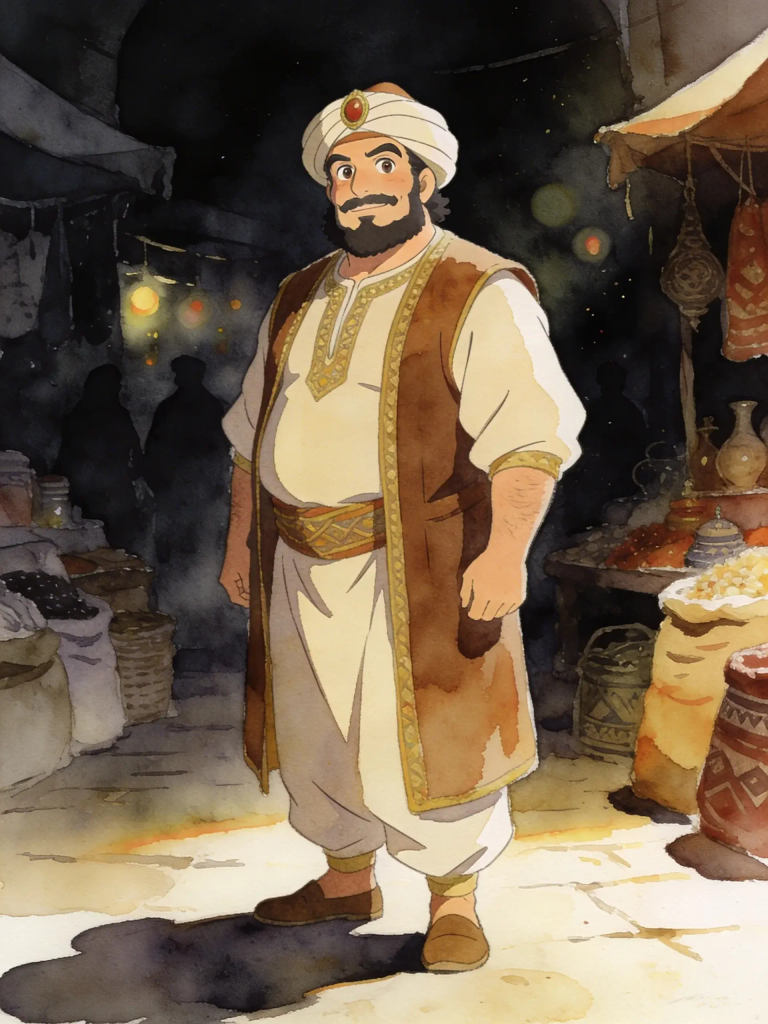
Abdul Karim ★ protagonist
A man of average height and build, weathered by years of manual labor under the sun. His hands are calloused, and his face shows the lines of a simple, hardworking life. His skin is likely tanned from outdoor work.
Attire: Simple, worn cotton or linen tunic (qamis) and trousers (shalwar) in muted, earthy tones, possibly a head covering (kufi or small turban) to protect from the sun. His clothes are practical for field work, not decorative.
Wants: To provide for his family, to honor God, and to fulfill his family's simple desires.
Flaw: Extreme naivety and lack of worldly experience, leading him to be easily swindled and misunderstood.
Transforms from a poor, naive laborer who is mocked and beaten for his generosity into a respected Governor, demonstrating that true piety and generosity are rewarded beyond material wealth.
Pious, honest, naive, hardworking, generous, easily astonished, devoted to his family.

Zeeba ◆ supporting
A plain-looking woman, despite her name meaning 'beautiful one'. Likely of average height and build, with a practical demeanor. Her appearance is unadorned, reflecting her family's poverty.
Attire: Simple, practical dress (perhaps a loose-fitting tunic and trousers or a simple dress) made of coarse, undyed fabric, possibly with a headscarf (chador or similar) covering her hair. Her clothes are functional and modest.
Wants: To improve her family's material circumstances, to acquire a new silk dress, and to see her children happy.
Flaw: Vanity and a quick temper, leading her to misjudge Abdul's actions and report him to the master.
Remains largely unchanged in personality, but her circumstances are dramatically improved by the end of the story.
Vain (due to her name), practical, easily delighted, quick to anger, concerned for her family's well-being, somewhat materialistic.

Yusuf ○ minor
A young boy, full of energy and typical of a child growing up in a poor, rural setting. Likely thin but active.
Attire: Simple, loose-fitting cotton tunic and trousers, likely hand-me-downs or patched, in muted colors. Practical for play and daily life.
Wants: To own a horse and a sword, symbols of adventure and heroism.
Flaw: Childish impatience and inability to understand complex situations.
Receives his desired horse and sword at the end, fulfilling his childhood dream.
Eager, imaginative, easily excited, disappointed when expectations are not met.

Fatima ○ minor
A young girl, likely small and delicate, typical of a child in her circumstances.
Attire: Simple, modest dress, likely a loose tunic or dress made of coarse fabric, in muted colors. Practical and unadorned.
Wants: To own an Indian handkerchief and golden slippers, symbols of beauty and luxury.
Flaw: Childish impatience and inability to understand complex situations.
Receives her desired Indian handkerchief and golden slippers at the end.
Expresses desires, disappointed when expectations are not met.

The Master ◆ supporting
A landowner, likely well-fed and dressed, indicating his status. His appearance suggests authority and wealth relative to his laborers.
Attire: Richer clothing than Abdul Karim, perhaps a fine wool or cotton robe (qaba or similar) in a darker, more substantial color, possibly with some embroidery, and a more elaborate turban. His clothes are clean and well-maintained.
Wants: To maintain order, to punish perceived foolishness, and to benefit from his land.
Flaw: Quick to anger and judgment, lacks empathy for Abdul's naivety.
Serves as an initial obstacle and punisher for Abdul, but inadvertently sets him on the path to finding the treasure by assigning him the digging task.
Initially pleased and generous, but quickly becomes scornful, harsh, and punitive when he perceives foolishness. Later, he is still somewhat mocking but ultimately pragmatic.

The Silk Merchant ○ minor
A shrewd, well-dressed merchant, likely of average build, with an air of business acumen. His hands might be soft, unlike a laborer's.
Attire: Fine, clean robes (perhaps a light silk or cotton caftan) in a respectable color, indicating his prosperity. A neat turban or cap. His clothes are well-maintained and suggest his trade.
Wants: To sell his silks for a good price and avoid wasting his time.
Flaw: Impatience and disdain for the poor, leading him to mistreat Abdul.
Serves as an example of the harsh realities of the world Abdul is unfamiliar with.
Shrewd, easily angered, dismissive of those he perceives as foolish or poor, focused on profit.

The King ◆ supporting
A powerful and regal monarch, likely of imposing stature and dignified bearing. His appearance reflects his immense wealth and authority.
Attire: Magnificent royal robes, possibly of silk or brocade, richly embroidered with gold thread and perhaps adorned with jewels. A jeweled turban or crown. His attire is the epitome of Persian royal splendor.
Wants: To obey the Holy Prophet's command, to protect and honor the worthy, and to ensure justice.
Flaw: None explicitly shown; he embodies ideal kingship.
Acts as the divine instrument of Abdul's reward, demonstrating the ultimate justice in the story.
Pious, just, compassionate, wise, follows divine guidance, generous, observant.

The Beggar ○ minor
An old, seemingly frail man, dressed in rags, embodying poverty and hardship. His appearance is designed to elicit sympathy.
Attire: Tattered, patched, and dirty robes or cloak made of coarse, faded fabric. His clothes are clearly insufficient for warmth or dignity.
Wants: To acquire money from sympathetic individuals.
Flaw: His dishonesty and exploitation of others' faith.
Serves as a catalyst for Abdul's punishment and later, indirectly, his reward, by taking his money and promising a 'hundredfold' return.
Cunning, manipulative, uses religious rhetoric to exploit the pious.
Locations

Abdul Karim's Sheltered Valley Home
A secluded valley surrounded by hills, with terraced gardens flourishing with peach, grape, and mulberry trees. Abdul Karim's humble cottage is nestled within this fertile landscape.
Mood: Initially peaceful and humble, later filled with anticipation and then despair.
Abdul Karim and his family live here; he returns here after his disappointing trip to Meshed and later after finding the treasure.

The Holy Shrine of Imam Reza, Meshed
A magnificent shrine with splendid domes, roofs glittering with gold, and tall minarets from which priests call to prayer. Inside, a great court is filled with worshipers, and the temple itself is rich with jewels, lovely carpets, silks, and golden ornaments.
Mood: Awe-inspiring, sacred, bustling with devotion and wealth.
Abdul Karim gives two krans to the shrine, fulfilling his vow.

The Bazaars of Meshed
Crowded, noisy streets leading to a sprawling marketplace where different trades have their own sections: fruit sellers, pot and pan vendors, jewelers, bakers, butchers, and silk merchants.
Mood: Lively, chaotic, overwhelming, initially exciting then frustrating for Abdul Karim.
Abdul Karim attempts to buy gifts for his family but discovers the true value of money; he later returns to sell his 'stones'.

The King's Palace, Capital City
A grand royal residence, implied to be opulent and powerful, where the King resides and makes decisions.
Mood: Regal, authoritative, later benevolent and just.
Abdul Karim is brought here as a prisoner, but is then honored and appointed Governor by the King.
Story DNA
Moral
True generosity and piety, even in poverty, will be rewarded beyond measure by divine intervention and benevolent authority.
Plot Summary
Abdul Karim, a poor laborer, receives ten krans and, after donating a portion to a shrine, attempts to buy gifts for his family but is ridiculed and punished for his naivete. He then gives his remaining money to a beggar, leading to a severe beating from his master. While digging for water as punishment, Abdul discovers the King's long-lost treasure. When he tries to sell some stones, he is arrested for theft. However, the King, guided by prophetic dreams, intervenes, recognizes Abdul's piety, frees him, and appoints him Governor, fulfilling the promise of a hundredfold reward for his generosity.
Themes
Emotional Arc
suffering to triumph
Writing Style
Narrative Elements
Cultural Context
The story reflects traditional Islamic values of charity and divine justice, set in a pre-modern Middle Eastern context. The reference to 'Cyrus' suggests a connection to ancient Persian history, implying the treasure's immense age and value.
Plot Beats (12)
- Abdul Karim, a poor laborer, lives with his vain wife Zeeba and their children, Yusuf and Fatima, receiving no wages.
- Abdul's master gives him ten krans for good work, which Abdul decides to spend on gifts for his family and a donation to the holy Imam's shrine in Meshed.
- In Meshed, Abdul donates two krans to the shrine, then attempts to buy expensive silks, a horse, a sword, an Indian handkerchief, and golden slippers, but is ridiculed by merchants for his meager funds.
- Abdul, disheartened, gives his remaining eight krans to a beggar who promises a hundredfold return, further angering his wife and master.
- His master, furious at Abdul's foolishness, orders him to receive one hundred stripes on his bare feet.
- The master then assigns Abdul to dig for water, where he unearths two brass vessels filled with dazzling precious stones, which he initially misunderstands.
- Abdul hides the bulk of the treasure and takes a pocketful of stones to Meshed, showing them to a jeweler.
- The jeweler, recognizing the stones as the long-lost treasure of Cyrus, alerts the police, leading to Abdul's arrest and his family being brought to the capital under guard.
- The King has three prophetic dreams where the Holy Prophet instructs him to protect his friend, Abdul Karim, who is being oppressed for finding the King's treasure.
- The King rides out to meet Abdul, personally frees him from his bonds, and declares his intention to honor him.
- The King appoints Abdul Karim as Governor of his province and provides all the gifts Abdul had originally wished to buy for Zeeba, Yusuf, and Fatima.
- Abdul's piety and generosity are rewarded far beyond a hundredfold, benefiting his family, the shrine, and the poor.