TAIVAS JA MAA HUKKUVAT
by Hanna Cederholm
Adapted Version
Once upon a time, Princess Veronica married King Päiviö. They were very happy.
At their wedding, her fairy friend Smaragda gave a gift. It was a magic headband. "This shows you far things," she said.
Veronica and Päiviö lived in a castle by the sea. They were happy. Then, Päiviö had to go away for a long time.
"I must go," said Päiviö. Veronica was sad. "Do not go," she said. But he had to go.
A letter came for Päiviö. It asked him to help with a big job. Veronica hid the letter. Then she gave it to him.
Päiviö left with his friends. He had white feathers on his armor. Veronica watched from her tower. She felt very sad.
A year later, Kurt brought news. "Your father had to go away forever," he said. "Päiviö is still traveling."
Two years passed. Kurt brought another message. "Things are hard far away," he said. "Päiviö misses home, but he must stay."
Many years went by. Veronica's hair turned gray. Things were sad and quiet at home.
One day, Veronica looked into her headband's green stone. She saw her home. Then she saw places far away where Päiviö was.
She saw Päiviö having a hard time. She saw his golden armor. His horse carried him across a big, dark river.
"I must find him," she thought. She put on the headband. She left the castle and walked toward the dark river.
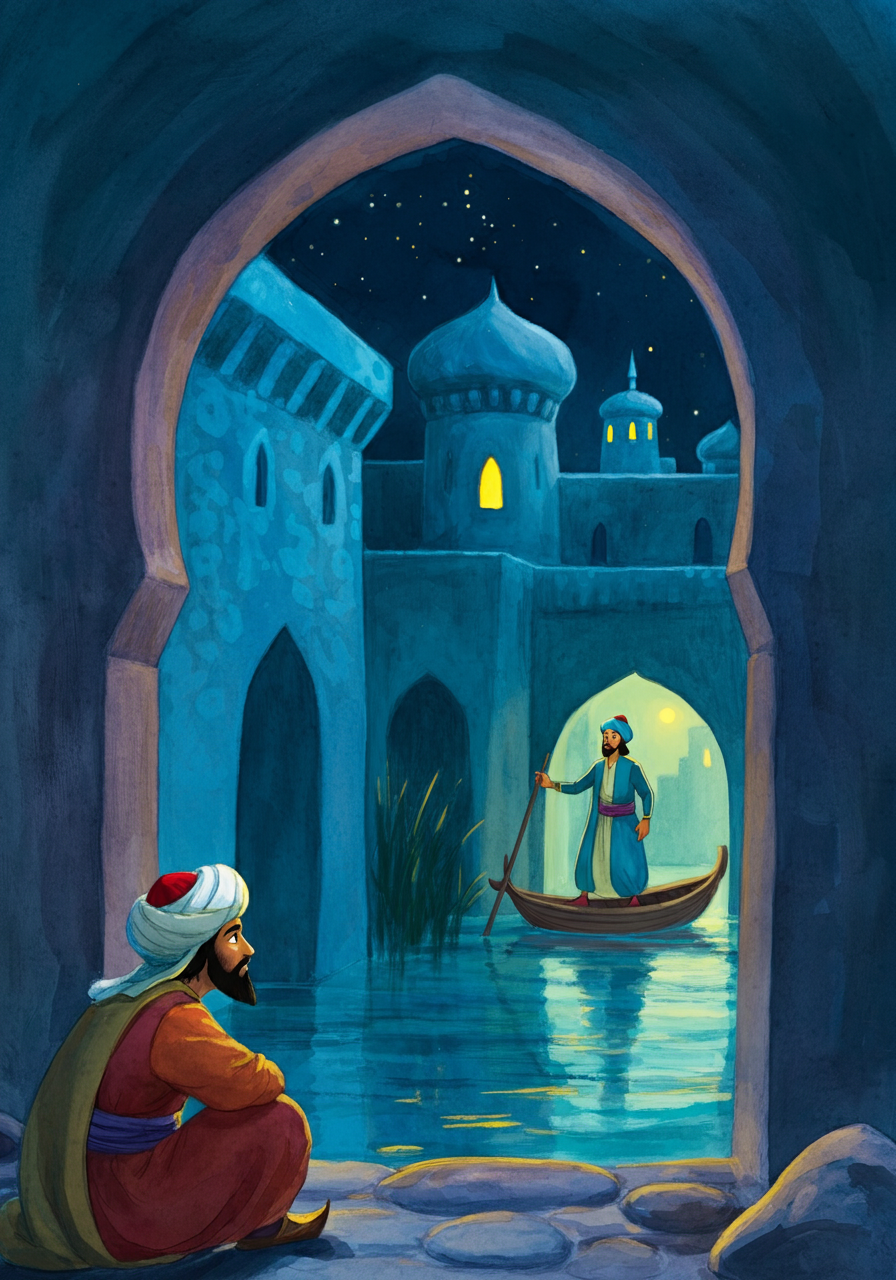
The river was wide and fast. A ferryman was there. "Give me your headband to cross," he said. Veronica gave him the headband.
On the other side, Päiviö waited. He was older, with gray hair like hers. They hugged each other.
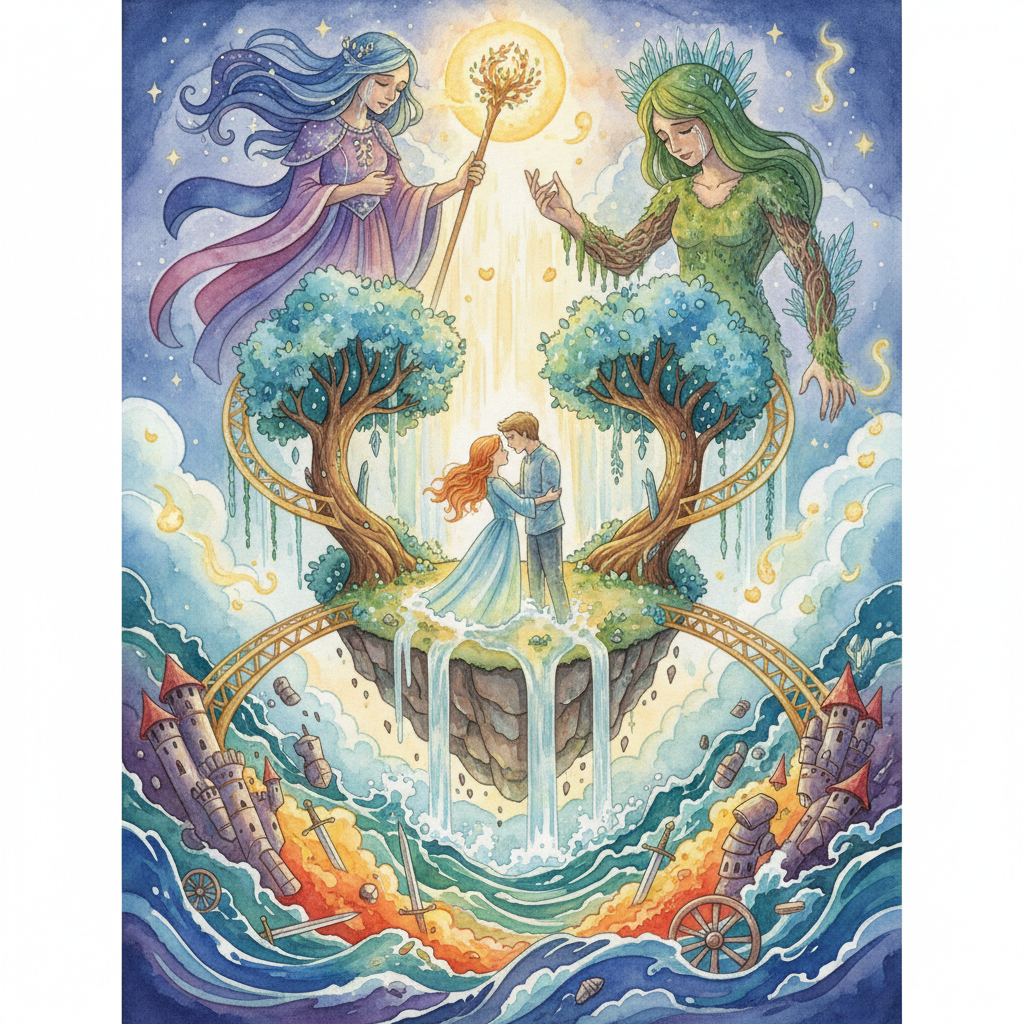
Everything became bright and peaceful. They were happy together. Love made everything bright. And they lived happily ever after, together forever.
Original Story
TAIVAS JA MAA HUKKUVAT —
Olipa kerran pikkuinen prinsessa, jonka piti viettää häitä. Hän oli hyvin nuori, ja hänen arvoisan äitinsä, kuningattaren, mielestä olisi naimista hyvin voitu hiukan lykätä. Mutta hänen armollinen isänsä, kuningas, oli toista mieltä. Kun hänellä viiden poikansa lisäksi vielä oli seitsemän tytärtä, niin oli hän tyytyväinen saadessaan vanhimman heistä hyviin naimisiin. Kuningaskunta ei ollut iso, sato oli viime aikoina kerta toisensa jälkeen ollut huono, oli vaikeata saada kokoon varat, ja valtiovarainministeri pudisti kaljua päätään. Kun asiain näin ollen nuoren naapurikuninkaan lähettiläät eräänä päivänä tulivat kosiomatkalle hallitsijansa puolesta, otti kuningas heidät hyvin armollisesti vastaan. Hän pani heidän kunniakseen toimeen juhlapäivälliset, ja osoitti heille kaikin mahdollisin tavoin suosiotaan. Lähtiessään oli heillä kuninkaan ja kuningattaren suostumus siihen, että sinisilmäisestä ja kultakutrisesta prinsessa Veronicasta tulisi kuningas Päiviön morsian.
Pian tämän jälkeen saapui kuningas Päiviö itse suuren seurueen kera kiittämään kuningasta ja kuningatarta suotuisasta vastauksesta. Hänen kypärässään liehui valkeita kameelikurjen sulkia ja hänen panssaripaitansa oli taottu puhtaasta kullasta. Aseenkantaja Kurt, joka ratsasti ihan hänen jäljessään, kantoi keihästä ja kultaista, auringon merkeillä taidokkaasti koristeltua kilpeä. Prinsessa odotti peilisalissa, hovineitojensa ympäröimänä, ja hänen sydämensä löi kiivaasti kuin vangitun linnun. Onnikohan nyt saapui ratsastaen laskusillan yli, vaiko ehkä suru?
Kun kuningas Päiviö seisoi hänen edessään, ja hän katseli tämän nuoriin, reippaisiin kasvoihin, tuli hän äkkiä niin iloiseksi, että ojensi molemmat kätensä suudeltaviksi. Peilisalissa pidetyissä tanssiaisissa tanssivat he kaikki tanssit kahden, ja siitä päivästä lähtien tiesi Veronica, että onni oli aivan kuningas Päiviön näköinen.
On päivänselvää, että häät olivat komeat. Monta kuningasta ja kuningatarta oli kutsuttu vieraiksi. He saapuivat ajaen kullatuissa, usean hevosen vetämissä vaunuissa. Esiratsastajien koreat puvut loistivat auringossa, ja ihmettelevää kansaa seisoi tien vierillä. Prinsessa Veronican kummi, haltijatar Smaragda, saapui häätaloon leijaillen puitten latvojen yläpuolella ja puettuna pilvireunuksiseen vaippaansa. Häälahjaksi antoi hän Veronicalle kultaisen otsavanteen, jonka ainoana koristuksena oli suuri, säteilevä jalokivi. Kivi oli vihreä kuin syvä, peilikirkas merivesi.
Veronica ja hän olivat linnan puistossa.
— Katso, sanoi haltijatar Smaragda, kääntäen kultavanteen niin, että kukkaryhmien ja leikattujen pensaiden vehreys kuvastui kiveen. Taas käänsi hän vannetta, ja Veronica näki ihmeekseen poppelien hiljakseen huojuvat latvat ja taivaan sinen loistavan kiven kirkkaassa pinnassa.
— Onneksesi, sanoi haltijatar Smaragda, antaessaan vanteen Veronicalle, tähän sisältyy kaikki. Annan sinulle taivaan ja maan. —
Häiden jälkeen vei kuningas Päiviö nuoren kuningattarensa omaan maahansa. He asettuivat asumaan kalliosaarella olevaan metsästyslinnaan. Meri huuhteli rantojen sileitä kallioita. Kun seisoi alhaalla ritarisalissa, jossa keihäät, metsästystorvet ja kaaripyssyt riippuivat seinillä, tuntui aivan siltä, kuin ulottuisi vesi ihan linnan muureihin asti, sillä katsoipa mistä ikkunasta tahansa, niin näki merta, vain merta taivaanrantaan saakka. Sieltä näkyi meri tyynenä ja myrskyävänä sekä vaahtopäiden lukemattomat sotajoukot. Joka aamu nousi auringon kehrä kirkkaana ja vastapestynä meren syvyydestä. Mutta jos illalla istui tornikamarissa, jonka ikkunat olivat päinvastaiselle suunnalle, näki auringon katoavan jonnekin sinertävän metsänreunan taakse. Pisimmät kuusenlatvat ulottuivat ikkunanpieleen, ja kauempana hehkuivat mäntyjen rungot tulenkarvaisina. Siellä olivat kuninkaan metsästysmaat, mutta sitä ei nuori kuningatar ajatellut. Hän ajatteli kotiaan, joka oli lännessä päin, ja vaikka onni asuikin hänen sydämessään, istui hän usein tornikamarin ikkunassa katsellen länteen, puiden latvojen yli. Hänen ohitsensa kiitivät pilvet linnan lammikossa uiskentelevien joutsenten tavoin.
Kurt Aseenkantaja toi kuningattaren valkean ratsun linnan pihalle. Joka ilta ratsastivat kuningas ja hän kerran kalliosaaren ympäri. Joskus ratsastivat he kahlauspaikan poikki suuriin metsiin. Kurt aseenkantaja ratsasti heidän perässään, ollakseen saapuvilla, jos jotakin tarvittaisiin. Hän auttoi kuningattaren satulaan, ja joka päivä kumartui hän suutelemaan tämän hameen lievettä.
Kuningas Päiviö ja kuningatar Veronica elivät onnellisina yhdessä, kunnes eräänä päivänä puhkesi sota. Heidän maansa asema oli syrjäinen, ja sanomat siitä, mitä maailmassa tapahtui, saapuivat heille myöhään ja niukkoina. Joku matkalainen oli tietävinään yhtä toinen toista. Kuta hälyyttävämmiksi huhut kävivät, sitä levottomammaksi tuli kuningas Päiviö.
— Minunkin täytyy varustautua sotaan, sanoi hän eräällä ratsastusretkellä kuningatar Veronicalle, jonka hatun leveät lieret estivät kuningasta huomaamasta, miten hän kalpeni. Mutta illalla pyysi kuningatar häntä olemaan ajattelematta sotaan lähtöä.
— Miten minun käy, jos sinä lähdet? sanoi hän valittaen.
Kuningas rypisti otsaansa, mutta ei tällä kertaa puhunut lähdöstään sen enempää.
— Teroita miekka ja katso, että ori kengitetään uudestaan, sanoi hän seuraavan päivän ratsastusretkellä aseenkantajalleen Kurtille.
Taas kalpeni kuningatar Veronica, ja tultuaan kotiin, sulkeutui hän huoneeseensa ja itki.
Seuraavana aamuna seisoi hän kyyhkyslakan luona syöttämässä lintuja. Seistessään siinä huomasi hän kyyhkysen lentävän luokseen. Se teki kierroksen hänen päänsä yläpuolella ja istuutui sitten hänen ojennetulle kädelleen. Silitettyään sen kiiltäviä höyheniä, otti hän sen tuoman kirjeen lukeakseen. Kirje oli hänen isältään. Jokainen sivu oli täynnä sotatietoja. Sota levisi maasta maahan, ja nyt olivat hänen isänsäkin joukot varustetut. Tämä oli jo vanha, mutta ei sentään liian vanha kaatumaan oikean asian puolesta! Kaikki hänen viisi veljeään olivat jo lähteneet sotaan. Ei yksikään mies saanut istua kotilieden ääressä! Missä viipyi Päiviö joukkoineen?
Veronica tunsi sydämensä kutistuvan kokoon tuskasta. Nopeasti piilotti hän kirjeen hameeseensa ja ajatteli, ettei ikinä jättäisi tuota sanomaa herralleen ja puolisolleen. Sinä päivänä ei hän lähtenyt ratsastamaan. Kurt aseenkantaja sai taluttaa hevosen takaisin talliin. Mutta kun tuli ilta, ojensi hän vaieten kirjeen kuningas Päiviölle.
Kaksi päivää myöhemmin ratsasti kuningas länteen päin sotajoukkonsa etupäässä. Kuningatar Veronica seisoi katsomassa ulos tornikamarin ikkunasta. Hitaasti kiemurteli ratsujoukko eteenpäin kahlauspaikan poikki. Kuningas Päiviön ori hyppi jo toisella rannalla, ja hänen varustuksensa loisti auringossa. Hän kääntyi satulassa ja katsoen linnaa ja kalliosaarta heilutti hän raskasta kypäriään korkealla ilmassa, niin että sulat liehuivat. Nuori kuningatar ojensi käsivartensa häntä kohti, ja kun ratsujoukko oli kadonnut ensimäiseen tienkäänteeseen, nojasi hän päänsä ikkunanpieleen ja kyyneleet valuivat pitkin hänen poskiaan.
Vuoden kuluttua sai kuningatar Veronica sanoman puolisoltaan. Kurt aseenkantaja oli ratsastanut päivät ja yöt.
— Herrani ja kuninkaani tervehtää armollista puolisoaan, sanoi hän, ja näin kuuluu hänen sanomansa:
»Kuolema kulkee kentillä kuin viikatemies. Isäsi, kuningas, on kaatunut. Armollisen äitisi on pukeuduttava leskenpukuun. Lohduttakoon Jumala häntä hänen surussaan.»
— Miten kuningas Päiviön itsensä laita on? kysyi kuningatar Veronica kalpein huulin.
— Hänen maineensa kasvaa päivä päivältä, mutta kuitenkaan ei hän ole yhtä iloinen kuin ennen, sanoi Kurt aseenkantaja. Joukkomme harvenee. Missä miekkojen teräskielet puhuvat, siellä ihmiset vaikenevat. Mutta sotilaan ammatti on joka tapauksessa hyvä. Silmä silmästä, hammas hampaasta.
— Tervehdä herraasi ja kuningastasi, sanoi kuningatar. Kurt aseenkantaja kumartui suutelemaan hänen hameensa lievettä.
Kaksi vuotta myöhemmin seisoi Kurt jälleen kuningattarensa edessä.
— Näin kuuluu herrani ja kuninkaan! sanoma, sanoi aseenkantaja:
»Taivas ja maa hukkuvat. Maailman neljällä kulmalla palaa. Kahlaamme veressä. Kaupungit ovat raunioina ja kansat lakaistaan pois. Kunpa saisi pistää miekkansa tuppeen! Kaipuu vetää kotia kohden, mutta velvollisuus käskee: jää!»
— Miltä kuningas nykyisin näyttää? kysyi kuningatar, ja hänen äänensä vapisi.
— Kalpealta ja synkältä, sanoi Kurt aseenkantaja. Mutta olen kuitenkin sitä mieltä, että sotilaan on hyvä saada tapella sydämen halusta.
— Sano herralleni, että hän on minulle hyvin rakas, sanoi kuningatar hiljaa. Kurt aseenkantaja kumartui suutelemaan hänen hameensa lievettä. —
Vuosi kului toisensa jälkeen, ja aina vain leimusi sodan liekki yhtä kuumana. Nälkä, puute ja kallis aika kulkivat kautta maailman, ja kuningas Päiviön maassa astui suru sisälle monen mökin ovesta. Kuningatar Veronica kulki kaikkialla hiljaisena ja auttavana. Missä puute oli suurin, siellä oli hän läsnä. Kuitenkin kasvoi nurina alinomaa kumeana ja uhkaavana. Missä viipyy kuningas Päiviö? Miksi eivät meikäläiset saavu? Rauhaa! Rauhaa ja leipää!
Enimmäkseen asui kuningatar kalliosaarella. Hänen kullankeltaisessa tukassaan oli nyt leveät hopeajuovat. Joka ilta istui hän auringonlaskun aikaan tornikamarissa ja katseli sinertäviä metsiä lännessä. Jossakin siellä kaukana taisteli kuningas Päiviö toivotonta taistelua, sillä aikaa kuin levottomuus kuohui nuoren viinin tavoin täällä kotiseudulla. Nähneekö hän milloinkaan enää kuningas Päiviön kultaisten varuksien loistavan kalliosaaren salmen läntisellä rannalla!
Hän muisti kumminsa, haltijatar Smaragdan, sanat: »Annan sinulle taivaan ja maan.» Miten huonosti olivatkaan sanat käyneet toteen! Hän otti kultavanteen hiuksistaan, ja istui se kädessään. Hän käänteli vannetta ja katseli kiven heijastavaa pintaa. Kääntäessään sen alas päin, näki hän veden kalliosaaren ympärillä. Hän näki aaltojen hiovan kalliopaasia, ja levien keinuvan veden pinnan alla iltamainingeissa. Kääntäessään kiven ylöspäin, näki hän mäntyjen kyhmyiset latvaoksat ja korkealla niiden yläpuolella kiitävät pilvet.
— Mitä huolin minä taivaasta ja maasta, ajatteli kuningatar Veronica surullisena, ja piti huomaamattaan kiveä suoraan edessään. Mutta kun hän sattumalta katsahti sen kirkkaaseen pintaan, kohtasi hänen katseensa sinertävän metsänreunan lännessä. Metsän tuolla puolen näki hän laaksoja ja järviä ja taas uusia peninkulmien laajuisia metsiä ja uusia niittymaita. Ja noiden rajattomien etäisyyksien takana kohtasi hänen hämmästynyt katseensa vieraita maita ja tuntemattomia seutuja. Hän näki savuavia kyliä ja taistelevia ihmisiä. Kaikkein kauimpana oli kaksi sotajoukkoa taistelussa keskenään mustan kuoleman virran rannalla. Hän näki herransa ja puolisonsa kultaisten varuksien loistavan ja hänen valkean sulkatöyhtönsä heiluvan taistelun kuumimmassa tuoksinassa. Toinen oli tässä voittava, toinen kuoleva, mutta kumpi? Toinen oli ratsastava kuoleman virran mustan veden halki, toinen ylös elämän viheriöiviä kunnaita. Mutta kumpi noista kahdesta, joiden komentosanat johtivat joukkoja? Ahdistava tuska valtasi hänet, kunnes hän näki kultaisen asepuvun horjuvan ja oriin hitaasti kulkevan alaspäin kantaen herraansa yli kuoleman virran tumman syvyyden.
Tietämättä oikein, mitä teki, painoi hän kultavanteen jälleen päähänsä, nousi ylös ja kulki linnan läpi puistoon. Tultuaan kahlauspaikalle, otti hän silkkikenkänsä ja sukkansa käteensä, keräsi kokoon hameensa laskokset, ja astui hienouurteiselle merenhiekalle. Sillä nyt hän tiesi, että hänen oli kuljettava eteenpäin, läpi metsien, yli järvien ja vuorten, aina kuoleman virran mustan veden partaalle asti.
Hän kulki kulkemistaan. Joskus sai hän ajaa vähän matkaa jonkun ajomiehen rattaissa tai olla kyyryllään laivurin purren kokassa. Viimein saapui hän kuoleman virralle. Joki oli leveä ja vuolas, mutta hänen täytyi päästä sen yli. Lauttamies mittaili häntä katseellaan päästä jalkoihin.
— Jos saan päässäsi olevan kultavanteen, niin soudan sinut yli, sanoi hän.
Kuningatar otti haltijatar Smaragdan vanteen käteensä ja katseli sitä.
— Ken ymmärtää, mitä omistaa, ennenkuin kadottaa sen, ajatteli hän ojentaessaan vanteen lauttamiehelle ja astui veneeseen.
Kun portit joen toisella puolen avautuivat, seisoi kuningas Päiviö kultaisessa asepuvussaan odottamassa häntä. Kypärää valkeine töyhtöineen piti hän käsivarrellaan. Kuningatar huomasi hänen hiuksensa yhtä harmaiksi kuin omansa.
— Päiviö, Päiviö, sanoi kuningatar Veronica painaen päänsä hänen sydäntään vasten, olen pelännyt ja vavissut sinun puolestasi, sillä maa hukkuu.
— Mitä siitä, sanoi kuningas Päiviö, eikö se ole ansainnut kohtaloaan!
— Miksi muuttuu ympärillämme niin valoisaksi, ja miksi taivuttavat kaikki päätään? sanoi Veronica.
— Maailmojen Herra lähestyy, sanoi kuningas Päiviö, vaipukaamme polvillemme ja kumartakaamme häntä. Taivas ja maa hukkuvat, mutta hänen valtakuntansa pysyy iankaikkisesti.
\*\*\* END OF THE PROJECT GUTENBERG EBOOK KULTAHUNTU \*\*\*
Updated editions will replace the previous one—the old editions will be renamed.
Creating the works from print editions not protected by U.S. copyright law means that no one owns a United States copyright in these works, so the Foundation (and you!) can copy and distribute it in the United States without permission and without paying copyright royalties. Special rules, set forth in the General Terms of Use part of this license, apply to copying and distributing Project Gutenberg™ electronic works to protect the PROJECT GUTENBERG™ concept and trademark. Project Gutenberg is a registered trademark, and may not be used if you charge for an eBook, except by following the terms of the trademark license, including paying royalties for use of the Project Gutenberg trademark. If you do not charge anything for copies of this eBook, complying with the trademark license is very easy. You may use this eBook for nearly any purpose such as creation of derivative works, reports, performances and research. Project Gutenberg eBooks may be modified and printed and given away—you may do practically ANYTHING in the United States with eBooks not protected by U.S. copyright law. Redistribution is subject to the trademark license, especially commercial redistribution.
Moral of the Story
True understanding and peace are found not in worldly possessions or power, but in spiritual devotion and enduring love.
Characters

Princess Veronica ★ protagonist
Of average height and slender build, she is initially very young and delicate. Over time, she becomes more resilient and determined, though her physical appearance remains gentle.
Attire: Initially, she wears fine, perhaps silk or brocade, gowns suitable for a princess, likely in light colors. Later, as she journeys, her clothing would be more practical, though still retaining a regal quality, possibly a sturdy linen or wool dress, gathered for travel, and silk shoes.
Wants: To be reunited with her husband, King Päiviö, and to protect her kingdom and people from the ravages of war and despair.
Flaw: Her initial fear and dependence on others, and a tendency to be overwhelmed by sorrow.
Transforms from a sheltered, somewhat fearful princess into a strong, compassionate, and courageous queen who actively seeks to save her husband and her kingdom, ultimately understanding the true meaning of 'heaven and earth'.
Initially timid and somewhat naive, she grows into a determined, compassionate, and resilient queen. She is deeply loving and loyal to her husband and her people.

King Päiviö ◆ supporting
A young, robust, and energetic king, initially appearing strong and valiant. Over time, the hardships of war make him pale and grim, and his hair turns grey.
Attire: A pure gold breastplate, a helmet adorned with white camel crane feathers, and a golden uniform. He carries a spear and a golden shield decorated with sun symbols. Later, he is seen in a golden uniform with a white plume on his helmet.
Wants: To protect his kingdom and fulfill his duty as a warrior king, even if it means fighting a seemingly hopeless battle.
Flaw: His intense focus on war and duty can make him seem distant or unaware of his wife's emotional struggles.
Remains a steadfast warrior throughout the war, enduring hardship and loss, but ultimately finds solace and understanding with his wife at the end of their journey.
Brave, determined, and initially cheerful. He is a devoted husband but also a king deeply committed to his duty and his kingdom, even to the point of being grim and focused on war.

Kurt the Armorbearer ◆ supporting
A loyal and capable man, likely of a sturdy build, as he is an armorbearer and rides behind the king. His appearance would be practical and soldierly.
Attire: Practical, sturdy clothing suitable for a soldier and armorbearer, perhaps leather or padded fabric, in muted colors. He would have a sword or dagger at his side.
Wants: To serve and protect King Päiviö and Queen Veronica, fulfilling his duties as an armorbearer.
Flaw: His unwavering loyalty might make him hesitant to question or challenge his superiors, even when he observes their distress.
Remains a constant and loyal presence, serving his king and queen without wavering, embodying steadfast duty.
Loyal, dutiful, observant, and respectful. He is a man of few words but strong actions, always present to assist his king and queen.

Fairy Smaragda ◆ supporting
Ethereal and graceful, she arrives by floating above treetops, suggesting a light and perhaps translucent form. Her presence is magical and serene.
Attire: A cloud-edged cloak, suggesting soft, flowing fabric that appears to be made of mist or light, possibly in shades of white, grey, or light blue.
Wants: To bestow a meaningful gift upon her goddaughter, Princess Veronica, and impart a lesson about true understanding and perception.
Flaw: Not explicitly stated, but perhaps her wisdom is sometimes too abstract for humans to immediately grasp.
Appears briefly to give her gift and wisdom, her role is to set the stage for Veronica's later revelations.
Wise, benevolent, and enigmatic. She bestows a powerful gift and offers cryptic but profound advice.

Veronica's Mother, the Queen ○ minor
Not explicitly described, but as a queen, she would likely carry herself with dignity. Her concern for her daughter suggests a gentle nature.
Attire: Regal attire, likely a formal gown of rich fabric, appropriate for a queen of a small kingdom, perhaps in deep jewel tones or embroidered with subtle patterns.
Wants: To ensure her daughter's well-being and happiness, and to act in her best interest.
Flaw: Her inability to sway the King's decision regarding Veronica's marriage.
A static character who expresses her opinion but does not actively participate in the main plot.
Caring and protective, especially towards her daughter. She is cautious and perhaps a bit traditional, preferring to delay her daughter's marriage.

Veronica's Father, the King ○ minor
Not explicitly described, but he is mentioned as 'old' later in the story, suggesting an elderly appearance. He is pragmatic about his kingdom's finances.
Attire: Regal attire, perhaps a tunic and cloak of rich fabric, suitable for a king of a small, financially struggling kingdom. Not overly ostentatious.
Wants: To secure the future and financial stability of his kingdom by marrying off his eldest daughter advantageously.
Flaw: His pragmatism sometimes overrides emotional considerations, such as his wife's desire to delay Veronica's marriage.
A static character whose decision sets the initial plot in motion but does not undergo significant change.
Pragmatic, decisive, and concerned with the welfare and stability of his kingdom. He is willing to make practical decisions, even if they go against his wife's wishes.

Ferryman ○ minor
A rugged and observant man, likely with a strong build from his work on the river. His appearance would be practical and perhaps a bit rough.
Attire: Simple, sturdy clothing suitable for a ferryman, such as a coarse linen tunic and trousers, possibly with a leather vest, in earthy tones.
Wants: To gain something valuable in exchange for his services, specifically the golden forehead band.
Flaw: His focus on material gain.
A static character who serves as a crucial gatekeeper for Veronica's journey.
Shrewd, practical, and opportunistic. He is willing to help but expects a fair (or valuable) exchange for his services.
Locations

The Mirror Hall (Peilisali)
A grand hall within the princess's original castle, filled with mirrors. It is where Princess Veronica first meets King Päiviö and they dance.
Mood: Excited, hopeful, romantic, grand
Princess Veronica meets King Päiviö and falls in love; their engagement is celebrated.

Castle Park
A formal garden area within the castle grounds, featuring flower groups and trimmed bushes. It is where the fairy godmother Smaragda gives Veronica the magical golden circlet.
Mood: Magical, serene, intimate
Fairy godmother Smaragda bestows the magical circlet upon Veronica, granting her 'heaven and earth'.

Hunting Castle on the Rocky Island
King Päiviö's hunting castle, situated on a rocky island. The sea washes against the smooth rocks of the shore. From the knight's hall, the sea is visible from every window. The tower chamber, however, faces inland towards a bluish forest edge with tall spruce and fiery pine trees.
Mood: Isolated, majestic, initially happy, later melancholic and anxious
Veronica and Päiviö's home after marriage; Veronica watches for Päiviö's return during the war, and uses the circlet to see distant lands.

The River of Death (Kuoleman Virta)
A wide and swift-flowing river, described as 'black water'. It marks a boundary between the known lands and the distant battlefields. A ferryman operates a boat across it.
Mood: Foreboding, final, a threshold
Veronica crosses this river to reunite with King Päiviö, sacrificing her magical circlet.
Story DNA
Moral
True understanding and peace are found not in worldly possessions or power, but in spiritual devotion and enduring love.
Plot Summary
Princess Veronica marries King Päiviö, and they fall deeply in love before war forces Päiviö to leave. Years pass with grim news from the battlefield, and Veronica, aging and alone, witnesses her kingdom's suffering. Using a magical headband, she sees Päiviö in a final, desperate battle, seemingly defeated, and embarks on a journey to find him. She sacrifices her magical headband to cross the symbolic River of Death, reuniting with an equally aged Päiviö on the other side, where they find spiritual peace as the 'Lord of Worlds' approaches, signifying an end to their earthly struggles.
Themes
Emotional Arc
innocence to suffering to spiritual enlightenment
Writing Style
Narrative Elements
Cultural Context
The story reflects themes of war's devastation and spiritual yearning, common in many cultures, but the specific names and narrative style are characteristic of Finnish literary fairy tales.
Plot Beats (15)
- A young Princess Veronica is arranged to marry King Päiviö for political and economic reasons.
- Veronica and Päiviö meet, fall in love, and have a grand wedding where Veronica receives a magical headband from her godmother, Smaragda, which shows "heaven and earth."
- Veronica and Päiviö live happily in his hunting castle by the sea until war breaks out.
- Veronica tries to dissuade Päiviö from going to war, but he prepares to leave.
- Veronica receives a letter from her father, urging Päiviö to join the war, which she hides but eventually gives to him.
- Päiviö leaves for war with his army, and Veronica watches him go from her tower, heartbroken.
- A year later, Kurt the Armorbearer brings news that Veronica's father has died in the war and Päiviö is still fighting, though weary.
- Two years later, Kurt brings another message from Päiviö, describing the world consumed by war and his longing for home, but his duty to stay.
- Years pass, Veronica grows older, and her kingdom suffers from famine and unrest due to the prolonged war.
- Veronica, feeling the weight of her godmother's gift, looks into the headband's jewel, seeing her kingdom and then, further away, the war-torn world.
- She sees Päiviö in the thick of battle, witnessing his golden armor waver and his horse carrying him across the dark River of Death.
- Veronica, understanding she must go to him, puts the headband back on, leaves the castle, and journeys towards the River of Death.
- She reaches the wide, flowing river and gives her magical headband to the ferryman to cross.
- On the other side, she reunites with an aged Päiviö, who is also gray-haired.
- They embrace, and as the world around them brightens and people bow, Päiviö explains that the Lord of Worlds is approaching, and though heaven and earth perish, His kingdom endures.